자동차용 레이더 시장 기회, 성장 촉진요인, 업계 동향 분석 및 예측(2026-2035년)
Automotive Radar Market Opportunity, Growth Drivers, Industry Trend Analysis, and Forecast 2026 - 2035
상품코드:1936604
리서치사:Global Market Insights Inc.
발행일:2026년 01월
페이지 정보:영문 260 Pages
라이선스 & 가격 (부가세 별도)
ㅁ Add-on 가능: 고객의 요청에 따라 일정한 범위 내에서 Customization이 가능합니다. 자세한 사항은 문의해 주시기 바랍니다.
한글목차
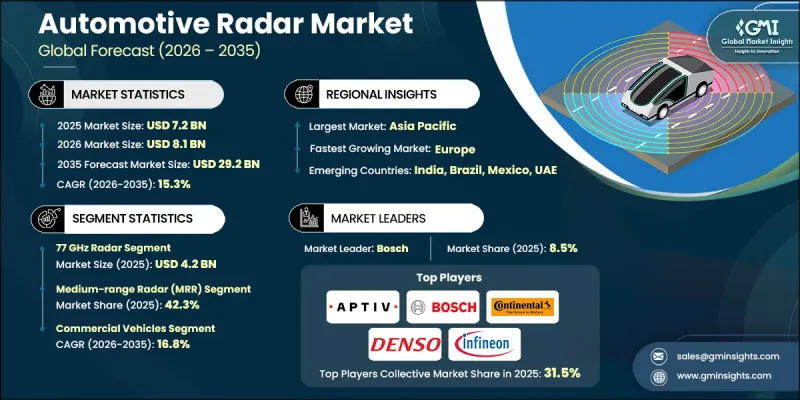
세계의 자동차용 레이더 시장은 2025년에 72억 달러로 평가되었으며, 2035년까지 CAGR 15.3%로 성장하여 292억 달러에 달할 것으로 예측됩니다.
ADAS(첨단 운전자 보조 시스템)의 보급 확대는 자동차용 레이더의 수요를 크게 견인하고 있습니다. 레이더는 이러한 시스템에서 중요한 구성요소로 작용하기 때문입니다. ADAS 기술 관련 특허 출원 증가도 레이더 솔루션에 대한 지속적인 수요를 뒷받침하고 있습니다. 자동차 업계에서는 안전과 자동화 기능을 강화하기 위해 여러 레이더 센서를 통합한 커넥티드카의 성장도 볼 수 있습니다. 이 레이더는 실시간 AI 및 머신러닝 애플리케이션을 지원하여 차량이 신속한 판단을 내리고, 위험을 예측하고, 교통 처리를 최적화할 수 있도록 돕습니다. 단거리 레이더는 주차 보조, 사각지대 감시, 저속 충돌 방지에서 주변 물체를 정확하게 감지하여 그 중요성이 커지고 있습니다. 제조업체들은 현재 이러한 레이더를 카메라 및 초음파 센서와 결합하여 상용차와 승용차 모두에서 정확도, 악천후 성능, 비용 효율성을 향상시키고 있습니다.
시장 범위
시작 연도
2025년
예측 연도
2026-2035
개시 금액
72억 달러
예측 금액
292억 달러
CAGR
15.3%
77GHz 레이더 부문은 2025년 42억 달러의 시장 규모를 차지했습니다. 뛰어난 정확도와 감지 범위를 제공하는 77GHz 레이더는 다양한 거리에 있는 차량, 보행자, 장애물을 식별하는 데 매우 신뢰할 수 있습니다. 이 기능은 어댑티브 크루즈 컨트롤, 자동 긴급 제동, 전방 충돌 경고, 사각지대 모니터링 등 현대의 ADAS 기능에 매우 중요하며, 여러 지역에서 의무화되는 추세입니다. 자동차 제조사들은 차량 전면, 후면, 코너 부분에 여러 개의 레이더 유닛을 설치하고 있으며, 대부분 견고성과 확장성을 이유로 77GHz 센서를 채택하고 있습니다.
중거리 레이더(MRR)는 2025년 42.3%의 점유율을 차지하며 2035년까지 123억 달러 규모에 이를 것으로 예측됩니다. MRR 시스템은 자동 주차, 도심에서의 충돌 방지, 주변 환경의 종합적인 인식을 실현하는 데 필수적입니다. 도시 지역이 첨단 교통 시스템으로 전환하는 가운데, 상업용 차량, 승차 공유 서비스, 라스트 마일 배송 차량은 교통량이 많은 지역의 항해에서 MRR에 크게 의존하고 있습니다. 스마트 교통 이니셔티브와 커넥티드 인프라의 성장으로 상용차와 승용차 모두 레이더 기반 안전 솔루션에 대한 수요가 증가하고 있습니다.
미국 자동차 레이더 시장은 2025년 8억 1,740만 달러에 달했습니다. 상용 트럭 fleet에서는 고속도로 사고 최소화 및 장거리 운행 시 운전 지원 강화를 목적으로 레이더 감지 기술의 통합이 진행되고 있습니다. 또한, 국내 주요 완성차 업체들의 하이테크 차량 생산을 배경으로 승용차에도 사각지대감지, 차선이탈 경보 등 안전 기능 강화를 목적으로 본 시스템 도입이 추진되고 있습니다.
목차
제1장 조사 방법
제2장 주요 요약
제3장 업계 인사이트
제4장 경쟁 구도
제5장 시장 추정 및 예측 : 주파수별, 2022-2035
제6장 시장 추정 및 예측 : 범위별, 2022-2035
제7장 시장 추정 및 예측 : 설치 장소별, 2022-2035
제8장 시장 추정 및 예측 : 차량별, 2022-2035
제9장 시장 추정 및 예측 : 차종별, 2022-2035
제10장 시장 추정 및 예측 : 추진력별, 2022-2035
제11장 시장 추정 및 예측 : 용도별, 2022-2035
제12장 시장 추정 및 예측 : 판매 채널별, 2022-2035
제13장 시장 추정 및 예측 : 지역별, 2022-2035
제14장 기업 개요
KSM
영문 목차
영문목차
The Global Automotive Radar Market was valued at USD 7.2 billion in 2025 and is estimated to grow at a CAGR of 15.3% to reach USD 29.2 billion by 2035.
The rising adoption of advanced driver-assistance systems (ADAS) has significantly fueled the demand for automotive radars, as they serve as critical components within these systems. Increasing patent filings related to ADAS technologies further sustain the consistent need for radar solutions. The automotive sector is also experiencing growth in connected vehicles, which integrate multiple radar sensors to enhance safety and automation features. These radars support real-time AI and machine learning applications, enabling vehicles to make faster decisions, anticipate hazards, and optimize traffic handling. Short-range radar is gaining prominence in assisting parking, monitoring blind spots, and preventing low-speed collisions by accurately detecting nearby objects. Manufacturers are now combining these radars with cameras and ultrasonic sensors to improve precision, performance in adverse weather conditions, and cost efficiency for both commercial and passenger vehicles.
Market Scope
Start Year
2025
Forecast Year
2026-2035
Start Value
$7.2 Billion
Forecast Value
$29.2 Billion
CAGR
15.3%
The 77 GHz radar segment accounted for USD 4.2 billion in 2025. Offering superior accuracy and detection range, 77 GHz radars are highly reliable for identifying vehicles, pedestrians, and obstacles at varying distances. Their capabilities are crucial for modern ADAS features, including adaptive cruise control, autonomous emergency braking, forward collision alerts, and blind-spot monitoring, which are increasingly mandated in several regions. Automotive companies are deploying multiple radar units throughout vehicles' front, rear, and corners, most of which rely on 77 GHz sensors due to their robustness and scalability.
The medium-range radar (MRR) held a 42.3% share in 2025 and is expected to reach USD 12.3 billion by 2035. MRR systems are essential for autonomous parking, urban collision prevention, and enabling a comprehensive awareness of the surrounding environment. As urban centers transition toward intelligent transportation systems, commercial fleets, ride-hailing services, and last-mile delivery vehicles are relying heavily on MRR for navigating high-traffic zones. The growth of smart transport initiatives and connected infrastructure is creating increasing demand for radar-based safety solutions in both commercial and passenger vehicles.
United States Automotive Radar Market reached USD 817.4 million in 2025. Commercial trucking fleets are increasingly integrating radar detection technologies to minimize highway accidents and enhance driver assistance during long-haul operations. These systems are also being installed in passenger vehicles to provide improved safety features such as blind-spot detection and lane departure alerts, driven by the presence of major domestic automakers producing high-tech vehicles.
Key players dominating the Global Automotive Radar Market include Bosch, Denso, Aptiv, Continental, Infineon, NXP Semiconductors, Analog Devices, ZF Friedrichshafen, Valeo, and Texas Instruments. Leading companies in the automotive radar market are adopting strategic measures to solidify their market presence. These include forging alliances and partnerships with automotive manufacturers to integrate radar technologies into new vehicles, expanding research and development for next-generation radar sensors, and investing in AI and machine learning capabilities to enhance real-time decision-making in vehicles. They are also focusing on regional expansion, acquiring smaller tech firms, and offering cost-effective, high-performance solutions for both commercial and passenger vehicles. By continuously innovating and diversifying product portfolios, these companies strengthen their foothold in the growing radar market while meeting evolving regulatory and technological demands.
Table of Contents
Chapter 1 Methodology
1.1 Research approach
1.2 Quality commitments
1.2.1 GMI AI policy & data integrity commitment
1.3 Research trail & confidence scoring
1.3.1 Research trail components
1.3.2 Scoring components
1.4 Data collection
1.4.1 Partial list of primary sources
1.5 Data mining sources
1.5.1 Paid sources
1.6 Base estimates and calculations
1.6.1 Base year calculation
1.7 Forecast model
1.8 Research transparency addendum
Chapter 2 Executive Summary
2.1 Industry 3600 synopsis, 2022 - 2035
2.2 Key market trends
2.2.1 Regional
2.2.2 Frequency
2.2.3 Range
2.2.4 Placement
2.2.5 Vehicle
2.2.6 Vehicle Class
2.2.7 Propulsion
2.2.8 Application
2.2.9 Sales Channel
2.3 TAM analysis, 2026-2035
2.4 CXO perspectives: Strategic imperatives
2.4.1 Executive decision points
2.4.2 Critical success factors
2.5 Future outlook and recommendations
Chapter 3 Industry Insights
3.1 Industry ecosystem analysis
3.1.1 Supplier landscape
3.1.2 Profit margin
3.1.3 Cost structure
3.1.4 Value addition at each stage
3.1.5 Factor affecting the value chain
3.1.6 Disruptions
3.2 Industry impact forces
3.2.1 Growth drivers
3.2.1.1 Rising adoption of advanced driver assistance systems (ADAS)
3.2.1.2 Growing demand for autonomous and semi-autonomous vehicles
3.2.1.3 Increasing focus on collision avoidance and road safety
3.2.1.4 Expansion of electric and software-defined vehicles
3.2.2 Industry pitfalls and challenges
3.2.2.1 High cost of automotive radar systems and integration
3.2.2.2 Complexity in signal processing and calibration
3.2.3 Market opportunities
3.2.3.1 Expansion of level 2+ and level 3 autonomous driving functions
3.2.3.2 Increasing adoption in commercial vehicles and fleet safety
3.2.3.3 Rapid growth of automotive radar in emerging markets
3.2.3.4 Demand for short-range radar in parking and blind spot applications
3.3 Growth potential analysis
3.4 Regulatory landscape
3.4.1 North America
3.4.1.1 Federal Communications Commission (FCC)
3.4.1.2 American National Standards Institute (ANSI)
3.4.1.3 Society of Automotive Engineers (SAE)
3.4.2 Europe
3.4.2.1 European Telecommunications Standards Institute (ETSI)
3.4.2.2 United Nations Economic Commission for Europe
3.4.2.3 European Committee for Electrotechnical Standardization
3.4.3 Asia Pacific
3.4.3.1 Vehicle Network Communication Protocol (China)
3.4.3.2 Association of Radio Industries and Businesses
3.4.3.3 Ministry of Internal Affairs and Communications (MIC)
3.4.4 Latin America
3.4.4.1 Agencia Nacional de Telecomunicacoes (ANATEL)
3.4.4.2 Comision de Regulacion de Comunicaciones
3.4.5 Middle East & Africa
3.4.5.1 Gulf Cooperation Council regulatory framework
3.4.5.2 National Communications Authority (UAE)
3.4.5.3 Vehicle regulations for safety systems
3.5 Porter's analysis
3.6 PESTEL analysis
3.7 Technology and innovation landscape
3.7.1 Current technological trends
3.7.2 Emerging technologies
3.8 Price trends
3.8.1 By region
3.8.2 By product
3.9 Production statistics
3.9.1 Production hubs
3.9.2 Consumption hubs
3.9.3 Export and import
3.10 Cost breakdown analysis
3.11 Sustainability and environmental impact
3.11.1 Environmental impact assessment
3.11.2 Social impact & community benefits
3.11.3 Governance & corporate responsibility
3.11.4 Sustainable finance & investment trends
3.12 Cybersecurity and functional safety framework
3.12.1 Cybersecurity threats and vulnerability assessment