숙취 해소 제품 시장 기회, 성장 촉진요인, 업계 동향 분석 및 예측(2026-2035년)
Hangover Cure Products Market Opportunity, Growth Drivers, Industry Trend Analysis, and Forecast 2026 - 2035
상품코드:1936565
리서치사:Global Market Insights Inc.
발행일:2026년 01월
페이지 정보:영문 210 Pages
라이선스 & 가격 (부가세 별도)
ㅁ Add-on 가능: 고객의 요청에 따라 일정한 범위 내에서 Customization이 가능합니다. 자세한 사항은 문의해 주시기 바랍니다.
한글목차
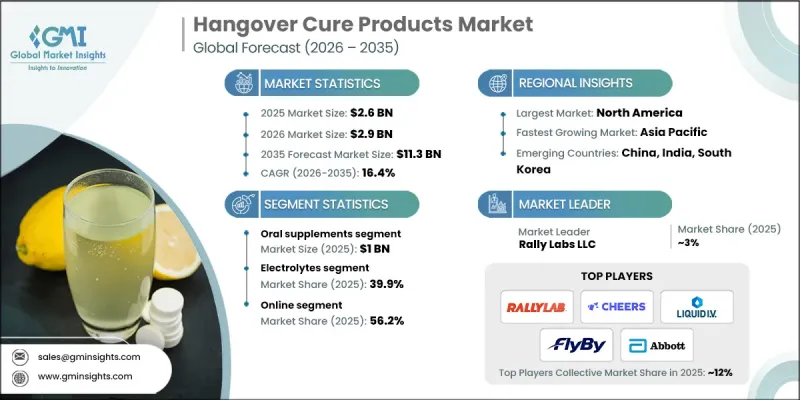
세계의 숙취 해소 제품 시장은 2025년에 26억 달러로 평가되었으며, 2035년까지 CAGR 16.4%로 성장하여 113억 달러에 달할 것으로 예측됩니다.
전 세계 알코올 소비량 증가, 특히 젊은 성인층의 소비 확대가 시장 성장의 주요 요인으로 작용하고 있습니다. 사회 행동의 변화, 유흥 활동 참여 증가, 가처분 소득 수준의 증가로 인해 도시 및 준도시 지역에서 사교적 음주 빈도가 증가하고 있습니다. 알코올 소비에 대한 문화적 태도의 변화와 개발도상국에서의 세계 트렌드의 영향력 확대로 소비자 기반이 더욱 확대되고 있습니다. 사교적 음주가 보편화됨에 따라 음주 후 영향을 관리할 수 있는 편리한 솔루션에 대한 수요가 증가하고 있습니다. 동시에 개인의 건강과 웰빙에 대한 인식이 높아지면서 장기적인 건강을 해치지 않으면서 신체적 불편함을 해소하는 기능성 제품에 대한 관심이 높아지고 있습니다. 소비자들은 활동적이고 건강 지향적인 라이프스타일에 부합하는 예방 및 회복에 초점을 맞춘 제품을 점점 더 많이 찾고 있으며, 이는 예측 기간 동안 숙취 해소 제품 시장의 지속적인 성장을 뒷받침할 것으로 보입니다.
시장 범위
시작 연도
2025년
예측 기간
2026-2035
개시 금액
26억 달러
예측 금액
113억 달러
CAGR
16.4%
경구 보충제 부문은 2025년에 10억 달러의 시장 규모를 기록했으며, 2026년부터 2035년까지 CAGR 17.1%로 성장할 것으로 예상됩니다. 정제와 캡슐은 사용 편의성, 정확한 복용량, 휴대성이 뛰어나 이 부문을 계속 선도하고 있습니다. 이러한 형태는 바쁜 라이프스타일에 적합하고 유통기한이 길고 신뢰성이 높다는 인식으로 인해 선호되고 있으며, 그 확고한 시장 지위를 더욱 강화하고 있습니다.
전해질 부문은 2025년 39.9%의 점유율을 차지했으며, 2026년부터 2035년까지 CAGR 17.3%로 성장할 것으로 전망됩니다. 전해질 기반 제제는 필수 미네랄을 보충하여 수분 균형과 회복을 돕기 위해 널리 사용되고 있으며, 효과적인 숙취 해소를 원하는 소비자들 사이에서 선호되는 선택이 되고 있습니다.
미국 숙취 해소 제품 시장은 2025년 5억 달러 규모로 2026년부터 2035년까지 연평균 15.8%의 성장률을 보일 것으로 예상됩니다. 높은 알코올 소비량, 높은 건강 의식, 선진화된 소매 인프라, 기능성 보충제의 보급은 시장 리더십을 계속 유지하고 있습니다. 중국의 발전된 디지털 커머스 환경과 프리미엄 제품 포지셔닝은 시장 침투를 더욱 촉진하고 있습니다.
목차
제1장 조사 방법과 범위
제2장 주요 요약
제3장 업계 인사이트
제4장 경쟁 구도
제5장 시장 추정 및 예측 : 제품 유형별, 2022-2035
제6장 시장 추정 및 예측 : 원료별, 2022-2035
제7장 시장 추정 및 예측 : 제제별, 2022-2035
제8장 시장 추정 및 예측 : 유통 채널별, 2022-2035
제9장 시장 추정 및 예측 : 지역별, 2022-2035
제10장 기업 개요
KSM
영문 목차
영문목차
The Global Hangover Cure Products Market was valued at USD 2.6 billion in 2025 and is estimated to grow at a CAGR of 16.4% to reach USD 11.3 billion by 2035.
Rising alcohol consumption worldwide, particularly among younger adult populations, is a major factor contributing to market expansion. Shifts in social behavior, increased participation in nightlife activities, and greater disposable income levels are encouraging more frequent social drinking across urban and semi-urban regions. Changing cultural attitudes toward alcohol consumption and the growing influence of global lifestyle trends in developing economies are further expanding the consumer base. As social drinking becomes more common, demand is increasing for convenient solutions that help manage the aftereffects of alcohol intake. At the same time, heightened awareness around personal health and wellness is driving interest in functional products that address physical discomfort without compromising long-term well-being. Consumers increasingly seek preventive and recovery-focused options that align with active, health-conscious lifestyles, supporting sustained growth of the hangover cure products market throughout the forecast period.
Market Scope
Start Year
2025
Forecast Year
2026-2035
Start Value
$2.6 Billion
Forecast Value
$11.3 Billion
CAGR
16.4%
The oral supplements segment generated USD 1 billion in 2025 and is expected to grow at a CAGR of 17.1% from 2026 to 2035. Tablets and capsules continue to lead this segment due to their ease of use, accurate dosing, and portability. These formats fit well with fast-paced lifestyles and are favored for their longer shelf life and perceived reliability, reinforcing their strong market position.
The electrolytes segment held 39.9% share in 2025 and is projected to grow at a CAGR of 17.3% during 2026-2035. Electrolyte-based formulations are widely adopted because they support hydration balance and recovery by replenishing essential minerals, making them a preferred choice among consumers seeking effective hangover relief solutions.
US Hangover Cure Products Market generated USD 0.5 billion in 2025 and is expected to grow at a CAGR of 15.8% from 2026 to 2035. High alcohol consumption levels, strong wellness awareness, advanced retail infrastructure, and widespread adoption of functional supplements continue to support market leadership. The country's well-developed digital commerce ecosystem and premium product positioning further enhance market penetration.
Key companies operating in the Global Hangover Cure Products Market include Bayer AG, Abbott, Liquid I.V., Inc., The Himalaya Drug Company, Cheers Health, More Labs, Drinkwel, LLC, Rally Labs LLC, Flyby, DOTSHOT, No Days Wasted, Toniiq, Purple Tree Labs, AfterDrinkm Ltd., LES Labs, and Liquid I.V., Inc. Companies in the hangover cure products market strengthen their foothold by investing in research-driven formulations and clean-label ingredient profiles. Many brands focus on combining functional nutrition with scientifically supported ingredients to build consumer trust. Expanding digital marketing strategies and influencer partnerships helps increase brand visibility among younger demographics. Firms also emphasize convenient formats, premium positioning, and transparent labeling to attract health-conscious buyers. Strategic expansion across e-commerce and retail channels improves accessibility, while product diversification allows companies to address varying consumer preferences and usage occasions, supporting long-term market competitiveness.
Table of Contents
Chapter 1 Methodology & Scope
1.1 Market scope & definitions
1.2 Research design
1.2.1 Research approach
1.2.2 Data collection methods
1.3 Base estimates and calculations
1.3.1 Base year calculation
1.3.2 Market estimates & forecasts parameters
1.4 Forecast Model
1.4.1 Key trends for market estimates
1.4.2 Quantified market impact analysis
1.4.2.1 Mathematical impact of growth parameters on forecast
1.4.3 Scenario analysis framework
1.5 Primary research and validation
1.5.1 Some of the primary sources (but not limited to)
1.6 Data mining sources
1.6.1 Paid Sources
1.7 Primary research and validation
1.7.1 Primary sources
1.8 Research Trail & confidence scoring
1.8.1 Research trail components
1.8.2 Scoring components
1.9 Research transparency addendum
1.9.1 Source attribution framework
1.9.2 Quality assurance metrics
1.9.3 Our commitment to trust
1.10 Market Definitions
Chapter 2 Executive Summary
2.1 Industry 3600 synopsis
2.2 Key market trends
2.2.1 Regional
2.2.2 Product Type
2.2.3 Price range
2.2.4 End use
2.2.5 Distribution channels
2.3 CXO perspectives: Strategic imperatives
2.3.1 Key decision points for industry executives
2.3.2 Critical success factors for market players
2.4 Future outlook and strategic recommendations
Chapter 3 Industry Insights
3.1 Industry ecosystem analysis
3.1.1 Supplier landscape
3.1.2 Profit margin
3.1.3 Value addition at each stage
3.1.4 Factor affecting the value chain
3.2 Industry impact forces
3.2.1 Growth drivers
3.2.1.1 Rising alcohol consumption globally
3.2.1.2 Health & wellness awareness
3.2.1.3 E-commerce expansion
3.2.2 Pitfalls & Challenges
3.2.2.1 Regulatory & safety concerns
3.2.2.2 Intense competition & price sensitivity
3.2.3 Opportunities
3.2.3.1 Innovation in formats & ingredients
3.2.3.2 Emerging markets growth
3.3 Growth potential analysis
3.4 Future market trends
3.5 Technology and innovation landscape
3.5.1 Current technological trends
3.5.2 Emerging technologies
3.6 Price trends
3.6.1 By region
3.6.2 By product
3.7 Regulatory landscape
3.7.1 North America
3.7.1.1 US: Consumer Product Safety Commission (CPSC) 16 Code of Federal Regulations (CFR) part 1512
3.7.1.2 Canada: International Organization for Standardization (ISO) 4210
3.7.2 Europe
3.7.2.1 Germany: Deutsches Institut fur Normung (DIN) European Norm (EN) ISO 4210
3.7.2.2 UK: European Norm (EN) ISO 4210 / United Kingdom Conformity Assessed (UKCA)
3.7.2.3 France: European Norm (EN) ISO 4210
3.7.3 Asia Pacific
3.7.3.1 China: Guobiao (GB) 3565
3.7.3.2 India: Indian Standard (IS) 10613
3.7.3.3 Japan: Japanese Industrial Standard (JIS) D 9110
3.7.4 Latin America
3.7.4.1 Brazil: Associacao Brasileira de Normas Tecnicas (ABNT) Norma Brasileira (NBR) ISO 4210
3.7.4.2 Mexico: International Organization for Standardization (ISO) 4210
3.7.5 Middle East & Africa
3.7.5.1 South Africa: South African National Standard (SANS) 311
3.7.5.2 Saudi Arabia: Saudi Standards, Metrology and Quality Organization (SASO) Gulf Standardization Organization (GSO) ISO 4210