이륜차 안전 솔루션 시장의 기회, 성장 촉진요인, 업계 동향 분석 및 예측(2026-2035년)
Two-Wheeler Safety Solutions Market Opportunity, Growth Drivers, Industry Trend Analysis, and Forecast 2026 - 2035
상품코드:1928977
리서치사:Global Market Insights Inc.
발행일:2026년 01월
페이지 정보:영문 250 Pages
라이선스 & 가격 (부가세 별도)
ㅁ Add-on 가능: 고객의 요청에 따라 일정한 범위 내에서 Customization이 가능합니다. 자세한 사항은 문의해 주시기 바랍니다.
한글목차
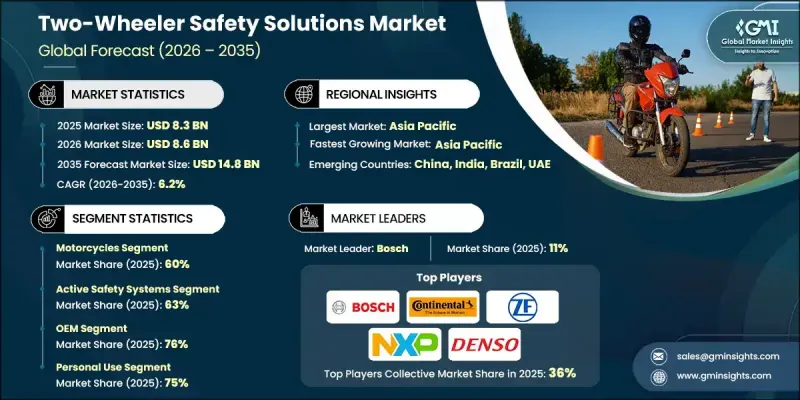
세계의 이륜차 안전 솔루션 시장은 2025년에 83억 달러로 평가되었으며, 2035년까지 CAGR 6.2%로 성장하여 148억 달러에 달할 것으로 예측됩니다.
본 시장은 도로 사고 발생 시 라이더를 보호하고 부상의 심각성을 최소화하기 위한 기술에 초점을 맞추고 있습니다. 안전 솔루션은 사고 발생 확률을 적극적으로 낮추는 예방 시스템과 충돌 시 신체적 손상을 줄이는 보호 시스템을 핵심으로 합니다. 전자장치, 센서 기술, 인공지능, 차량 커넥티비티의 지속적인 혁신은 이륜차 생태계 전반의 안전에 대한 기대치를 재구성했습니다. 주요 지역에서의 규제 시행과 라이더의 인식 개선으로 인해 채택률이 가속화되고 있으며, 비용 최적화를 통해 프리미엄 모델 이외의 차량에 안전 기능을 통합할 수 있게 되었습니다. 제조업체들은 상황 인식 능력, 차량 안정성, 라이더의 반응성을 향상시키기 위해 지능형 소프트웨어 기반 기능을 점점 더 많이 통합하고 있습니다. 커넥티비티를 지원하는 안전 플랫폼은 데이터 기반의 인사이트를 지원하여 사고 대응 시간과 차량 진단을 개선할 수 있습니다. 이러한 발전이 결합되어 라이더의 신뢰성을 높이고 도시와 고속도로에서 안전한 이동을 지원하고 있습니다. 시장의 진화는 기계식 안전 부품에서 실시간 의사결정과 장기적인 성능 모니터링을 지원하는 디지털 지원 시스템으로의 전환을 반영하고 있으며, 현대 모터사이클의 핵심 가치 제안으로서 안전의 역할을 강화하고 있습니다.
시장 범위
시작 연도
2025년
예측 연도
2026-2035
개시시 가치
83억 달러
예측 금액
148억 달러
CAGR
6.2%
고급 자전거와 스쿠터에 첨단 라이더 지원 기능과 전자 제어 안전 기능이 점점 더 많이 통합되어 지능형 안전 통합에 대한 수요가 증가하고 있습니다. IoT 프레임워크, 위성 측위, 비상 대응 기능, 충돌 감지, 지속적인 라이더 분석으로 뒷받침되는 커넥티드 안전 플랫폼의 활용이 가속화되고 있습니다. 스마트폰과의 연동, 고속 연결, 클라우드 기반 처리를 통해 특히 인구 밀집 도시 및 차량 기반 모빌리티 사업에서 유지보수 예측, 안전한 경로 안내, 긴급 서비스와의 연계 등의 기능을 실현하고 있습니다.
오토바이 부문은 2025년에 60%의 점유율을 차지했으며, 2026년부터 2035년까지 CAGR 5.7%로 성장할 것으로 예측됩니다. 이 카테고리에는 통근용 모델, 투어링 바이크, 고성능 바이크, 어드벤처 모델, 크루저 등이 포함되며, 각각 최적의 안전 구성이 요구됩니다. 시장에서의 선도적 지위는 방대한 세계 차량 기반, 첨단 안전 기능의 도입을 뒷받침하는 높은 평균 판매 가격, 속도 성능 향상과 사고 위험 증가에 따른 엄격한 안전 규제에 의해 뒷받침되고 있습니다.
능동형 안전 시스템 분야는 2025년 63%의 점유율을 차지하며 2026년부터 2035년까지 연평균 6.6%의 가장 빠른 성장을 기록할 것으로 예측됩니다. 강력한 규제 지원, 기술 성숙에 따른 시스템 비용 절감, 사고 감소 효과의 입증으로 도입을 지속적으로 추진하고 있습니다. 브레이크 제어 기술은 여전히 가장 널리 도입된 능동형 안전 솔루션이며, 여러 주요 경제권에서 규정된 엔진 출력 기준을 초과하는 이륜차에 대한 법적 의무화를 시행하고 있습니다.
중국의 이륜차 안전 솔루션 시장은 2026년부터 2035년까지 CAGR 6.6%로 성장할 것으로 예상됩니다. 중국은 세계 전기이륜차 보급을 선도하고 있으며, 여러 부문에서 신차 판매량의 90% 이상을 전기 모델이 차지하고 있습니다. 이러한 우위가 디지털 첨단 안전 아키텍처에 대한 수요를 뒷받침하고 있습니다. 클린 모빌리티 우대 정책 지원, 전기자동차 도심 진입 우대, 안전 중심 규제의 단계적 도입이 시장 역학을 재구성하고 있습니다.
목차
제1장 조사 방법
제2장 주요 요약
제3장 업계 인사이트
생태계 분석
공급업체 상황
이익률 분석
비용 구조
각 단계의 부가가치
밸류체인에 영향을 미치는 요인
디스럽션
업계에 대한 영향요인
성장 촉진요인
도시화 진전과 교통 정체 증가
AI, IoT, 센서의 통합에 의한 첨단 안전 기능 개발
엄격한 안전 규제
소비자 사이에서 높아지는 라이다 안전성에 대한 의식
증가하는 교통사고율과 안전 인식 확산
업계의 잠재적 리스크와 과제
첨단 안전 시스템의 고비용
저가격 차량의 도입 한정성
시장 기회
스마트하고 접속된 안전 장치의 도입
애프터마켓 및 개조 솔루션 수요
전기이륜차에의 안전 기술 통합
플릿 및 상업용 안전 솔루션 성장
성장 가능성 분석
규제 상황
북미
미국 연방 자동차 안전기준(FMVSS)
캐나다 - 자동차 안전 규제(MVSR)
유럽
독일 - EU 규칙168/2013
영국 - 1986년 영국 도로 차량(구조 및 사용) 규칙
프랑스 - RE2020
이탈리아 - PNRR 도로 안전 의무
아시아태평양
중국 - GB/T 차량 안전기준
인도 - 자동차(개정) 법 2019
일본 - i-Construction 및 도로 교통법
호주 - 호주 설계 규칙(ADR)
LATAM
멕시코 - 공식 멕시코 규격 NOM-036-SCFI-2018
아르헨티나 - 국가 교통법 24.449
중동 및 아프리카
남아프리카공화국 - 도로 교통법(1996년)
사우디아라비아 - 교통 법규 및 비전 2030의 교통 정책
Porters 분석
PESTEL 분석
기술과 혁신 동향
현재 기술 동향
신기술
특허 분석
사용 사례와 성공 사례
지속가능성과 환경면
지속가능한 실천
폐기물 절감 전략
생산의 에너지 효율
친환경적인 대처
탄소발자국에 관한 고려사항
가격 책정, 상업 모델 및 수익 모델
하드웨어 투자와 소프트웨어/구독 경제성의 비교
OEM 통합과 플랫폼 도입 경제성
OEM 및 플릿용 총소유비용(TCO)
제4장 경쟁 구도
소개
기업의 시장 점유율 분석
북미
유럽
아시아태평양
라틴아메리카
중동 및 아프리카
주요 시장 기업 경쟁 분석
경쟁 포지셔닝 매트릭스
전략적 전망 매트릭스
주요 발전
인수합병
제휴·협업
신제품 발매
사업 확대 계획과 자금 조달
제5장 시장 추정 및 예측 : 기술별, 2022-2035
액티브 세이프티 시스템
잠김 방지 제동 시스템(ABS)
트랙션 컨트롤 시스템(TCS)
어댑티브 크루즈 컨트롤(ACC)
첨단 운전자 보조 시스템(ARAS)
수동적 안전 시스템
에어백
스마트 헬멧
방호복
제6장 시장 추정 및 예측 : 차종별, 2022-2035
오토바이
스쿠터
제7장 시장 추정 및 예측 : 판매 채널별, 2022-2035
OEM
애프터마켓
제8장 시장 추정 및 예측 : 용도별, 2022-2035
개인 이용
상업용/플릿
제9장 시장 추정 및 예측 : 지역별, 2022-2035
북미
미국
캐나다
유럽
독일
영국
프랑스
이탈리아
스페인
러시아
북유럽 국가
베네룩스
아시아태평양
중국
인도
일본
호주
한국
싱가포르
태국
인도네시아
베트남
라틴아메리카
브라질
멕시코
아르헨티나
콜롬비아
중동 및 아프리카
남아프리카공화국
사우디아라비아
아랍에미리트
제10장 기업 개요
세계 기업
Autoliv
BMW Motorrad
Bosch
Continental
Delphi
Denso
Harman
Honda
Kawasaki
Magneti Marelli
NXP
Valeo
Yamaha
ZF
지역 기업
Alpinestars
Dainese
Helite
Klim
Racer Gloves
Spidi
Emerging Technology 이노베이터
In& Motion
Leatt
Reevu
RST
Sena Technologies
KSM
영문 목차
영문목차
The Global Two-Wheeler Safety Solutions Market was valued at USD 8.3 billion in 2025 and is estimated to grow at a CAGR of 6.2% to reach USD 14.8 billion by 2035.
The market focuses on technologies designed to protect riders and minimize injury severity during road incidents. Safety solutions are structured around preventive systems that actively reduce accident probability and protective systems that mitigate physical harm when crashes occur. Continuous innovation in electronics, sensor technology, artificial intelligence, and vehicle connectivity has reshaped safety expectations across the two-wheeler ecosystem. Regulatory enforcement across key regions and growing rider awareness have accelerated adoption rates, while cost optimization has enabled safety integration beyond premium models. Manufacturers increasingly embed intelligent software-driven features to enhance situational awareness, vehicle stability, and rider responsiveness. Connectivity-enabled safety platforms support data-driven insights, improving accident response times and vehicle diagnostics. These developments collectively enhance rider confidence and support safer urban and highway mobility. The market's evolution reflects a shift from mechanical safety components to digitally enabled systems that support real-time decision-making and long-term performance monitoring, reinforcing the role of safety as a core value proposition in modern two-wheelers.
Market Scope
Start Year
2025
Forecast Year
2026-2035
Start Value
$8.3 Billion
Forecast Value
$14.8 Billion
CAGR
6.2%
Advanced rider assistance and electronically supported safety functions are increasingly embedded in high-end motorcycles and scooters, signaling stronger demand for intelligent safety integration. The use of connected safety platforms supported by IoT frameworks, satellite positioning, emergency response functions, crash sensing, and continuous rider analytics is accelerating. Integration with smartphones, high-speed connectivity, and cloud-based processing enables capabilities related to maintenance forecasting, safer route guidance, and coordinated emergency services, particularly in densely populated cities and fleet-based mobility operations.
The motorcycles segment accounted for 60% share in 2025 and is forecast to grow at a CAGR of 5.7% between 2026 and 2035. This category includes commuter models, touring motorcycles, performance-oriented bikes, adventure variants, and cruisers, each requiring tailored safety configurations. Market leadership is supported by a substantial global vehicle base, higher average selling prices that support advanced safety adoption, and stringent safety regulations driven by elevated speed capabilities and accident exposure.
The active safety systems segment held a 63% share in 2025 and is projected to register the fastest growth at a CAGR of 6.6% from 2026 to 2035. Strong regulatory backing, declining system costs due to technological maturity, and demonstrated effectiveness in accident reduction continue to drive adoption. Braking control technologies remain the most broadly deployed active safety solutions and are legally required in multiple major economies for motorcycles above defined engine thresholds.
China Two-Wheeler Safety Solutions Market is anticipated to grow at a CAGR of 6.6% during 2026 to 2035. China leads global electric two-wheeler adoption, with electric models accounting for more than 90% of new unit sales across several segments. This dominance supports demand for digitally advanced safety architectures. Policy support through clean mobility incentives, urban access advantages for electric vehicles, and the gradual rollout of safety-focused regulations continues to reshape market dynamics.
Key companies shaping the Global Two-Wheeler Safety Solutions Market include Bosch, Continental, ZF, Denso, Autoliv, Valeo, Harman, NXP, Delphi, and Magneti Marelli. Companies operating in the Two-Wheeler Safety Solutions Market focus on technology integration, strategic partnerships, and geographic expansion to strengthen market positioning. Leading players prioritize investment in software-defined safety platforms, sensor fusion, and data analytics to improve system intelligence and reliability. Collaboration with two-wheeler manufacturers enables early-stage integration of safety technologies into new vehicle platforms. Firms also emphasize scalable and cost-efficient solutions to penetrate mid-range and entry-level segments. Expansion in high-growth regions, particularly Asia-Pacific, supports volume growth and regulatory alignment.
Table of Contents
Chapter 1 Methodology
1.1 Research approach
1.2 Quality commitments
1.3 Research trail and confidence scoring
1.3.1 Research trail components
1.3.2 Scoring components
1.4 Data collection
1.4.1 Partial list of primary sources
1.5 Data mining sources
1.5.1 Paid sources
1.6 Best estimates and calculations
1.6.1 Base year calculation for any one approach
1.7 Forecast model
1.8 Research transparency addendum
Chapter 2 Executive Summary
2.1 Industry 360° synopsis, 2022 - 2035
2.2 Key market trends
2.2.1 Regional
2.2.2 Technology
2.2.3 Vehicle
2.2.4 Sales Channel
2.2.5 Application
2.3 TAM Analysis, 2026-2035
2.4 CXO perspectives: Strategic imperatives
2.4.1 Executive decision points
2.4.2 Critical success factors
2.5 Future outlook and strategic recommendations
Chapter 3 Industry Insights
3.1 Industry ecosystem analysis
3.1.1 Supplier landscape
3.1.2 Profit margin analysis
3.1.3 Cost structure
3.1.4 Value addition at each stage
3.1.5 Factor affecting the value chain
3.1.6 Disruptions
3.2 Industry impact forces
3.2.1.1 Growth drivers
3.2.1.2 Rising urbanization and increasing traffic congestion
3.2.1.3 Integration of AI, IoT, and sensors to develop advanced safety features
3.2.1.4 Stringent safety regulations
3.2.1.5 Growing awareness among consumers about rider safety