Lead Acid Battery Market Opportunity, Growth Drivers, Industry Trend Analysis, and Forecast 2026 - 2035
상품코드:1928938
리서치사:Global Market Insights Inc.
발행일:2026년 01월
페이지 정보:영문 215 Pages
라이선스 & 가격 (부가세 별도)
ㅁ Add-on 가능: 고객의 요청에 따라 일정한 범위 내에서 Customization이 가능합니다. 자세한 사항은 문의해 주시기 바랍니다.
한글목차
세계의 납축전지 시장은 2025년에 1,021억 달러로 평가되었고, 2035년까지 연평균 복합 성장률(CAGR) 3.2%로 성장하여 1,406억 달러에 이를 것으로 예측됩니다.
액상 배터리 및 흡수성 유리 매트(AGM) 배터리의 지속적인 기술 혁신은 시작 및 정지 시스템과 같은 보조 응용 분야 및 기타 기능적 요구 사항에 대한 성능을 향상시켜 전체 시장의 잠재력을 높이고 있습니다. 칼슘 합금 그리드 및 탄소 첨가제를 포함한 전극 설계 및 재료의 발전으로 전도성, 방전 효율 및 사이클 수명이 향상되어 성장이 더욱 가속화되고 있습니다. 납축전지는 그 신뢰성, 비용 효율성, 재활용 가능성으로 인해 에너지 저장의 기반 기술로서의 지위를 유지하고 있습니다. 리튬 이온 배터리와 같은 대체 기술과의 경쟁에도 불구하고, 안정적인 전력 공급, 높은 서지 전류, 입증된 내구성이 요구되는 응용 분야에서는 여전히 납축전지가 주류를 이루고 있습니다. 재생에너지 시스템과의 통합을 통해 잉여 전력을 저장하고 발전량이 적은 시간대에 전력을 공급할 수 있게 됨에 따라, 특히 외딴 지역과 오프 그리드 지역에서 상업 및 산업 분야에 경제적이고 효율적이며 견고한 에너지 저장 솔루션을 제공함으로써 새로운 기회가 확대되고 있습니다. 새로운 기회가 확대되고 있습니다.
시장 범위
개시 연도
2025년
예측 연도
2026-2035년
개시 연도 가치
1,021억 달러
예측 금액
1,406억 달러
CAGR
3.2%
고정형 납축전지 부문은 2035년까지 220억 달러에 달할 것으로 예측됩니다. 이 배터리는 통신, 유틸리티, 데이터센터, 산업 시설에서 백업 전원 및 대기 전원을 제공합니다. 전력계통의 신뢰성, 긴 수명, 비용 효율성, 재활용 가능성에 대한 요구가 중요 인프라 용도에 대한 채택을 촉진하고 있습니다.
VRLA 배터리 부문은 2025년 205억 달러로 평가되었고, 유지보수가 필요 없는 밀폐형 AGM 및 젤 유형을 포함합니다. 통신, UPS 시스템, 신재생에너지 설비, 산업분야에 널리 도입되어 높은 안전성을 동반한 안정적이고 긴 수명의 전원을 제공하므로 중요 용도 및 협소한 공간에서 사용하기에 적합합니다.
미국 납축전지 시장은 2025년 85%의 점유율을 차지하며 119억 달러 규모에 달할 것으로 예측됩니다. 강력한 교체 수요, 인프라 성장, 백업 전원 공급 장치 요구 사항이 시장의 안정성을 유지하고 있습니다. AGM 및 개선된 전해액형 납축전지 기술의 발전으로 신뢰성과 성능이 향상되고, 잘 구축된 재활용 네트워크와 저렴한 가격으로 납축전지 에너지 솔루션에 대한 지속적인 선호도가 강화되고 있습니다.
목차
제1장 조사 방법과 범위
제2장 주요 요약
제3장 업계 인사이트
생태계 분석
원재료 가용성과 조달 분석
제조능력 평가
공급망 회복탄력성와 리스크 요인
유통 네트워크 분석
규제 상황
업계에 대한 영향요인
성장 촉진요인
업계의 잠재적 리스크&과제
성장 가능성 분석
Porter의 Five Forces 분석
공급 기업의 교섭력
바이어의 교섭력
신규 진출업체의 위협
대체품의 위협
PESTEL 분석
납축전지 비용 구조 분석
가격 동향 분석(달러/단위)
지역별
용도별
새로운 기회와 동향
투자 분석과 전망
디지털 전환과 인더스트리 4.0통합
지속가능성 이니셔티브와 컴플라이언스
제4장 경쟁 구도
서론
기업의 시장 점유율 분석 : 지역별
북미
유럽
아시아태평양
중동 및 아프리카
라틴아메리카
전략적 대시보드
전략적 이니셔티브
주요 제휴·협력 관계
주요 M&A활동
제품 혁신과 신제품 발매
시장 확대 전략
경쟁 벤치마킹
혁신과 지속가능성 상황
제5장 시장 규모와 예측 : 용도별, 2022-2035
고정형
통신
UPS
제어·개폐 장비
기타
동력용
SLI
자동차
오토바이
제6장 시장 규모와 예측 : 구조별, 2022-2035
개방형
VRLA
AGM
겔 배터리
제7장 시장 규모와 예측 : 판매채널별, 2022-2035
OEM
애프터마켓
제8장 시장 규모와 예측 : 지역별, 2022-2035
북미
미국
캐나다
유럽
독일
영국
프랑스
러시아
이탈리아
스페인
오스트리아
네덜란드
스웨덴
아시아태평양
중국
일본
인도
한국
호주
인도네시아
말레이시아
태국
필리핀
베트남
싱가포르
중동 및 아프리카
사우디아라비아
아랍에미리트
이란
이집트
튀르키예
모로코
남아프리카공화국
나이지리아
알제리
라틴아메리카
브라질
아르헨티나
멕시코
칠레
제9장 기업 개요
Amara Raja Energy &Mobility Limited
Banner
Camel Group Co.
C&D Technologies
Chaowei Power Holdings
Clarios
Crown Equipment Corporation
CSB Battery
Concorde Battery Corporation
East Penn Manufacturing Company
EnerSys
EnergoAlliance
Exide Industries
First Battery
Focus Technology Co., Ltd.
GS Yuasa International
HOPPECKE Battery
Leoch International Technology
MUTLU
Narada
Power-Sonic
The Furukawa Battery Co., Ltd.
Yokohama Batteries
Zibo Torch Energy
LSH
영문 목차
영문목차
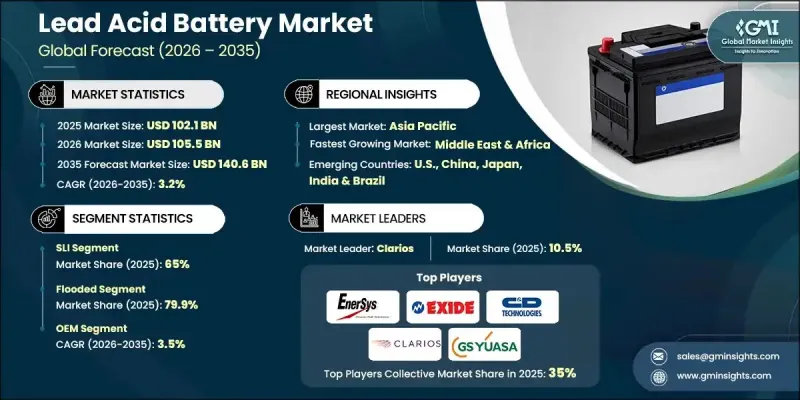
The Global Lead Acid Battery Market was valued at USD 102.1 billion in 2025 and is estimated to grow at a CAGR of 3.2% to reach USD 140.6 billion by 2035.
Ongoing innovations in flooded batteries and absorbent glass mat (AGM) batteries are enhancing performance for auxiliary applications such as start-stop systems and other functional requirements, improving overall market potential. Advancements in electrode design and materials, including calcium alloy grids and carbon additives, are boosting conductivity, discharge efficiency, and cycle life, further accelerating growth. Lead-acid batteries remain a cornerstone of energy storage due to their reliability, cost-effectiveness, and recyclability. Despite competition from lithium-ion alternatives, these batteries dominate applications requiring dependable power, high surge currents, and proven durability. Their integration with renewable energy systems for storing excess power and supplying energy during low-production periods is expanding opportunities, particularly in remote and off-grid regions, by offering affordable, efficient, and resilient energy storage solutions for both commercial and industrial uses.
Market Scope
Start Year
2025
Forecast Year
2026-2035
Start Value
$102.1 Billion
Forecast Value
$140.6 Billion
CAGR
3.2%
The stationary lead-acid battery segment is expected to reach USD 22 billion by 2035. These batteries provide backup and standby power across telecom, utilities, data centers, and industrial facilities. Their adoption is driven by the need for grid reliability, long operational life, cost-effectiveness, and recyclability in critical infrastructure applications.
The VRLA batteries segment was valued at USD 20.5 billion in 2025, including sealed AGM and gel types that offer maintenance-free operation. They are widely deployed in telecom, UPS systems, renewable energy installations, and industrial sectors, delivering consistent, long-lasting power with high safety, making them ideal for critical or confined-space use.
U.S. Lead Acid Battery Market held 85% share, generating USD 11.9 billion in 2025. Strong replacement demand, infrastructure growth, and backup power requirements have maintained market stability. Advances in AGM and enhanced flooded battery technologies improve reliability and performance, while well-established recycling networks and affordability reinforce the continued preference for lead-acid energy solutions.
Major players operating in the Global Lead Acid Battery Market include Amara Raja Energy & Mobility, Banner, Camel Group, C&D Technologies, Chaowei Power Holdings, Clarios, Crown Equipment Corporation, CSB Battery, Concorde Battery Corporation, East Penn Manufacturing Company, EnerSys, EnergoAlliance, Exide Industries, First Battery, Focus Technology, GS Yuasa International, HOPPECKE Battery, Leoch International Technology, MUTLU, Narada, Power-Sonic, The Furukawa Battery, Yokohama Batteries, and Zibo Torch Energy. Companies in the Lead Acid Battery Market are focusing on technological innovation to improve cycle life, energy density, and efficiency of flooded, AGM, and gel batteries. Firms are forming strategic partnerships with OEMs, renewable energy providers, and telecom operators to expand adoption. Investments in advanced electrode materials, carbon additives, and maintenance-free technologies enhance product differentiation. Regional expansion, particularly in emerging markets, coupled with strengthening recycling networks, supports sustainable growth.
Table of Contents
Chapter 1 Methodology & Scope
1.1 Research approach
1.2 Quality commitments
1.2.1 GMI AI policy & data integrity commitment
1.2.1.1 Source consistency protocol
1.3 Research trail & confidence scoring
1.3.1 Research trail components
1.3.2 Scoring components
1.4 Data collection
1.4.1 Partial list of primary sources
1.5 Data mining sources
1.5.1 Paid sources
1.5.1.1 Sources, by region
1.6 Base estimates and calculations
1.6.1 Base year calculation for any one approach
1.7 Market estimates & forecasts parameters
1.8 Forecast model
1.8.1 Quantified market impact analysis
1.8.1.1 Mathematical impact of growth parameters on forecast
1.9 Research transparency addendum
1.9.1 Source attribution framework
1.9.2 Quality assurance metrics
1.9.3 Our commitment to trust
1.10 Market definitions
Chapter 2 Executive Summary
2.1 Industry synopsis, 2022 - 2035
2.1.1 Business trends
2.1.2 Application trends
2.1.3 Construction trends
2.1.4 Sales channel trends
2.1.5 Regional trends
Chapter 3 Industry Insights
3.1 Industry ecosystem analysis
3.1.1 Raw material availability & sourcing analysis
3.1.2 Manufacturing capacity assessment
3.1.3 Supply chain resilience & risk factors
3.1.4 Distribution network analysis
3.2 Regulatory landscape
3.3 Industry impact forces
3.3.1 Growth drivers
3.3.2 Industry pitfalls & challenges
3.4 Growth potential analysis
3.5 Porter';s analysis
3.5.1 Bargaining power of suppliers
3.5.2 Bargaining power of buyers
3.5.3 Threat of new entrants
3.5.4 Threat of substitutes
3.6 PESTEL analysis
3.6.1 Political factors
3.6.2 Economic factors
3.6.3 Social factors
3.6.4 Technological factors
3.6.5 Legal factors
3.6.6 Environmental factors
3.7 Cost structure analysis of lead acid battery
3.8 Price trend analysis (USD/Unit)
3.8.1 By region
3.8.2 By application
3.9 Emerging opportunities & trends
3.10 Investment analysis & future prospects
3.11 Digital transformation & industry 4.0 integration
3.12 Sustainability initiatives & compliances
Chapter 4 Competitive Landscape, 2026
4.1 Introduction
4.2 Company market share analysis, by region, 2025
4.2.1 North America
4.2.2 Europe
4.2.3 Asia Pacific
4.2.4 Middle East & Africa
4.2.5 Latin America
4.3 Strategic dashboard
4.4 Strategic initiatives
4.4.1 Key partnerships & collaborations
4.4.2 Major M&A activities
4.4.3 Product innovations & launches
4.4.4 Market expansion strategies
4.5 Competitive benchmarking
4.6 Innovation & sustainability landscape
Chapter 5 Market Size and Forecast, By Application, 2022 - 2035 (USD Million & Million Units)
5.1 Key trends
5.2 Stationary
5.2.1 Telecommunications
5.2.2 UPS
5.2.3 Control & switchgear
5.2.4 Others
5.3 Motive
5.4 SLI
5.4.1 Automobiles
5.4.2 Motorcycles
Chapter 6 Market Size and Forecast, By Construction, 2022 - 2035 (USD Million & Million Units)
6.1 Key trends
6.2 Flooded
6.3 VRLA
6.3.1 AGM
6.3.2 GEL
Chapter 7 Market Size and Forecast, By Sales Channel, 2022 - 2035 (USD Million & Million Units)
7.1 Key trends
7.2 OEM
7.3 Aftermarket
Chapter 8 Market Size and Forecast, By Region, 2022 - 2035 (USD Million & Million Units)