Monochloroacetic Acid Market Opportunity, Growth Drivers, Industry Trend Analysis, and Forecast 2026 - 2035
상품코드:1928915
리서치사:Global Market Insights Inc.
발행일:2026년 01월
페이지 정보:영문 190 Pages
라이선스 & 가격 (부가세 별도)
ㅁ Add-on 가능: 고객의 요청에 따라 일정한 범위 내에서 Customization이 가능합니다. 자세한 사항은 문의해 주시기 바랍니다.
한글목차
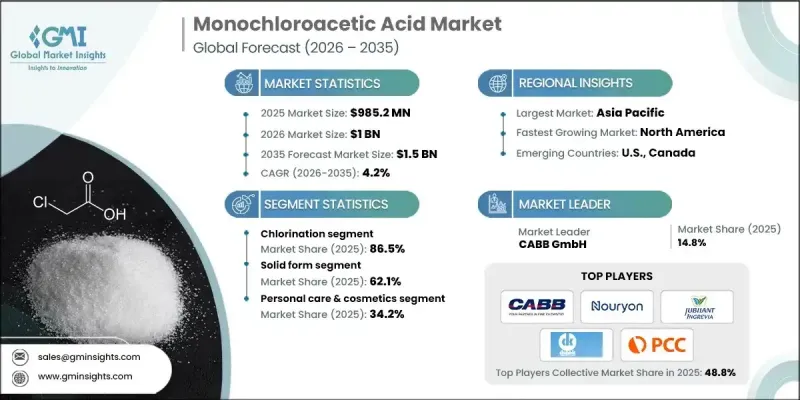
세계의 모노클로로아세트산 시장은 2025년에 9억 8,520만 달러로 평가되었고, 2035년까지 연평균 복합 성장률(CAGR) 4.2%로 성장하여 15억 달러에 이를 것으로 예측됩니다.
본 산업은 여러 분야에서의 용도 확대로 꾸준한 성장을 거듭하고 있습니다. 모노클로로아세트산은 의약품, 계면활성제, 염료, 농약 제조에서 중요한 중간체 역할을 합니다. 카르복시메틸셀룰로오스 및 제초제를 포함한 특수 화학제품의 기본 구성 요소로서의 역할은 화학 제조에서 그 중요성을 강조하고 있습니다. 본 화합물의 높은 반응성, 비용 효율성, 범용성은 화학합성에서 이상적인 선택이 될 수 있습니다. 농업 분야의 작물 보호 솔루션에 대한 수요 증가, 의약품 생산 확대, 의약품 개발에 대한 투자가 결합되어 시장 성장을 더욱 촉진하고 있습니다. 그러나 업계는 원자재 비용 변동, 염소화 화합물 관련 환경 문제, 엄격한 규제 프레임워크와 같은 문제에 직면해 있습니다. 안전과 지속 가능한 생산 방식에 대한 관심이 높아짐에 따라 제조업체는 보다 친환경적인 방법을 채택해야 하며, 이는 간접적으로 시장 트렌드를 형성하고 있습니다.
시장 범위
개시 연도
2025년
예측 연도
2026-2035년
개시 연도 가치
9억 8,520만 달러
예측 금액
15억 달러
CAGR
4.2%
염소화 부문은 2025년 86.5%의 점유율을 차지할 것으로 예상되며, 2035년까지 연평균 복합 성장률(CAGR) 4.2%를 유지할 것으로 전망됩니다. 부산물 발생을 최소화하면서 수율을 향상시키고, 에너지 절약 및 친환경 염소화 공정을 포함한 생산 기술의 개선으로 시장은 지속적으로 혜택을 받고 있습니다. 의약품, 퍼스널케어 제품, 농업 분야에서 고순도 모노클로로아세트산에 대한 수요가 증가함에 따라 제조 공정 최적화를 위한 이러한 변화를 주도하고 있습니다.
제품 형태별로는 고체 모노클로로아세트산 부문이 2025년 62.1%의 점유율을 차지할 것으로 예상되며, 2026년부터 2035년까지 연평균 4.2%의 성장률을 보일 것으로 전망됩니다. 고체 형태는 정확한 용량 관리, 안정성, 취급 용이성 등의 이점을 제공하기 때문에 의약품, 특수 화학제품, 농산물에서 선호되고 있습니다. 고체 상태의 가공 기술 및 저장 솔루션의 발전은 제조업체의 저장 기간 연장, 운송 간소화 및 운영 효율성 향상을 더욱 촉진하고 있습니다.
북미 모노클로로아세트산 시장은 2025년 28.2%의 점유율을 차지했습니다. 이러한 성장은 진화하는 기술, 엄격한 환경 규제, 그리고 잘 발달된 화학 인프라에 의해 촉진되고 있습니다. 제약, 퍼스널케어, 농업 분야에서의 용도 확대와 더불어 지속 가능한 생산으로의 전환이 수요를 견인하고 있습니다. 이 지역의 기업들은 환경 기준을 준수하는 동시에 효율성과 생산성을 높이기 위해 더 깨끗한 제조 방식을 채택하고 있습니다.
목차
제1장 조사 방법과 범위
제2장 주요 요약
제3장 업계 인사이트
생태계 분석
공급업체 상황
이익률
각 단계 부가가치
밸류체인에 영향을 미치는 요인
파괴적 변화
업계에 대한 영향요인
성장 촉진요인
업계의 잠재적 리스크&과제
시장 기회
성장 가능성 분석
규제 상황
북미
유럽
아시아태평양
라틴아메리카
중동 및 아프리카
Porter의 Five Forces 분석
PESTEL 분석
가격 동향
지역별
모노클로로아세트산 분류별
향후 시장 동향
기술과 혁신 동향
현재 기술 동향
신기술
특허 상황
무역 통계(HS코드)(주 : 무역 통계는 주요 국가에 한해 제공됩니다)
주요 수입국
주요 수출국
지속가능성과 환경면
지속가능한 대처
폐기물 감축 전략
생산 에너지 효율
친환경 이니셔티브
탄소발자국 고려
제4장 경쟁 구도
서론
기업의 시장 점유율 분석
지역별
북미
유럽
아시아태평양
라틴아메리카
중동 및 아프리카
기업 매트릭스 분석
주요 시장 기업의 경쟁 분석
경쟁 포지셔닝 매트릭스
주요 발전
인수합병(M&A)
제휴 및 협업
신제품 발매
사업 확대 계획
제5장 시장 추산·예측 : 제조 공정별, 2022-2035
염소화 프로세스
가수분해 프로세스
제6장 시장 추산·예측 : 제품 형태별, 2022-2035
고형 형태
액체 형태
제7장 시장 추산·예측 : 최종 이용 산업별, 2022-2035
퍼스널케어 및 화장품
헤어케어 제품
스킨케어 제제
농업·작물 보호
제초제 제조
농약 합성
식물 성장 조절제
식품 및 음료
식품용증점제·안정제
식품 포장용 코팅
의약품 및 헬스케어
원료의약품
의약품 첨가제
의료기기용 접착제
석유 및 가스
시추액·오수 첨가제
증진 채유 기술
섬유·종이 제품
섬유 인쇄·염색
제지·코팅
섬유 가공
건설 및 건축자재
시멘트 첨가제·지연제
타일용 접착제·줄눈재
석고보드 제조
세제·청소 용품
액체 세제
산업용 세정제
가정용 세제·청소 용품
수처리
이온교환수지
킬레이트제
페인트 및 코팅·잉크
자동차용 페인트
인쇄용 잉크
산업용 페인트
제8장 시장 추산·예측 : 지역별, 2022-2035
북미
미국
캐나다
유럽
독일
영국
프랑스
스페인
이탈리아
기타 유럽
아시아태평양
중국
인도
일본
호주
한국
기타 아시아태평양
라틴아메리카
브라질
멕시코
아르헨티나
기타 라틴아메리카
중동 및 아프리카
사우디아라비아
남아프리카공화국
아랍에미리트
기타 중동 및 아프리카
제9장 기업 개요
CABB GmbH
Denak Co., Ltd.
Jubilant Ingrevia Limited
Merck KGaA
Niacet Corporation
Nouryon
PCC Group
Puyang Tiancheng Chemical Co. Ltd
Shandong Minji Chemical Co., Ltd.
Shiv Chem Industries
Xuchang Dongfang Chemical Co. Ltd.
LSH
영문 목차
영문목차
The Global Monochloroacetic Acid Market was valued at USD 985.2 million in 2025 and is estimated to grow at a CAGR of 4.2% to reach USD 1.5 billion by 2035.
The industry is experiencing steady growth due to its increasing utility across multiple sectors. Monochloroacetic acid serves as a critical intermediate in the production of pharmaceuticals, surfactants, dyes, and agrochemicals. Its role as a building block for specialty chemicals, including carboxymethyl cellulose and herbicides, highlights its significance in chemical manufacturing. The compound's high reactivity, cost-effectiveness, and versatility make it an ideal choice for chemical synthesis. Rising demand in agriculture for crop protection solutions, coupled with expansion in pharmaceutical production and investment in drug development, further supports market growth. However, the industry faces challenges such as fluctuating raw material costs, environmental concerns linked to chlorinated compounds, and strict regulatory frameworks. Increasing emphasis on safety and sustainable production methods is influencing manufacturers to adopt greener practices, indirectly shaping market trends.
Market Scope
Start Year
2025
Forecast Year
2026-2035
Start Value
$985.2 Million
Forecast Value
$1.5 Billion
CAGR
4.2%
The chlorination segment accounted for 86.5% share in 2025 and is expected to maintain a CAGR of 4.2% through 2035. The market continues to benefit from improvements in production techniques, including energy-efficient and eco-friendly chlorination processes that minimize by-product formation while enhancing yield. Growing demand for high-purity monochloroacetic acid in pharmaceuticals, personal care products, and agricultural applications is driving this shift toward optimized manufacturing processes.
In terms of product form, the solid monochloroacetic acid segment held 62.1% share in 2025 and is anticipated to grow at a CAGR of 4.2% between 2026 and 2035. Solid forms offer advantages such as precise dosing, stability, and ease of handling, making them preferred for pharmaceuticals, specialty chemicals, and agricultural products. Advances in solid-state processing and storage solutions are further supporting longer shelf life, simplified transportation, and better operational efficiency for manufacturers.
North America Monochloroacetic Acid Market held 28.2% share in 2025. This growth is fueled by evolving technologies, stringent environmental regulations, and a well-developed chemical infrastructure. Increasing applications in pharmaceuticals, personal care, and agriculture, along with a shift toward sustainable production, are driving demand. Companies in the region are adopting cleaner manufacturing practices to comply with environmental standards while enhancing efficiency and output.
Leading players in the Global Monochloroacetic Acid Market include CABB GmbH, Jubilant Ingrevia Limited, PCC Group, Merck KGaA, Denak Co., Ltd., Nouryon, Shandong Minji Chemical Co., Ltd., Xuchang Dongfang Chemical Co., Ltd., Shiv Chem Industries, Niacet Corporation, and Puyang Tiancheng Chemical Co., Ltd. Companies in the Monochloroacetic Acid Market are employing several key strategies to strengthen their position. These include expanding production capacities, adopting advanced and eco-friendly manufacturing technologies, forming strategic partnerships, and investing in R&D for high-purity products. Firms are also focusing on improving supply chain efficiency, exploring new geographic markets, and enhancing their product portfolios to meet growing demand across industries. By prioritizing sustainability, technological innovation, and strategic alliances, market players are solidifying their foothold and driving long-term growth.
Table of Contents
Chapter 1 Methodology & Scope
1.1 Market scope and definition
1.2 Research design
1.2.1 Research approach
1.2.2 Data collection methods
1.3 Data mining sources
1.3.1 Global
1.3.2 Regional/Country
1.4 Base estimates and calculations
1.4.1 Base year calculation
1.4.2 Key trends for market estimation
1.5 Primary research and validation
1.5.1 Primary sources
1.6 Forecast model
1.7 Research assumptions and limitations
Chapter 2 Executive Summary
2.1 Industry 3600 synopsis
2.2 Key market trends
2.2.1 Regional
2.2.2 Manufacturing process
2.2.3 Product form
2.2.4 End Use Industry
2.3 TAM Analysis, 2026-2035
2.4 CXO perspectives: Strategic imperatives
2.4.1 Executive decision points
2.4.2 Critical success factors
2.5 Future Outlook and Strategic Recommendations
Chapter 3 Industry Insights
3.1 Industry ecosystem analysis
3.1.1 Supplier landscape
3.1.2 Profit margin
3.1.3 Value addition at each stage
3.1.4 Factor affecting the value chain
3.1.5 Disruptions
3.2 Industry impact forces
3.2.1 Growth drivers
3.2.2 Industry pitfalls and challenges
3.2.3 Market opportunities
3.3 Growth potential analysis
3.4 Regulatory landscape
3.4.1 North America
3.4.2 Europe
3.4.3 Asia Pacific
3.4.4 Latin America
3.4.5 Middle East & Africa
3.5 Porter';s analysis
3.6 PESTEL analysis
3.7 Price trends
3.7.1 By region
3.7.2 By monochloroacetic acid class
3.8 Future market trends
3.9 Technology and Innovation landscape
3.9.1 Current technological trends
3.9.2 Emerging technologies
3.10 Patent Landscape
3.11 Trade statistics (HS code) ( Note: the trade statistics will be provided for key countries only)
3.11.1 Major importing countries
3.11.2 Major exporting countries
3.12 Sustainability and environmental aspects
3.12.1 Sustainable practices
3.12.2 Waste reduction strategies
3.12.3 Energy efficiency in production
3.12.4 Eco-friendly initiatives
3.13 Carbon footprint consideration
Chapter 4 Competitive Landscape, 2025
4.1 Introduction
4.2 Company market share analysis
4.2.1 By region
4.2.1.1 North America
4.2.1.2 Europe
4.2.1.3 Asia Pacific
4.2.1.4 LATAM
4.2.1.5 MEA
4.3 Company matrix analysis
4.4 Competitive analysis of major market players
4.5 Competitive positioning matrix
4.6 Key developments
4.6.1 Mergers & acquisitions
4.6.2 Partnerships & collaborations
4.6.3 New Product Launches
4.6.4 Expansion Plans
Chapter 5 Market Estimates and Forecast, By Manufacturing Process, 2022-2035 (USD Million) (Kilo Tons)
5.1 Key trends
5.2 Chlorination process
5.3 Hydrolysis process
Chapter 6 Market Estimates and Forecast, By Product Form, 2022-2035 (USD Million) (Kilo Tons)
6.1 Key trends
6.2 Solid forms
6.3 Liquid forms
Chapter 7 Market Estimates and Forecast, By End Use Industry, 2022-2035 (USD Million) (Kilo Tons)
7.1 Key trends
7.2 Personal care & cosmetics
7.2.1 Hair care products
7.2.2 Skin care formulations
7.3 Agriculture & crop protection
7.3.1 Herbicide manufacturing
7.3.2 Pesticide synthesis
7.3.3 Plant growth regulators
7.4 Food & beverage
7.4.1 Food thickeners & stabilizers
7.4.2 Food packaging coatings
7.5 Pharmaceuticals & healthcare
7.5.1 Active pharmaceutical ingredients
7.5.2 Pharmaceutical excipients
7.5.3 Medical device adhesives
7.6 Oil & gas
7.6.1 Drilling fluids & mud additives
7.6.2 Enhanced oil recovery
7.7 Textiles & paper
7.7.1 Textile printing & dyeing
7.7.2 Paper manufacturing & coating
7.7.3 Textile finishing
7.8 Construction & building materials
7.8.1 Cement additives & retarders
7.8.2 Tile adhesives & grouts
7.8.3 Gypsum board production
7.9 Detergents & cleaning products
7.9.1 Liquid detergents
7.9.2 Industrial cleaners
7.9.3 Household cleaning products
7.10 Water treatment
7.10.1 Ion-exchange resins
7.10.2 Chelating agents
7.11 Paints, coatings & inks
7.11.1 Automotive coatings
7.11.2 Printing inks
7.11.3 Industrial coatings
Chapter 8 Market Estimates and Forecast, By Region, 2022-2035 (USD Million) (Kilo Tons)