ORC Waste Heat to Power Market Opportunity, Growth Drivers, Industry Trend Analysis, and Forecast 2026 - 2035
상품코드:1913469
리서치사:Global Market Insights Inc.
발행일:2025년 12월
페이지 정보:영문 110 Pages
라이선스 & 가격 (부가세 별도)
ㅁ Add-on 가능: 고객의 요청에 따라 일정한 범위 내에서 Customization이 가능합니다. 자세한 사항은 문의해 주시기 바랍니다.
한글목차
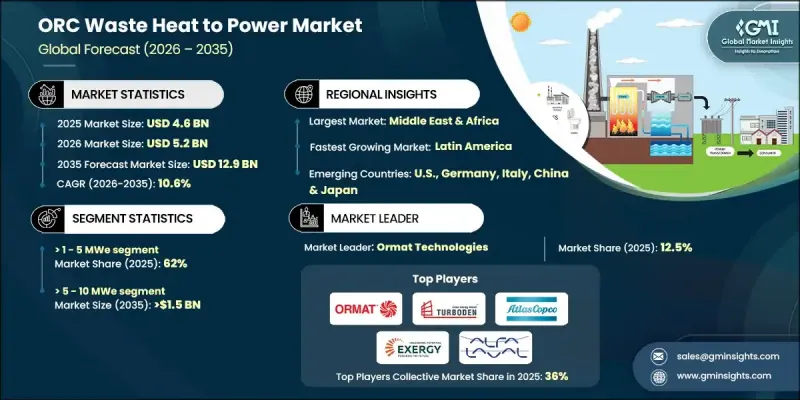
세계 ORC 폐열발전 시장은 2025년에 46억 달러로 평가되었으며, 2035년까지 연평균 복합 성장률(CAGR) 10.6%로 성장하고 129억 달러에 이를 것으로 예측됩니다.
이러한 성장은 탈탄소화 노력의 가속화, 환경 규제 강화, 산업 사업자에 대한 에너지 효율 향상의 압력 증가에 의해 추진되고 있습니다. 산업 공정에서 발생하는 대량의 회수가능한 열은 손실이 아닌 미사용 에너지 자원으로 점점 인식되고 있습니다. ORC 기술은 이러한 잔류 열 에너지를 사용 가능한 전력으로 변환하여 배출량을 줄이면서 전반적인 효율을 향상시킵니다. 에너지 가격의 변동성과 장기적인 비용 관리의 우선 과제도 도입을 뒷받침하고 있으며, ORC 시스템은 전력망에 대한 의존도를 줄이고 운영 비용 절감에 기여합니다. 기술의 성숙과 시스템 도입 규모의 확대에 의해 균등화 발전원가(LCOE)가 지속적으로 저하되고 있기 때문에 대규모 시설 이외의 도입도 확대하고 있습니다. 시스템 설계, 부품 효율성, 운영 신뢰성이 발전함에 따라 출력이 향상됨과 동시에 유지보수 요구사항이 줄어들어 보다 광범위한 운영 환경에서 ORC 솔루션의 상업적 매력이 증가하고 있습니다.
시장 범위
시작 연도
2025년
예측 연도
2026-2035년
시작 금액
46억 달러
예측 금액
129억 달러
CAGR
10.6%
5-10MWe 이상의 용량 부문은 2035년까지 15억 달러에 이를 것으로 예측됩니다. 이 범위의 시스템은 대규모의 안정된 열 흐름으로 인해 현장에서 유의미한 발전이 가능한 대량의 열 회수 용도에 적합합니다. 규제 준수 목표와 장기적인 지속가능성에 대한 노력은 고용량 설비에 대한 투자를 계속 추진하고 있습니다.
2025년 현재 미국 ORC 폐열발전 시장은 6억 6,000만 달러 규모로 73%의 점유율을 차지했습니다. 시장 성장은 유리한 정책 틀, 에너지 비용 상승 및 배출량 감소에 대한 관심 증가에 의해 지원됩니다. 분산형 발전과 지역에너지 탄력성에 대한 관심도 도입의 기세를 더욱 뒷받침하고 있습니다.
목차
제1장 조사 방법과 범위
제2장 주요 요약
제3장 업계 인사이트
생태계 분석
원재료 가용성 및 조달 분석
제조 능력 평가
공급망의 회복력과 리스크 요인
유통 네트워크 분석
규제 상황
업계에 미치는 영향요인
성장 촉진요인
업계의 잠재적 위험 및 과제
성장 가능성 분석
Porter's Five Forces 분석
PESTEL 분석
유도 가열 시스템의 비용 구조 분석
새로운 기회와 동향
투자분석과 전망
지속가능성 시책과 Industry 4.0의 통합
제4장 경쟁 구도
소개
기업의 시장 점유율 분석 : 지역별
북미
유럽
아시아태평양
중동 및 아프리카
라틴아메리카
전략적 대시보드
전략적 노력
주요 제휴 및 협력관계
주요 M&A 활동
제품 혁신과 신제품 출시
시장 확대 전략
경쟁 벤치마킹
혁신과 지속가능성의 정세
제5장 시장 규모와 예측 : 출력별, 2022-2035
1MWe 이하
1MWe 초과-5MWe 이하
5MWe 초과-10MWe 이하
10MWe 초과
제6장 시장 규모와 예측 : 지역별, 2022-2035
북미
미국
캐나다
멕시코
유럽
독일
영국
이탈리아
프랑스
벨기에
스페인
러시아
아시아태평양
중국
호주
인도
일본
한국
중동 및 아프리카
사우디아라비아
아랍에미리트(UAE)
남아프리카
라틴아메리카
브라질
아르헨티나
제7장 기업 프로파일
ABB
ALFA LAVAL
Atlas Copco AB
Calnetix Technologies, LLC
Elvosolar, as
Enertime
ENOGIA
Exergy International Srl
General Electric
INTEC GMK
Kaishan USA
Mitsubishi Heavy Industries, Ltd.
ORCAN ENERGY AG
Ormat Technologies
Triogen
Turboden SpA
SHW
영문 목차
영문목차
The Global ORC Waste Heat to Power Market was valued at USD 4.6 billion in 2025 and is estimated to grow at a CAGR of 10.6% to reach USD 12.9 billion by 2035.
Growth is driven by accelerating decarbonization efforts, tightening environmental regulations, and rising pressure on industrial operators to improve energy efficiency. Large volumes of recoverable heat generated during industrial processes are increasingly viewed as an untapped energy resource rather than a loss. ORC technology enables this residual thermal energy to be converted into usable electricity, improving overall efficiency while reducing emissions. Volatile energy pricing and long-term cost control priorities are further strengthening adoption, as ORC systems help offset grid dependence and lower operational expenses. Continuous declines in the levelized cost of electricity, supported by technological maturity and scaling of system deployment, are expanding adoption beyond large facilities. Advances in system design, component efficiency, and operational reliability are improving output while reducing maintenance requirements, making ORC solutions more commercially attractive across a wider range of operating environments.
Market Scope
Start Year
2025
Forecast Year
2026-2035
Start Value
$4.6 Billion
Forecast Value
$12.9 Billion
CAGR
10.6%
The greater than 5 to 10 MWe capacity segment is expected to reach USD 1.5 billion by 2035. Systems within this range are selected for high-volume heat recovery applications where large, stable thermal streams allow for meaningful on-site power generation. Regulatory compliance goals and long-term sustainability commitments continue to support investment in higher-capacity installations.
United States ORC Waste Heat to Power Market held 73% share in 2025, generating USD 660 million. Market growth is supported by favorable policy frameworks, rising energy costs, and increased focus on emissions reduction. Interest in distributed power generation and localized energy resilience further contributes to adoption momentum.
Key companies active in the Global ORC Waste Heat to Power Market include Turboden S.p.A, Ormat Technologies, Mitsubishi Heavy Industries, Ltd., ABB, General Electric, Atlas Copco AB, Alfa Laval, Kaishan USA, Enertime, ENOGIA, Exergy International Srl, ORCAN ENERGY AG, Calnetix Technologies, LLC, Elvosolar, a.s., INTEC GMK, and Triogen. Companies operating in the Global ORC Waste Heat to Power Market strengthen their market position through technology innovation, system efficiency improvements, and strategic expansion. Leading players invest in advanced system designs to increase conversion efficiency while lowering lifecycle costs. Portfolio diversification across different capacity ranges allows suppliers to address a broader customer base. Strategic partnerships with engineering firms and energy solution providers help accelerate project deployment and market access. Manufacturers also focus on modular system development to reduce installation time and improve scalability.
Table of Contents
Chapter 1 Methodology & Scope
1.1 Research design
1.1.1 Research approach
1.1.2 Data collection methods
1.2 Base estimates and calculations
1.2.1 Base year calculation
1.2.2 Market estimates & forecast parameters
1.3 Forecast
1.3.1 Key trends for market estimates
1.3.2 Quantified market impact analysis
1.3.2.1 Mathematical impact of growth parameters on forecast
1.3.3 Scenario analysis framework
1.4 Primary research and validation
1.4.1 Some of the primary sources (but not limited to)
1.5 Data mining sources
1.5.1 Paid Sources
1.5.2 Sources, by region
1.6 Research trail & scoring components
1.6.1 Research trail components
1.6.2 Scoring components
1.7 Research transparency addendum
1.7.1 Source attribution framework
1.7.2 Quality assurance metrics
1.7.3 Our commitment to trust
1.8 Market definitions
Chapter 2 Executive Summary
2.1 Industry synopsis, 2022 - 2035
2.1.1 Business trends
2.1.2 Power output trends
2.1.3 Regional trends
Chapter 3 Industry Insights
3.1 Industry ecosystem analysis
3.1.1 Raw material availability & sourcing analysis
3.1.2 Manufacturing capacity assessment
3.1.3 Supply chain resilience & risk factors
3.1.4 Distribution network analysis
3.2 Regulatory landscape
3.3 Industry impact forces
3.3.1 Growth drivers
3.3.2 Industry pitfalls & challenges
3.4 Growth potential analysis
3.5 Porter's analysis
3.5.1 Bargaining power of suppliers
3.5.2 Bargaining power of buyers
3.5.3 Threat of new entrants
3.5.4 Threat of substitutes
3.6 PESTEL analysis
3.6.1 Political factors
3.6.2 Economic factors
3.6.3 Social factors
3.6.4 Technological factors
3.6.5 Legal factors
3.6.6 Environmental factors
3.7 Cost structure analysis of induction heating systems
3.8 Emerging opportunities & trends
3.9 Investment analysis & future prospects
3.10 Sustainability initiatives & industry 4.0 integration
Chapter 4 Competitive Landscape, 2025
4.1 Introduction
4.2 Company market share analysis, by region, 2025
4.2.1 North America
4.2.2 Europe
4.2.3 Asia Pacific
4.2.4 Middle East & Africa
4.2.5 Latin America
4.3 Strategic dashboard
4.4 Strategic initiatives
4.4.1 Key partnerships & collaborations
4.4.2 Major M&A activities
4.4.3 Product innovations & launches
4.4.4 Market expansion strategies
4.5 Competitive benchmarking
4.6 Innovation & sustainability landscape
Chapter 5 Market Size and Forecast, By Power Output, 2022 - 2035 (USD Million)
5.1 Key trends
5.2 ≤ 1 MWe
5.3 > 1 - 5 MWe
5.4 > 5 - 10 MWe
5.5 > 10 MWe
Chapter 6 Market Size and Forecast, By Region, 2022 - 2035 (USD Million)