Textile Recycling Market Opportunity, Growth Drivers, Industry Trend Analysis, and Forecast 2026 - 2035
상품코드:1913457
리서치사:Global Market Insights Inc.
발행일:2025년 12월
페이지 정보:영문 210 Pages
라이선스 & 가격 (부가세 별도)
ㅁ Add-on 가능: 고객의 요청에 따라 일정한 범위 내에서 Customization이 가능합니다. 자세한 사항은 문의해 주시기 바랍니다.
한글목차
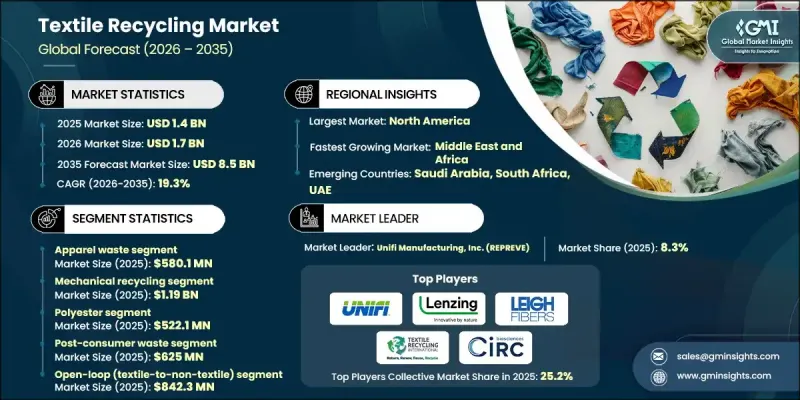
세계의 섬유 재활용 시장은 2025년 14억 달러로 평가되었으며, 2035년까지 연평균 복합 성장률(CAGR) 19.3%로 성장하여 85억 달러에 이를 것으로 예측됩니다.
시장 성장은 세계 공급망 전반에 걸친 환경 영향, 자원 보전, 폐기물 감축에 대한 관심 증가에 의해 견인되고 있습니다. 섬유 재활용은 폐기된 섬유 소재의 회수 및 재가공에 초점을 맞추어 매립지의 용량을 줄이고 섬유 생산의 환경 부하를 줄입니다. 소비 패턴과 제품 수명주기에 대한 감시의 강화가 섬유 밸류 체인 전체에서의 재활용 기법의 도입을 가속화하고 있습니다. 회수와 재생에 의한 섬유 소재의 사용 수명 연장은 신규 원료에 대한 의존도 저감을 지원해, 순환형 경제의 목표에 따르는 것입니다. 그러나 시장은 여전히 소재의 복잡성, 오염 문제, 불충분한 회수 인프라와 같은 구조적 과제에 직면하고 있습니다. 폐기되는 섬유 제품의 양이 증가함에 따라 확장성과 효율성을 결합한 재활용 시스템의 필요성이 커지고 있습니다. 제조업자, 소매업체, 정부 간 지속가능성에 대한 노력이 강화되고 있는 가운데, 섬유 재활용은 장기적인 환경 전략의 중요한 구성요소가 되고 있으며, 선진국과 신흥국 모두 시장 성장을 지지하고 있습니다.
시장 범위
시작 연도
2025년
예측 연도
2026-2035년
시작 규모
14억 달러
예측 금액
85억 달러
CAGR
19.3%
의류 폐기물 부문은 2025년 5억 8,010만 달러에 달했습니다. 높은 폐기율은 재활용 가능한 자재 공급량에 크게 기여하고 있지만, 다른 섬유 폐기물은 양, 밀도, 교환 빈도가 다릅니다. 이러한 폐기물 공급원은 함께 원료 공급을 형성하고 시장 전체의 처리 요건에 영향을 미치고 있습니다.
기계적 재활용 분야는 2025년 11억 9,000만 달러를 차지했습니다. 이 기술은 비용 효율성, 운영의 간편성 및 기존 인프라와의 호환성을 통해 계속 주목을 받고 있습니다. 재료 분리가 보다 복잡하고 회수 우선순위가 다른 분야에서는 대체 회수 방법도 확대되고 있습니다.
북미의 섬유 재활용 시장은 높은 지속가능성에 대한 의식, 규제 프레임워크, 첨단 선별 및 리사이클 기술에 대한 투자에 힘입어 2025년 5억 670만 달러에서 2035년까지 29억 달러로 성장할 것으로 예측되고 있습니다. 높은 소비 수준과 기업 환경에 대한 노력은 계속해서 지역 수요를 형성하고 있습니다.
목차
제1장 조사 방법과 범위
제2장 주요 요약
제3장 업계 인사이트
생태계 분석
공급자의 상황
이익률
각 단계에서의 부가가치
밸류체인에 영향을 주는 요인
혁신
업계에 미치는 영향요인
성장 요인
재생 섬유 소재 수요
재활용 분야에서의 기술 개발
섬유폐기물 발생량 증가
업계의 잠재적 위험 및 과제
섬유 재료의 복잡성
재활용 공정의 고비용
시장 기회
섬유에서 섬유로의 재활용 기술
디지털화와 스마트 선별 시스템
2차 원료 시장의 성장
성장 가능성 분석
규제 상황
북미
유럽
아시아태평양
라틴아메리카
중동 및 아프리카
Porter's Five Forces 분석
PESTEL 분석
기술과 혁신 동향
현재의 기술 동향
신흥기술
가격 동향
지역별
원료별
미래 시장 동향
기술과 혁신 동향
현재의 기술 동향
신흥기술
특허 동향
무역 통계(HS코드)(참고 : 무역 통계는 주요 국가에서만 제공됨)
주요 수입국
주요 수출국
지속가능성과 환경면
지속가능한 대처
폐기물 감축 전략
생산에서의 에너지 효율
환경에 배려한 대처
탄소발자국 고려
제4장 경쟁 구도
소개
기업의 시장 점유율 분석
지역별
북미
유럽
아시아태평양
라틴아메리카
중동 및 아프리카
기업 매트릭스 분석
주요 시장 기업의 경쟁 분석
경쟁 포지셔닝 매트릭스
주요 발전
인수합병
제휴 및 협업
신제품 발매
확대 계획
제5장 시장 추계 및 예측 : 원료별, 2022-2035년
의류 폐기물
홈 퍼니싱 폐기물
가구 및 덮개 폐기물
카펫 및 바닥재 폐기물
산업용 및 기술용 섬유
와이핑 재료
제6장 시장 추계 및 예측 : 프로세스별, 2022-2035년
기계적 재활용
화학적 재활용
생물학적 및 효소적 재활용
열분해 재활용
제7장 시장 추계 및 예측 : 소재 유형별, 2022-2035년
폴리에스테르
코튼
나일론 및 폴리아미드
울
비스코스 및 레이온(셀룰로오스계 섬유)
아크릴
혼방 섬유
기타 셀룰로오스계 섬유
제8장 시장 추계 및 예측 : 폐기물 유형별, 2022-2035년
소비 전 폐기물
소비 후 폐기물
산업폐기물
제9장 시장 추계 및 예측 : 재활용 유형별, 2022-2035년
폐쇄 루프(Fiber-to-Fiber/Textile-to-Textile)
개방 루프(Textile-to-Non-Textile)
제10장 시장 추계 및 예측 : 최종 용도별, 2022-2035년
의류/패브릭 및 가구용 원단
홈 퍼니싱
건축 및 건설
자동차 및 운송
산업용
의료 및 보호구
기타
제11장 시장 추계 및 예측 : 지역별, 2022-2035년
북미
미국
캐나다
멕시코
유럽
독일
영국
프랑스
스페인
이탈리아
기타 유럽
아시아태평양
중국
인도
일본
호주
한국
기타 아시아태평양
라틴아메리카
브라질
멕시코
아르헨티나
기타 라틴아메리카
중동 및 아프리카
사우디아라비아
남아프리카
아랍에미리트(UAE)
기타 중동 및 아프리카
제12장 기업 프로파일
BLS Ecotech
Circ
Fibersort
iinouiio Recycled Textiles
Leigh Fibers, LLC
Lenzing AG
Martex Fiber/ReVive Fiber
Patagonia, Inc.(Worn Wear Program)
Refiberd
Renewcell AB(Circulose)
RE TEXTIL Deutschland
Textile Recycling International(TRI Group)
Unifi Manufacturing, Inc.(REPREVE)
Worn Again Technologies Ltd
Worn Again Technologies Ltd
JHS
영문 목차
영문목차
The Global Textile Recycling Market was valued at USD 1.4 billion in 2025 and is estimated to grow at a CAGR of 19.3% to reach USD 8.5 billion by 2035.
Market growth is driven by rising concern over environmental impact, resource conservation, and waste reduction across global supply chains. Textile recycling focuses on the recovery and reprocessing of discarded textile materials to reduce landfill volumes and lower the ecological footprint of textile production. Increasing scrutiny of consumption patterns and product life cycles is accelerating the adoption of recycling practices across the textile value chain. Extending the usable life of textile materials through recovery and regeneration supports reduced reliance on virgin inputs and aligns with circular economy goals. However, the market continues to face structural challenges related to material complexity, contamination issues, and insufficient collection infrastructure. The growing volume of discarded textiles has intensified the need for scalable and efficient recycling systems. As sustainability commitments strengthen among manufacturers, retailers, and governments, textile recycling is becoming a critical component of long-term environmental strategies, supporting market growth across both developed and emerging economies.
Market Scope
Start Year
2025
Forecast Year
2026-2035
Start Value
$1.4 Billion
Forecast Value
$8.5 Billion
CAGR
19.3%
The apparel waste segment reached USD 580.1 million during 2025. High disposal rates contribute significantly to recyclable material availability, while other textile waste streams differ in volume, density, and replacement frequency. Together, these waste sources shape feedstock supply and influence processing requirements across the market.
The mechanical recycling segment accounted for USD 1.19 billion in 2025. This approach continues to gain traction due to cost efficiency, operational simplicity, and compatibility with existing infrastructure. Alternative recovery methods are also expanding where material separation is more complex and recovery priorities differ.
North America Textile Recycling Market is projected to grow from USD 506.7 million in 2025 to USD 2.9 billion by 2035, supported by strong sustainability awareness, regulatory frameworks, and investment in advanced sorting and recycling technologies. High consumption levels and corporate environmental commitments continue to shape regional demand.
Key companies operating in the Global Textile Recycling Market include Lenzing AG, Renewcell AB, Unifi Manufacturing, Inc., Leigh Fibers, LLC, Martex Fiber, RE TEXTIL Deutschland, Worn Again Technologies Ltd, Textile Recycling International, BLS Ecotech, Patagonia, Inc., Circ, Fibersort, iinouiio Recycled Textiles, and Refiberd. Companies in the Global Textile Recycling Market are strengthening their position through technology innovation, strategic partnerships, and supply chain integration. Many are investing in advanced sorting and processing systems to improve material recovery efficiency and output quality. Collaborations with brands and manufacturers help secure consistent feedstock and long-term demand. Geographic expansion enables access to new waste streams and regional policy incentives. Firms are also focusing on traceability, transparency, and certification to meet sustainability expectations from regulators and customers.
Table of Contents
Chapter 1 Methodology & Scope
1.1 Market scope and definition
1.2 Research design
1.2.1 Research approach
1.2.2 Data collection methods
1.3 Data mining sources
1.3.1 Global
1.3.2 Regional/Country
1.4 Base estimates and calculations
1.4.1 Base year calculation
1.4.2 Key trends for market estimation
1.5 Primary research and validation
1.5.1 Primary sources
1.6 Forecast model
1.7 Research assumptions and limitations
Chapter 2 Executive Summary
2.1 Industry 360° synopsis
2.2 Key market trends
2.2.1 Source
2.2.2 Process
2.2.3 Material Type
2.2.4 Waste Type
2.2.5 Recycling Type
2.2.6 End Use
2.2.7 Regional
2.3 TAM Analysis, 2025-2035
2.4 CXO perspectives: Strategic imperatives
2.4.1 Executive decision points
2.4.2 Critical success factors
2.5 Future outlook and strategic recommendations
Chapter 3 Industry Insights
3.1 Industry ecosystem analysis
3.1.1 Supplier landscape
3.1.2 Profit margin
3.1.3 Value addition at each stage
3.1.4 Factor affecting the value chain
3.1.5 Disruptions
3.2 Industry impact forces
3.2.1 Growth drivers
3.2.1.1 Demand for recycled textile materials
3.2.1.2 Technological development in recycling
3.2.1.3 Increase in textile waste generation
3.2.2 Industry pitfalls and challenges
3.2.2.1 Complexity of textile materials
3.2.2.2 High cost of recycling processes
3.2.3 Market opportunities
3.2.3.1 Fiber-to-fiber recycling technologies
3.2.3.2 Digitalization and smart sorting systems
3.2.3.3 Growth of secondary raw material markets
3.3 Growth potential analysis
3.4 Regulatory landscape
3.4.1 North America
3.4.2 Europe
3.4.3 Asia Pacific
3.4.4 Latin America
3.4.5 Middle East & Africa
3.5 Porter's analysis
3.6 PESTEL analysis
3.7 Technology and innovation landscape
3.7.1 Current technological trends
3.7.2 Emerging technologies
3.8 Price trends
3.8.1 By region
3.8.2 By source
3.9 Future market trends
3.10 Technology and innovation landscape
3.10.1 Current technological trends
3.10.2 Emerging technologies
3.11 Patent landscape
3.12 Trade statistics (HS code) (Note: the trade statistics will be provided for key countries only)
3.12.1 Major importing countries
3.12.2 Major exporting countries
3.13 Sustainability and environmental aspects
3.13.1 Sustainable practices
3.13.2 Waste reduction strategies
3.13.3 Energy efficiency in production
3.13.4 Eco-friendly initiatives
3.14 Carbon footprint consideration
Chapter 4 Competitive Landscape, 2025
4.1 Introduction
4.2 Company market share analysis
4.2.1 By region
4.2.1.1 North America
4.2.1.2 Europe
4.2.1.3 Asia Pacific
4.2.1.4 LATAM
4.2.1.5 MEA
4.3 Company matrix analysis
4.4 Competitive analysis of major market players
4.5 Competitive positioning matrix
4.6 Key developments
4.6.1 Mergers & acquisitions
4.6.2 Partnerships & collaborations
4.6.3 New product launches
4.6.4 Expansion plans
Chapter 5 Market Estimates and Forecast, By Source, 2022-2035 (USD Billion) (Kilo Tons)
5.1 Key trends
5.2 Apparel waste
5.3 Home furnishing waste
5.4 Furniture & upholstery waste
5.5 Carpet & floor covering waste
5.6 Industrial & technical textiles
5.7 Wiping materials
Chapter 6 Market Estimates and Forecast, By Process, 2022-2035 (USD Billion) (Kilo Tons)
6.1 Key trends
6.2 Mechanical recycling
6.3 Chemical recycling
6.4 Biological & enzymatic recycling
6.5 Thermal recycling
Chapter 7 Market Estimates and Forecast, By Material Type, 2022-2035 (USD Billion) (Kilo Tons)
7.1 Key trends
7.2 Polyester
7.3 Cotton
7.4 Nylon & polyamide
7.5 Wool
7.6 Viscose & rayon (cellulosic fibers)
7.7 Acrylic
7.8 Blended textiles
7.9 Other cellulosic fibers
Chapter 8 Market Estimates and Forecast, By Waste Type, 2022-2035 (USD Billion) (Kilo Tons)
8.1 Key trends
8.2 Pre-consumer waste
8.3 Post-consumer waste
8.4 Post-industrial waste
Chapter 9 Market Estimates and Forecast, By Recycling Type, 2022-2035 (USD Billion) (Kilo Tons)