Fleet Management Market Opportunity, Growth Drivers, Industry Trend Analysis, and Forecast 2026 - 2035
상품코드:1913333
리서치사:Global Market Insights Inc.
발행일:2025년 12월
페이지 정보:영문 225 Pages
라이선스 & 가격 (부가세 별도)
ㅁ Add-on 가능: 고객의 요청에 따라 일정한 범위 내에서 Customization이 가능합니다. 자세한 사항은 문의해 주시기 바랍니다.
한글목차
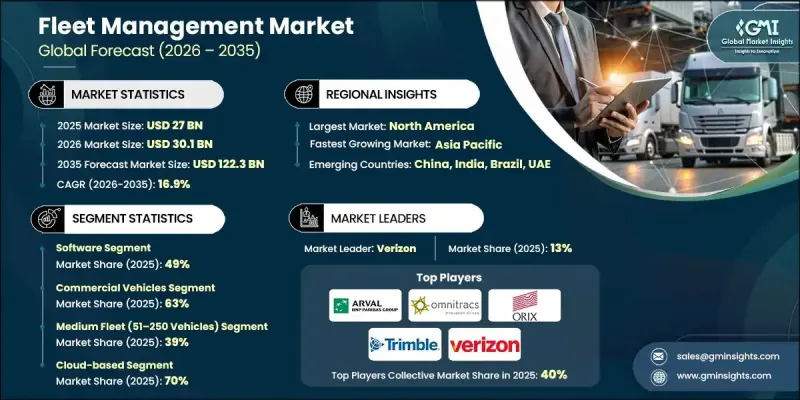
세계의 플릿 관리 시장은 2025년에 270억 달러로 평가되며, 2035년까지 CAGR 16.9%로 성장하며, 1,223억 달러에 달할 것으로 예측됩니다.
시장의 강력한 성장은 지속적인 디지털 전환, 차량 전동화, 엄격한 규제 준수, 급성장하는 E-Commerce 부문에 의해 주도되고 있습니다. 이 시장은 GPS/GNSS 트래커, 텔레매틱스 제어 장치, 대시 캠, IoT 센서 등 광범위한 하드웨어를 포함하며, 차량 추적, 유지보수, 연료 모니터링, 분석을 위한 소프트웨어 플랫폼도 포함합니다. 설치, 컨설팅, 매니지드 서비스, 교육 등의 전문 서비스가 시장 생태계를 더욱 강화하고 있습니다. 클라우드 기반 솔루션은 기존 On-Premise 시스템에 비해 확장성, 원격 접근성, 자동 업데이트, 인프라 비용 절감을 실현하는 데 중요한 역할을 하고 있습니다. 특히 중소기업은 많은 IT 투자 없이도 첨단 차량 관리 기능을 이용하기 위해 SaaS 모델을 활용하고 있습니다. 북미가 이 시장을 주도하고 있으며, 미국은 높은 상용차 활동량, 엄격한 전자기록장치(ELD) 의무화, 첨단 텔레매틱스 통합, 주요 솔루션 프로바이더들의 집중으로 인해 지역적 확장을 주도하고 있습니다.
시장 범위
시작연도
2025년
예측연도
2026-2035
개시시 가치
270억 달러
예측 금액
1,223억 달러
CAGR
16.9%
소프트웨어 분야는 2025년 49%의 점유율을 차지할 것으로 예상되며, 2026-2035년 연평균 복합 성장률(CAGR) 17.1%로 성장할 것으로 전망됩니다. 기술 발전에도 불구하고 하드웨어가 상품화되는 가운데, 업계는 지속적인 매출 모델을 갖춘 소프트웨어 중심 솔루션으로 빠르게 전환하고 있습니다. 소프트웨어 플랫폼은 단순한 데이터 수집을 넘어 데이터 집계, 분석, 시각화, 실행 가능한 인사이트을 제공하는 종합적인 기능을 통해 현재 시장을 장악하고 있습니다. 이 부문의 성장은 프리미엄 가격을 정당화할 수 있는 고급 기능, 고매출의 지속적인 매출을 창출하는 SaaS 구독 모델, 측정 가능한 비즈니스 ROI를 실현하는 지능형 의사결정 툴의 채택 확대에 힘입어 성장세를 보이고 있습니다.
상용차 부문은 2025년 63%의 점유율을 차지할 것으로 예상되며, 2026-2035년 연평균 복합 성장률(CAGR) 17%로 성장할 것으로 전망됩니다. 이 부문에는 경상용 밴, 중형 트럭, 대형 트랙터가 포함됩니다. 이 차량들은 연간 3만 마일에서 10만 마일 이상을 주행하며, 지역과 연료 유형에 따라 갤런당 3달러에서 4.50달러의 연료를 연간 5,000갤런에서 20,000갤런까지 소비합니다. 소형 배송 트럭, 서비스 밴 등 소형 상용차는 지역 배송 및 서비스 차량으로 널리 활용되고 있으며, 경로 최적화, 생산성 모니터링, 운영 효율성 향상 등의 이점을 누리고 있습니다.
미국 차량 관리 시장은 2025년 121억 달러 규모에 달할 것으로 예상되며, 2026-2035년 연평균 복합 성장률(CAGR) 14.6%를 보일 것으로 예측됩니다. 이러한 성장은 성숙한 텔레매틱스 생태계, 탄탄한 디지털 인프라, 커넥티드카 기술의 급속한 보급에 힘입어 이루어지고 있습니다. 물류, 운송, 유틸리티, 공공 서비스 분야의 차량 운영자들은 첨단 차량 솔루션 도입에 박차를 가하고 있습니다. 이러한 도입은 운영 효율성, 안전성, 규제 준수를 향상시키고자 하는 소프트웨어 개발자, 텔레매틱스 프로바이더, 클라우드 플랫폼 기업에 의해 더욱 강화되고 있습니다.
목차
제1장 조사 방법
제2장 개요
제3장 업계 인사이트
에코시스템 분석
공급업체의 상황
이익률 분석
비용 구조
각 단계에서의 부가가치
밸류체인에 영향을 미치는 요인
파괴적 변화
업계에 대한 영향요인
촉진요인
효율성과 비용 삭감에 대한 수요
자동차 정비에 관한 규제의 증가
E-Commerce(E-Commerce)와 라스트 마일 배송의 부상
텔레매틱스, 사물인터넷(IoT), 인공지능에서 첨단 기술의 통합
지속가능성에 대한 주목의 증가
업계의 잠재적 리스크 & 과제
데이터 과다와 관리상 우려
드라이버 관리와 안전상 과제
시장 기회
AI, IoT, 첨단 분석 기술의 통합에 의한, 보다 스마트한 플릿 운영의 실현
전용 감시 툴을 갖춘 전기자동차 및 하이브리드차 플릿의 도입
자율주행차 플릿 관리 솔루션
신흥 시장 및 지역 시장에 대한 확대
커넥티드카 및 5G 대응 플릿 관리 시스템
성장 가능성 분석
규제 상황
Porter의 산업 분석
PESTEL 분석
기술과 혁신의 동향
현재 기술 동향
신규 기술
비용 내역 분석
특허 분석
사용 사례와 성공 사례
지속가능성과 환경면
지속가능구상
폐기물 삭감 전략
생산에서 에너지 효율
친환경 구상
탄소발자국에 관한 고려사항
전망과 기회
제4장 경쟁 구도
서론
기업의 시장 점유율 분석
북미
유럽
아시아태평양
라틴아메리카
중동 및 아프리카
주요 시장 기업의 경쟁 분석
경쟁 포지셔닝 매트릭스
전략적 전망 매트릭스
주요 발전
합병·인수
제휴·협업
신제품 발매
사업 확대 계획과 자금조달
제5장 시장 추산·예측 : 컴포넌트별, 2022-2035
하드웨어
차량 추적 기기
온보드 진단(OBD) 기기
텔레매틱스 기기
센서
소프트웨어
플릿 관리 소프트웨어(FMS)
텔레매틱스 플랫폼
루트 최적화 및 스케줄링 소프트웨어
운전자 행동 모니터링 소프트웨어
유지보수 관리 소프트웨어
서비스
설치 및 통합
데이터 분석과 리포트 작성
유지보수·지원 서비스
제6장 시장 추산·예측 : 차량별, 2022-2035
승용차
SUV
해치백
세단
상용차
라이트 듀티
미디엄 듀티
헤비 듀티
전기자동차
특수 차량용 플릿
건설·광산기계
긴급 차량
유틸리티 서비스 차량
제7장 시장 추산·예측 : 플릿 규모별, 2022-2035
소규모 플릿(1-50대)
중규모 플릿(51-250대)
대규모 플릿(250대 이상)
제8장 시장 추산·예측 : 접속 기술별, 2022-2035
GPS/GNSS
4G/LTE
5G
Bluetooth/Wi-Fi
위성통신
IoT 센서와 CAN 버스의 통합
제9장 시장 추산·예측 : 배포별, 2022-2035
온프레미스
클라우드 기반
제10장 시장 추산·예측 : 최종 용도별, 2022-2035
운송
운영 관리
드라이버 관리
차량 추적 시스템
컴플라이언스 관리
유지보수 관리
연료 관리
자산 추적
기타
건설
운영 관리
드라이버 관리
차량 추적 시스템
컴플라이언스 관리
유지보수 관리
연료 관리
자산 추적
기타
제조업
운영 관리
드라이버 관리
차량 추적 시스템
컴플라이언스 관리
유지보수 관리
연료 관리
자산 추적
기타
유틸리티
운영 관리
드라이버 관리
차량 추적 시스템
컴플라이언스 관리
유지보수 관리
연료 관리
자산 추적
기타
의료·의약품
운영 관리
드라이버 관리
차량 추적 시스템
컴플라이언스 관리
유지보수 관리
연료 관리
자산 추적
기타
소매업 및 E-Commerce
운영 관리
드라이버 관리
차량 추적 시스템
컴플라이언스 관리
유지보수 관리
연료 관리
자산 추적
기타
식품 및 음료/콜드체인
운영 관리
드라이버 관리
차량 추적 시스템
컴플라이언스 관리
유지보수 관리
연료 관리
자산 추적
기타
기타
운영 관리
드라이버 관리
차량 추적 시스템
컴플라이언스 관리
유지보수 관리
연료 관리
자산 추적
기타
제11장 시장 추산·예측 : 지역별, 2022-2035
북미
미국
캐나다
유럽
독일
영국
프랑스
이탈리아
스페인
러시아
북유럽 국가
베네룩스
아시아태평양
중국
인도
일본
호주
한국
싱가포르
태국
인도네시아
베트남
라틴아메리카
브라질
멕시코
아르헨티나
콜롬비아
중동 및 아프리카
남아프리카공화국
사우디아라비아
아랍에미리트
제12장 기업 개요
세계 기업
ARI Fleet Management
Donlen
Element Fleet Management
Geotab
LeasePlan
Omnitracs
Orix
Trimble
Verizon Connect
Wheels
지역 기업
Azuga
Bestmile
ClearPath GPS
GPS Insights
Inseego
NexTraq
Onfleet
Teletrac Navman
ThingTech
TomTom Telematics
신규 기술 이노베이터
Automile
Fleet Complete
KeepTruckin(Motive)
Lytx
Samsara
KSA
영문 목차
영문목차
The Global Fleet Management Market was valued at USD 27 billion in 2025 and is estimated to grow at a CAGR of 16.9% to reach USD 122.3 billion by 2035.
The market's strong growth is fueled by ongoing digital transformation, the rise of vehicle electrification, stringent regulatory compliance, and the booming e-commerce sector. This market spans a wide range of hardware, including GPS/GNSS trackers, telematics control units, dashcams, and IoT sensors, while also encompassing software platforms for fleet tracking, maintenance, fuel monitoring, and analytics. Professional services such as installation, consulting, managed services, and training further enhance the market ecosystem. Cloud-based solutions play a pivotal role, offering scalability, remote accessibility, automatic updates, and lower infrastructure costs compared to traditional on-premises systems. Small and medium-sized enterprises are particularly leveraging SaaS models to access advanced fleet management functionalities without heavy IT investment. North America leads this market, with the U.S. driving regional expansion due to high commercial vehicle activity, strict ELD mandates, advanced telematics integration, and a concentration of key solution providers.
Market Scope
Start Year
2025
Forecast Year
2026-2035
Start Value
$27 Billion
Forecast Value
$122.3 Billion
CAGR
16.9%
The software segment accounted for a 49% share in 2025 and is forecasted to grow at a CAGR of 17.1% from 2026 to 2035. The industry is increasingly shifting toward software-centric solutions with recurring revenue models, while hardware is becoming commoditized despite technological advancements. Software platforms now dominate by offering comprehensive capabilities for data aggregation, analytics, visualization, and actionable insights, which go far beyond simple data collection. The segment's growth is driven by advanced features that justify premium pricing, SaaS subscription models with high-margin recurring revenues, and the rising adoption of intelligent decision-making tools that deliver measurable operational ROI.
The commercial vehicles segment held a 63% share in 2025 and is expected to grow at a CAGR of 17% between 2026 and 2035. This segment includes light-duty vans, medium-duty trucks, and heavy-duty tractors, which travel between 30,000 and over 100,000 miles annually, consuming 5,000 to 20,000 gallons of fuel per year, with prices ranging from USD 3.00 to USD 4.50 per gallon depending on the region and fuel type. Light-duty commercial vehicles, such as small delivery trucks and service vans, are widely used in local deliveries and service fleets, benefiting from route optimization, productivity monitoring, and operational efficiency improvements.
U.S. Fleet Management Market generated USD 12.1 billion in 2025 and is expected to grow at a CAGR of 14.6% from 2026 to 2035. The growth is supported by a mature telematics ecosystem, strong digital infrastructure, and rapid adoption of connected vehicle technologies. Fleet operators across logistics, transportation, utilities, and public services are increasingly implementing advanced fleet solutions. This adoption is reinforced by software developers, telematics providers, and cloud platform companies aiming to improve operational efficiency, safety, and regulatory compliance.
Major players operating in the Global Fleet Management Industry include Geotab, Samsara, Omnitracs, Trimble, ARI Fleet Management, Wheels, Verizon Connect, Arval-Element, Donlen, and Teletrac Navman. Key strategies adopted by companies in the Global Fleet Management Market include expanding both hardware and software offerings to provide end-to-end solutions, developing cloud-based platforms for scalable and remote fleet management, and implementing SaaS subscription models that generate high-margin recurring revenues. Providers are integrating AI, predictive analytics, and real-time reporting features to enhance decision-making and operational efficiency. Partnerships with vehicle manufacturers, telematics vendors, and cloud service providers enable companies to broaden market reach and strengthen global presence.
Table of Contents
Chapter 1 Methodology
1.1 Market scope and definition
1.2 Research design
1.2.1 Research approach
1.2.2 Data collection methods
1.3 Data mining sources
1.3.1 Global
1.3.2 Regional/Country
1.4 Base estimates and calculations
1.4.1 Base year calculation
1.4.2 Key trends for market estimation
1.5 Primary research and validation
1.5.1 Primary sources
1.6 Forecast model
1.7 Research assumptions and limitations
Chapter 2 Executive Summary
2.1 Industry 3600 synopsis, 2022 - 2035
2.2 Key market trends
2.2.1 Regional
2.2.2 Component
2.2.3 Vehicle
2.2.4 Fleet Size
2.2.5 Connectivity Technology
2.2.6 Deployment Mode
2.2.7 End Use
2.3 TAM Analysis, 2026-2035
2.4 CXO perspectives: Strategic imperatives
2.4.1 Executive decision points
2.4.2 Critical success factors
2.5 Future outlook and strategic recommendations
Chapter 3 Industry Insights
3.1 Industry ecosystem analysis
3.1.1 Supplier landscape
3.1.2 Profit margin analysis
3.1.3 Cost structure
3.1.4 Value addition at each stage
3.1.5 Factor affecting the value chain
3.1.6 Disruptions
3.2 Industry impact forces
3.2.1.1 Growth drivers
3.2.1.2 Demand for efficiency and cost reduction
3.2.1.3 A growing number of regulations in vehicle maintenance
3.2.1.4 Rise of e-commerce and last-mile delivery
3.2.1.5 Integration of advanced technologies in telematics, the Internet of Things (IoT), and artificial intelligence
3.2.1.6 Increasing focus on sustainability
3.2.2 Industry pitfalls and challenges
3.2.2.1 Data overload and management concerns
3.2.2.2 Driver management and safety issues
3.2.3 Market opportunities
3.2.3.1 Integration of AI, IoT, and advanced analytics for smarter fleet operations.
3.2.3.2 Adoption of electric and hybrid vehicle fleets with specialized monitoring tools.