



세계의 가정용 수면무호흡 검사 기기 시장은 2025년에 16억 달러로 평가되었고, 2035년까지 연평균 복합 성장률(CAGR) 11.6%로 성장하여 50억 달러에 이를 것으로 예측됩니다.

시장 성장의 배경에는 고령 인구 증가, 수면무호흡증 및 관련 만성질환의 발병률 증가, 휴대용 및 웨어러블 진단 기술의 급속한 혁신이 있습니다. 수면 건강 관리에 대한 대중의 인식 개선과 미진단 수면장애에 따른 임상적 위험에 대한 이해는 수요를 더욱 촉진하고 있습니다. 재택 검사 솔루션은 저렴한 가격, 편의성, 기존 임상 환경 밖에서도 신뢰할 수 있는 진단 결과를 제공할 수 있다는 점에서 점점 더 많은 사람들이 선택하고 있습니다. 원격 의료 및 원격 환자 모니터링의 보급 확대도 도입을 가속화하고 있으며, 이러한 장비는 디지털 의료 워크플로우에 쉽게 통합될 수 있습니다. 비만, 당뇨병, 심혈관 질환의 유병률이 증가함에 따라 조기 검진 및 개입의 필요성이 높아지고 있습니다. 수면무호흡증을 치료하지 않으면 심각한 합병증 위험이 크게 증가하기 때문입니다. 센서의 정확도 향상, 무선 데이터 전송 기술, 인공지능의 발전으로 더 작고 정확도가 높으며 환자가 혼자서도 쉽게 조작할 수 있는 기기가 실현되고 있습니다. 이러한 요인들로 인해, 가정용 수면무호흡증 검사는 전 세계 의료 시스템에서 실용적인 1차 진단 도구로 자리매김하고 있습니다.
| 시장 범위 | |
|---|---|
| 개시 연도 | 2025년 |
| 예측 연도 | 2026-2035년 |
| 개시 연도 시장 규모 | 16억 달러 |
| 예측 금액 | 50억 달러 |
| CAGR | 11.6% |
2025년 기준, 유형 3 디바이스 부문은 66.1%의 점유율을 차지할 것으로 예측됩니다. 이 부문의 성장은 조기 진단과 예방의학에 대한 관심이 높아지면서 성장세를 보이고 있습니다. 이 장치는 여러 생리적 신호를 추적하고, 임상적 신뢰성과 사용자 편의성 사이에서 균형을 이루며, 합병증 없이 중등도에서 중증의 폐쇄성 질환을 식별하는 데 적합합니다.
폐쇄성 수면무호흡증 부문은 2025년 15억 달러로 평가됐습니다. 이 질환은 수면무호흡증 중 가장 흔한 형태이며, 대사 및 심혈관 위험과 밀접한 관련이 있기 때문에 적시에 진단하고 모니터링하는 것이 더욱 중요해졌습니다.
북미 재택 수면무호흡증 검사 장비 시장은 2025년 33.6%의 점유율을 차지할 것으로 예상되며, 향후에도 견조한 성장세를 유지할 것으로 전망됩니다. 수면장애에 대한 높은 인식, 원격의료의 보급, 첨단 의료 인프라, 생활습관 관련 위험요인 증가가 지역 수요를 견인하고 있습니다.
The Global Home Sleep Apnea Testing Devices Market was valued at USD 1.6 billion in 2025 and is estimated to grow at a CAGR of 11.6% to reach USD 5 billion by 2035.
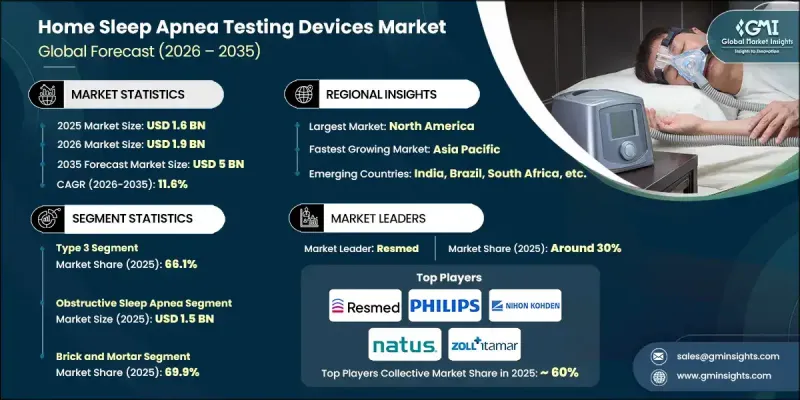
Market growth is fueled by the expanding elderly population, rising incidence of sleep apnea and related chronic conditions, and rapid innovation in portable and wearable diagnostic technologies. Increasing public awareness of sleep health and the clinical risks associated with undiagnosed sleep disorders is further supporting demand. Home-based testing solutions are gaining preference due to their affordability, convenience, and ability to deliver reliable diagnostic results outside traditional clinical environments. The growing adoption of telemedicine and remote patient monitoring is also accelerating uptake, as these devices integrate easily into digital healthcare workflows. The rising prevalence of obesity, diabetes, and cardiovascular disease is increasing the need for early screening and intervention, since untreated sleep apnea significantly elevates the risk of serious complications. Advances in sensor accuracy, wireless data transmission, and artificial intelligence are enabling devices that are smaller, more precise, and simpler for patients to operate independently. These factors are positioning home sleep apnea testing as a practical frontline diagnostic tool across global healthcare systems.
| Market Scope | |
|---|---|
| Start Year | 2025 |
| Forecast Year | 2026-2035 |
| Start Value | $1.6 Billion |
| Forecast Value | $5 Billion |
| CAGR | 11.6% |
The type 3 device segment held a 66.1% share in 2025. Growth in this segment is supported by increased emphasis on early diagnosis and preventive care. These devices track multiple physiological signals and offer a balance between clinical reliability and user convenience, making them suitable for identifying moderate to severe obstructive conditions in uncomplicated cases.
The obstructive sleep apnea segment was valued at USD 1.5 billion in 2025. This condition represents the most common form of sleep apnea and is closely associated with metabolic and cardiovascular risks, reinforcing the importance of timely diagnosis and monitoring.
North America Home Sleep Apnea Testing Devices Market accounted for a 33.6% share in 2025 and is expected to maintain strong growth. High awareness of sleep disorders, widespread telehealth adoption, advanced healthcare infrastructure, and elevated prevalence of lifestyle-related risk factors continue to drive regional demand.
Key companies active in the Global Home Sleep Apnea Testing Devices Market include ResMed, Philips, Nox Medical, Compumedics, ZOLL Itamar, Nihon Kohden, Natus, SOMNOmedics, CleveMed, Neurosoft, CADWELL, CONTEC, NEUROVIRTUAL, and Nox Medical. Companies in the Global Home Sleep Apnea Testing Devices Market are strengthening their market position through continuous product innovation, digital integration, and strategic partnerships. Manufacturers focus on improving diagnostic accuracy, comfort, and ease of use through advanced sensors and AI-driven analytics. Integration with telehealth platforms and cloud-based data management systems supports seamless clinical workflows. Many players invest in regulatory approvals and clinical validation to expand adoption across healthcare settings. Geographic expansion into underserved markets and collaboration with sleep clinics and healthcare providers help increase reach.