Press Machine Market Opportunity, Growth Drivers, Industry Trend Analysis, and Forecast 2026 - 2035
상품코드:1892867
리서치사:Global Market Insights Inc.
발행일:2025년 12월
페이지 정보:영문 180 Pages
라이선스 & 가격 (부가세 별도)
ㅁ Add-on 가능: 고객의 요청에 따라 일정한 범위 내에서 Customization이 가능합니다. 자세한 사항은 문의해 주시기 바랍니다.
한글목차
세계의 프레스 머신 시장은 2025년에 147억 달러로 평가되었고, 2035년까지 연평균 복합 성장률(CAGR) 6.5%로 성장하여 272억 달러에 이를 것으로 예측됩니다.
프레스 머신은 자동차, 항공우주, 건설, 전자기기 등 여러 산업의 제조 공정에서 중요한 역할을 하고 있어 시장이 확대되고 있습니다. 이 기계들은 성형, 프레스, 단조, 주조 작업에 필수적이며, 그 효율성은 생산량과 제품 품질에 직접적인 영향을 미칩니다. 서보 프레스, 유압 프레스 등 첨단 프레스 기술에 대한 수요 증가는 제조업체들이 생산성과 작업 정확도 향상에 집중하고 있음을 반영합니다. 자동차 생산의 연비 및 지속가능성 향상을 위한 경량화 및 고강도 소재의 채용 확대도 시장을 더욱 견인하고 있습니다. 전동화 및 산업 현대화 지원 정책과 더불어 전 세계 자동차 생산량 증가로 인해 대량 및 고정밀 작업이 가능한 프레스 머신에 대한 수요가 증가하고 있습니다. 현대 제조 환경의 변화하는 요구에 부응하기 위해 자동화, 에너지 효율, 고신뢰성을 갖춘 프레스 솔루션을 제공하기 위해 끊임없이 혁신을 거듭하고 있습니다.
시장 범위
개시 연도
2025년
예측 연도
2026-2035년
개시 연도 시장 규모
147억 달러
예측 금액
272억 달러
CAGR
6.5%
기계식 프레스 머신 부문은 2025년 58억 달러 시장 규모를 기록할 것으로 예상되며, 2035년에는 109억 달러에 달할 것으로 예측됩니다. 기계식 프레스 머신은 비용 효율성, 작동 유연성 및 저비용 생산 응용 분야에 적합하기 때문에 여전히 높은 인기를 유지하고 있습니다. 효율적인 제조 솔루션에 대한 전 세계적인 수요 증가는 다양한 산업 분야에서 기계식 프레스 머신의 보급을 촉진하고 있으며, 대량의 금속 성형 및 프레스 가공 요구에 대한 신뢰할 수 있는 솔루션을 제공합니다.
자동차 부문은 2025년 36%의 점유율을 차지했습니다. 이러한 우위는 자동차 부품의 정밀하고 효율적인 생산에 대한 자동차 제조업체의 높은 수요에 기인합니다. 엄격한 공차와 효율적인 대량 생산의 필요성 때문에 제조업체들은 생산성 향상, 재료 폐기물 감소, 제품 품질 향상을 실현하는 첨단 프레스 기술에 투자하고 있습니다.
미국 프레스 머신 시장은 2024년 87.4%의 점유율을 차지했습니다. 이러한 성장은 자동차 및 항공우주 산업의 견조한 생산 활동과 대규모 인프라 투자에 의해 뒷받침되고 있습니다. 산업 현대화, 정밀 제조 및 반도체 생산을 지원하는 정부 정책으로 인해 금속 성형, 부품 제조 및 고정밀 제조 응용 분야에서 고성능 프레스 머신에 대한 수요가 더욱 증가하고 있습니다.
목차
제1장 조사 방법과 범위
제2장 주요 요약
제3장 업계 인사이트
생태계 분석
공급업체 상황
이익률
각 단계별 부가가치
밸류체인에 영향을 미치는 요인
업계에 대한 영향요인
성장 촉진요인
업계의 잠재적 리스크&과제
기회
성장 가능성 분석
향후 시장 동향
기술과 혁신 동향
현재 기술 동향
신기술
가격 동향
유형별
지역별
규제 상황
규격 및 컴플라이언스 요건
지역별 규제 구조
인증 기준
무역 통계(HS코드8462;8465)
주요 수입국
주요 수출국
갭 분석
리스크 평가와 경감책
Porter's Five Forces 분석
PESTEL 분석
제4장 경쟁 구도
서론
기업의 시장 점유율 분석
지역별
기업 매트릭스 분석
주요 시장 기업의 경쟁 분석
경쟁 포지셔닝 매트릭스
주요 발전
인수합병(M&A)
제휴 및 협업
신제품 발매
확대 계획
제5장 시장 추산 및 예측 : 유형별, 2022-2035
주요 동향
기계식 프레스
유압 프레스
서보 프레스
공기압 프레스
제6장 시장 추산 및 예측 : 용량별, 2022-2035
주요 동향
500톤 이하
500-2,000톤
2,000톤 이상
제7장 시장 추산 및 예측 : 자동화별, 2022-2035
주요 동향
수식동 프레스 머신
반자동 프레스 머신
완전 자동화 프레스 머신
스마트/IoT 대응 프레스 머신
제8장 시장 추산 및 예측 : 용도별, 2022-2035
주요 동향
금속 가공
목공
플라스틱 제조
기타(고무, 복합재료 등)
제9장 시장 추산 및 예측 : 최종 용도별, 2022-2035
주요 동향
항공우주 및 방위
자동차
일반 기계 및 설비
전기 및 전자기기
기타(의료, 선박 등)
제10장 시장 추산 및 예측 : 유통 채널별, 2022-2035
주요 동향
직접 판매
간접 판매
제11장 시장 추산 및 예측 : 지역별, 2022-2035
주요 동향
북미
미국
캐나다
유럽
독일
프랑스
영국
이탈리아
스페인
아시아태평양
중국
인도
일본
한국
호주
라틴아메리카
브라질
멕시코
아르헨티나
중동 및 아프리카
남아프리카공화국
사우디아라비아
아랍에미리트(UAE)
제12장 기업 개요
AIDA
Amada Press System
Beckwood Press
Bliss-Bret
Bruderer
Isgec Heavy Engineering
Komatsu
Macrodyne Technologies
Nidec Minster
Schuler Group
Shieh Yih Machinery Industry
SMS Group
Stamtec
Sutherland Presses
Yangli Group
LSH
영문 목차
영문목차
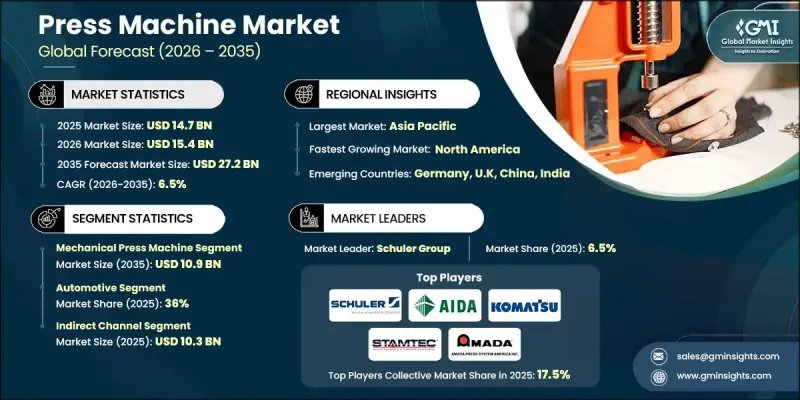
The Global Press Machine Market was valued at USD 14.7 billion in 2025 and is estimated to grow at a CAGR of 6.5% to reach USD 27.2 billion by 2035.
The market is expanding as press machines play a crucial role in manufacturing across multiple industries, including automotive, aerospace, construction, and electronics. These machines are essential for shaping, stamping, forging, and molding operations, and their efficiency directly impacts production output and product quality. The growing demand for advanced press technologies, including servo and hydraulic presses, reflects manufacturers' focus on improving productivity and operational precision. Rising adoption of lightweight and high-strength materials to enhance fuel efficiency and sustainability in vehicle production further drives the market. Policies supporting electrification and industrial modernization, coupled with increasing global vehicle production, have elevated the demand for press machines capable of high-volume, high-precision operations. Companies are continuously innovating to provide automated, energy-efficient, and highly reliable press solutions that meet the evolving needs of modern manufacturing environments.
Market Scope
Start Year
2025
Forecast Year
2026-2035
Start Value
$14.7 Billion
Forecast Value
$27.2 Billion
CAGR
6.5%
The mechanical press machine segment generated USD 5.8 billion in 2025 and is expected to reach USD 10.9 billion by 2035. Mechanical presses remain popular due to their cost-effectiveness, operational flexibility, and suitability for low-cost production applications. Rising global demand for efficient manufacturing solutions is encouraging widespread adoption of mechanical presses across various industries, providing reliable solutions for high-volume metal forming and stamping needs.
The automotive sector accounted for a 36% share in 2025. This dominance is driven by the high demand from automotive manufacturers for precise, efficient production of vehicle components. The need for tight tolerances and efficient mass production has prompted manufacturers to invest in advanced press technologies that enhance productivity, reduce material waste, and improve product quality.
United States Press Machine Market held 87.4% share in 2024. The growth is fueled by strong automotive and aerospace production as well as large-scale infrastructure investments. Government initiatives supporting industrial modernization, precision manufacturing, and semiconductor production have further increased the need for high-performance press machines in metal forming, component fabrication, and high-precision manufacturing applications.
Major companies operating in the Global Press Machine Market include AIDA, Komatsu, Amada Press System, Schuler Group, Macrodyne Technologies, Beckwood Press, Bruderer, Bliss-Bret, Nidec Minster, Isgec Heavy Engineering, SMS Group, Sutherland Presses, Yangli Group, Shieh Yih Machinery Industry, and Stamtec. Companies in the Press Machine Market are strengthening their position by investing in research and development to introduce advanced, energy-efficient, and automated press solutions. Strategic partnerships and collaborations with OEMs and Tier-1 suppliers allow firms to expand market reach and optimize production processes. They focus on customizing presses for high-precision and high-volume manufacturing while integrating smart technologies for predictive maintenance and operational monitoring. Expanding local production facilities and service networks improves delivery timelines and after-sales support. Standardizing technical specifications and adhering to regulatory and safety standards enhances credibility and customer trust.
Table of Contents
Chapter 1 Methodology & Scope
1.1 Market scope and definition
1.2 Research design
1.2.1 Research approach
1.2.2 Data collection methods
1.3 Data mining sources
1.3.1 Global
1.3.2 Regional/Country
1.4 Base estimates and calculations
1.4.1 Base year calculation
1.4.2 Key trends for market estimation
1.5 Primary research and validation
1.5.1 Primary sources
1.6 Forecast model
1.7 Research assumptions and limitations
Chapter 2 Executive Summary
2.1 Industry 360° synopsis
2.2 Key market trends
2.2.1 Regional
2.2.2 Type
2.2.3 Capacity
2.2.4 Automation
2.2.5 Application
2.2.6 End Use
2.2.7 Distribution channel
2.3 CXO perspectives: Strategic imperatives
2.3.1 Key decision points for industry executives
2.3.2 Critical success factors for market players
2.4 Future outlook and strategic recommendations
Chapter 3 Industry Insights
3.1 Industry ecosystem analysis
3.1.1 Supplier landscape
3.1.2 Profit margin
3.1.3 Value addition at each stage
3.1.4 Factor affecting the value chain
3.2 Industry impact forces
3.2.1 Growth drivers
3.2.1.1 Expansion in the manufacturing industries
3.2.1.2 Growing emphasis on automation in manufacturing industries
3.2.1.3 Rapid growth in the urbanization and industrialization
3.2.2 Industry pitfalls & challenges
3.2.2.1 High initial investment and intensive maintenance requirement
3.2.2.2 Volatility in raw material prices & supply chain disruptions
3.2.3 Opportunities
3.2.3.1 Adoption of servo press technology for precision & energy efficiency
3.2.3.2 Integration of IoT & predictive maintenance solutions