자동차 3D 프린팅 시장 기회, 성장 촉진요인, 업계 동향 분석 및 예측(2026-2035년)
Automotive 3D Printing Market Opportunity, Growth Drivers, Industry Trend Analysis, and Forecast 2026 - 2035
상품코드:1892865
리서치사:Global Market Insights Inc.
발행일:2025년 12월
페이지 정보:영문 220 Pages
라이선스 & 가격 (부가세 별도)
ㅁ Add-on 가능: 고객의 요청에 따라 일정한 범위 내에서 Customization이 가능합니다. 자세한 사항은 문의해 주시기 바랍니다.
한글목차
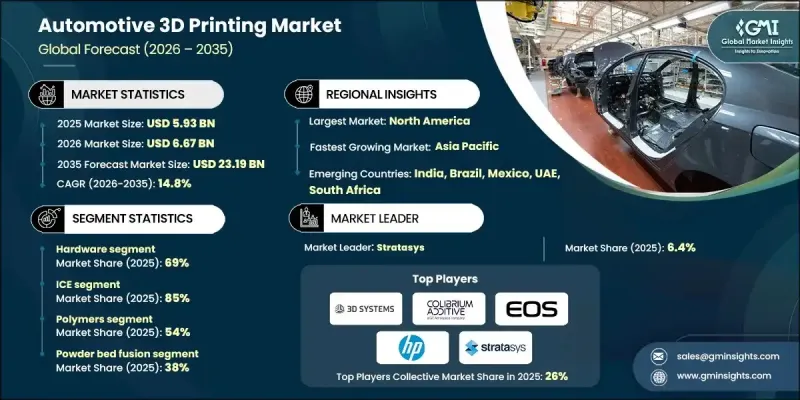
세계의 자동차 3D 프린팅 시장은 2025년에 59억 3,000만 달러로 평가되었으며, 2035년까지 CAGR 14.8%로 성장하여 231억 9,000만 달러에 달할 것으로 예측됩니다.
자동차 제조업체들은 설계 테스트와 반복을 가속화하고 양산 전 결함을 줄이기 위해 3D 프린팅에 대한 의존도를 높이고 있습니다. 이러한 장점은 신차 모델 및 전기자동차(EV) 플랫폼 출시에 특히 중요하며, 제조업체에게 경쟁 우위, 시장 출시 시간 단축, 소비자 수요 및 규제 기준 대응 능력 향상 등의 이점을 제공합니다. 경량 차량과 전기자동차 보급 확대도 시장 성장을 더욱 촉진하고 있습니다. 적층조형 기술을 통해 배터리 인클로저, 구조 지지대, 열 관리 시스템 등 보다 경량화된 부품의 제조가 가능하기 때문입니다. 경량 부품은 차량 성능 향상, 에너지 효율 개선, EV의 주행거리 연장에 기여하며, 3D 프린팅은 현대 자동차 설계 및 생산에 필수적인 도구로 자리매김하고 있습니다.
시장 범위
시작 연도
2025년
예측 연도
2026-2035
시작 가치
59억 3,000만 달러
예측 금액
231억 9,000만 달러
CAGR
14.8%
하드웨어 부문은 2025년 69%의 점유율을 차지했으며, 2035년까지 CAGR 15%로 성장할 것으로 전망됩니다. 이 부문에는 파우더 베드 용융 시스템, 재료 압출기, 인탱크 광중합 장비, 바인더젯팅 라인, 기타 생산 등급의 3D 프린팅 하드웨어가 포함됩니다.
내연기관(ICE) 부문은 2025년 85%의 점유율을 차지했으며, 2026년부터 2035년까지 15.4%의 CAGR로 성장할 것으로 전망됩니다. 전통적인 자동차 응용 분야, 특히 신속한 프로토타이핑 및 고성능 부품 생산이 계속해서 도입을 주도하고 있습니다.
미국 자동차 3D 프린팅 시장은 2025년 18억 5,000만 달러 규모에 달했습니다. EV 배터리 하우징, 열관리 부품, 복잡한 브래킷 제조가 도입을 주도하고 있습니다. 미국 자동차 제조업체는 초기 개발 가속화, 복잡한 부품 생산, 전반적인 혁신 촉진을 위해 적층 가공 기술을 활용하여 업계의 세계 경쟁력을 강화하고 있습니다.
목차
제1장 조사 방법
시장 범위와 정의
조사 설계
조사 접근법
데이터 수집 방법
데이터 마이닝 소스
세계
지역별/국가별
기본 추정치와 계산
기준 연도 계산
시장 추정의 주요 동향
1차 조사와 검증
1차 정보
예측 모델
조사 가정과 제한사항
제2장 주요 요약
제3장 업계 인사이트
생태계 분석
공급업체 상황
이익률
비용 구조
각 단계의 부가가치
밸류체인에 영향을 미치는 요인
디스럽션
업계에 대한 영향요인
성장 촉진요인
신속한 시제품 제작/시장 투입까지 시간 단축
경량 부품 수요
기술적 진보
공급망 회복력과 유연성
업계의 잠재적 리스크와 과제
재료의 제약과 표준화에 관한 과제
고비용과 확장성 과제
시장 기회
온디맨드 부품 공급·애프터마켓 교환 부품
매스·커스터마이제이션/한정 생산 차량
전기자동차(EV) 및 차세대 파워트레인 부품
지속가능한/재료 효율적인 생산
성장 가능성 분석
규제 상황
북미
연방 자동차 안전기준(FMVSS)
환경 보호 청(EPA) 유럽
유럽
VDA 가이드라인(VDA 5)
EU 형식 인증/차량 전체 형식 인증(WVTA)
아시아태평양
중국 국가 표준(GB)
일본의 JIS 규격 요건
한국 KS인증
자동차 산업 표준 140
태국 공업 규격 협회(TISI)
라틴아메리카
INMETRO(국립 계량 연구소)
INTI 인증(국립 공업 기술 연구소)
NOM 규격(Norma Oficial Mexicana)
중동 및 아프리카
ESMA/에미레이트 적합성 평가 스킴(ECAS)
GCC 기술 규제
SABS 인증
Porters 분석
PESTEL 분석
기술과 혁신 동향
현재 기술 동향
신기술
가격 분석
제품별
지역별
비용 내역 분석
총소유비용(TCO) 프레임워크
기술 유형별 TCO
부품 단가 분석
AM와 기존 제조 비용 비교
특허 분석
지속가능성과 환경면
지속가능한 대처
폐기물 절감 전략
생산의 에너지 효율
친환경적인 대처
탄소발자국에 관한 고려사항
사용 사례
제4장 경쟁 구도
소개
기업의 시장 점유율 분석
북미
유럽
아시아태평양
라틴아메리카
중동 및 아프리카
주요 시장 기업 경쟁 분석
경쟁 포지셔닝 매트릭스
전략적 전망 매트릭스
주요 발전
인수합병
제휴·협업
신제품 발매
사업 확대 계획과 자금 조달
제5장 시장 추정 및 예측 : 제공별, 2022-2035
주요 동향
하드웨어
소프트웨어
서비스
제6장 시장 추정 및 예측 : 차량별, 2022-2035
주요 동향
내연기관(ICE)
승용차
상용차
전기자동차(EV)
승용차
상용차
제7장 시장 추정 및 예측 : 재료별, 2022-2035
주요 동향
금속
알루미늄 합금
스테인리스강
티타늄 합금
코발트 크롬
기타
폴리머
세라믹
복합재료
제8장 시장 추정 및 예측 : 기술별, 2022-2035
주요 동향
재료 압출
액조 광중합
파우더 베드 용융법
재료 제팅
바인더 제팅
직접 에너지 적층
시트 라미네이션
제9장 시장 추정 및 예측 : 용도별, 2022-2035
주요 동향
신속한 시제품 제작과 설계 검증
공구, 치구 및 고정구
생산 부품/최종 용도 제조
예비 부품 및 애프터마켓
제10장 시장 추정 및 예측 : 지역별, 2022-2035
주요 동향
북미
미국
캐나다
유럽
독일
영국
프랑스
이탈리아
스페인
북유럽 국가
러시아
폴란드
루마니아
아시아태평양
중국
인도
일본
한국
ANZ
베트남
인도네시아
라틴아메리카
브라질
멕시코
아르헨티나
중동 및 아프리카
남아프리카공화국
사우디아라비아
아랍에미리트
제11장 기업 개요
세계 기업
D Systems
AddUp Solutions
Bright Laser Technologies(BLT)
Desktop Metal
EOS
Eplus3 D Technology
Farsoon Technologies
GE Additive/Colibrium Additive
HP
Materialise
Stratasys
TRUMPF
지역 기업
Additive Industries
Formlabs
Markforged
Nikon SLM Solutions
Renishaw
Voxeljet
신흥 기업
Carbon
Divergent Technologies
Nano Dimension
Nexa3 D
Tritone Technologies
Velo3 D
KSM
영문 목차
영문목차
The Global Automotive 3D Printing Market was valued at USD 5.93 billion in 2025 and is estimated to grow at a CAGR of 14.8% to reach USD 23.19 billion by 2035.
Automotive manufacturers are increasingly relying on 3D printing to accelerate design testing and iteration, reducing defects before mass production. These advantages are particularly critical for the launch of new vehicle models and electric vehicle (EV) platforms, giving manufacturers a competitive edge, faster time-to-market, and enhanced ability to respond to consumer demand and regulatory standards. The growing adoption of lightweight vehicles and EVs has further fueled market growth, as additive manufacturing enables the production of lighter components, such as battery enclosures, structural supports, and thermal management systems. Lighter parts enhance vehicle performance, improve energy efficiency, and extend EV range, making 3D printing an essential tool in modern automotive design and production.
Market Scope
Start Year
2025
Forecast Year
2026-2035
Start Value
$5.93 Billion
Forecast Value
$23.19 Billion
CAGR
14.8%
The hardware segment held a 69% share in 2025 and is expected to grow at a CAGR of 15% through 2035. This segment includes powder bed fusion systems, material extrusion machines, vat photopolymerization equipment, binder jetting lines, and other production-class 3D printing hardware.
The internal combustion engine (ICE) segment held an 85% share in 2025, expected to grow at a CAGR of 15.4% from 2026 to 2035. Traditional automotive applications continue to drive adoption, particularly for rapid prototyping and high-performance component production.
US Automotive 3D Printing Market generated USD 1.85 billion in 2025. Adoption is driven by the manufacturing of EV battery housings, thermal management parts, and complex brackets. US vehicle manufacturers are leveraging additive manufacturing to accelerate early development, produce intricate components, and boost overall innovation, strengthening the industry's competitiveness globally.
Key players in the Global Automotive 3D Printing Market include Stratasys, 3D Systems, HP, EOS, SLM Solutions, Nikon SLM Solutions, Desktop Metal, Materialise, Colibrium Additive/GE Additive, and GE Additive. Companies in the Global Automotive 3D Printing Market are deploying multiple strategies to reinforce their market presence. Firms are investing in advanced hardware and multi-material printing technologies to meet the evolving demands of lightweight and complex automotive components. Strategic partnerships with automotive OEMs and tier-1 suppliers are being established to integrate additive manufacturing into standard production processes. Companies are expanding regional footprints to target emerging EV and ICE markets and offering cloud-based design platforms to streamline prototyping and design iteration.
Table of Contents
Chapter 1 Methodology
1.1 Market scope and definition
1.2 Research design
1.2.1 Research approach
1.2.2 Data collection methods
1.3 Data mining sources
1.3.1 Global
1.3.2 Regional/Country
1.4 Base estimates and calculations
1.4.1 Base year calculation
1.4.2 Key trends for market estimation
1.5 Primary research and validation
1.5.1 Primary sources
1.6 Forecast model
1.7 Research assumptions and limitations
Chapter 2 Executive Summary
2.1 Industry 360° synopsis
2.2 Key market trends
2.2.1 Regional
2.2.2 Offering
2.2.3 Vehicle
2.2.4 Material
2.2.5 Technology
2.2.6 Application
2.3 TAM analysis, 2026-2035
2.4 CXO perspectives: Strategic imperatives
2.4.1 Executive decision points
2.4.2 Critical success factors
2.5 Future outlook
2.6 Strategic recommendations
Chapter 3 Industry Insights
3.1 Industry ecosystem analysis
3.1.1 Supplier landscape
3.1.2 Profit margin
3.1.3 Cost structure
3.1.4 Value addition at each stage
3.1.5 Factor affecting the value chain
3.1.6 Disruptions
3.2 Industry impact forces
3.2.1 Growth drivers
3.2.1.1 Rapid prototyping / faster time-to-market
3.2.1.2 Lightweight components demand
3.2.1.3 Technological advances
3.2.1.4 Supply-chain resilience & flexibility
3.2.2 Industry pitfalls and challenges
3.2.2.1 Material limitations & standardization issues
3.2.2.2 High costs & scalability challenges
3.2.3 Market opportunities
3.2.3.1 On-demand spare parts & aftermarket replacements