Trenchers Market Opportunity, Growth Drivers, Industry Trend Analysis, and Forecast 2025 - 2034
상품코드:1892861
리서치사:Global Market Insights Inc.
발행일:2025년 12월
페이지 정보:영문 230 Pages
라이선스 & 가격 (부가세 별도)
ㅁ Add-on 가능: 고객의 요청에 따라 일정한 범위 내에서 Customization이 가능합니다. 자세한 사항은 문의해 주시기 바랍니다.
한글목차
세계의 트렌처 시장은 2024년에 8억 3,910만 달러로 평가되었고, 2034년까지 연평균 복합 성장률(CAGR) 3.4%로 성장하여 11억 6,000만 달러에 이를 것으로 예측됩니다.
주정부 및 지방정부의 고속도로, 철도망, 도시개발 등 인프라 프로젝트가 확대됨에 따라 공공시설, 기초공사, 배수시스템용 도랑 굴착을 위한 트렌처에 대한 수요가 증가하고 있습니다. 교통망 개선과 스마트시티 구상에 수십억 달러가 투자되는 가운데, 건설업체들은 프로젝트를 효율적으로 완료하고 인건비를 절감하기 위해 고성능 트렌처의 구매를 늘리고 있습니다. 이에 제조업체들은 GPS 통합, 자동 깊이 제어 등의 첨단 기능을 도입하여 보다 정밀한 도랑 굴착 작업을 가능하게 함으로써 대응하고 있습니다. 도시화의 진전과 전력, 수도, 가스 공급망에 대한 수요 증가가 맞물리면서 수요는 더욱 증가하고 있습니다. 유틸리티 회사는 지표면 손상을 최소화하고 복구 비용을 절감할 수 있으며, 안정적인 굴착 깊이를 구현할 수 있는 트렌처를 선호하고 있습니다. 또한, 지하 케이블 증가와 다양한 토양 조건에 대응하기 위해 다양한 도랑 폭과 용도에 적합한 범용성 높은 굴착 장비가 요구되고 있습니다.
시장 범위
개시 연도
2024년
예측 기간
2025-2034년
개시 연도 시장 규모
8억 3,910만 달러
예측 금액
11억 6,000만 달러
CAGR
3.4%
휠 트레이너 부문은 2024년 3억 5,930만 달러의 매출을 기록하며 시장을 선도하고 있습니다. 휠트랜처는 아스팔트, 콘크리트, 마사토 등 단단한 지반을 높은 정밀도와 속도로 절단할 수 있는 능력으로 대규모 인프라 및 유틸리티 프로젝트에서 필수적인 존재로 선택되고 있습니다. 이 설계는 트렌치의 깊이와 폭을 일정하게 유지하여 지표면 복구 작업을 줄여 전체 프로젝트 비용을 절감할 수 있습니다.
2024년에는 전자동 부문이 61.2%의 점유율을 차지할 것으로 예측됩니다. 전자동 트렌처는 정확성, 안전성, 숙련공에 대한 의존도 감소로 인해 보급이 확대되고 있습니다. 자동화를 통해 트렌치 깊이와 정렬을 균일화하여 오차를 줄이고 프로젝트 품질을 향상시킵니다. 유틸리티 네트워크 및 광섬유 설치에 종사하는 계약자들은 특히 시간적 제약이 있는 프로젝트에서 작업 효율성과 다운타임을 최소화하기 위해 자동 제어 기능이 있는 트렌처를 점점 더 선호하고 있습니다.
미국 트렌처 시장은 2024년 79.5%의 점유율을 차지하며 1억 9,830만 달러의 매출을 기록했습니다. 이러한 선도적 지위는 대규모 인프라 현대화, 광범위한 광섬유 구축, 스마트 시티, 재생에너지 파이프라인 및 유틸리티 네트워크에 대한 투자로 뒷받침되고 있습니다. 강력한 렌탈 생태계와 주요 제조업체의 존재는 미국 시장을 더욱 강화하여 GPS 지원 및 자동화 트렌처 장비의 혁신 거점으로 자리매김하고 있습니다.
목차
제1장 조사 방법과 범위
제2장 주요 요약
제3장 업계 인사이트
생태계 분석
공급업체 상황
이익률
각 단계별 부가가치
밸류체인에 영향을 미치는 요인
업계에 대한 영향요인
성장 촉진요인
과제
기회
성장 가능성 분석
향후 시장 동향
기술과 혁신 동향
현재 기술 동향
신기술
가격 동향
지역별
제품 유형별
규제 상황
규격 및 컴플라이언스 요건
지역별 규제 구조
인증 기준
무역 통계(HS코드-842959)
주요 수입국
주요 수출국
갭 분석
리스크 평가와 경감책
Porter's Five Forces 분석
PESTEL 분석
제4장 경쟁 구도
서론
기업의 시장 점유율 분석
지역별
기업 매트릭스 분석
주요 시장 기업의 경쟁 분석
경쟁 포지셔닝 매트릭스
주요 발전
인수합병(M&A)
제휴 및 협업
신제품 발매
확대 계획
제5장 시장 추산 및 예측 : 제품 유형별, 2021-2034
주요 동향
휠 트렌처
체인 트렌처
마이크로 트렌처
락 트렌처
제6장 시장 추산 및 예측 : 조작 모드별, 2021-2034
주요 동향
수동
반자동
전자동
제7장 시장 추산 및 예측 : 전력별, 2021-2034
주요 동향
디젤
전기
가솔린
제8장 시장 추산 및 예측 : 용도별, 2021-2034
주요 동향
석유 및 가스 파이프라인 설치
에너지 케이블 및 광섬유 설치
배수 및 관개
도로 건설
농업용 도랑 설치
통신 네트워크 건설
기타(주택용 유틸리티 등)
제9장 시장 추산 및 예측 : 최종 이용 산업별, 2021-2034
주요 동향
건설
농업
통신
석유 및 가스
유틸리티
광업
기타(조경 등)
제10장 시장 추산 및 예측 : 유통 채널별, 2021-2034
주요 동향
직접
간접
제11장 시장 추산 및 예측 : 지역별, 2021-2034
주요 동향
북미
미국
캐나다
유럽
독일
영국
프랑스
이탈리아
스페인
아시아태평양
중국
일본
인도
호주
한국
라틴아메리카
브라질
멕시코
아르헨티나
중동 및 아프리카
남아프리카공화국
사우디아라비아
아랍에미리트(UAE)
제12장 기업 개요
Barreto Manufacturing
Bobcat Company
Cleveland Trencher Company
Ditch Witch
Gravis Robotics
Inter-Drain
Mastenbroek Ltd.
Miah Trenchers
Simex S.r.l.
Takeuchi Manufacturing
Tesmec S.p.A.
Toro Company
Trencor
Vermeer Manufacturing Company
Wolfe Heavy Equipment
LSH
영문 목차
영문목차
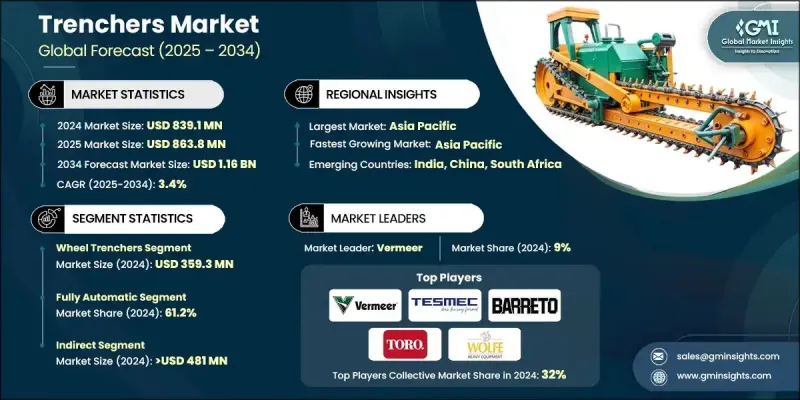
The Global Trenchers Market was valued at USD 839.1 million in 2024 and is estimated to grow at a CAGR of 3.4% to reach USD 1.16 billion by 2034.
The expansion of infrastructure projects by state and local governments, including highways, rail networks, and urban development, has driven the demand for trenching machines to create trenches for utilities, foundations, and drainage systems. With billions being invested in transportation upgrades and smart city initiatives, contractors are increasingly purchasing high-performance trenchers to complete projects efficiently while reducing labor costs. Manufacturers are responding by introducing advanced features such as GPS integration and automatic depth control, enabling more precise trenching operations. Rising urbanization, coupled with the growing need for electricity, water, and gas distribution networks, is further increasing demand. Utility companies prefer trenchers for consistent trench depth, which minimizes surface damage and lowers restoration costs. Additionally, the growth of underground cabling and diverse soil conditions necessitates versatile trenching equipment suitable for a variety of trench widths and applications.
Market Scope
Start Year
2024
Forecast Year
2025-2034
Start Value
$839.1 Million
Forecast Value
$1.16 Billion
CAGR
3.4%
The wheel trenchers segment generated USD 359.3 million in 2024, dominating the market. Wheel trenchers are preferred for their ability to cut through tough surfaces such as asphalt, concrete, and compacted soil with high accuracy and speed, making them indispensable for large-scale infrastructure and utility projects. Their design ensures consistent trench depth and width, reducing the need for surface repairs and cutting overall project expenses.
The fully automatic segment accounted for a 61.2% share in 2024. Fully automated trenchers are gaining traction due to their precision, safety, and reduced dependence on skilled labor. Automation ensures uniform trench depth and alignment, reducing errors and improving project quality. Contractors working on utility networks and fiber optic installations increasingly favor trenchers with automated controls, which streamline operations and minimize downtime, especially in time-sensitive projects.
U.S. Trenchers Market held 79.5% share, generating USD 198.3 million in 2024. The country's leadership is driven by large-scale infrastructure modernization, extensive fiber optic deployment, and investments in smart cities, renewable energy pipelines, and utility networks. A strong rental ecosystem and the presence of leading manufacturers further reinforce the U.S. market, establishing it as a hub for innovation in GPS-enabled and automated trenching equipment.
Key players operating in the Global Trenchers Market include Wolfe Heavy Equipment, Inter-Drain, Miah Trenchers, Gravis Robotics, Ditch Witch, Tesmec S.p.A., Simex S.r.l., Trencor, Takeuchi Manufacturing, Toro Company, Cleveland Trencher Company, Barreto Manufacturing, Bobcat Company, and Mastenbroek Ltd. Companies in the Global Trenchers Market are strengthening their position through several strategic initiatives. They are investing in research and development to introduce automated, GPS-integrated, and high-performance trenching machines tailored to diverse soil types and trenching requirements. Strategic partnerships with construction and utility firms improve distribution channels and market access. Manufacturers are expanding geographically to capture emerging markets while enhancing their service and rental networks to increase customer reach. Emphasis on product durability, precision, and compliance with safety standards ensures long-term customer trust.
Table of Contents
Chapter 1 Methodology and Scope
1.1 Market scope and definition
1.2 Research design
1.2.1 Research approach
1.2.2 Data collection methods
1.3 Data mining sources
1.3.1 Global
1.3.2 Regional/Country
1.4 Base estimates and calculations
1.4.1 Base year calculation
1.4.2 Key trends for market estimation
1.5 Primary research and validation
1.5.1 Primary sources
1.6 Forecast model
1.7 Research assumptions and limitations
Chapter 2 Executive Summary
2.1 Industry 360° synopsis
2.2 Key market trends
2.2.1 Regional
2.2.2 Product type
2.2.3 Mode of Operation
2.2.4 Power source
2.2.5 Application
2.2.6 End Use industry
2.2.7 Distribution channel
2.3 CXO perspectives: strategic imperatives
2.3.1 Key decision points for industry executives
2.3.2 Critical success factors for market players
2.4 Future outlook and strategic recommendations
Chapter 3 Industry Insights
3.1 Industry ecosystem analysis
3.1.1 Supplier landscape
3.1.2 Profit margin
3.1.3 Value addition at each stage
3.1.4 Factor affecting the value chain
3.2 Industry impact forces
3.2.1 Growth drivers
3.2.1.1 Infrastructure development investments
3.2.1.2 Utility installation expansion
3.2.1.3 Fiber optic network deployment
3.2.2 Pitfalls & Challenges
3.2.2.1 High equipment costs
3.2.2.2 Skilled labor shortage
3.2.3 Opportunities
3.2.3.1 Rental and leasing services
3.2.3.2 Technological advancements in automation
3.3 Growth potential analysis
3.4 Future market trends
3.5 Technology and innovation landscape
3.5.1 Current technological trends
3.5.2 Emerging technologies
3.6 Price trends
3.6.1 By region
3.6.2 By product type
3.7 Regulatory landscape
3.7.1 Standards and compliance requirements
3.7.2 Regional regulatory frameworks
3.7.3 Certification standards
3.8 Trade statistics (HS code-842959)
3.8.1 Major importing countries
3.8.2 Major exporting countries
3.9 Gap Analysis
3.10 Risk assessment and mitigation
3.11 Porter's analysis
3.12 PESTEL analysis
Chapter 4 Competitive Landscape, 2024
4.1 Introduction
4.2 Company market share analysis
4.2.1 By region
4.2.1.1 North America
4.2.1.2 Europe
4.2.1.3 Asia Pacific
4.2.1.4 Latin America
4.2.1.5 Middle East and Africa
4.3 Company matrix analysis
4.4 Competitive analysis of major market players
4.5 Competitive positioning matrix
4.6 Key developments
4.6.1 Mergers & acquisitions
4.6.2 Partnerships & collaborations
4.6.3 New product launches
4.6.4 Expansion plans
Chapter 5 Market Estimates and Forecast, By Product Type, 2021 - 2034 (USD Million) (Units)
5.1 Key trends
5.2 Wheel trencher
5.3 Chain trencher
5.4 Micro trencher
5.5 Rock Trencher
Chapter 6 Market Estimates and Forecast, By Mode of Operation, 2021 - 2034 (USD Million) (Units)
6.1 Key trends
6.2 Manual
6.3 Semi-automatic
6.4 Fully automatic
Chapter 7 Market Estimates and Forecast, By Power Source, 2021 - 2034 (USD Million) (Units)
7.1 Key trends
7.2 Diesel
7.3 Electric
7.4 Gasoline
Chapter 8 Market Estimates and Forecast, By Application, 2021 - 2034 (USD Million) (Units)
8.1 Key trends
8.2 Oil & gas pipeline installation
8.3 Energy cable and fiber optic installation
8.4 Drainage and irrigation
8.5 Road construction
8.6 Agricultural trenching
8.7 Telecom networks construction
8.8 Others (residential utilities, etc.)
Chapter 9 Market Estimates and Forecast, By End Use Industry, 2021 - 2034 (USD Million) (Units)
9.1 Key trends
9.2 Construction
9.3 Agriculture
9.4 Telecommunications
9.5 Oil & gas
9.6 Utilities
9.7 Mining
9.8 Others (Landscaping, etc.)
Chapter 10 Market Estimates and Forecast, By Distribution Channel, 2021 - 2034 (USD Million) (Units)
10.1 Key trends
10.2 Direct
10.3 Indirect
Chapter 11 Market Estimates and Forecast, By Region, 2021 - 2034 (USD Million) (Units)