Industry 4.0 Market Opportunity, Growth Drivers, Industry Trend Analysis, and Forecast 2026 - 2035
상품코드:1892831
리서치사:Global Market Insights Inc.
발행일:2025년 12월
페이지 정보:영문 225 Pages
라이선스 & 가격 (부가세 별도)
ㅁ Add-on 가능: 고객의 요청에 따라 일정한 범위 내에서 Customization이 가능합니다. 자세한 사항은 문의해 주시기 바랍니다.
한글목차
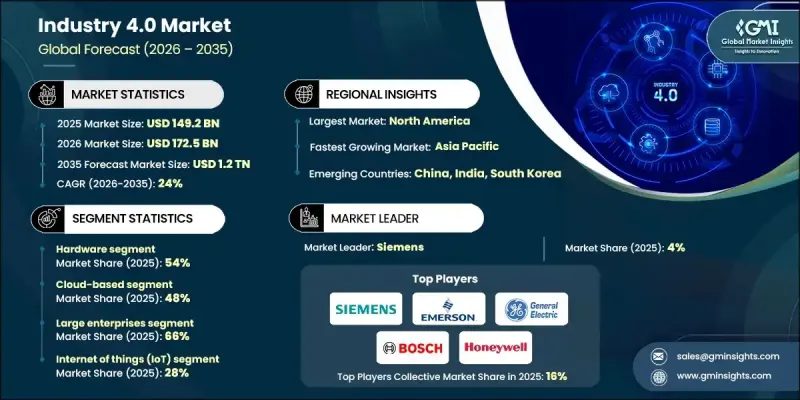
세계의 인더스트리 4.0 시장은 2025년에 1,492억 달러로 평가되었고, 2035년까지 연평균 복합 성장률(CAGR) 24%로 성장하여 1조 2,000억 달러에 이를 것으로 예측됩니다.
이러한 빠른 성장은 산업 환경 전반에 걸쳐 디지털 시스템, 인공지능, 운영 기술의 융합이 가속화되고 있기 때문입니다. 제조업체들은 생산성, 지속가능성, 운영 가시성 향상을 위해 실험적인 디지털 이니셔티브에서 스마트 팩토리 프레임워크를 본격적으로 도입하는 단계로 전환하고 있습니다. 제조 공정 전반에 걸쳐 인공지능 도입이 확대되고 있으며, 예측 운영, 지능형 스케줄링, 품질 모니터링, 실시간 의사결정 등의 기능을 지원하고 있습니다. 생성형 AI는 도입 기간을 더욱 단축하고, 고도화된 용도의 신속한 배포를 가능하게 합니다. 특히 중소기업에서 비용 효율성, 운영 안전성, 통합 용이성 등으로 인해 협동로봇 시스템 도입이 빠르게 확대되고 있습니다. 디지털 트윈, 엣지 컴퓨팅, 지능형 자동화 플랫폼의 활용 확대는 시뮬레이션 기반 최적화, 자산 활용률 향상, 데이터 기반 성능 개선을 통해 산업 워크플로우를 재구성하고 있습니다. 이러한 발전과 함께 인더스트리 4.0은 현대 산업 혁신의 기본 지주로 자리매김하고 있습니다.
시장 범위
개시 연도
2025년
예측 연도
2026-2035년
개시 연도 시장 규모
1,492억 달러
예측 금액
1조 2,000억 달러
CAGR
24%
하드웨어 부문은 2025년 54%의 점유율을 차지할 것으로 예상되며, 2026년부터 2035년까지 연평균 복합 성장률(CAGR) 22.1%로 성장할 것으로 전망됩니다. 이 부문에는 산업용 센서, 커넥티드 디바이스, 로보틱스, 엣지 인프라, 산업용 컴퓨팅 시스템, 스마트 제조 장비 등이 포함됩니다. 처리 능력, 에너지 효율성, 디바이스 소형화 등 지속적인 혁신이 첨단 산업용 하드웨어에 대한 지속적인 투자를 촉진하고 있습니다. 산업 네트워크가 더 높은 데이터 처리량을 처리하기 위해 진화하고 있는 가운데, 엣지 하드웨어는 AI 기반 워크로드를 관리하고 생산 수준에서 실시간 분석을 가능하게 하는 데 중요한 역할을 하고 있습니다.
클라우드 기반 배포는 2025년 48%의 점유율을 차지할 것으로 예상되며, 2026년부터 2035년까지 연평균 복합 성장률(CAGR) 24.3%를 보일 것으로 예측됩니다. 클라우드 플랫폼은 중앙 집중식 데이터 액세스, 고급 분석, 비용 최적화, 규제 준수, 세계 시스템 통합을 제공함으로써 인더스트리 4.0 기술의 확장 가능한 도입을 지원합니다. 이 모델을 통해 모든 규모의 제조업체는 대규모 자본 투자 없이도 운영의 유연성과 보안을 유지하면서 디지털 솔루션을 도입할 수 있습니다.
미국의 인더스트리 4.0 시장은 2026년부터 2035년까지 30.4%의 높은 CAGR로 성장할 것으로 예측됩니다. 이러한 시장 선도적 지위는 첨단 디지털 인프라, 광범위한 산업용 IoT 도입, 자동화 및 스마트 제조에 대한 강력한 집중에 의해 뒷받침되고 있습니다. 민관의 지속적인 노력으로 사이버 보안, 탄력성, 확장 가능한 산업 성장에 초점을 맞춘 책임감 있는 디지털 도입이 지속적으로 촉진되고 있습니다.
목차
제1장 조사 방법
시장 범위와 정의
조사 설계
조사 접근
데이터 수집 방법
데이터 마이닝 정보원
세계
지역별/국가별
기본 추정치와 계산
기준연도 계산
시장 추정 주요 동향
1차 조사와 검증
1차 정보
예측 모델
조사의 전제조건과 제한 사항
제2장 주요 요약
제3장 업계 인사이트
생태계 분석
공급업체 상황
이익률 분석
비용 구조
각 단계별 부가가치
밸류체인에 영향을 미치는 요인
파괴적 변화
업계에 대한 영향요인
성장 촉진요인
업계의 잠재적 리스크&과제
시장 기회
성장 가능성 분석
규제 상황
Porter's Five Forces 분석
PESTEL 분석
기술과 혁신 동향
현재 기술 동향
신기술
특허 분석
가격 동향
지역별
제품별
비용 내역 분석
이용 사례와 성공 사례
지속가능성과 환경 측면
지속가능한 대처
폐기물 감축 전략
생산 에너지 효율
친환경 이니셔티브
탄소발자국에 관한 고려사항
전망과 기회
제4장 경쟁 구도
서론
기업의 시장 점유율 분석
북미
유럽
아시아태평양
라틴아메리카
중동 및 아프리카
주요 시장 기업의 경쟁 분석
경쟁 포지셔닝 매트릭스
전략적 전망 매트릭스
주요 발전
인수합병(M&A)
제휴 및 협업
신제품 발매
사업 확대 계획과 자금조달
제5장 시장 추산 및 예측 : 컴포넌트별, 2022-2035
주요 동향
하드웨어
소프트웨어
서비스
제6장 시장 추산 및 예측 : 도입 형태별, 2022-2035
주요 동향
On-Premise
클라우드 기반
하이브리드
제7장 시장 추산 및 예측 : 기업 규모별, 2022-2035
주요 동향
대기업
중소기업(SME)
제8장 시장 추산 및 예측 : 기술별, 2022-2035
주요 동향
사물인터넷(IoT)
디지털 트윈
빅데이터 및 AI분석
사이버 보안
클라우드 컴퓨팅
로보틱스 및 자동화
증강현실(AR)
기타
제9장 시장 추산 및 예측 : 최종 용도별, 2022-2035
주요 동향
제조업
자동차
헬스케어
항공우주 및 방위 분야
에너지 및 유틸리티
식품 및 음료
기타
제10장 시장 추산 및 예측 : 지역별, 2022-2035
주요 동향
북미
미국
캐나다
유럽
독일
영국
프랑스
이탈리아
스페인
러시아
북유럽 국가
베네룩스
아시아태평양
중국
인도
일본
호주
한국
싱가포르
태국
인도네시아
베트남
라틴아메리카
브라질
멕시코
아르헨티나
콜롬비아
중동 및 아프리카
남아프리카공화국
사우디아라비아
아랍에미리트(UAE)
제11장 기업 개요
세계 기업
ABB
Emerson Electric
Fanuc
General Electric
Honeywell International
Mitsubishi Electric
Robert Bosch
Rockwell Automation
Schneider Electric
Siemens
지역 기업
Beckhoff Automation
Cisco Systems
Dassault Systemes
Eaton
Hitachi
KUKA
Microsoft
Oracle
Yokogawa Electric
Emerging Technology 이노베이터
AspenTech
AVEVA
Bright Machines
Instrumental
PTC
LSH
영문 목차
영문목차
The Global Industry 4.0 Market was valued at USD 149.2 billion in 2025 and is estimated to grow at a CAGR of 24% to reach USD 1.2 trillion by 2035.
The rapid growth is driven by the accelerating convergence of digital systems, artificial intelligence, and operational technologies across industrial environments. Manufacturers are increasingly transitioning from experimental digital initiatives to full-scale deployment of smart factory frameworks to improve productivity, sustainability, and operational visibility. Artificial intelligence adoption across manufacturing processes continues to scale, supporting functions such as predictive operations, intelligent scheduling, quality monitoring, and real-time decision-making. Generative AI is further streamlining implementation timelines, allowing faster deployment of advanced applications. Robotics adoption is expanding rapidly as collaborative systems gain traction due to cost efficiency, operational safety, and ease of integration, particularly for smaller enterprises. The growing use of digital twins, edge computing, and intelligent automation platforms is reshaping industrial workflows by enabling simulation-driven optimization, enhanced asset utilization, and data-driven performance improvements. Collectively, these developments are establishing Industry 4.0 as a foundational pillar of modern industrial transformation.
Market Scope
Start Year
2025
Forecast Year
2026-2035
Start Value
$149.2 Billion
Forecast Value
$1.2 Trillion
CAGR
24%
The hardware segment accounted for a 54% share in 2025 and is expected to grow at a CAGR of 22.1% from 2026 to 2035. This segment encompasses industrial sensors, connected devices, robotics, edge infrastructure, industrial computing systems, and smart manufacturing equipment. Continued innovation in processing capability, energy efficiency, and device miniaturization is driving sustained investment in advanced industrial hardware. As industrial networks evolve to handle higher data throughput, edge hardware plays a critical role in managing AI-driven workloads and enabling real-time analytics at the production level.
The cloud-based deployment held a share of 48% in 2025 and is expected to grow at a 24.3% CAGR between 2026 and 2035. Cloud platforms support scalable adoption of Industry 4.0 technologies by offering centralized data access, advanced analytics, cost optimization, regulatory compliance, and global system integration. This model allows manufacturers of all sizes to implement digital solutions without large capital investments while maintaining operational flexibility and security.
U.S. Industry 4.0 Market is forecast to grow at a strong CAGR of 30.4% from 2026 to 2035. Market leadership is supported by advanced digital infrastructure, widespread industrial IoT deployment, and strong emphasis on automation and smart manufacturing. Ongoing public and private initiatives continue to encourage responsible digital adoption with a focus on cybersecurity, resilience, and scalable industrial growth.
Key players operating in the Global Industry 4.0 Market include Siemens, Microsoft, Schneider Electric, General Electric, Cisco Systems, Mitsubishi Electric, Oracle, Robert Bosch, Honeywell International, and Emerson Electric. Companies active in the Global Industry 4.0 Market pursue focused strategies to reinforce their competitive positioning and expand global reach. Technology providers invest heavily in research and development to advance AI-driven automation, industrial analytics, and connected systems. Strategic partnerships with manufacturers and cloud platforms enable integrated solution delivery and faster deployment cycles. Firms emphasize modular and scalable platforms to address diverse industrial needs while reducing implementation complexity. Expansion into emerging markets supports long-term growth, while cybersecurity-focused innovation builds customer trust.
Table of Contents
Chapter 1 Methodology
1.1 Market scope and definition
1.2 Research design
1.2.1 Research approach
1.2.2 Data collection methods
1.3 Data mining sources
1.3.1 Global
1.3.2 Regional/Country
1.4 Base estimates and calculations
1.4.1 Base year calculation
1.4.2 Key trends for market estimation
1.5 Primary research and validation
1.5.1 Primary sources
1.6 Forecast model
1.7 Research assumptions and limitations
Chapter 2 Executive Summary
2.1 Industry 3600 synopsis, 2022 - 2035
2.2 Key market trends
2.2.1 Regional
2.2.2 Component
2.2.3 Deployment Mode
2.2.4 Organization Size
2.2.5 Technology
2.2.6 End Use
2.3 TAM Analysis, 2026-2035
2.4 CXO perspectives: Strategic imperatives
2.4.1 Executive decision points
2.4.2 Critical success factors
2.5 Future outlook and strategic recommendations
Chapter 3 Industry Insights
3.1 Industry ecosystem analysis
3.1.1 Supplier landscape
3.1.2 Profit margin analysis
3.1.3 Cost structure
3.1.4 Value addition at each stage
3.1.5 Factor affecting the value chain
3.1.6 Disruptions
3.2 Industry impact forces
3.2.1.1 Growth drivers
3.2.1.2 Increasing adoption of Industrial IoT (IIoT) and smart factory solutions.
3.2.1.3 Rising demand for automation and robotics across manufacturing sectors.
3.2.1.4 Growing need for real-time data analytics and predictive maintenance.
3.2.1.5 Expansion of cloud computing, AI, and edge computing in industrial operations.
3.2.1.6 Government initiatives and investments support digital manufacturing and smart industries.
3.2.2 Industry pitfalls and challenges
3.2.2.1 High implementation costs for SMEs
3.2.2.2 Cybersecurity and data privacy risks
3.2.3 Market opportunities
3.2.3.1 Expansion of smart factories and automated production lines
3.2.3.2 Integration of AI and machine learning for predictive maintenance
3.2.3.3 Growth in Industrial IoT (IIoT) adoption
3.2.3.4 Cloud and edge computing solutions for industrial operations
3.2.3.5 Government incentives and initiatives promoting digital manufacturing