



세계의 광업용 센서 기반 선별기 시장은 2025년에 1억 4,500만 달러로 평가되었으며, 2035년까지 연평균 복합 성장률(CAGR) 7.1%를 나타내 2억 8,660만 달러에 이를 것으로 예측됩니다.
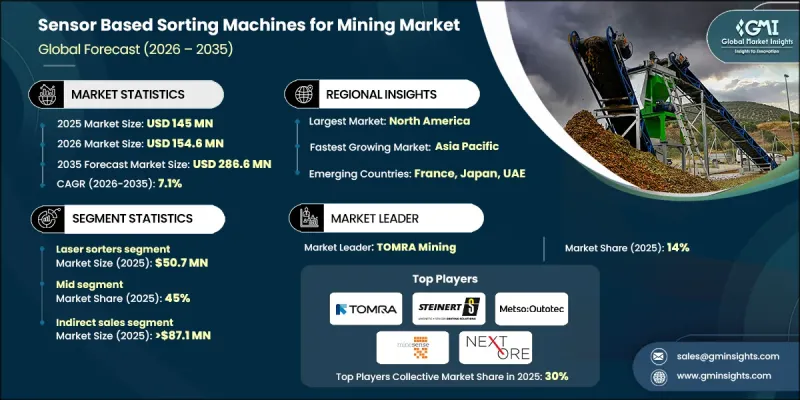
시장 성장은 인프라 확장, 가속화된 도시 개발 및 진행 중인 에너지 전환을 지원하는 기본 금속, 귀금속 및 산업 광물에 대한 세계 수요 증가로 인한 것입니다. 이러한 구조적 변화에 의해 구리나 니켈 등의 재료 수요가 증가하고, 결과적으로 채굴량 전체가 확대되고 있습니다. 생산 규모가 확대되는 가운데, 광산 사업자는 효율 향상과 폐기물 발생 억제의 양립이 요구되고 있습니다. 센서 기반의 선별 기술은 광석의 초기 단계에서 사전 농축을 허용하고 다운스트림 공정 전에 유가물을 분리하는 것을 실현합니다. 이로 인해 회수율이 향상되고 에너지 및 물 사용량을 줄임으로써 환경 부하를 줄일 수 있습니다. 광업 활동이 저품위 광상과 지리적으로 원격 지역으로 이동함에 따라 기존의 광업 방법은 더욱 복잡하고 비용이 많이 듭니다. 센서 구동 선별 기술은 불필요한 재료 이동을 최소화하고 분쇄 공정에 대한 부하를 줄이는 선택적 처리를 가능하게 합니다. 이러한 시스템은 보다 엄격한 지속가능성 목표에 따라 종합적인 생산성 향상을 지원하고, 효율성, 비용관리, 환경책임에 초점을 맞춘 현대광업운영에 있어서 센서기반선별을 핵심기술로 자리매김하고 있습니다.
| 시장 범위 | |
|---|---|
| 시작 연도 | 2025년 |
| 예측 연도 | 2026-2035년 |
| 시작 가치 | 1억 4,500만 달러 |
| 예측 금액 | 2억 8,660만 달러 |
| CAGR | 7.1% |
레이저 선별기 부문은 2025년 5,070만 달러의 수익을 창출했습니다. 이러한 시스템은 표면 및 조성 특성을 사용하여 광석 입자를 평가하는 고급 레이저 기반 감지 기술에 의존합니다. 광물의 조직, 반사율, 원소 조성을 분석함으로써, 레이저 선별은 밀도나 색에 근거한 방법보다 높은 선별 정밀도를 실현합니다. 이 분석 능력은 고에너지 펄스가 측정 가능한 스펙트럼을 생성하고 미네랄 특성을 정밀하게 식별하는 레이저 유도 파괴 분광법에 의해 달성됩니다.
중용량 시스템 부문은 2025년 45%의 점유율을 차지했습니다. 이 기계는 일반적으로 시간당 150-350톤을 처리하며 소형 모듈 유닛과 본격적인 산업 설비 사이에 위치합니다. 주로 1차 또는 2차 전선별로 도입되어 다운스트림 공정을 방해하지 않고 안정된 처리 능력을 유지하도록 설계되었습니다. 분쇄 전 폐기물 제거, 시약 소비 감소, 공급 변동 안정화에 기여합니다.
미국의 광업용 센서 기반 선별기 시장은 2025년에 75.6%의 점유율을 차지해 1억 960만 달러의 수익을 창출했습니다. 활발한 광업 활동, 첨단 조업 인프라, 생산성 최적화에 대한 주력은 시장 리더십을 지원합니다. 일본의 광업 사업자는 환경 영향을 최소화하면서 자원 이용률을 향상시키기 위해 센서 기반 기술을 널리 채택하고 있습니다.
The Global Sensor Based Sorting Machines for Mining Market was valued at USD 145 million in 2025 and is estimated to grow at a CAGR of 7.1% to reach USD 286.6 million by 2035.
Market growth is driven by rising global demand for base metals, precious metals, and industrial minerals, supported by infrastructure expansion, accelerating urban development, and the ongoing energy transition. These structural shifts are increasing the need for materials such as copper and nickel, which in turn is raising overall mining volumes. As production scales up, mining operators are under pressure to improve efficiency while controlling waste generation. Sensor-based sorting enables early-stage ore pre-concentration, allowing operators to separate valuable material before downstream processing. This improves recovery rates and reduces environmental impact by lowering energy and water consumption. As mining activity increasingly shifts toward lower-grade deposits and geographically remote locations, conventional beneficiation methods are becoming more complex and costly. Sensor-driven sorting technologies allow selective processing that minimizes unnecessary material movement and reduces the load on milling operations. These systems support higher overall productivity while aligning with stricter sustainability targets, positioning sensor-based sorting as a core technology in modern mining operations focused on efficiency, cost control, and environmental responsibility.
| Market Scope | |
|---|---|
| Start Year | 2025 |
| Forecast Year | 2026-2035 |
| Start Value | $145 Million |
| Forecast Value | $286.6 Million |
| CAGR | 7.1% |
The laser sorter segment generated USD 50.7 million in 2025. These systems rely on advanced laser-based sensing to evaluate ore particles using surface and compositional characteristics. By analyzing mineral texture, reflectivity, and elemental composition, laser sorting delivers higher selectivity than density- or color-based methods. This analytical capability is achieved through laser-induced breakdown spectroscopy, where high-energy pulses create measurable spectra used to identify mineral properties with precision.
The mid-capacity systems segment accounted for a 45% share in 2025. These machines typically process between 150 and 350 tons per hour, placing them between small modular units and full-scale industrial installations. They are commonly deployed for primary or secondary pre-concentration and are designed to maintain consistent throughput without disrupting downstream circuits. Their use supports waste removal before grinding, reduces reagent consumption, and stabilizes feed variability.
US Sensor Based Sorting Machines for Mining Market held 75.6% share and generated USD 109.6 million in 2025. Strong mining activity, advanced operational infrastructure, and a focus on productivity optimization support market leadership. Mining operators in the country have widely adopted sensor-based technologies to improve resource utilization while minimizing environmental impact.
Key companies active in the Global Sensor Based Sorting Machines for Mining Market include TOMRA Systems, Metso, STEINERT, REDWAVE, FLSmidth, Buhler Group, Sesotec, Binder+Co AG, Eriez Manufacturing, NextOre, MineSense Technologies, Scantech, HPY Sorting Technology, Comex, and Pellenc ST. Companies operating in the Sensor Based Sorting Machines for Mining Market are reinforcing their competitive position through continuous technology development, strategic collaborations, and expanded global presence. Manufacturers are investing in advanced sensing capabilities, artificial intelligence integration, and data analytics to improve sorting accuracy and throughput. Partnerships with mining operators enable customized solutions that align with specific ore characteristics and operational requirements. Many players focus on modular system designs that allow flexible deployment and scalability across mine sizes.