자동차 공기청정 시스템 시장 기회, 성장 촉진요인, 업계 동향 분석 및 예측(2025-2034년)
Automotive Air Purification System Market Opportunity, Growth Drivers, Industry Trend Analysis, and Forecast 2025 - 2034
상품코드:1876552
리서치사:Global Market Insights Inc.
발행일:2025년 11월
페이지 정보:영문 220 Pages
라이선스 & 가격 (부가세 별도)
ㅁ Add-on 가능: 고객의 요청에 따라 일정한 범위 내에서 Customization이 가능합니다. 자세한 사항은 문의해 주시기 바랍니다.
한글목차
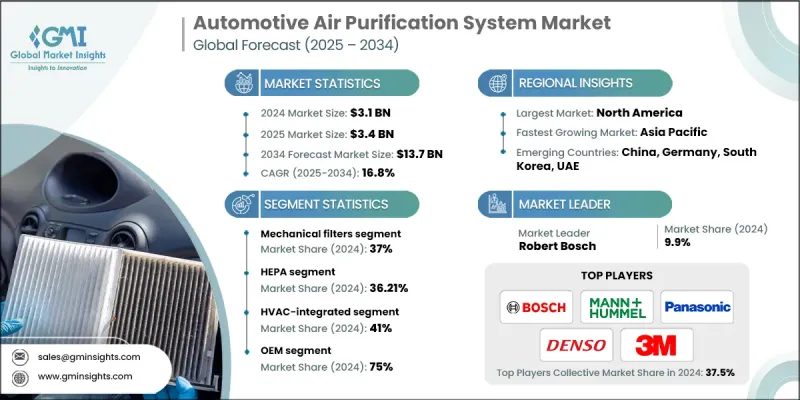
세계의 자동차 공기청정 시스템 시장은 2024년 31억 달러로 평가되었으며, 2034년까지 연평균 복합 성장률(CAGR) 16.8%를 나타내 137억 달러에 이를 것으로 예측됩니다.
시장 성장은 센서 기술의 진보, AI를 활용한 공기 품질 관리, 환경 친화적인 여과재의 개발에 의해 촉진되고 있습니다. 주요 제조업체는 현대 HVAC 시스템 및 차량 전자 장비와 원활하게 통합 할 수있는 에너지 절약, 공간 절약 및 지능형 정화 모듈에 많은 투자를하고 있습니다. 덴소, 3M, 파나소닉, 로버트 보쉬, 맨훈멜 등의 업계 리더은 HEPA 필터, 활성탄, 이온화, UV 살균 기술을 포함한 다단계 정화 시스템의 혁신을 추진하고 있습니다. 이러한 시스템은 승객의 편안함을 향상시킬 뿐만 아니라 재활용 가능한 필터 재료와 저전력 전자 제어를 통해 지속가능성 노력을 지원합니다. 도시화의 진전, 대기 오염의 악화, 차내 공기질에 대한 소비자의 의식 향상에 의해 세계적으로 수요가 높아지고 있습니다. 한편, 자동차 제조업체는 보다 안전하고 건강한 모빌리티 체험에 수요 증가에 대응하기 위해, 신형 차량에 센서 구동식 에어 매니지먼트 유닛을 탑재하고 있습니다.
시장 범위
시작 연도
2024년
예측 연도
2025-2034년
시작 가치
31억 달러
예측 금액
137억 달러
CAGR
16.8%
기계식 필터 부문은 2024년에 37%의 점유율을 차지했으며 2025년부터 2034년에 걸쳐 CAGR 13%를 나타낼 것으로 예측됩니다. 이 필터는 미세 미립자 물질(PM2.5 및 PM10)을 효율적으로 포착하며 저렴한 가격과 신뢰성으로 OEM 시스템과 애프터마켓 시스템 모두에서 널리 사용됩니다.
HEPA 필터 부문은 2024년에 36.21%의 점유율을 차지했으며 2034년까지 연평균 복합 성장률(CAGR) 14.3%를 나타낼 것으로 예측됩니다. HEPA 필터는 알레르겐과 미립자를 포착하는 입증된 능력을 통해 여러 기술을 통합한 하이브리드 시스템이 보급되는 가운데 비용과 성능의 최적의 균형을 제공하기 때문에 여전히 우선적으로 선택되고 있습니다.
아시아태평양의 자동차 공기청정 시스템 시장은 2024년 48.1%의 점유율을 차지했습니다. 이 지역은 CAGR 17.9%라는 가장 빠른 성장이 예상되며 2034년까지 72억 2,000만 달러에 달할 것으로 예측되고 있습니다. 견조한 자동차 생산, 급속한 도시화, 주요 도시의 높은 오염 수준이 도입을 촉진하는 주요 요인입니다. 환경 의식 증가, 가처분 소득 증가, 국내외 제조업체의 공기청정 기술에 대한 적극적인 투자는 시장 확대를 뒷받침하고 있습니다.
자동차 공기청정 시스템 시장의 주요 기업으로는 3M, Sharp, MANN+HUMMEL, Robert Bosch, Panasonic, Denso, Marelli, CabinAir Sweden, SKF, Honeywell 등이 있습니다. 이 시장의 기업은 시장에서의 지위 강화와 사업 확대를 위한 여러 전략을 전개하고 있습니다. 다단계 정화 시스템, 에너지 절약 모듈, 현대 차량 구조에 적합한 콤팩트 설계 개발을 위해 연구 개발에 많은 투자를 실시했습니다. 자동차 제조업체와의 전략적 제휴로 신형 차량에 첨단 공기청정 장치를 원활하게 통합할 수 있습니다. 제조업체는 또한 세계 유통 네트워크의 확대와 애프터마켓용 제품의 강화에 주력하여 지속적인 수요를 획득하고 있습니다. AI를 활용한 공기질 관리와 하이브리드 필터 솔루션의 도입도 제품의 차별화와 소비자에게 부가가치 제공을 도모하는 중요한 전략입니다.
목차
제1장 조사 방법
시장 범위와 정의
조사 설계
조사 접근
데이터 수집 방법
데이터 마이닝의 출처
세계
지역별/국가별
기본 추정치와 계산
기준연도 계산
시장 추정에서의 주요 동향
1차 조사 및 검증
1차 정보
예측 모델
조사의 전제조건과 제한 사항
제2장 주요 요약
제3장 업계 인사이트
생태계 분석
공급자의 상황
이익률 분석
비용 구조
각 단계에서의 부가가치
밸류체인에 영향을 주는 요인
파괴적 혁신
업계에 미치는 영향요인
성장 촉진요인
대기 오염 수준의 상승과 건강 의식의 고조
엄격한 자동차 배출 가스 규제 및 차내 공기질 기준
프리미엄 차량 기능에 대한 소비자 수요 증가
전기자동차의 보급과 특유의 HVAC 요건
업계의 잠재적 위험 및 과제
고도의 정화 기술에 있어서 초기 투자 비용의 높이
기존 HVAC 시스템과의 통합 복잡성
유지보수 요건 및 필터 교환 비용
신흥 시장에서의 소비자 인지도의 낮음
시장 기회
중기·광업에 있어서 ISO 23875에의 적합성
기존 차량 플릿용 애프터마켓 개조 솔루션
커넥티드카 기술 및 IoT 시스템과의 통합
신흥 시장에서의 자동차 보급과 도시의 대기질 문제
성장 가능성 분석
규제 상황
지역 통합 규제
국제 규격의 조화
Porter's Five Forces 분석
PESTEL 분석
기술과 혁신 동향
현재의 기술 동향
신흥기술
기술 라이프사이클 및 성숙도 평가
정화 방법별 기술 성숙도 레벨
파괴적 혁신 파이프라인과 신기술
특허 만료 시기와 기술의 코모디티화
파괴적 기술에 의한 위협과 시장 혼란의 가능성
특허 분석
코스트 내역 분석
지속가능성과 환경면
지속가능한 실천
폐기물 감축 전략
생산에 있어서 에너지 효율
환경에 배려한 대처
탄소발자국에 관한 고려 사항
고객 행동과 구매 의사 결정 분석
OEM의 의사결정 기준과 벤더 선정 프로세스
애프터마켓에 있어서 소비자의 기호와 가격감응도
플릿 운영자의 요건과 ROI(투자이익률) 고려사항
고객 우선도의 지역적 차이
제4장 경쟁 구도
서론
기업의 시장 점유율 분석
북미
유럽
아시아태평양
라틴아메리카
중동 및 아프리카
주요 시장 기업의 경쟁 분석
경쟁 포지셔닝 매트릭스
전략적 전망 매트릭스
주요 발전
인수 및 합병
파트너십 및 협력
신제품 발매
사업 확장 계획과 자금 조달
제5장 시장 추계·예측 : 제품별(2021-2034년)
주요 동향
기계식 필터
흡착
능동적 살균
이온화 및 정전기 시스템
통합 시스템
센서 및 전자 장치
제6장 시장 추계·예측 : 기술별(2021-2034년)
주요 동향
HEPA
흡착
정전기
UV/광촉매
하이브리드
제7장 시장 추계·예측 : 설치 방법별(2021-2034년)
주요 동향
HVAC 통합형
대시보드
천장형
좌석 하부형
휴대용
제8장 시장 추계·예측 : 최종 용도별(2021-2034년)
주요 동향
개인 소비자/소매
차량 소유주 및 렌탈 업체
대중교통 사업자
상업기업
정부/비상 서비스
제9장 시장 추계·예측 : 판매 채널별(2021-2034년)
주요 동향
OEM
애프터마켓
제10장 시장 추계·예측 : 지역별(2021-2034년)
주요 동향
북미
미국
캐나다
유럽
독일
영국
프랑스
이탈리아
스페인
러시아
북유럽 국가
포르투갈
크로아티아
아시아태평양
중국
인도
일본
호주
한국
싱가포르
태국
인도네시아
라틴아메리카
브라질
멕시코
아르헨티나
중동 및 아프리카
남아프리카
사우디아라비아
아랍에미리트(UAE)
튀르키예
제11장 기업 프로파일
세계의 기업
Panasonic
Denso
3 M
Honeywell
Robert Bosch
MANN HUMMEL
Sharp
Marelli
CabinAir Sweden
SKF
Valeo
Freudenberg Filtration
BorgWarner
Donaldson
지역 제조업체
Hengst
Camfil
Hanon Systems
Visteon
Parker Hannifin
K&N Engineering
신흥 제조업체
Philips Automotive
Johnson Electric
Filtron
Sanden
KTH
영문 목차
영문목차
The Global Automotive Air Purification System Market was valued at USD 3.1 billion in 2024 and is estimated to grow at a CAGR of 16.8% to reach USD 13.7 billion by 2034.
Market growth is fueled by advancements in sensor technology, AI-enabled air quality management, and the development of eco-friendly filtration materials. Leading manufacturers are heavily investing in energy-efficient, space-saving, and intelligent purification modules that can seamlessly integrate with modern HVAC systems and vehicle electronics. Industry leaders such as Denso, 3M, Panasonic, Robert Bosch, and MANN+HUMMEL are driving innovation in multi-stage purification systems that incorporate HEPA filters, activated carbon, ionization, and UV sterilization technologies. These systems not only improve passenger comfort but also support sustainability initiatives through recyclable filter materials and low-power electronic controls. Growing urbanization, increasing air pollution, and rising consumer awareness of in-cabin air quality are driving demand globally, while automakers are incorporating sensor-driven air management units in new vehicles to meet the rising need for safer and healthier mobility experiences.
Market Scope
Start Year
2024
Forecast Year
2025-2034
Start Value
$3.1 Billion
Forecast Value
$13.7 Billion
CAGR
16.8%
The mechanical filters segment held a 37% share in 2024 and is expected to grow at a CAGR of 13% from 2025 to 2034. These filters efficiently capture fine particulate matter (PM2.5 and PM10) and are widely used in both OEM and aftermarket systems due to their affordability and reliability.
The HEPA filtration segment held a 36.21% share in 2024 and is projected to grow at a CAGR of 14.3% through 2034. HEPA filters remain the preferred choice for their proven ability to trap allergens and fine particles, offering an optimal balance between cost and performance, even as hybrid systems incorporating multiple technologies gain popularity.
Asia-Pacific Automotive Air Purification System Market held a 48.1% share in 2024. The region is expected to achieve the fastest growth at a CAGR of 17.9%, reaching USD 7.22 billion by 2034. Strong automotive production, rapid urbanization, and high pollution levels in major cities are key factors driving adoption. Rising environmental awareness, higher disposable incomes, and active investments from both local and international manufacturers in air purification technologies are further boosting market expansion.
Key players in the Automotive Air Purification System Market include 3M, Sharp, MANN+HUMMEL, Robert Bosch, Panasonic, Denso, Marelli, CabinAir Sweden, SKF, and Honeywell. Companies in the Automotive Air Purification System Market are employing multiple strategies to enhance their market position and expand their footprint. They are investing heavily in R&D to develop multi-stage purification systems, energy-efficient modules, and compact designs suitable for modern vehicle architectures. Strategic partnerships with automotive OEMs ensure seamless integration of advanced air purification units in new vehicle models. Manufacturers are also focusing on expanding their global distribution networks and strengthening aftermarket offerings to capture recurring demand. Adoption of AI-enabled air quality management and hybrid filtration solutions is another key strategy to differentiate products and offer added value to consumers.
Table of Contents
Chapter 1 Methodology
1.1 Market scope and definition
1.2 Research design
1.2.1 Research approach
1.2.2 Data collection methods
1.3 Data mining sources
1.3.1 Global
1.3.2 Regional/Country
1.4 Base estimates and calculations
1.4.1 Base year calculation
1.4.2 Key trends for market estimation
1.5 Primary research and validation
1.5.1 Primary sources
1.6 Forecast model
1.7 Research assumptions and limitations
Chapter 2 Executive Summary
2.1 Industry 3600 synopsis, 2021 - 2034
2.2 Key market trends
2.2.1 Regional
2.2.2 Product
2.2.3 Technology
2.2.4 Mounting
2.2.5 End use
2.2.6 Sales Channel
2.3 TAM Analysis, 2025-2034
2.4 CXO perspectives: Strategic imperatives
2.4.1 Executive decision points
2.4.2 Critical success factors
2.5 Future outlook and strategic recommendations
Chapter 3 Industry Insights
3.1 Industry ecosystem analysis
3.1.1 Supplier landscape
3.1.2 Profit margin analysis
3.1.3 Cost structure
3.1.4 Value addition at each stage
3.1.5 Factor affecting the value chain
3.1.6 Disruptions
3.2 Industry impact forces
3.2.1 Growth drivers
3.2.1.1 Increasing Air pollution levels & health awareness
3.2.1.2 Stringent vehicle emissions regulations & interior air quality standards
3.2.1.3 Rising consumer demand for premium vehicle features
3.2.1.4 Electric vehicle adoption & unique HVAC requirements
3.2.2 Industry pitfalls and challenges
3.2.2.1 High Initial Investment Costs for Advanced Purification Technologies
3.2.2.2 Integration Complexity with Existing HVAC Systems