누트로픽 식품 원료 시장 : 기회, 성장 요인, 업계 동향 분석 및 예측(2025-2034년)
Nootropic Food Ingredients Market Opportunity, Growth Drivers, Industry Trend Analysis, and Forecast 2025 - 2034
상품코드:1871133
리서치사:Global Market Insights Inc.
발행일:2025년 10월
페이지 정보:영문 230 Pages
라이선스 & 가격 (부가세 별도)
ㅁ Add-on 가능: 고객의 요청에 따라 일정한 범위 내에서 Customization이 가능합니다. 자세한 사항은 문의해 주시기 바랍니다.
한글목차
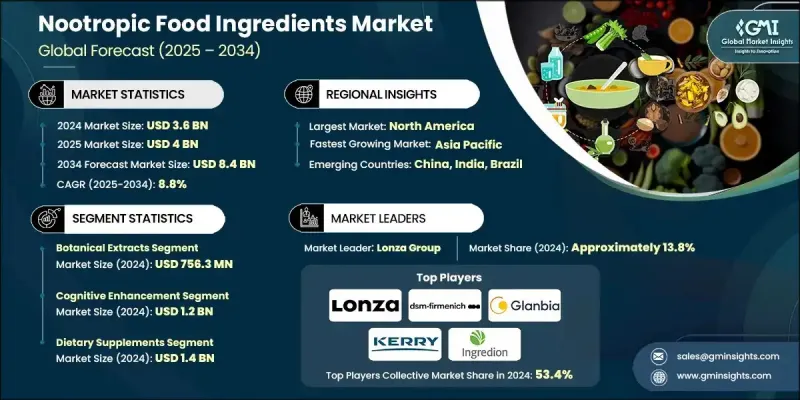
세계의 누트로픽 식품 원료 시장은 2024년에 36억 달러로 평가되었고, 2034년까지 연평균 복합 성장률(CAGR)은 8.8%를 나타낼 것으로 예측되며 84억 달러에 달할 전망입니다.
이 시장은 틈새 웰니스 부문에서 영양 산업의 주류로 진화했습니다. 최근 몇 년간 오메가-3, 인삼, L-테아닌과 같은 성분들은 인지 능력 향상, 스트레스 관리, 전반적인 정신 건강과의 연관성으로 인해 일상 식품에 통합되었습니다. 소비자 건강 우선순위가 변화함에 따라 스낵, 음료, 구미 형태의 기능성 식품이 기존 보충제를 보완하고 있습니다. 시장은 전 세계적으로 확장되었으며, 아시아태평양 지역은 한방 치료에 대한 문화적 친숙도와 증가하는 가처분 소득 덕분에 주목할 만한 성장을 보이고 있습니다. 이전에는 지역 건강 식품점에 한정되었던 성분들이 이제 클린 라벨, 지속 가능한 옵션으로 전 세계적으로 이용 가능합니다. 시장의 미래는 신경과학, 영양학, 혁신의 통합에 의해 형성되고 있으며, 장-뇌 상호작용에 대한 새로운 연구는 기분 안정화와 수면 최적화를 위한 새로운 프로바이오틱-누트로픽 조합 및 정밀 제품을 도입할 가능성이 있습니다.
시장 범위
시작 연도
2024년
예측 기간
2025-2034년
시작 금액
36억 달러
예측 금액
84억 달러
CAGR
8.8%
식물 추출물 부문은 2024년 7억 5,630만 달러를 기록했으며, 2025-2034년 연평균 7.7% 성장할 것으로 예상됩니다. 식물성 클린 라벨 인지 기능 강화제에 대한 수요 증가로 아슈와간다, 바코파, 은행나무와 같은 적응성 허브의 사용이 확대되고 있습니다. 인지 기능 및 스트레스 완화 효과를 입증하는 임상 연구가 이 부문의 확장을 뒷받침하고 있습니다. 이러한 허브 성분을 함유한 기능성 음료와 스낵은 일상적인 인지 영양 공급의 기초가 되었습니다.
인지 기능 향상 부문은 2024년 12억 달러 규모에 도달했으며, 2034년까지 연평균 8%의 성장률을 보일 것으로 전망됩니다. 누트로픽 식품 성분의 핵심 적용 부문는 인지 기능 향상, 스트레스 및 기분 관리, 수면 개선, 신경 보호 등입니다. 이러한 용도는 정신적 에너지, 정서적 안정성 및 전반적인 뇌 건강을 향상시키는 통합 솔루션에 대한 소비자 수요를 반영합니다. 주간 집중력 향상과 야간 회복 효과를 결합한 다기능 제형이 주목받고 있습니다.
미국의 누트로픽 식품 원료 시장은 2024년에 10억 달러로 평가되고 2025-2034년 연평균 복합 성장률(CAGR)은 8.3%를 보일 것으로 예측됩니다. 이 성장은 FDA 준수 제형과 증가하는 소비자 관심에 힘입어 소매 채널 전반에 걸쳐 인지 기능 제품이 채택되면서 촉진되고 있습니다. 음료 기반 전달 시스템의 혁신과 L-테아닌, 바코파, 오메가-3와 같은 임상적으로 검증된 성분의 사용은 미국 시장 확장을 더욱 뒷받침합니다.
누트로픽 식품 원료 시장의 주요 기업으로는 글랜비아 뉴트리셔널스(Glanbia Nutritionals), 인그레디온 인코포레이티드(Ingredion Incorporated), 론자 그룹(Lonza Group), DSM-피르메니히(DSM-Firmenich), 케리 그룹(Kerry Group) 등이 있습니다. 누트로픽 식품 원료 시장 기업들은 시장 지위 강화를 위해 제품 혁신, 임상 검증, 전략적 파트너십에 주력하고 있습니다. 기업들은 변화하는 소비자 선호도를 반영한 다기능 클린 라벨 제형을 개발하고 글로벌 시장으로의 진출을 확대하고 있습니다. 소매업체 및 식품 제조사와의 협업은 기능성 식품, 음료, 스낵 기반 전달 방식의 채택을 촉진합니다. 연구개발(R&D) 투자는 누트로픽 성분의 효능, 안전성 및 차별화를 보장합니다. 기업들은 또한 과학적 근거를 바탕으로 한 혜택, 지속 가능한 원료 조달, 프리미엄 제품 포지셔닝을 강조하는 마케팅 전략을 활용하여 브랜드 신뢰도를 높이고 성장하는 인지 영양 부문에서 더 큰 점유율을 확보하고 있습니다.
목차
제1장 조사 방법
시장 범위와 정의
조사 설계
조사 접근
데이터 수집 방법
데이터 마이닝 소스
세계
지역별/국가별
기본 추정치와 계산
기준연도 계산
시장 추정에서의 주요 동향
1차 조사 및 검증
1차 정보
예측 모델
조사의 전제조건과 제한 사항
제2장 주요 요약
제3장 업계 인사이트
생태계 분석
공급자의 상황
이익률
각 단계에서의 부가가치
밸류체인에 영향을 주는 요인
혁신
업계에 미치는 영향요인
성장 촉진요인
업계의 잠재적 억제요인 및 과제
시장 기회
성장 가능성 분석
규제 상황
북미
유럽
아시아태평양
라틴아메리카
중동 및 아프리카
Porter's Five Forces 분석
PESTEL 분석
가격 동향
지역별
장래 시장 동향
기술과 혁신의 상황
현재의 기술 동향
신흥기술
특허 상황
무역 통계(HS코드)(참고 : 무역 통계는 주요 국가에서만 제공됨)
주요 수입국
주요 수출국
지속가능성과 환경적 측면
지속가능한 실천
폐기물 감축 전략
생산에서의 에너지 효율
환경에 배려한 대처
탄소발자국에 관한 고려 사항
제4장 경쟁 구도
소개
기업의 시장 점유율 분석
지역별
북미
유럽
아시아태평양
라틴아메리카
중동 및 아프리카
기업 매트릭스 분석
주요 시장 기업의 경쟁 분석
경쟁 포지셔닝 매트릭스
주요 발전
합병 및 인수
제휴 및 협업
신제품 발매
사업 확대 계획
제5장 시장 추계 및 예측 : 제품 유형별(2025-2034년)
주요 동향
아미노산 및 그 유도체
L-테아닌
GABA(감마아미노부티르산)
L-카르니틴 및 아세틸-L-카르니틴
기타 아미노산 유도체
식물 추출물
은행나무 잎 추
인삼
아슈와간다 및 강장성 식물성 원료
로디올라
바코파 및 모니에리
신흥 식물성분
비타민 및 미네랄
비타민 B군
오메가-3 지방산
마그네슘과 아연
비타민 D
합성 누트로픽
피라세탐 유사체
모다피닐 유도체
신규 합성 화합물
제6장 시장 추계 및 예측 : 용도별(2025-2034년)
주요 동향
인지 기능 향상
기억력 및 학습 능력 향상
집중력 및 주의력 향상
처리 속도 및 정신적 명료
기분 및 스트레스 관리
불안의 경감
스트레스 반응 조절
정서적 안정
수면 및 일상 리듬 개선
수면의 질
일상 리듬
회복과 재생
신경 보호
뇌의 노화 및 장수
신경퇴행성 질환 예방
인지기능 저하 완화
제7장 시장 추계 및 예측 : 최종 용도별(2025-2034년)
주요 동향
영양보조식품
캡슐 및 정제
분말 및 액체 제품
구미 및 추어블 유형
설하 및 속용성 제제
기능성 식음료
기능성 워터
에너지 음료
영양 바 및 스낵 식품
유제품 및 식물성 제품
스포츠 영양
사전 운동
회복 및 운동 후
지구력 및 성능 보충제
임상 및 의료 영양
치료용 식품
의료용 보충제
병원 및 임상 용도
영유아 및 고령자용 영양
소아 인지 발달
고령자 인지 기능 지원
연령별 영양
제8장 시장 추계 및 예측 : 지역별(2025-2034년)
주요 동향
북미
미국
캐나다
유럽
독일
영국
프랑스
이탈리아
스페인
기타 유럽
아시아태평양
중국
인도
일본
호주
한국
기타 아시아태평양
라틴아메리카
브라질
멕시코
아르헨티나
기타 라틴아메리카
중동 및 아프리카
사우디아라비아
남아프리카
아랍에미리트(UAE)
기타 중동 및 아프리카
제9장 기업 프로파일
Lonza Group
DSM-Firmenich
Glanbia Nutritionals
Ingredion Incorporated
Kerry Group
McCormick &Company(Fona)
Ajinomoto Co., Inc.
Balchem Corporation
Naturex(Givaudan)
Sabinsa Corporation
NutriScience Innovations LLC
KEYVIEW LABS Inc.
Innovus Pharmaceuticals Inc.
Indena SpA
Pharmavite LLC
HBR
영문 목차
영문목차
The Global Nootropic Food Ingredients Market was valued at USD 3.6 Billion in 2024 and is estimated to grow at a CAGR of 8.8% to reach USD 8.4 Billion by 2034.
This market has evolved from a niche wellness segment into a mainstream part of the nutrition industry. Over recent years, ingredients such as Omega-3s, Ginseng, and L-Theanine have been incorporated into everyday foods due to their links with cognitive clarity, stress management, and overall mental wellness. Consumer health priorities are shifting, and functional foods like snacks, beverages, and gummies now complement traditional supplements. The market has expanded globally, with the Asia-Pacific region witnessing notable growth thanks to cultural familiarity with herbal remedies and rising disposable income. Ingredients previously limited to local health stores are now globally available as clean-label, sustainable options. The future of the market is being shaped by the integration of neuroscience, nutrition, and innovation, with emerging research on gut-brain interactions likely to introduce new probiotic-nootropic combinations and precision products for mood stabilization and sleep optimization.
Market Scope
Start Year
2024
Forecast Year
2025-2034
Start Value
$3.6 Billion
Forecast Value
$8.4 Billion
CAGR
8.8%
The botanical extracts segment generated USD 756.3 million in 2024 and is expected to grow at a CAGR of 7.7% from 2025 to 2034. Rising demand for plant-based, clean-label cognitive enhancers has driven the use of adaptogenic herbs such as ashwagandha, bacopa, and ginkgo biloba. Clinical research validating cognitive and stress-relief benefits is supporting the expansion of this segment. Functional beverages and snacks incorporating these herbal ingredients have become foundational in delivering daily cognitive nutrition.
The cognitive enhancement segment reached USD 1.2 Billion in 2024 and is projected to grow at an 8% CAGR through 2034. Core applications of nootropic food ingredients include cognitive support, stress and mood management, sleep improvement, and neuroprotection. These uses reflect consumers' demand for integrated solutions that enhance mental energy, emotional stability, and overall brain health. Multi-functional formulations are gaining traction, combining daytime concentration support with restorative night-time benefits.
U.S. Nootropic Food Ingredients Market was valued at USD 1 Billion in 2024 and is anticipated to grow at an 8.3% CAGR from 2025 to 2034. Growth is fueled by the adoption of cognitive functional products across retail channels, backed by FDA-compliant formulations and rising consumer interest. Innovation in beverage-based delivery systems and the use of clinically validated ingredients like L-Theanine, bacopa, and Omega-3s further support U.S. market expansion.
Key players in the Nootropic Food Ingredients Market include Glanbia Nutritionals, Ingredion Incorporated, Lonza Group, DSM-Firmenich, and Kerry Group. Companies in the Nootropic Food Ingredients Market are focusing on product innovation, clinical validation, and strategic partnerships to strengthen their market position. Firms are developing multi-functional, clean-label formulations to cater to evolving consumer preferences and expanding into global markets. Collaboration with retailers and food manufacturers helps drive adoption of functional foods, beverages, and snack-based delivery formats. Investment in R&D ensures efficacy, safety, and differentiation of nootropic ingredients. Companies are also leveraging marketing strategies highlighting science-backed benefits, sustainable sourcing, and premium product positioning, enabling them to enhance brand credibility and capture a larger share of the growing cognitive nutrition segment.
Table of Contents
Chapter 1 Methodology
1.1 Market scope and definition
1.2 Research design
1.2.1 Research approach
1.2.2 Data collection methods
1.3 Data mining sources
1.3.1 Global
1.3.2 Regional/Country
1.4 Base estimates and calculations
1.4.1 Base year calculation
1.4.2 Key trends for market estimation
1.5 Primary research and validation
1.5.1 Primary sources
1.6 Forecast model
1.7 Research assumptions and limitations
Chapter 2 Executive Summary
2.1 Industry 3600 synopsis
2.2 Key market trends
2.2.1 Regional
2.2.2 Product Type
2.2.3 Application
2.2.4 End use Industry
2.3 TAM Analysis, 2025-2034
2.4 CXO perspectives: Strategic imperatives
2.4.1 Executive decision points
2.4.2 Critical success factors
2.5 Future Outlook and Strategic Recommendations
Chapter 3 Industry Insights
3.1 Industry ecosystem analysis
3.1.1 Supplier Landscape
3.1.2 Profit Margin
3.1.3 Value addition at each stage
3.1.4 Factor affecting the value chain
3.1.5 Disruptions
3.2 Industry impact forces
3.2.1 Growth drivers
3.2.2 Industry pitfalls and challenges
3.2.3 Market opportunities
3.3 Growth potential analysis
3.4 Regulatory landscape
3.4.1 North America
3.4.2 Europe
3.4.3 Asia Pacific
3.4.4 Latin America
3.4.5 Middle East & Africa
3.5 Porter's analysis
3.6 PESTEL analysis
3.6.1 Technology and Innovation landscape
3.6.2 Current technological trends
3.6.3 Emerging technologies
3.7 Price trends
3.7.1 By region
3.8 Future market trends
3.9 Technology and Innovation landscape
3.9.1 Current technological trends
3.9.2 Emerging technologies
3.10 Patent Landscape
3.11 Trade statistics (HS code) (Note: the trade statistics will be provided for key countries only)
3.11.1 Major importing countries
3.11.2 Major exporting countries
3.12 Sustainability and Environmental Aspects
3.12.1 Sustainable Practices
3.12.2 Waste Reduction Strategies
3.12.3 Energy Efficiency in Production
3.12.4 Eco-friendly Initiatives
3.13 Carbon Footprint Considerations
Chapter 4 Competitive Landscape, 2024
4.1 Introduction
4.2 Company market share analysis
4.2.1 By region
4.2.1.1 North America
4.2.1.2 Europe
4.2.1.3 Asia Pacific
4.2.1.4 LATAM
4.2.1.5 MEA
4.3 Company matrix analysis
4.4 Competitive analysis of major market players
4.5 Competitive positioning matrix
4.6 Key developments
4.6.1 Mergers & acquisitions
4.6.2 Partnerships & collaborations
4.6.3 New Product Launches
4.6.4 Expansion Plans
Chapter 5 Market Estimates and Forecast, By Product Type, 2025 - 2034 (USD Million, Kilo Tons)
5.1 Key trends
5.2 Amino Acids & Derivatives
5.2.1 L-Theanine
5.2.2 GABA (Gamma-Aminobutyric Acid)
5.2.3 L-Carnitine & Acetyl-L-Carnitine
5.2.4 Other Amino Acid Derivatives
5.3 Botanical Extracts
5.3.1 Ginkgo Biloba
5.3.2 Ginseng Varieties
5.3.3 Ashwagandha & Adaptogenic Botanicals
5.3.4 Rhodiola
5.3.5 Bacopa Monnieri
5.3.6 Emerging Botanical Ingredients
5.4 Vitamins & Minerals
5.4.1 B-Complex Vitamins
5.4.2 Omega-3 Fatty Acids
5.4.3 Magnesium & Zinc
5.4.4 Vitamin D
5.5 Synthetic Nootropics
5.5.1 Piracetam Analogs
5.5.2 Modafinil Derivatives
5.5.3 Novel Synthetic Compounds
Chapter 6 Market Estimates and Forecast, By Application, 2025 - 2034 (USD Million, Kilo Tons)
6.1 Key trends
6.2 Cognitive Enhancement
6.2.1 Memory & Learning Enhancement
6.2.2 Focus & Attention Improvement
6.2.3 Processing Speed & Mental Clarity
6.3 Mood & Stress Management
6.3.1 Anxiety Reduction
6.3.2 Stress Response Modulation
6.3.3 Emotional Wellness
6.4 Sleep & Circadian Support
6.4.1 Sleep Quality
6.4.2 Circadian Rhythm
6.4.3 Recovery & Restoration
6.5 Neuroprotection
6.5.1 Brain Aging & Longevity
6.5.2 Neurodegenerative Disease Prevention
6.5.3 Cognitive Decline Mitigation
Chapter 7 Market Estimates and Forecast, By End Use, 2025 - 2034 (USD Million, Kilo Tons)
7.1 Key trends
7.2 Dietary Supplements
7.2.1 Capsules & Tablets
7.2.2 Powders & Liquids
7.2.3 Gummies & Chewables
7.2.4 Sublingual & Fast-Dissolving Formats
7.3 Functional Foods & Beverages
7.3.1 Enhanced Waters
7.3.2 Energy Drinks
7.3.3 Nutrition Bars & Snack Foods
7.3.4 Dairy & Plant-Based Products
7.4 Sports Nutrition
7.4.1 Pre-Workout
7.4.2 Recovery & Post-Exercise
7.4.3 Endurance & Performance
7.5 Clinical & Medical Nutrition
7.5.1 Therapeutic Foods
7.5.2 Medical Supplements
7.5.3 Hospital & Clinical Use
7.6 Infant & Elderly Nutrition
7.6.1.1 Pediatric Cognitive Development
7.6.1.2 Geriatric Cognitive Support
7.6.1.3 Age-Specific Nutrition
Chapter 8 Market Estimates and Forecast, By Region, 2025 - 2034 (USD Million, Kilo Tons)