Tethered Drone Market Opportunity, Growth Drivers, Industry Trend Analysis, and Forecast 2025 - 2034
상품코드:1773396
리서치사:Global Market Insights Inc.
발행일:2025년 06월
페이지 정보:영문 185 Pages
라이선스 & 가격 (부가세 별도)
ㅁ Add-on 가능: 고객의 요청에 따라 일정한 범위 내에서 Customization이 가능합니다. 자세한 사항은 문의해 주시기 바랍니다.
한글목차
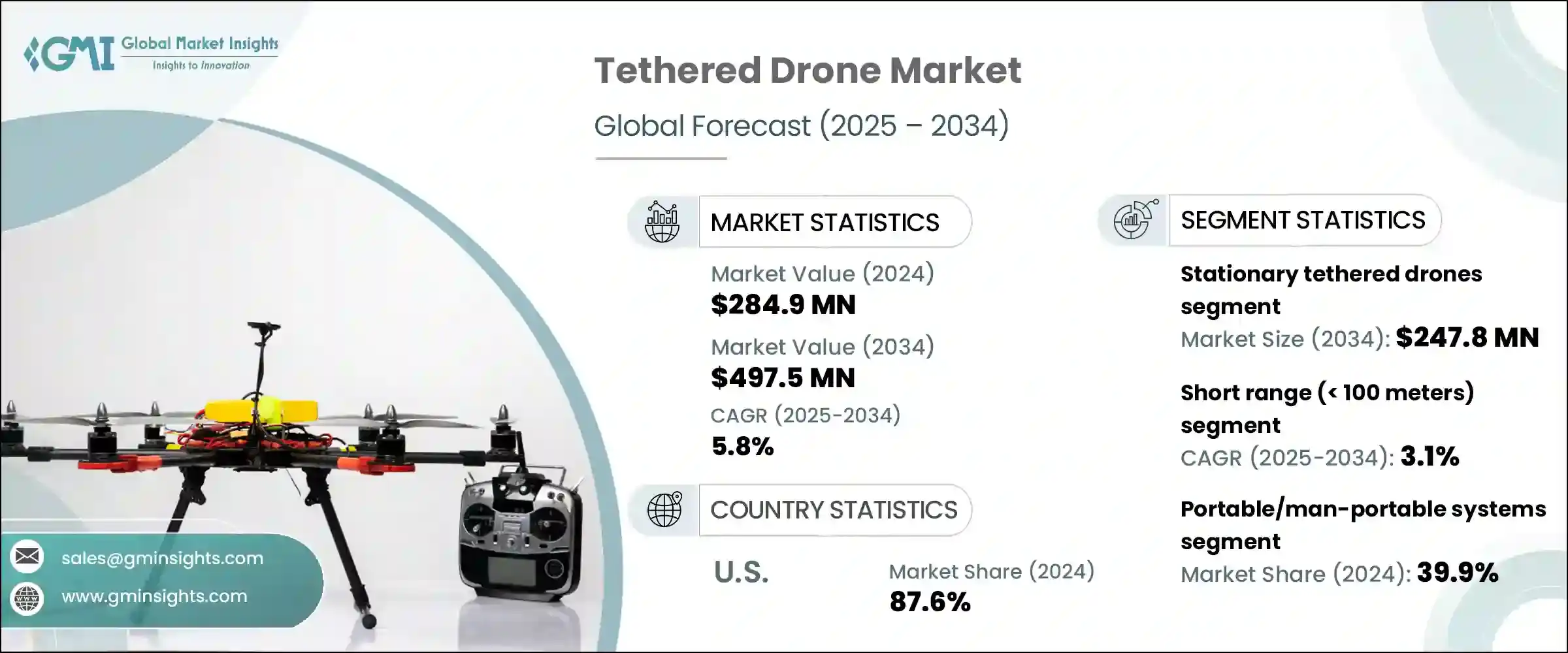
세계의 테더 드론 시장은 2024년 2억 8,490만 달러로 평가되었고 CAGR 5.8%를 나타내 2034년에는 4억 9,750만 달러에 이를 것으로 추정됩니다.
이 상승은 방위, 국토 안보, 감시 작전에 있어서의 테더 드론의 사용 확대에 의해 부추겨지고 있습니다. 대출은 지속적인 비행 능력과 실시간 데이터 전송을 통해 미션 크리티컬한 운영에 선호되고 있습니다.
미국이 수입전자부품에 부과한 관세 등의 무역정책의 전환은 드론 제조 공급체인에 큰 영향을 주었습니다. 상업화의 이니셔티브에 영향을 주어 기술 혁신의 사이클을 늦추고 차세대 시스템의 전개를 늦추게 되었습니다. 그 결과 많은 기업이 생산 전략을 검토하고 주요 부품의 대체 조달을 모색하고 공급망의 혼란을 극복해야 했습니다.
시장 범위
시작 연도
2024년
예측 연도
2025-2034년
시작 금액
2억 8,490만 달러
예측 금액
4억 9,750만 달러
CAGR
5.8%
하이브리드 연결 드론 분야는 2034년까지 연평균 복합 성장률(CAGR) 8.1%를 나타낼 것으로 예측됩니다. 연결 모드와 비 연결 모드 모두에서 작동하는 이중 기능으로 다양한 방어 및 긴급 시나리오에 범용성이 있습니다. 수명을 잃지 않고 신속한 전개를 필요로 하는 임무에 이상적입니다.
단거리(100미터 미만) 부문은 2025년부터 2034년에 걸쳐 CAGR 3.1%를 나타낼 것으로 예측됩니다.
2024년 미국의 테더 드론 점유율은 87.6%였습니다. 국내 기술 공급자의 리더십과 연방 정부의 강력한 조달 이니셔티브가 결합되어 선진적인 테더식 무인 시스템 분야에서의 이 나라의 지위는 계속 강화되고 있습니다.
세계 시장에서 활약하는 주목할만한 기업으로는 Fotokite, FlyFocus, Bharat Electronics, Easy Aerial, Elistair, Acecore Technologies, Aerial IQ 등이 있습니다. 시장의 포지셔닝을 강화하기 위해, 테더 드론 업계의 기업은 에너지 효율, 자율적인 테더링, AI를 탑재한 추적 시스템을 중심으로 연구 개발을 진행하고 있습니다. 각사는 또한 페이로드의 소형화나, 다양한 미션 프로파일에 적응하기 위한 모듈식 드론 아키텍쳐에도 주력하고 있습니다.
목차
제1장 조사 방법과 범위
제2장 주요 요약
제3장 업계 인사이트
생태계 분석
트럼프 정권의 관세 분석
무역에 미치는 영향
무역량의 혼란
보복 조치
업계에 미치는 영향
공급측의 영향(원재료)
주요 원재료의 가격 변동
공급망 재구성
생산 비용에 미치는 영향
수요측의 영향(판매가격)
최종 시장에의 가격 전달
시장 점유율 동향
소비자의 반응 패턴
영향을 받는 주요 기업
전략적인 업계 대응
공급망 재구성
가격 설정 및 제품 전략
정책관여
전망과 향후 검토 사항
업계에 미치는 영향요인
성장 촉진요인
항공 감시 솔루션에 대한 규제 지원
방위와 국토안보에 있어서의 채용 증가
산업 인프라 감시 요구의 확대
재해 관리와 긴급 대응을 위한 배치 강화
스마트 시티와 공공 안전 이니셔티브에 대한 투자 증가
업계의 잠재적 위험 및 과제
기동성과 작전 범위가 한정
지상 전원에의 의존
성장 가능성 분석
규제 상황
기술의 상황
향후 시장 동향
갭 분석
Porter's Five Forces 분석
PESTEL 분석
제4장 경쟁 구도
서론
기업의 시장 점유율 분석
주요 시장 기업의 경쟁 분석
경쟁 포지셔닝 매트릭스
전략 대시보드
제5장 시장 추계·예측 : 유형별(2021-2034년)
주요 동향
고정식 테더 드론
이동식 유선 드론
하이브리드 테더 드론
제6장 시장 추계·예측 : 범위별(2021-2034년)
주요 동향
단거리(100미터 미만)
중거리(100-300미터)
장거리(300미터 이상)
제7장 시장 추계·예측 : 배포 모드별(2021-2034년)
주요 동향
휴대용 시스템
차량 탑재 시스템
고정 지상국 기반 시스템
해양
제8장 시장 추계·예측 : 기술 통합별(2021-2034년)
주요 동향
AI 지원 테더링 드론
컴퓨터 비전 강화 시스템
자동 실행 및 복구
실시간 엣지 컴퓨팅 시스템
암호화된 통신 및 사이버 보안 기능
기타
제9장 시장 추계·예측 : 용도별(2021-2034년)
주요 동향
국방 및 보안
국경 감시
군사 통신
전술 작전
기타
공공 안전 및 긴급 대응
대응
재난 모니터링
소방 지원
군중 모니터링
기타
상업 및 산업
인프라 및 자산 점검
방송 및 미디어 보도
레크리에이션
기타
환경 모니터링
대기질 측정
야생동물 관찰
자연재해 평가
기타
기타
제10장 시장 추계·예측 : 지역별(2021-2034년)
주요 동향
북미
미국
캐나다
유럽
독일
영국
프랑스
스페인
이탈리아
네덜란드
아시아태평양
중국
인도
일본
호주
한국
라틴아메리카
브라질
멕시코
아르헨티나
중동 및 아프리카
사우디아라비아
남아프리카
아랍에미리트(UAE)
제11장 기업 프로파일
Acecore Technologies
Aerial IQ
Bharat Electronics
Easy Aerial
Elistair
FlyFocus
Fotokite
Hoverfly Technologies
Maverick Drones and Technologies
Menet Aero
Mistral Solutions
Spooky Action
Teledyne FLIR
Unmanned Systems and Solutions
Volarious
Yuneec International
Zenith Aerotech
KTH
영문 목차
영문목차
The Global Tethered Drone Market was valued at USD 284.9 million in 2024 and is estimated to grow at a CAGR of 5.8% to reach USD 497.5 million by 2034. This rise is fueled by the expanding use of tethered drones in defense, homeland security, and surveillance operations. Security forces worldwide are increasingly turning to tethered systems for their ability to support persistent aerial observation and tactical communication. These drones are preferred for mission-critical operations due to their continuous flight capabilities and real-time data transfer. Substantial government investment in national security and infrastructure protection continues to play a central role in boosting demand across regions.
Trade policy shifts, such as the US-imposed tariffs on imported electronic components, significantly impacted the drone manufacturing supply chain. These restrictions disrupted the flow of essential items like sensors and communications modules, delaying research, stalling innovation, and constraining smaller tech-driven firms in space. This led to a temporary dip in R&D spending and affected commercialization efforts across the tethered drone landscape, slowing innovation cycles and delaying the rollout of next-generation systems. Smaller firms faced budgetary constraints that disrupted prototyping, testing phases, and product launches. As a result, many companies had to reassess their production strategies, seek alternative sourcing for key components, and navigate supply chain disruptions that ultimately hindered the pace of market expansion and technological progress.
Market Scope
Start Year
2024
Forecast Year
2025-2034
Start Value
$284.9 Million
Forecast Value
$497.5 Million
CAGR
5.8%
Hybrid tethered drones segment a projected to grow at a CAGR of 8.1% through 2034. Their dual capability to operate both in tethered and untethered modes makes them versatile for a range of defense and emergency scenarios. These drones provide a strong mix of endurance and mobility, ideal for missions that require rapid deployment without compromising on operational longevity. Breakthroughs in automated tethering and energy management systems are also fueling adoption in complex operational environments that span land, sea, and air domains.
Short range ( < 100 meters) segment is projected to grow at a CAGR of 3.1% during 2025-2034. Their ease of deployment and compact form factor make them highly attractive for urban surveillance, event management, and critical infrastructure monitoring. These systems are becoming widely used in local law enforcement, emergency services, and safety inspections due to their maneuverability and convenience.
United States Tethered Drone Market held an 87.6% share in 2024. Rising investments in military and homeland security applications have pushed the country ahead, especially in areas focused on long-duration surveillance, border control, and disaster response. The leadership of domestic technology providers, combined with strong federal procurement initiatives, continues to reinforce the country's position in the advanced tethered unmanned systems sector.
Notable players active in the global market include Fotokite, FlyFocus, Bharat Electronics, Easy Aerial, Elistair, Acecore Technologies, and Aerial IQ. To strengthen market positioning, companies in the tethered drone industry are advancing their R&D efforts around energy efficiency, autonomous tethering, and AI-powered tracking systems. Many are diversifying product lines to include hybrid systems capable of switching between tethered and untethered modes. Partnerships with defense agencies and homeland security bodies play a key role in securing high-value contracts. Firms are also focusing on miniaturization of payloads and modular drone architecture to adapt to a variety of mission profiles. Several vendors are expanding globally by aligning with local manufacturing capabilities and leveraging government incentives for defense tech localization.
Table of Contents
Chapter 1 Methodology and scope
1.1 Market scope and definitions
1.2 Research design
1.2.1 Research approach
1.2.2 Data collection methods
1.3 Base estimates and calculations
1.3.1 Base year calculation
1.3.2 Key trends for market estimation
1.4 Forecast model
1.5 Primary research and validation
1.5.1 Primary sources
1.5.2 Data mining sources
Chapter 2 Executive summary
2.1 Industry 360° synopsis
Chapter 3 Industry insights
3.1 Industry ecosystem analysis
3.2 Trump administration tariffs analysis
3.2.1 Impact on trade
3.2.1.1 Trade volume disruptions
3.2.1.2 Retaliatory measures
3.2.2 Impact on the industry
3.2.2.1 Supply-side impact (raw materials)
3.2.2.1.1 Price volatility in key materials
3.2.2.1.2 Supply chain restructuring
3.2.2.1.3 Production cost implications
3.2.2.2 Demand-side impact (selling price)
3.2.2.2.1 Price transmission to end markets
3.2.2.2.2 Market share dynamics
3.2.2.2.3 Consumer response patterns
3.2.3 Key companies impacted
3.2.4 Strategic industry responses
3.2.4.1.1 Supply chain reconfiguration
3.2.4.1.2 Pricing and product strategies
3.2.4.1.3 Policy engagement
3.2.5 Outlook and future considerations
3.3 Industry impact forces
3.3.1 Growth drivers
3.3.1.1 Regulatory support for aerial monitoring solutions
3.3.1.2 Growing adoption in defense and homeland security
3.3.1.3 Expansion of industrial infrastructure monitoring needs
3.3.1.4 Increased deployment for disaster management and emergency response
3.3.1.5 Growing investments in smart city and public safety initiatives
3.3.2 Industry pitfalls and challenges
3.3.2.1 Limited mobility and operational range
3.3.2.2 Dependence on ground power sources
3.4 Growth potential analysis
3.5 Regulatory landscape
3.6 Technology landscape
3.7 Future market trends
3.8 Gap analysis
3.9 Porter's analysis
3.10 Pestel analysis
Chapter 4 Competitive landscape, 2024
4.1 Introduction
4.2 Company market share analysis
4.3 Competitive analysis of major market players
4.4 Competitive positioning matrix
4.5 Strategy dashboard
Chapter 5 Market Estimates & Forecast, By Type, 2021-2034 (USD Million & Units)
5.1 Key trends
5.2 Stationary tethered drones
5.3 Mobile tethered drones
5.4 Hybrid tethered drones
Chapter 6 Market Estimates & Forecast, By Range, 2021-2034 (USD Million & Units)
6.1 Key trends
6.2 Short-range (< 100 meters)
6.3 Mid- range (100 – 300 meters)
6.4 Long- range (> 300 meters)
Chapter 7 Market Estimates & Forecast, By Deployment Mode, 2021-2034 (USD Million & Units)
7.1 Key trends
7.2 Portable/man-portable systems
7.3 Vehicle-mounted systems
7.4 Fixed ground station-based systems
7.5 Maritime
Chapter 8 Market Estimates & Forecast, By Technology Integration, 2021-2034 (USD Million & Units)
8.1 Key trends
8.2 AI-enabled tethered drones
8.3 Computer vision-enhanced systems
8.4 Automated launch & recovery
8.5 Real-time edge computing systems
8.6 Encrypted communication & cybersecurity features
8.7 Others
Chapter 9 Market Estimates & Forecast, By Application, 2021-2034 (USD Million & Units)
9.1 Key trends
9.2 Defense & security
9.2.1 Border surveillance
9.2.2 Military communications
9.2.3 Tactical operations
9.2.4 Others
9.3 Public safety & emergency response
9.3.1 Response
9.3.2 Disaster monitoring
9.3.3 Firefighting support
9.3.4 Crowd monitoring
9.3.5 Others
9.4 Commercial & industrial
9.4.1 Infrastructure & asset inspection
9.4.2 Broadcasting and media coverage
9.4.3 Recreational
9.4.4 Others
9.5 Environmental monitoring
9.5.1 Air quality measurement
9.5.2 Wildlife observation
9.5.3 Natural disaster assessment
9.5.4 Others
9.6 Others
Chapter 10 Market Estimates and Forecast, By Region, 2021 – 2034 (USD Million & Units)