


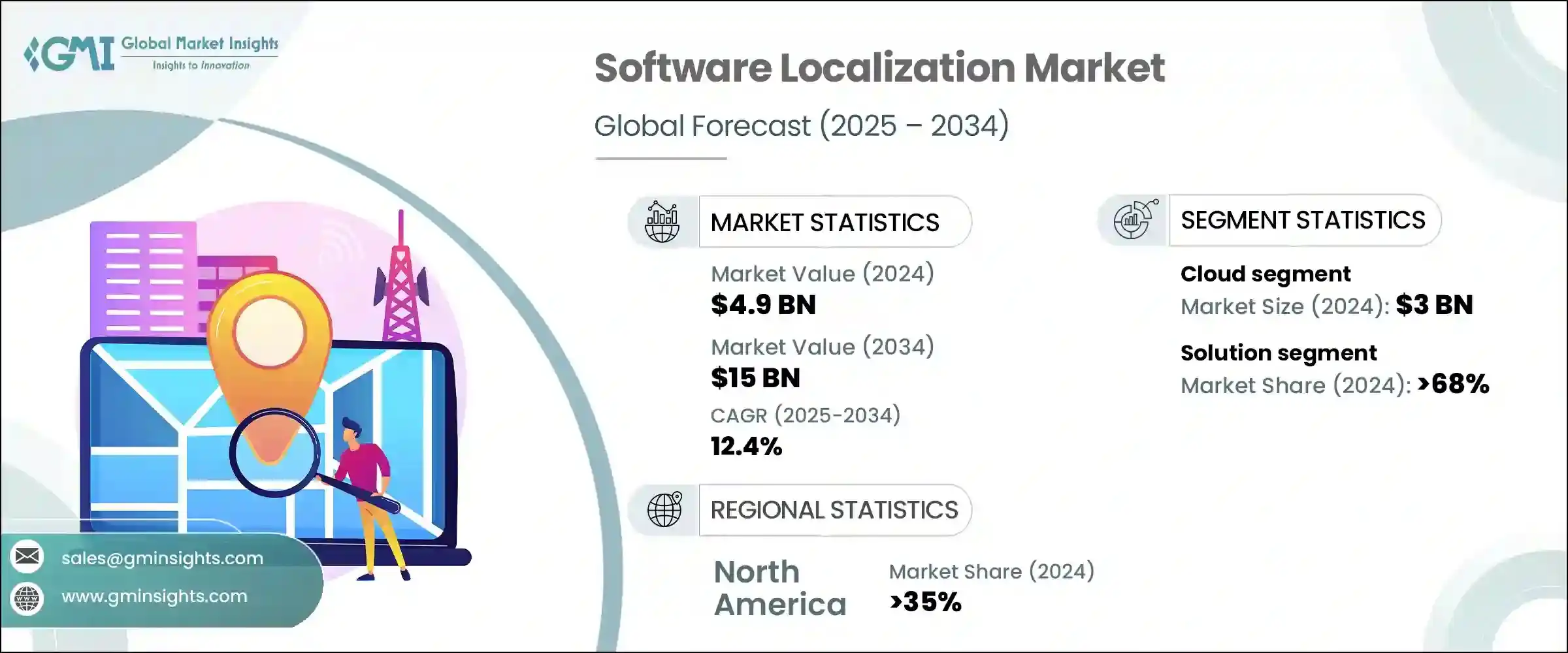
소프트웨어 로컬라이제이션 시장 규모는 2024년에 49억 달러로 평가되었고, CAGR 12.4%를 나타내 2034년에는 150억 달러에 이를 것으로 추정됩니다. 이러한 성장은 특히 소프트웨어 개발에 있어서 마이크로서비스 아키텍처의 채용이 증가하고 있는 것이 큰 요인이 되고 있습니다. 최신 용도, 특히 SaaS 기반 서비스는 전 세계 배포에 최적화된 느슨하게 결합된 서비스에 의존합니다. 이 모듈화된 접근 방식은 전체 시스템을 재설계하지 않고도 로컬라이제이션된 업데이트를 가능하게 하며, 소프트웨어 로컬라이제이션를 더욱 민첩하고 확장할 수 있습니다. 기업이 지역별로 로컬라이제이션된 마이크로기능의 A/B 테스트를 실시함으로써 로컬라이제이션 프로세스를 강화하는 지속적인 피드백 루프가 형성되어 보다 효과적인 제품의 세계 전개를 지원합니다.
유럽, 아시아 및 라틴아메리카 정부는 디지털 접근성과 다국어 규정 준수에 대한 엄격한 규제를 도입하여 소프트웨어 로컬라이제이션에 대한 수요를 더욱 밀어 올리고 있습니다. 다양한 지역의 법률이 웹사이트와 앱을 사용자의 모국어로 액세스할 수 있도록 요구하고 있으며, 이러한 규정은 정부 및 은행과 같은 분야에도 적용됩니다. 이러한 법적 요구 사항은 기업이 소프트웨어를 로컬라이제이션하도록 강요합니다. 이는 포괄성뿐만 아니라 잠재적인 법적 영향을 피하고 현지 사람들과의 신뢰를 구축하기 위한 것입니다.
| 시장 범위 | |
|---|---|
| 시작 연도 | 2024년 |
| 예측 연도 | 2025-2034년 |
| 시작 금액 | 49억 달러 |
| 예측 금액 | 150억 달러 |
| CAGR | 12.4% |
2024년 클라우드 기반 소프트웨어 로컬라이제이션 분야는 30억 달러를 차지했습니다. 클라우드 기반 번역 관리 시스템(TMS)은 확장성, 협업 및 중앙 관리를 기업에 제공할 수 있기 때문에 채용이 증가하고 있습니다. 이러한 시스템은 전 세계 팀에 실시간 액세스를 제공하며 컨텐츠 관리 시스템(CMS), 코드 리포지토리, CI/CD 파이프라인과 같은 다른 시스템과 원활하게 통합됩니다. 클라우드 TMS 솔루션은 비용 효율성이 뛰어나며, 특히 여러 지역에 걸쳐 비즈니스를 구축하는 기업의 경우 비즈니스 민첩성을 향상시킵니다. 엔터프라이즈가 보다 유연하고 신속한 대응을 요구하는 동안 클라우드 기반 로컬라이제이션 도구에 대한 수요는 계속 가속화되어 팀의 위치에 관계없이 필요한 툴에 액세스할 수 있습니다.
2024년에는 솔루션 부문의 점유율이 68%에 달했습니다. 기업은 단일 목적 로컬라이제이션 도구를 사용하여 번역 메모리, 프로젝트 관리, 기계 번역, 품질 보증 및 분석을 하나의 솔루션으로 통합하는 다기능 통합 플랫폼을 채택하고 있습니다. 이 전환은 단편화를 없애고 일관성을 높이고 시장 출시 시간을 단축합니다. 올인원 솔루션은 마케팅, 소프트웨어 개발, 고객 지원 등 다양한 부서에서 복잡한 다국어 프로젝트를 관리하는 대기업에게 특히 매력적입니다.
북미의 소프트웨어 로컬라이제이션 시장은 2024년 35%의 점유율을 차지했습니다. 미국의 다양한 인구는 특히 건강 관리, 교육, 정부 등 업계에서 다국어 컨텐츠에 대한 수요를 촉진하는 주요 요인이 되고 있습니다. 접근성을 높이고 비영어권 커뮤니티에 더 나은 서비스를 제공하기 위해 기업은 소프트웨어를 로컬라이제이션하고 보다 종합적이고 접근성이 높습니다. 미국의 주요 하이테크 기업은 민첩한 DevOps 환경에서 AI를 활용한 로컬라이제이션 플랫폼을 활용하여 실시간 업데이트 배포, 효율적인 버전 관리 및 빠르게 진화하는 디지털 제품 간의 일관된 경험을 제공합니다.
세계의 소프트웨어 로컬라이제이션 시장에서 사업을 전개하고 있는 톱 기업으로는 Smartling, Phrase, Transifex, Lokalise, Crowdin, Blend 및 TransPerfect가 있습니다. 소프트웨어를 로컬라이제이션하려는 기업의 진화하는 요구에 부응하는 혁신적인 솔루션을 제공하고 시장을 형성하고 있습니다. 또한 AI를 활용한 로컬라이제이션 플랫폼 개발에 많은 투자를 하고 있습니다. 또한 기계 번역 및 품질 보증과 같은 특정 요구에 대응하는 전문적인 도구를 포함하여 서비스 제공의 폭을 넓히고 있습니다.
The Global Software Localization Market was valued at USD 4.9 billion in 2024 and is estimated to grow at a CAGR of 12.4% to reach USD 15 billion by 2034. This growth is largely driven by the increasing adoption of microservices architecture, particularly in software development. Modern applications, especially SaaS-based services, rely on loosely coupled services that are optimized for global deployment. This modular approach allows for localized updates without the need to redesign the entire system, making software localization more agile and scalable. As companies conduct A/B tests of localized micro-features for different regions, they create an ongoing feedback loop that enhances the localization process, supporting more effective product launches worldwide.
Governments across Europe, Asia, and Latin America are introducing stricter regulations on digital accessibility and multilingual compliance, which is further boosting the demand for software localization. Laws in various regions require websites and apps to be accessible in the native languages of their users, and these regulations extend to sectors like government and banking. These legal requirements force companies to localize their software not only for inclusivity but also to avoid potential legal consequences and to build trust with local populations.
| Market Scope | |
|---|---|
| Start Year | 2024 |
| Forecast Year | 2025-2034 |
| Start Value | $4.9 Billion |
| Forecast Value | $15 Billion |
| CAGR | 12.4% |
In 2024, the cloud-based software localization segment accounted for USD 3 billion. Cloud-based Translation Management Systems (TMS) are increasingly being adopted due to their ability to offer scalability, collaboration, and centralized control for enterprises. These systems enable real-time access to global teams and seamlessly integrate with other systems like content management systems (CMS), code repositories, and CI/CD pipelines. Cloud TMS solutions are cost-effective and improve business agility, particularly for companies operating across multiple regions. As businesses seek more flexibility and speed, the demand for cloud-based localization tools continues to accelerate, allowing companies to access the necessary tools regardless of where their teams are located.
The solutions segment held a 68% share in 2024. Companies are increasingly shifting from using single-purpose localization tools to adopting multifunctional, unified platforms that combine translation memory, project management, machine translation, quality assurance, and analytics into a single solution. This transition helps eliminate fragmentation, improving consistency and reducing time-to-market. All-in-one solutions are particularly attractive to large companies that manage complex, multilingual projects across various departments, including marketing, software development, and customer support.
North America Software Localization Market held a 35% share in 2024. The diverse population of the United States is a major factor driving the demand for multilingual content, particularly in industries such as healthcare, education, and government. To enhance accessibility and better serve non-English-speaking communities, organizations are localizing software to make it more inclusive and accessible. Leading U.S. tech companies are leveraging AI-powered localization platforms within agile DevOps environments, enabling them to deliver real-time updates, manage versions effectively, and provide consistent experiences across fast-evolving digital products.
Top companies operating in the Global Software Localization Market include Smartling, Phrase, Transifex, Lokalise, Crowdin, Blend, and TransPerfect. These players are key to shaping the landscape by offering a range of innovative solutions that cater to the evolving needs of businesses seeking to localize their software across multiple languages and regions. To strengthen their position in the software localization market, companies are focusing on several strategies. They are investing heavily in the development of AI-driven localization platforms to enhance automation, accuracy, and real-time updates. Additionally, companies are shifting towards integrated, all-in-one solutions that allow for seamless management of localization workflows, providing greater efficiency. They are also expanding their service offerings by including specialized tools that address specific needs, such as machine translation or quality assurance. Collaborations with global enterprises and partnerships with other software developers are also becoming increasingly common to ensure broader reach and scalability.