해양 다이나믹 포지셔닝 시스템 시장 : 기회, 성장 촉진 요인, 산업 동향 분석, 예측(2025-2034년)
Marine Dynamic Positioning System Market Opportunity, Growth Drivers, Industry Trend Analysis, and Forecast 2025 - 2034
상품코드:1755265
리서치사:Global Market Insights Inc.
발행일:2025년 05월
페이지 정보:영문 180 Pages
라이선스 & 가격 (부가세 별도)
ㅁ Add-on 가능: 고객의 요청에 따라 일정한 범위 내에서 Customization이 가능합니다. 자세한 사항은 문의해 주시기 바랍니다.
한글목차
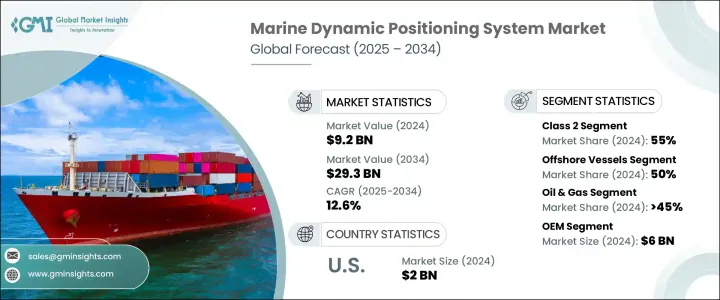
해양 다이나믹 포지셔닝 시스템 세계 시장 규모는 2024년에는 92억 달러로 평가되었고, CAGR 12.6%로 성장하여 2034년에는 293억 달러에 이를 것으로 예측됩니다.
이 시장은 해양 탐사 및 생산 활동, 해양 조사, 특수 함정 증가에 의해 급속히 확대되고 있으며, 앞으로도 강력한 성장이 예상됩니다. 이 선박들은 고정밀 스테이션 유지 기능을 보장하기 위해 범용 또는 특수 동적 위치 확인 시스템(DPS)이 필요합니다. 제어 시스템, 센서 및 자동화 기술의 최근 기술 혁신은 DPS의 성능과 신뢰성을 향상시키고 DPS가 현대 해상 운영의 필수 도구로 자리 잡고 있습니다.
또한 강력한 해양 다이나믹 포지셔닝 시스템의 향후 개발은 인공지능 기반 제어 기술과 예지보전 소프트웨어에 크게 의존하게 될 것입니다. 아시아 태평양 지역은 해양 인프라와 재생 에너지 프로젝트에 대한 막대한 투자로 인해 DPS의 중요한 시장이 되고 있습니다. 이 지역의 나라들은 전통적인 정박 방법에 의지하지 않는 선박 등, 선진적인 해상 기능을 우선하고 있습니다.
시장 범위
시작 연도
2024년
예측 연도
2025-2034년
시작 금액
92억 달러
예측 금액
293억 달러
CAGR
12.6%
2024년에는 제어 시스템이 시장의 45%를 차지했고 시장을 선도했으며 2034년까지 110억 달러의 매출이 전망되고 있습니다. 해상 작전이 더욱 정교해짐에 따라 제어 시스템은 현대 DPS의 증가하는 수요를 충족하기 위해 계속 발전하고 있습니다. 이 시스템은 향상된 알고리즘, 직관적 인 휴먼 머신 인터페이스 및 가장 엄격한 조건에서도 선박이 안정된 상태를 유지할 수있는 자동화 기능으로 크게 향상되었습니다.
2024년에는 2등급 시장 점유율이 55%에 달할 전망입니다. 이 시스템들은 운영 신뢰성, 위치 유지의 정확성, 극한의 운영 조건을 처리할 수 있는 능력으로 잘 알려져 있습니다. 고급 제어 기능과 중복성을 갖춘 클래스 2 시스템은 심각한 고장이 발생해도 운전을 계속할 수 있습니다.
미국의 해양 다이나믹 포지셔닝 시스템 2024년 시장 규모는 20억 달러.미국은 특히 안전하고 효율적인 조업을 확보하기 위해 높은 정밀도가 필요한 지역에서 대규모 해양 석유 및 가스 활동에 견인되어 이 분야에서 지배적인 역할을 완수하고 있습니다. 서비스 제공업체의 존재는 또한 다양한 산업에서 다양한 수준의 DPS 수요에 기여하고 있습니다.
세계 해양 다이나믹 포지셔닝 시스템 업계에서 사업을 전개하는 주요 기업은 ABB, L3 Harris, Rolls Royce, Kongsberg, Volvo Penta, Marine Technologies, Wartsila, Xenta Systems, GE Vernova 등이 있습니다. 해양 다이나믹 포지셔닝 시스템 업계의 각 사는 시장에서의 지위를 굳히기 위해, 제품의 혁신에 주력해, AI를 탑재한 제어 시스템의 연구 개발에 투자해, 예지 보전 능력을 강화하고 있습니다. 최첨단 센서, 자동화 기술, 실시간 데이터 분석을 통합함으로써 이들 기업은 시스템의 성능과 효율을 향상시키고 있습니다. 또한, 일부 기업은 해상 풍력 발전소 등의 재생에너지 솔루션 수요 증가에 대응하기 위해 제품 라인업을 확충하고 있습니다.
목차
제1장 조사 방법
시장의 범위와 정의
조사 디자인
조사 접근
데이터 수집 방법
데이터 마이닝 소스
세계
지역/국가
기본 추정과 계산
기준연도 계산
시장 예측의 주요 동향
1차 조사와 검증
1차 정보
예측 모델
조사의 전제와 한계
제2장 주요 요약
제3장 업계 인사이트
생태계 분석
공급자의 상황
이익률
비용 구조
각 단계에서의 부가가치
밸류체인에 영향을 주는 요인
혁신
업계에 미치는 영향요인
성장 촉진요인
해상 안전에 대한 수요 증가
해상교통과 세계무역 증가
해군과 군사의 근대화
앞바다 에너지 탐사와 개발 증가
업계의 잠재적 위험 및 과제
기술적인 복잡성과 숙련된 인재의 부족
초기 비용과 유지비가 높아
시장 기회
성장 가능성 분석
규제 상황
북미
유럽
아시아태평양
라틴아메리카
중동 및 아프리카
Porter's Five Forces 분석
PESTEL 분석
기술과 혁신의 상황
현재의 기술 동향
고급 센서 융합 시스템의 통합
중복성과 페일 세이프성을 갖춘 아키텍처 사용
실시간 원격 모니터링 및 진단
AI 기반 동적 제어 알고리즘
신흥기술
통합DP를 갖춘 자율선박 항행
DP 시뮬레이션을 위한 디지털 트윈 기술
하이브리드 전력 통합과 그린 DP 시스템
DP 로그의 데이터 무결성을 위한 블록체인
가격 동향
지역별
기기별
코스트 내역 분석
특허 분석
지속가능성과 환경 측면
지속가능한 관행
폐기물 삭감 전략
생산에 있어서의 에너지 효율
환경 친화적 인 노력
카본 풋 프린트의 고려
제4장 경쟁 구도
소개
기업의 시장 점유율 분석
북미
유럽
아시아태평양
라틴아메리카 항공
중동 및 아프리카
주요 시장 기업의 경쟁 분석
경쟁 포지셔닝 매트릭스
전략적 전망 매트릭스
주요 발전
합병과 인수
파트너십 및 협업
신제품 발매
확장계획과 자금조달
제5장 시장 추정 및 예측 : 기기별, 2021년-2034년
주요 동향
제어 시스템
DP 컨트롤 콘솔
위치 참조 시스템
모션 센서
전력 시스템
발전기
배전반
전력 관리 시스템
스러스터 시스템
터널 래스터
수국 추진기
휘트슈나이더 프로펠러
제6장 시장 추정 및 예측 : 시스템별, 2021년-2034년
주요 동향
클래스 1
클래스 2
클래스 3
제7장 시장 추정 및 예측 : 용도별, 2021년-2034년
주요 동향
해양 선박
플랫폼 공급선(PSV)
앵커 핸들링 태그 공급선(AHTSV)
다이빙 지원선(DSV)
ROV 지원선
해외 플랫폼
부체식 생산 저장 적출 설비(FPSO) 유닛
반 다이빙 유형 다이빙 보트
드릴링 장비
해군 함정
조사 및 조사선
지뢰 헌터
기타
크루즈선
페리
케이블 부설선
풍력발전소 설치선
제8장 시장 추정 및 예측 : 최종 용도별, 2021년-2034년
주요 동향
석유 및 가스
해상 재생에너지
방위 및 해군
해양조사
상업 수송
제9장 시장 추정 및 예측 : 판매 채널별, 2021년-2034년
주요 동향
OEM
애프터마켓
제10장 시장 추정 및 예측 : 지역별, 2021년-2034년
북미
미국
캐나다
유럽
영국
독일
프랑스
이탈리아
스페인
러시아
벨기에
스웨덴
아시아태평양
중국
인도
일본
호주
싱가포르
한국
동남아시아
라틴아메리카
브라질
멕시코
아르헨티나
중동 및 아프리카
남아프리카
사우디아라비아
아랍에미리트(UAE)
제11장 기업 프로파일
ABB
Alphatron Marine
GE Vernova
Japan Radio Company
Kongsberg
L3 Harris
Marine Technologies
Navis Engineering
Norr Systems
Praxis Automation Technology
RH Marine
Rolls Royce
Royal IHC
Sonardyne
Thrustmaster of Texas
Twin Disc
Veethree
Volvo Penta
Wartsila
Xenta Systems
SHW
영문 목차
영문목차
The Global Marine Dynamic Positioning System Market was valued at USD 9.2 billion in 2024 and is estimated to grow at a CAGR of 12.6% to reach USD 29.3 billion by 2034. The market is expanding rapidly and is expected to maintain strong growth in the future, driven by an increase in offshore exploration and production activities, maritime research, and specialized naval vessels. These vessels require either general-purpose or specialized dynamic positioning systems (DPS) to ensure high-precision station-keeping capabilities. Recent innovations in control systems, sensors, and automation technologies have improved the performance and reliability of DPS, positioning them as essential tools in modern maritime operations.
Moreover, the future development of powerful dynamic positioning systems will rely heavily on artificial intelligence-based control technologies and predictive maintenance software. These advancements will reduce operational risks, optimize fuel consumption, and leverage real-time data for greater operational efficiency. The Asia-Pacific region is becoming a significant market for DPS due to substantial investments in offshore infrastructure and renewable energy projects. Countries in the region are prioritizing advanced maritime capabilities, including ships that don't rely on traditional anchoring methods. As technological and operational considerations evolve, the DPS market is poised to experience substantial growth, driven by global priorities surrounding safety and efficiency in oceanic and aquatic operations.
Market Scope
Start Year
2024
Forecast Year
2025-2034
Start Value
$9.2 Billion
Forecast Value
$29.3 Billion
CAGR
12.6%
In 2024, control systems led the market, accounting for 45% of the share, with expectations for the segment to generate USD 11 billion by 2034. As offshore operations become more sophisticated, control systems continue to evolve to meet the increasing demands of modern DPS. These systems have significantly improved with enhanced algorithms, intuitive human-machine interfaces, and automation features that allow vessels to remain steady in even the most challenging conditions.
In 2024, the Class 2 segment held a 55% market share. Class 2 dynamic positioning systems are widely used in offshore drilling, subsea construction, and other critical marine environments, where maintaining system integrity is paramount. These systems are known for their operational reliability, accuracy in maintaining position, and ability to handle extreme operational conditions. Equipped with advanced control features and redundancy, Class 2 systems can continue to operate even during critical failures. Their high reliability and cost-effectiveness make them the preferred choice for operators, as they provide strong positioning without the complexity and higher costs associated with Class 3 systems.
United States Marine Dynamic Positioning System Market was valued at USD 2 billion in 2024. The U.S. plays a dominant role in this sector, driven by substantial offshore oil and gas activities, particularly in regions where high precision is necessary to ensure safe and efficient operations. The country's advanced marine infrastructure and the presence of top offshore service providers further contribute to the demand for various levels of DPS across different industries. In addition to supporting oil and gas operations, the U.S. is also increasingly focusing on developing DPS solutions for naval operations, renewable energy projects, such as offshore wind farms, and other specialized applications.
Key players operating in the Global Marine Dynamic Positioning System Industry include ABB, L3 Harris, Rolls Royce, Kongsberg, Volvo Penta, Marine Technologies, Wartsila, Xenta Systems, and GE Vernova. To solidify their market positions, companies in the marine dynamic positioning system industry are focusing on product innovation, investing in R&D for AI-powered control systems, and enhancing predictive maintenance capabilities. By integrating cutting-edge sensors, automation technologies, and real-time data analytics, these companies are improving the performance and efficiency of their systems. Additionally, some players are expanding their product offerings to cater to the growing demand for renewable energy solutions, such as offshore wind farms. Strategic partnerships, acquisitions, and regional expansion are also key strategies to enhance market presence and leverage new growth opportunities.
Table of Contents
Chapter 1 Methodology
1.1 Market scope and definition
1.2 Research design
1.2.1 Research approach
1.2.2 Data collection methods
1.3 Data mining sources
1.3.1 Global
1.3.2 Regional/Country
1.4 Base estimates and calculations
1.4.1 Base year calculation
1.4.2 Key trends for market estimation
1.5 Primary research and validation
1.5.1 Primary sources
1.6 Forecast model
1.7 Research assumptions and limitations
Chapter 2 Executive Summary
2.1 Industry 3600 synopsis
2.2 Key market trends
2.2.1 Regional
2.2.2 Equipment
2.2.3 System
2.2.4 Application
2.2.5 End use
2.2.6 Sales Channel
2.3 TAM Analysis, 2025-2034
2.4 CXO perspectives: Strategic imperatives
2.4.1 Executive decision points
2.4.2 Critical success factors
2.5 Future outlook and strategic recommendations
Chapter 3 Industry Insights
3.1 Industry ecosystem analysis
3.1.1 Supplier Landscape
3.1.2 Profit Margin
3.1.3 Cost structure
3.1.4 Value addition at each stage
3.1.5 Factor affecting the value chain
3.1.6 Disruptions
3.2 Industry impact forces
3.2.1 Growth drivers
3.2.1.1 Rising demand for maritime safety
3.2.1.2 Increased maritime traffic and global trade
3.2.1.3 Naval and military modernization
3.2.1.4 Increase in offshore energy exploration and development
3.2.2 Industry pitfalls and challenges
3.2.2.1 Technological complexity and lack of skilled personnel
3.2.2.2 High initial and maintenance costs
3.2.3 Market opportunity
3.3 Growth potential analysis
3.4 Regulatory landscape
3.4.1 North America
3.4.2 Europe
3.4.3 Asia Pacific
3.4.4 Latin America
3.4.5 Middle East & Africa
3.5 Porter's analysis
3.6 PESTEL analysis
3.7 Technology and Innovation landscape
3.7.1 Current technological trends
3.7.1.1 Integration of advanced sensor fusion systems
3.7.1.2 Use of redundant and fail-safe architectures
3.7.1.3 Real-time remote monitoring & diagnostics
3.7.1.4 AI-based dynamic control algorithms
3.7.2 Emerging technologies
3.7.2.1 Autonomous vessel navigation with integrated DP
3.7.2.2 Digital twin technology for DP simulation
3.7.2.3 Hybrid power integration & green DP systems