Continence Care Market Opportunity, Growth Drivers, Industry Trend Analysis, and Forecast 2025 - 2034
상품코드:1716672
리서치사:Global Market Insights Inc.
발행일:2025년 03월
페이지 정보:영문 160 Pages
라이선스 & 가격 (부가세 별도)
ㅁ Add-on 가능: 고객의 요청에 따라 일정한 범위 내에서 Customization이 가능합니다. 자세한 사항은 문의해 주시기 바랍니다.
한글목차
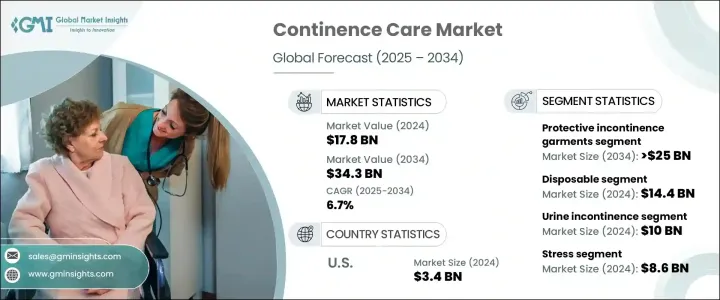
세계의 요실금 관리 시장은 2024년 178억 달러로 평가되었으며, 2025년부터 2034년까지 연평균 복합 성장률(CAGR) 6.7%를 나타낼 것으로 예측됩니다.
요실금, 방광의 문제, 관련 질환의 유병률 상승이 시장 성장의 원동력이 되고 있습니다. 제품 수요 증가에 기여하고 있습니다. 세계 보건기구(WHO)는 2050년까지 15억명 이상이 65세 이상의 노인이 될 것으로 추정하고 있으며, 효과적인 요실금 관리 솔루션의 필요성은 계속 증가할 것으로 보입니다.
헬스케어 인프라의 진보나 요실금 관리에 대한 의식의 고조도, 시장의 확대를 뒷받침하고 있습니다. 또한, 요실금에 관련된 편견이 서서히 희미해져, 다양한 연령층에서 요실금 관리 솔루션이 받아들여지게 되어 있습니다. 혁신은 적절한 요실금 관리 솔루션을 요구하는 개인을 더욱 강화하고 있습니다. 전자상거래 플랫폼은 소비자가 광범위한 요실금 관리 제품을 검토하고 필요에 맞는 제품을 선택할 수 있도록함으로써 제품에 대한 접근성을 향상시키는 데 매우 중요한 역할을 합니다.
시장 범위
시작 연도
2024년
예측 연도
2025-2034년
시작 금액
178억 달러
예측 금액
343억 달러
CAGR
6.7%
요실금 관리 시장은 흡수성 물품, 외용기구, 간헐 카테터 등 다양한 제품 카테고리로 구성되어 있습니다. 소비자는 개인적이고 효과적으로 요실금을 관리할 수 있는 눈에 띄지 않고 사용하기 쉬운 솔루션을 선택하게 되었습니다. 신흥국의 건강 관리 투자 증가는 요실금 관리 솔루션의 보급을 더욱 확대하고 개발 도상국의 사람들이 이러한 필수 제품에 액세스할 수 있도록 하고 있습니다.
주요 제품 범주 중에서 보호용 요실금의가 현저한 성장을 이룰 것으로 예상되고 있습니다. 이 부문은 CAGR 6.8%를 나타내며 2034년까지 250억 달러에 이를 것으로 예측됩니다. 범용성과 유효성에 의해 병원, 간병 시설, 재택 간병의 현장에서 널리 채용되고 있어, 요실금 관리 시장의 불가결한 일부가 되고 있습니다.
시장은 일회용 제품과 재사용 가능한 제품으로 나뉘어져 있으며 일회용 제품이 부문을 지배하고 있습니다. 세정이나 유지관리의 필요가 없기 때문에 고령자나 감염 대책이 최우선되는 임상 현장에서의 사용에 최적입니다. 그 실용성과 효율성에 의해 재택 간병 환경에서의 요실금 관리에 선호되는 선택지가 되어, 시장의 성장에 크게 기여하고 있습니다.
미국의 요실금 관리 시장은 요실금 문제를 안고 있는 노인 증가, 비만이나 전립선 질환 등의 기타 건강 상태에 견인되어, 2024년에는 34억 달러로 평가되었습니다. 제품에 대한 수요가 높아짐에 따라 시장의 성장을 뒷받침하고 있습니다. 이러한 제품이 소매점과 온라인 상점에서 판매되기 때문에 소비자에게 더 친숙해지고, 보급이 촉진되어 시장의 밝은 전망이 강해지고 있습니다.
목차
제1장 조사 방법과 조사 범위
제2장 주요 요약
제3장 업계 인사이트
생태계 분석
업계에 미치는 영향요인
성장 촉진요인
비뇨기 질환의 유병률 증가
각국 정부에 의한 지원 상환 정책
인구의 고령화에 수반하는 만성 질환 증가
최근 기술 진보 및 신제품 개발 동향
업계의 잠재적 위험 및 과제
사회적 낙인 및 환자의 거부감
제품 관련 합병증 및 부작용
성장 가능성 분석
규제 상황
기술 상황
상환 시나리오
소비자 행동 분석
갭 분석
Porter's Five Forces 분석
PESTEL 분석
향후 시장 동향
제4장 경쟁 구도
서론
기업 점유율 분석
기업 매트릭스 분석
경쟁 포지셔닝 매트릭스
전략 대시보드
제5장 시장 추계·예측 : 제품별(2021-2034년)
주요 동향
요실금 보호복
일회용 보호 속옷
일회용 성인용 기저귀
패브릭 성인용 기저귀
일회용 패드 및 라이너
남성용 가드
방광 조절 패드
요실금 라이너
벨트 부착 및 벨트 없는 속옷
일회용 언더패드
요도 카테터
유치(폴리) 카테터
간헐적 카테터
체외 카테터
요실금 페서리
링 페서리
겔혼 페서리
기타 페서리
요실금 슬링 및 메쉬
여성용 요실금 슬링 및 메쉬
남성용 요실금 슬링 및 메쉬
요실금 배수 가방
신경 자극
천골 신경 자극
전기 신경 자극
소변 주머니
다리 소변 주머니
침대 옆 소변 주머니
요실금 클램프
인공 괄약근
인공 요도 괄약근
인공 장 괄약근
제6장 시장 추계·예측 : 사용성별(2021-2034년)
주요 동향
일회용
재사용 가능
제7장 시장 추계·예측 : 용도별(2021-2034년)
주요 동향
요실금
대변실금
이중 요실금
제8장 시장 추계·예측 : 요실금 유형별(2021-2034년)
주요 동향
스트레스
혼합
절박
기타 요실금 유형
제9장 시장 추계·예측 : 질환별(2021-2034년)
주요 동향
여성 건강
임신 및 출산
폐경
자궁 절제술
기타 여성 질환
만성 질환
정신 장애
양성 전립선 비대증
방광암
기타 질환
제10장 시장 추계·예측 : 재료별(2021-2034년)
주요 동향
고흡수성
면직물
플라스틱
라텍스
기타 재료
제11장 시장 추계·예측 : 성별(2021-2034년)
주요 동향
여성
남성
제12장 시장 추계·예측 : 연령별(2021-2034년)
주요 동향
40-59세
60-79세
20-39세
80세 이상
20세 미만
제13장 시장 추계·예측 : 유통 채널별(2021-2034년)
주요 동향
소매점포
전자상거래
제14장 시장 추계·예측 : 최종 용도별(2021-2034년)
주요 동향
병원
간병 시설
장기 케어 센터
외래수술센터(ASC)
기타 최종 용도
제15장 시장 추계·예측 : 지역별(2021-2034년)
주요 동향
북미
미국
캐나다
유럽
독일
영국
프랑스
스페인
이탈리아
네덜란드
아시아태평양
중국
일본
인도
호주
한국
라틴아메리카
브라질
멕시코
아르헨티나
중동 및 아프리카
남아프리카
사우디아라비아
아랍에미리트(UAE)
제16장 기업 프로파일
ABENA
Attends Healthcare
B. Braun
BD
CardinalHealth
Coloplast
ConvaTec
Essity
First Quality
Fu Burg
Hollister
Kimberly-Clark
Medline
MRK Healthcare
Ontex
Paul Hartmann
Principle Business
Unicharm
Urocare
KTH
영문 목차
영문목차
The Global Continence Care Market was valued at USD 17.8 billion in 2024 and is anticipated to grow at a CAGR of 6.7% between 2025 and 2034. The rising prevalence of urinary incontinence, bladder issues, and related disorders is driving market growth. As the global population continues to age, conditions such as stress incontinence, Overactive Bladder (OAB), and neurogenic bladder problems are becoming more widespread, contributing to an increased demand for continence care products. With the World Health Organization (WHO) estimating that by 2050, over 1.5 billion people will be aged 65 or older, the need for effective continence care solutions will continue to rise.
Advances in healthcare infrastructure and increasing awareness about incontinence management are also supporting market expansion. Additionally, the stigma surrounding incontinence is gradually diminishing, leading to higher acceptance of continence care solutions across diverse age groups. Innovations in product design, including the development of discreet, comfortable, and odor-controlling garments, have further encouraged individuals to seek appropriate continence care solutions. E-commerce platforms have played a pivotal role in improving product accessibility, enabling consumers to explore a wide range of continence care products and select those that best meet their needs.
Market Scope
Start Year
2024
Forecast Year
2025-2034
Start Value
$17.8 Billion
Forecast Value
$34.3 Billion
CAGR
6.7%
The continence care market is composed of various product categories, including absorbent items, external devices, and intermittent catheters. The shift toward home care and self-managed healthcare is influencing the growing preference for non-invasive continence care devices. Consumers are increasingly opting for discreet and easy-to-use solutions that allow them to manage incontinence privately and effectively. Increased healthcare investments in emerging regions have further expanded the reach of continence care solutions, ensuring that individuals in developing countries can access these essential products. Moreover, technological advancements, such as sensor-based incontinence devices that provide real-time alerts, are reshaping the market by offering enhanced user experience and improved care.
Among the key product categories, protective incontinence garments are expected to witness notable growth. This segment is projected to grow at a CAGR of 6.8%, reaching USD 25 billion by 2034. These garments are designed to handle both urinary and fecal incontinence, offering high absorption, odor control, and superior comfort. They are widely adopted in hospitals, nursing homes, and home care settings due to their versatility and effectiveness, making them an integral part of the continence care market.
The market is further divided into disposable and reusable products, with disposable products dominating the segment. Disposable products generated USD 14.4 billion in 2024, largely due to their convenience and ease of use. These products eliminate the need for washing and maintenance, making them ideal for elderly individuals and those in clinical settings where infection control is a top priority. Their practicality and efficiency have made them a preferred choice for managing incontinence in home care settings, contributing significantly to market growth.
The U.S. continence care market was valued at USD 3.4 billion in 2024, driven by the rising number of older adults experiencing incontinence issues and other health conditions such as obesity and prostate ailments. The growing demand for innovative, easy-to-manage products, including super-absorbent materials and smart incontinence devices, is boosting market growth. The increased availability of these products in both retail and online stores has made them more accessible to consumers, encouraging greater adoption and reinforcing the market's positive outlook.
Table of Contents
Chapter 1 Methodology and Scope
1.1 Market scope and definitions
1.2 Research design
1.2.1 Research approach
1.2.2 Data collection methods
1.3 Base estimates and calculations
1.3.1 Base year calculation
1.3.2 Key trends for market estimation
1.4 Forecast model
1.5 Primary research and validation
1.5.1 Primary sources
1.5.2 Data mining sources
Chapter 2 Executive Summary
2.1 Industry 3600 synopsis
Chapter 3 Industry Insights
3.1 Industry ecosystem analysis
3.2 Industry impact forces
3.2.1 Growth drivers
3.2.1.1 Increasing prevalence of urologic disorders
3.2.1.2 Supportive reimbursement policies by governments
3.2.1.3 Increasing incidence of chronic diseases coupled with rising aging population
3.2.1.4 Recent technological advancements and new product developments
3.2.2 Industry pitfalls and challenges
3.2.2.1 Social stigma and patient reluctance
3.2.2.2 Product-related complications and side effects
3.3 Growth potential analysis
3.4 Regulatory landscape
3.5 Technology landscape
3.6 Reimbursement scenario
3.7 Consumer behaviour analysis
3.8 Gap analysis
3.9 Porter's analysis
3.10 PESTEL analysis
3.11 Future market trends
Chapter 4 Competitive Landscape, 2024
4.1 Introduction
4.2 Company market share analysis
4.3 Company matrix analysis
4.4 Competitive positioning matrix
4.5 Strategy dashboard
Chapter 5 Market Estimates and Forecast, By Product, 2021 – 2034 ($ Mn)
5.1 Key trends
5.2 Protective incontinence garments
5.2.1 Disposable protective underwears
5.2.2 Disposable adult diapers
5.2.3 Cloth adult diapers
5.2.4 Disposable pads and liners
5.2.4.1 Male guards
5.2.4.2 Bladder control pads
5.2.4.3 Incontinence liners
5.2.4.3.1 Belted and beltless under garments
5.2.4.3.2 Disposable under pads
5.3 Urinary catheters
5.3.1 Indwelling (foley) catheters
5.3.2 Intermittent catheter
5.3.3 External catheters
5.4 Incontinence pessaries
5.4.1 Ring pessaries
5.4.2 GellHorn pessaries
5.4.3 Other pessaries
5.5 Incontinence slings and meshes
5.5.1 Female incontinence slings and meshes
5.5.2 Male incontinence slings and meshes
5.6 Incontinence drainage bags
5.7 Nerve stimulation
5.7.1 Sacral nerve stimulation
5.7.2 Electrical nerve stimulation
5.8 Urine bags
5.8.1 Leg urine bags
5.8.2 Bedside urine bags
5.9 Incontinence clamps
5.10 Artificial sphincters
5.10.1 Artificial urinary sphincters
5.10.2 Artificial bowel sphincters
Chapter 6 Market Estimates and Forecast, By Usability, 2021 – 2034 ($ Mn)
6.1 Key trends
6.2 Disposable
6.3 Reusable
Chapter 7 Market Estimates and Forecast, By Application, 2021 – 2034 ($ Mn)
7.1 Key trends
7.2 Urine incontinence
7.3 Fecal incontinence
7.4 Dual incontinence
Chapter 8 Market Estimates and Forecast, By Incontinence Type, 2021 – 2034 ($ Mn)
8.1 Key trends
8.2 Stress
8.3 Mixed
8.4 Urge
8.5 Other incontinence types
Chapter 9 Market Estimates and Forecast, By Disease, 2021 – 2034 ($ Mn)
9.1 Key trends
9.2 Feminine health
9.2.1 Pregnancy and childbirth
9.2.2 Menopause
9.2.3 Hysterectomy
9.2.4 Other feminine health diseases
9.3 Chronic diseases
9.4 Mental disorders
9.5 Benign prostatic hyperplasia
9.6 Bladder cancer
9.7 Other diseases
Chapter 10 Market Estimates and Forecast, By Material, 2021 – 2034 ($ Mn)
10.1 Key trends
10.2 Super absorbents
10.3 Cotton fabrics
10.4 Plastic
10.5 Latex
10.6 Other materials
Chapter 11 Market Estimates and Forecast, By Gender, 2021 – 2034 ($ Mn)
11.1 Key trends
11.2 Female
11.3 Male
Chapter 12 Market Estimates and Forecast, By Age, 2021 – 2034 ($ Mn)
12.1 Key trends
12.2 40 to 59 years
12.3 60 to 79 years
12.4 20 to 39 years
12.5 80+ years
12.6 Below 20 years
Chapter 13 Market Estimates and Forecast, By Distribution Channel, 2021 – 2034 ($ Mn)
13.1 Key trends
13.2 Retail stores
13.3 E-commerce
Chapter 14 Market Estimates and Forecast, By End Use, 2021 – 2034 ($ Mn)
14.1 Key trends
14.2 Hospitals
14.3 Nursing facilities
14.4 Long term care centers
14.5 Ambulatory surgical centers
14.6 Other end use
Chapter 15 Market Estimates and Forecast, By Region, 2021 – 2034 ($ Mn)