


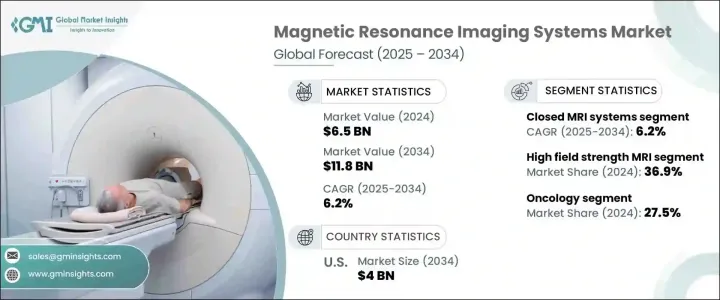
세계의 자기공명영상(MRI) 시스템 시장은 2024년에 65억 달러에 달했고, 2025년부터 2034년까지 연평균 복합 성장률(CAGR) 6.2%를 나타낼 것으로 예측됩니다.
MRI 기술은 강력한 자기장과 전파를 이용하여 체내 구조의 상세한 이미지를 생성하는 비침습적 이미징 기법으로 현대 진단에서 중요한 역할을 합니다. 다른 이미징 기술과는 달리, MRI는 절개나 전리 방사선에 대한 노출을 필요로 하지 않기 때문에 연부 조직의 정밀한 시각화에 적합합니다. 신경질환, 심혈관질환, 근골격계 질환 등의 만성질환 증가로 진보된 진단 솔루션에 대한 수요가 증가하고 있습니다.
자기공명영상(MRI) 시스템의 기술적 진보는 이미지 해상도 향상, 스캔 시간 단축, 환자 편의성 향상에 중점을 두고 시장 확대의 원동력이 되고 있습니다. MRI 이미징에 인공지능(AI)을 통합하면 이미지 판독을 자동화하고 편차를 줄임으로써 진단 정확도가 더욱 향상되었습니다. 또한 휴대용 MRI 시스템과 개방형 MRI 시스템으로의 이동으로 이동에 어려움이 있는 환자나 폐소 공포증 환자에서도 영상 진단을 이용할 수 있게 되었습니다. 헬스케어 투자 증가와 질병의 조기 발견의 중시가 함께 시장의 성장을 가속할 것으로 예상됩니다. 정부 및 민간 건강 관리 제공업체는 정밀 이미징에 대한 수요 증가에 대응하기 위해 최첨단 진단 장비에 투자하고 있습니다. 특히 신흥국에서는 헬스케어의 인프라 정비가 진행됨에 따라 고성능 MRI 시스템의 채용이 가속해 갈 것으로 보입니다.
| 시장 범위 | |
|---|---|
| 시작 연도 | 2024년 |
| 예측 연도 | 2025-2034년 |
| 시작 금액 | 65억 달러 |
| 예측 금액 | 118억 달러 |
| CAGR | 6.2% |
시장은 아키텍처에 따라 개방형 MRI 시스템과 폐쇄형 MRI 시스템으로 구분됩니다. 폐쇄형 MRI 시스템 분야는 예측 기간 동안 CAGR 6.2%를 나타낼 것으로 예측됩니다. 이 시스템은 완벽하게 밀폐된 원통형 설계로 외부 간섭 및 모션 아티팩트를 최소화하여 뛰어난 화질을 제공합니다. 폐쇄형 MRI 장치는 이상 검출에 정확한 영상화가 중요한 신경학 및 종양학의 고해상도 진단에 널리 사용됩니다. 최근의 기술 혁신은 보다 넓은 설계와 스캔 시간의 단축을 실현해, 폐소 공포증이나 촬상 처치중의 불쾌감에 대한 환자의 우려를 경감하고 있습니다.
MRI 시스템은 자기장 강도에 기초하여 저자계, 중자계, 고자계로 분류됩니다. 고자계 부문은 2024년에 36.9%의 점유율로 시장을 독점했고 앞으로도 주도적 지위를 유지할 것으로 예상됩니다. 일반적으로 1.5 테슬라 이상에서 작동하는 고자계 MRI 시스템은 매우 선명한 이미지를 제공하여 정확한 진단을 보장합니다. 이러한 시스템은 이미지의 충실도를 높이고, 왜곡을 줄이고, 스캔을 가속화하는 진보의 혜택을 받으며, 환자의 전반적인 경험을 크게 향상시킵니다. 병원과 영상 진단센터가 정밀 진단을 우선시함에 따라 고자계 MRI 기술에 대한 수요가 증가하고 있습니다.
미국의 자기공명영상(MRI) 시스템 시장은 최첨단 진단 기술에 대한 강한 주목으로 2034년까지 40억 달러를 창출할 것으로 예측됩니다. 미국 전역의 병원과 영상 진단센터는 진단 정확도와 효율성을 높이기 위해 차세대 MRI 장비에 많은 투자를 하고 있습니다. 미국의 건강 관리 부서는 AI와 머신러닝을 통합하고 워크플로우를 최적화하고 스캔 시간을 단축하는 고급 영상 진단 시스템으로 이동하고 있습니다. 환자의 예후 개선에 대한 요구가 증가함에 따라 MRI 기술의 확대는 의료 진단의 진화 상황에서 중요한 역할을 할 것으로 예상됩니다.
The Global Magnetic Resonance Imaging Systems Market reached USD 6.5 billion in 2024 and is set to grow at a CAGR of 6.2% between 2025 and 2034. MRI technology, a non-invasive imaging method that utilizes strong magnetic fields and radio waves to generate detailed images of the body's internal structures, plays a crucial role in modern diagnostics. Unlike other imaging techniques, MRI does not require incisions or exposure to ionizing radiation, making it a preferred choice for precise visualization of soft tissues. The rising prevalence of chronic diseases, including neurological disorders, cardiovascular conditions, and musculoskeletal issues, has intensified the demand for advanced diagnostic solutions.
Technological advancements in MRI systems are driving market expansion, with a focus on improved image resolution, shorter scan times, and enhanced patient comfort. The integration of artificial intelligence (AI) into MRI imaging has further refined diagnostic accuracy by automating image interpretation and reducing variability. Additionally, the shift toward portable and open MRI systems has made imaging more accessible for patients with mobility challenges or claustrophobia. Increasing healthcare investments, coupled with a growing emphasis on early disease detection, are expected to propel market growth. Governments and private healthcare providers are investing in cutting-edge diagnostic equipment to meet the rising demand for precision imaging. As healthcare infrastructure advances, particularly in emerging economies, the adoption of high-performance MRI systems will continue to accelerate.
| Market Scope | |
|---|---|
| Start Year | 2024 |
| Forecast Year | 2025-2034 |
| Start Value | $6.5 Billion |
| Forecast Value | $11.8 Billion |
| CAGR | 6.2% |
The market is segmented based on architecture into open and closed MRI systems. The closed MRI system segment is anticipated to grow at a 6.2% CAGR throughout the forecast period. These systems, characterized by fully enclosed cylindrical designs, deliver superior image quality by minimizing external interference and motion artifacts. Closed MRI machines are widely used for high-resolution diagnostics in neurology and oncology, where precise imaging is critical for detecting abnormalities. Recent innovations have led to more spacious designs and shorter scan durations, alleviating patient concerns about claustrophobia and discomfort during imaging procedures.
Based on field strength, MRI systems are categorized into low, mid, and high field strength. The high field strength segment dominated the market in 2024 with a 36.9% share and is expected to maintain its leading position. Typically operating above 1.5 Tesla, high-field MRI systems provide exceptional image clarity, ensuring accurate diagnostics. These systems benefit from advancements that enhance image fidelity, reduce distortions, and expedite scanning, significantly improving the overall patient experience. As hospitals and imaging centers prioritize precision diagnostics, the demand for high-field MRI technology continues to rise.
U.S. MRI systems market is projected to generate USD 4 billion by 2034, driven by a strong focus on cutting-edge diagnostic technologies. Hospitals and imaging centers across the country are making significant investments in next-generation MRI equipment to enhance diagnostic accuracy and efficiency. The U.S. healthcare sector is shifting toward more advanced imaging systems that integrate AI and machine learning, optimizing workflow and reducing scan times. As the demand for improved patient outcomes grows, the expansion of MRI technology is expected to play a key role in the evolving landscape of medical diagnostics.