자동차 전동 냉각수 밸브 시장 기회, 성장 촉진요인, 산업 동향 분석 및 예측(2025-2034년)
Automotive Electric Coolant Valve Market Opportunity, Growth Drivers, Industry Trend Analysis, and Forecast 2025 - 2034
상품코드:1664863
리서치사:Global Market Insights Inc.
발행일:2024년 12월
페이지 정보:영문 175 Pages
라이선스 & 가격 (부가세 별도)
ㅁ Add-on 가능: 고객의 요청에 따라 일정한 범위 내에서 Customization이 가능합니다. 자세한 사항은 문의해 주시기 바랍니다.
한글목차
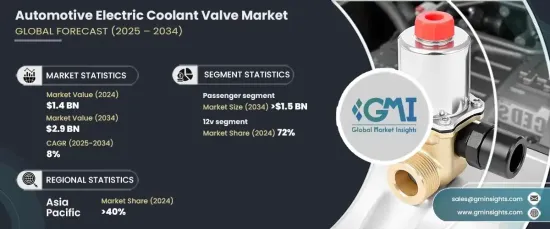
세계의 자동차 전동 냉각수 밸브 시장은 2024년에 14억 달러로 평가되었고, 2025년부터 2034년에 걸쳐 CAGR 8%로 견조하게 성장할 것으로 예측되고 있습니다.
이러한 성장의 원동력은 열 관리 시스템의 지속적인 발전이며, 최신 자동차, 특히 전기자동차 및 하이브리드 모델에서 효율적인 온도 조절이 점점 더 중요해지고 있습니다.
자동차 제조업체가 배출가스 감축과 연비 향상을 중시하는 가운데 혁신적인 기술에 대한 수요는 계속 증가하고 있습니다. 자동차 배출 가스 및 연비에 대한 엄격한 세계 규정은 제조업체가 최첨단 솔루션을 요구하도록 촉구하고 있습니다. 자동차 전동 냉각수 밸브는 이러한 전환에서 매우 중요한 역할을 하며 자동차 성능을 향상시킬 뿐만 아니라 환경에 미치는 영향을 줄이는 정확한 열 관리를 제공합니다.
시장 범위
시작 연도
2024년
예측 연도
2025-2034년
시작 금액
14억 달러
예측 금액
29억 달러
CAGR
8%
시장은 승용차와 상용차로 구분됩니다. 2024년에는 승용차가 전체 시장의 65%를 차지했으며 가장 큰 점유율을 차지했습니다. 저연비 모델과 함께 전기자동차 및 하이브리드 자동차에 대한 수요가 증가함에 따라 첨단 열 관리 시스템에 대한 요구가 높아지고 있습니다. 이러한 자동차는 성능 최적화, 안전성 향상 및 배터리 수명 연장을 위한 효과적인 온도 조절에 의존하며, 전동 냉각수 밸브는 파워트레인 및 배터리 시스템을 관리하는 중요한 구성 요소가 되었습니다.
전압별로 시장은 12V 시스템과 24V 시스템으로 구분됩니다. 12V 시스템은 2024년에 72%의 점유율을 차지하고 시장을 선도했습니다. 기존의 내연기관(ICE)차에 널리 채용되어 비용대비 효과도 높은 것이 그 우위성을 이야기하고 있습니다. 12V 전기 아키텍처는 기존 차량 시스템 및 부품과의 호환성을 보장하기 위해 자동차 업계에서 오랫동안 표준이되었습니다.
아시아태평양은 2024년 가장 규모가 큰 지역 시장으로 떠오르며 40%의 점유율을 획득했습니다. 이 지역의 주도적 지위는 세계 최대의 자동차 시장으로서의 지위, 전기자동차의 급속한 보급, 청정 에너지 및 배출 감축을 지원하는 정부 정책에 기인하고 있습니다. 주요 자동차 시장의 왕성한 수요는 견고한 제조 능력과 함께 아시아태평양 전역에서 전동 냉각수 밸브 채택의 성장을 가속화하고 있습니다.
자동차 전동 냉각수 밸브 시장은 진화하는 자동차 기술, 규제 압력 및 전동화 차량으로의 지속적인 이동으로 지속적인 성장이 예상됩니다. 자동차의 열 관리 시스템이 복잡해짐에 따라 전동 냉각수 밸브는 세계 시장에서 자동차의 효율성과 성능을 높이는 데 필수적인 역할을 할 것으로 보입니다.
목차
제1장 조사 방법과 조사 범위
조사 디자인
조사 접근
데이터 수집 방법
기본 추정과 계산
기준연도의 산출
시장추계의 주요 동향
예측 모델
1차 조사와 검증
1차 소스
데이터 마이닝 소스
시장 범위와 정의
제2장 주요 요약
제3장 업계 인사이트
업계 생태계 분석
원재료 공급자
부품 제조업체
기술 제공업체
유통업체
최종 사용자
공급자의 상황
이익률 분석
기술과 혁신의 전망
특허 분석
가격 분석
주요 뉴스·이니셔티브
규제 상황
영향요인
성장 촉진요인
전기자동차와 하이브리드 자동차의 채용 확대
배출가스 규제와 연비규제 강화
자동차 열 관리의 진보
전동 쿨런트 밸브 설계의 기술적 진보
업계의 잠재적 리스크·과제
높은 초기 비용
표준화의 부족
성장 가능성 분석
Porter's Five Forces 분석
PESTEL 분석
제4장 경쟁 구도
서론
기업의 시장 점유율 분석
경쟁 포지셔닝 매트릭스
전략 전망 매트릭스
제5장 시장 추계·예측 : 유형별(2021-2034년), 10억 달러
주요 동향
2way
3way
4way
기타
제6장 시장 추계·예측 : 차량별(2021-2034년), 10억 달러
주요 동향
승용차
ICE
전기자동차
상용차
LCV
HCV
전기자동차
오프로드 차량
제7장 시장 추계·예측 : 전압별(2021-2034년), 10억 달러
주요 동향
12v
24v
제8장 시장 추계·예측 : 기술별(2021-2034년), 10억 달러
주요 동향
기존
스마트
제9장 시장 추계·예측 : 판매 채널별(2021-2034년), 10억 달러
주요 동향
OEM
애프터마켓
제10장 시장 추계·예측 : 지역별(2021-2034년), 10억 달러
주요 동향
북미
미국
캐나다
유럽
영국
독일
프랑스
이탈리아
스페인
러시아
북유럽
아시아태평양
중국
인도
일본
호주
한국
동남아시아
라틴아메리카
브라질
멕시코
아르헨티나
중동 및 아프리카
UAE
남아프리카
사우디아라비아
제11장 기업 프로파일
Aisin Seiki
Bosch
Continental
Cummins
Denso
Hanon Systems
Hitachi
Mahle GmbH
Parker-Hannifin
PV Clean Mobility Technologies
Rheinmetall
Rotex Automation
Schaeffler Group
Schrader-Bridgeport International
Tenneco
Valeo SA
Vitesco Technologies
VOSS Fluid GmbH
Webasto Group
ZF Friedrichshafen
KTH
영문 목차
영문목차
The Global Automotive Electric Coolant Valve Market was valued at USD 1.4 billion in 2024 and is projected to grow at a robust CAGR of 8% from 2025 to 2034. This significant growth is driven by the ongoing advancements in thermal management systems, which are becoming increasingly crucial for efficient temperature regulation in modern vehicles, particularly electric and hybrid models.
As automakers emphasize reducing emissions and improving fuel efficiency, the demand for innovative technologies continues to rise. Stringent global regulations on vehicle emissions and fuel economy are pushing manufacturers to seek cutting-edge solutions. Automotive electric coolant valves play a pivotal role in this transition, offering precise thermal management that not only enhances vehicle performance but also reduces environmental impact.
Market Scope
Start Year
2024
Forecast Year
2025-2034
Start Value
$1.4 Billion
Forecast Value
$2.9 Billion
CAGR
8%
The market is divided into passenger and commercial vehicles. In 2024, passenger vehicles accounted for the largest share, with 65% of the total market. The growing demand for electric and hybrid vehicles, alongside fuel-efficient models, is driving the need for advanced thermal management systems. These vehicles rely on effective temperature regulation to optimize performance, enhance safety, and extend battery life-making electric coolant valves a key component in managing powertrain and battery systems.
By voltage, the market is segmented into 12V and 24V systems. The 12V segment led the market in 2024, holding a 72% share. Its widespread adoption in traditional internal combustion engine (ICE) vehicles, combined with its cost-effectiveness, explains its dominance. The 12V electrical architecture has long been the standard in the automotive industry, ensuring compatibility with existing vehicle systems and components.
Asia Pacific emerged as the largest regional market in 2024, capturing a 40% share. This region's leading position is driven by its status as the largest automotive market globally, rapid adoption of electric vehicles, and government policies supporting clean energy and emissions reduction. The strong demand from key automotive markets, along with robust manufacturing capabilities, continues to accelerate the growth of electric coolant valve adoption throughout Asia Pacific.
The automotive electric coolant valve market is set for sustained growth, driven by evolving automotive technologies, regulatory pressures, and the ongoing shift toward electrified vehicles. As thermal management systems in vehicles become more complex, electric coolant valves will play an essential role in boosting vehicle efficiency and performance across global markets.
Table of Contents
Chapter 1 Methodology & Scope
1.1 Research design
1.1.1 Research approach
1.1.2 Data collection methods
1.2 Base estimates & calculations
1.2.1 Base year calculation
1.2.2 Key trends for market estimation
1.3 Forecast model
1.4 Primary research and validation
1.4.1 Primary sources
1.4.2 Data mining sources
1.5 Market scope & definition
Chapter 2 Executive Summary
2.1 Industry 3600 synopsis, 2021 - 2034
Chapter 3 Industry Insights
3.1 Industry ecosystem analysis
3.1.1 Raw material suppliers
3.1.2 Component manufacturers
3.1.3 Technology providers
3.1.4 Distributors
3.1.5 End users
3.2 Supplier landscape
3.3 Profit margin analysis
3.4 Technology & innovation landscape
3.5 Patent analysis
3.6 Pricing analysis
3.7 Key news & initiatives
3.8 Regulatory landscape
3.9 Impact forces
3.9.1 Growth drivers
3.9.1.1 Increasing adoption of electric and hybrid vehicles
3.9.1.2 Stricter emissions and fuel efficiency regulations
3.9.1.3 Advancements in automotive thermal management
3.9.1.4 Technological advancements in electric coolant valve design