폴리하이드록시알카노에이트(PHA) 시장 : 시장 기회, 성장 요인, 산업 동향 분석 및 예측(2026-2035년)
Polyhydroxyalkanoate (PHA) Market Opportunity, Growth Drivers, Industry Trend Analysis, and Forecast 2026 - 2035
상품코드:1913352
리서치사:Global Market Insights Inc.
발행일:2025년 12월
페이지 정보:영문 210 Pages
라이선스 & 가격 (부가세 별도)
ㅁ Add-on 가능: 고객의 요청에 따라 일정한 범위 내에서 Customization이 가능합니다. 자세한 사항은 문의해 주시기 바랍니다.
한글목차
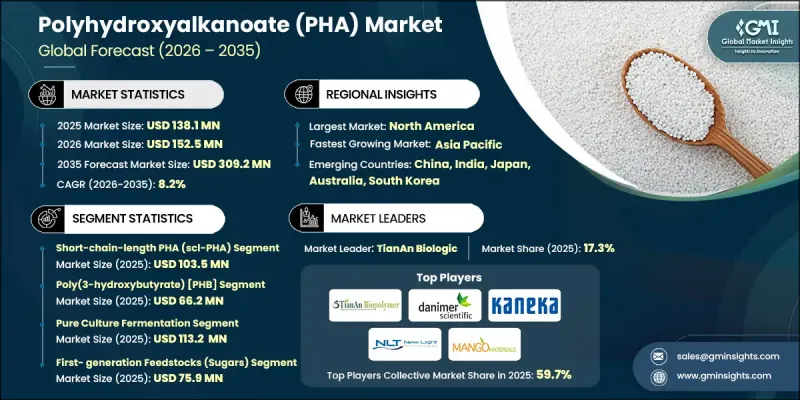
세계의 폴리하이드록시알카노에이트(PHA) 시장은 2025년에 1억 3,810만 달러로 평가되었고, 2035년까지 연평균 복합 성장률(CAGR) 8.2%로 성장할 전망이며, 3억 920만 달러에 이를 것으로 예측됩니다.
PHA는 미생물이 에너지 저장 화합물로 생성하는 천연 유래 생분해성 고분자입니다. 과도한 탄소와 제한된 영양소 조건 하에서 미생물은 기존 플라스틱과 매우 유사한 특성을 가진 PHA를 합성합니다. 이 폴리머는 석유 유래 플라스틱을 대체하는 환경 친화적인 생체 적합성 대체품으로 부상하며 지속 가능한 용도 분야에서 매우 중요한 위치를 차지합니다. 발효 기술의 진보, 유전자 공학, 저비용 원료의 이용에 의해 상업 규모에서의 PHA 생산이 경제적으로 실현 가능하게 되어, 기존 플라스틱과 생분해성 소재 사이의 갭을 메우고 있습니다. 이 기술적 진보로 포장, 의료, 농업, 소비재 등 PHA의 용도 분야가 확대되고 있습니다. PHA가 토양, 담수 및 해양 환경에서 생분해되는 특성은 환경 오염을 줄이고 재생 가능 원료의 사용은 순환 바이오 이코노미를 지원합니다. 지속 가능한 소재에 대한 수요 증가와 플라스틱 폐기물 감축을 중시하는 규제가 시장의 보급을 촉진하고 새로운 혁신을 뒷받침하고 있습니다.
시장 범위
시작 연도
2025년
예측 연도
2026-2035년
시작 시 가치
1억 3,810만 달러
예측 금액
3억 920만 달러
CAGR
8.2%
단쇄 PHA(scl-PHA) 부문은 2025년 1억 350만 달러를 차지했습니다. scl-PHA에 대한 높은 수요는 기계적 강도, 생분해성 및 포장, 농업, 수의학 용도 분야와 같은 분야의 다양성에 기인합니다. 확립된 제조 방법은 비용 효율적이고 쉽게 스케일업이 가능하기 때문에 플라스틱 폐기물의 감소를 목표로 하는 산업에 선호되는 솔루션으로 자리매김하고 있습니다.
폴리(3-하이드록시부티르산)(PHB) 부문은 2025년에 6,620만 달러에 달했습니다. PHB 및 폴리(3-하이드록시부티레이트-코-3-하이드록시발레레이트)(PHBV)와 같은 공중합체는 우수한 기계적 특성과 생분해성으로 인해 주목받고 있습니다. PHB는 주로 포장재나 농업용 필름에 사용되는 한편, PHBV는 유연성과 인성이 향상되어 의료기기 및 소비재에 대한 용도가 가능합니다. 낮은 생산 비용 및 안정적인 수요가 결합되어 이러한 중합체 시장 성장은 지속될 것으로 예측됩니다.
북미의 폴리하이드록시알카노에이트(PHA) 시장은 2025년 3,860만 달러 규모에 이르렀습니다. 이 지역에서는 브랜드가 지속가능성에 주력하는 동안 재생 가능하고 생분해성 소재의 채용이 증가하고 있습니다. 푸드 서비스 산업 및 소비재 제조업체 수요 증가 외에도 견고한 연구개발 생태계 및 발효 공정의 조종사 규모 최적화가 시장 침투를 가속화하고 있습니다. 주요 소매 체인의 관심도 채용 동향을 더욱 뒷받침하고 있습니다.
목차
제1장 조사 방법 및 범위
제2장 주요 요약
제3장 업계 인사이트
생태계 분석
공급자의 상황
이익률
각 단계에서의 부가가치
밸류체인에 영향을 주는 요인
혁신
업계에 미치는 영향요인
성장 촉진요인
생분해성 플라스틱 수요 증가
미생물 발효에 있어서의 기술적 진보
최종 이용 산업 확대
업계의 잠재적 위험 및 과제
화석 유래 플라스틱에 비해 높은 생산 비용
기타 바이오플라스틱과 경쟁 구도
시장 기회
고성능 PHA 블렌드
프리미엄 환경 배려 제품
순환형 경제에 대한 통합
성장 가능성 분석
규제 상황
북미
유럽
아시아태평양
라틴아메리카
중동 및 아프리카
Porter's Five Forces 분석
PESTEL 분석
기술 및 혁신 동향
현재 기술 동향
신흥 기술
가격 동향
지역별
사슬 길이 분류별
장래 시장 동향
기술 및 혁신 동향
현재 기술 동향
신흥 기술
특허 동향
무역 통계(HS코드)(참고 : 무역 통계는 주요 국가에서만 제공됨)
주요 수입국
주요 수출국
지속가능성 및 환경면
지속가능한 대처
폐기물 감축 전략
생산에 있어서 에너지 효율
환경에 배려한 대처
탄소발자국 고려
제4장 경쟁 구도
서문
기업의 시장 점유율 분석
지역별
북미
유럽
아시아태평양
라틴아메리카
중동 및 아프리카
기업 매트릭스 분석
주요 시장 기업의 경쟁 분석
경쟁 포지셔닝 매트릭스
주요 발전
합병 및 인수
제휴 및 협업
신제품 발매
확대 계획
제5장 시장 추계 및 예측 : 쇄장별 분류(2022-2035년)
단쇄 PHA(scl-PHA)
중쇄 PHA(mcl-PHA)
장쇄 PHA(lcl-PHA)
제6장 시장 추계 및 예측 : 폴리머 유형별(2022-2035년)
폴리(3-하이드록시부티르산)(PHB)
폴리(3-하이드록시부티르산-코-3-하이드록시발레르산)(PHBV)
폴리(3-하이드록시부티르산-공-4-하이드록시부티르산)(P3H4B)
폴리(3-하이드록시부티르산-코-3-하이드록시헥산산)(PHBH)
기타 PHA 폴리머 (P(3HB-co-3HP), P(3HB-co-LA))
제7장 시장 추계 및 예측 : 생산 방법별(2022-2035년)
순수 배양 발효
혼합 미생물 배양(MMC)
호염성 및 극한 환경 미생물 생산
유전자 변형 시스템
제8장 시장 추계 및 예측 : 원료 유형별(2022-2035년)
제1세대 원료(당류)
제2세대 원료(식물성 기름)
제3세대 원료(폐기물류)
차세대 원료(CO2, CO, CH4, C1 화합물)
제9장 시장 추계 및 예측 : 용도별(2022-2035년)
포장 용도
경질 포장
플렉서블 필름
기타
바이오메디컬 용도
의료기기
외과용 봉합사
기타
농업 용도
멀티 필름
씨앗 코팅
기타
섬유 용도
섬유 및 실
부직포
기타
소비재
화장품 포장
장난감 및 오락 제품
기타
기타 산업 용도
제10장 시장 추계 및 예측 : 지역별(2022-2035년)
북미
미국
캐나다
유럽
독일
영국
프랑스
스페인
이탈리아
기타 유럽
아시아태평양
중국
인도
일본
호주
한국
기타 아시아태평양
라틴아메리카
브라질
멕시코
아르헨티나
기타 라틴아메리카
중동 및 아프리카
사우디아라비아
남아프리카
아랍에미리트(UAE)
기타 중동 및 아프리카
제11장 기업 프로파일
Biomer
Bluepha
CJ BIO(CJ CheilJedang)
Danimer Scientific
Full Cycle Bioplastics
Kaneka Corporation
Mango Materials
Newlight Technologies
Paques Biomaterials
PhaBuilder
Phangel Biotechnology
Tepha Inc.
TianAn Biologic
Tianjin Green-Bio
Weining Biotechnology
Yield10 Bioscience
AJY
영문 목차
영문목차
The Global Polyhydroxyalkanoate (PHA) Market was valued at USD 138.1 million in 2025 and is estimated to grow at a CAGR of 8.2% to reach USD 309.2 million by 2035.
PHAs are naturally occurring biodegradable polymers produced by microorganisms as energy-storage compounds. Under conditions of excess carbon and limited nutrients, microorganisms synthesize PHAs with properties closely resembling conventional plastics. These polymers have emerged as eco-friendly and biocompatible alternatives to petroleum-based plastics, making them highly relevant for sustainable applications. Advances in fermentation, genetic engineering, and the use of low-cost feedstocks have made commercial-scale PHA production economically feasible, bridging the gap between traditional plastics and biodegradable options. This technological progress has expanded PHA applications across packaging, medical, agricultural, and consumer products. The ability of PHAs to biodegrade in soil, freshwater, and marine environments reduces environmental pollution, while renewable feedstock utilization supports a circular bioeconomy. Growing demand for sustainable materials and regulatory emphasis on reducing plastic waste are driving market adoption and encouraging further innovation.
Market Scope
Start Year
2025
Forecast Year
2026-2035
Start Value
$138.1 Million
Forecast Value
$309.2 Million
CAGR
8.2%
The short-chain-length PHAs (scl-PHA) segment accounted for USD 103.5 million in 2025. The high demand for scl-PHAs stems from their mechanical strength, biodegradability, and versatility across sectors such as packaging, agriculture, and veterinary applications. Their established production methods make them cost-efficient and readily scalable, positioning them as a preferred solution for industries aiming to reduce plastic waste.
The poly(3-hydroxybutyrate) [PHB] segment reached USD 66.2 million in 2025. PHB and its copolymers, such as Poly(3-hydroxybutyrate-co-3-hydroxyvalerate) (PHBV), are gaining traction due to favorable mechanical properties and biodegradability. PHB is primarily used in packaging and agricultural films, while PHBV's enhanced flexibility and toughness enable applications in medical and consumer goods. The combination of low production costs and steady demand ensures sustained market growth for these polymers.
North America Polyhydroxyalkanoate (PHA) Market generated USD 38.6 million in 2025. The region is witnessing increased adoption of renewable and biodegradable materials as brands focus on sustainability. Rising demand from food-service and consumer goods manufacturers, coupled with robust R&D ecosystems and pilot-scale optimization of fermentation processes, is accelerating market penetration. Interest from major retail chains is further reinforcing adoption trends.
Key players in the Global Polyhydroxyalkanoate (PHA) Market include Biomer, Bluepha, CJ BIO (CJ CheilJedang), Danimer Scientific, Full Cycle Bioplastics, Kaneka Corporation, Mango Materials, Newlight Technologies, Paques Biomaterials, PhaBuilder, Phangel Biotechnology, Tepha Inc., TianAn Biologic, Tianjin Green-Bio, Weining Biotechnology, and Yield10 Bioscience. Companies in the Global Polyhydroxyalkanoate (PHA) Market are strengthening their presence by investing heavily in R&D to improve fermentation efficiency, reduce production costs, and enhance polymer properties. Strategic partnerships with research institutions and industrial stakeholders enable the co-development of application-specific products. Expanding production capacities, adopting low-cost and renewable feedstocks, and developing scalable commercial processes help increase market reach.
Table of Contents
Chapter 1 Methodology & Scope
1.1 Market scope and definition
1.2 Research design
1.2.1 Research approach
1.2.2 Data collection methods
1.3 Data mining sources
1.3.1 Global
1.3.2 Regional/Country
1.4 Base estimates and calculations
1.4.1 Base year calculation
1.4.2 Key trends for market estimation
1.5 Primary research and validation
1.5.1 Primary sources
1.6 Forecast model
1.7 Research assumptions and limitations
Chapter 2 Executive Summary
2.1 Industry 3600 synopsis
2.2 Key market trends
2.2.1 Chain Length Classification
2.2.2 Copolymer Type
2.2.3 Production Method
2.2.4 Feedstock Type
2.2.5 Application
2.2.6 Regional
2.3 TAM Analysis, 2025-2035
2.4 CXO perspectives: Strategic imperatives
2.4.1 Executive decision points
2.4.2 Critical success factors
2.5 Future outlook and strategic recommendations
Chapter 3 Industry Insights
3.1 Industry ecosystem analysis
3.1.1 Supplier landscape
3.1.2 Profit margin
3.1.3 Value addition at each stage
3.1.4 Factor affecting the value chain
3.1.5 Disruptions
3.2 Industry impact forces
3.2.1 Growth drivers
3.2.1.1 Rising demand for biodegradable plastics
3.2.1.2 Technological advancements in microbial fermentation
3.2.1.3 Expansion of end-use industries
3.2.2 Industry pitfalls and challenges
3.2.2.1 High production cost compared to fossil-based plastics
3.2.2.2 Competition from other bioplastics
3.2.3 Market opportunities
3.2.3.1 High-performance PHA blends
3.2.3.2 Premium eco-friendly products
3.2.3.3 Circular economy integration
3.3 Growth potential analysis
3.4 Regulatory landscape
3.4.1 North America
3.4.2 Europe
3.4.3 Asia Pacific
3.4.4 Latin America
3.4.5 Middle East & Africa
3.5 Porter's analysis
3.6 PESTEL analysis
3.7 Technology and innovation landscape
3.7.1 Current technological trends
3.7.2 Emerging technologies
3.8 Price trends
3.8.1 By region
3.8.2 By chain length classification
3.9 Future market trends
3.10 Technology and innovation landscape
3.10.1 Current technological trends
3.10.2 Emerging technologies
3.11 Patent landscape
3.12 Trade statistics (HS code) (Note: the trade statistics will be provided for key countries only)
3.12.1 Major importing countries
3.12.2 Major exporting countries
3.13 Sustainability and environmental aspects
3.13.1 Sustainable practices
3.13.2 Waste reduction strategies
3.13.3 Energy efficiency in production
3.13.4 Eco-friendly initiatives
3.14 Carbon footprint consideration
Chapter 4 Competitive Landscape, 2025
4.1 Introduction
4.2 Company market share analysis
4.2.1 By region
4.2.1.1 North America
4.2.1.2 Europe
4.2.1.3 Asia Pacific
4.2.1.4 LATAM
4.2.1.5 MEA
4.3 Company matrix analysis
4.4 Competitive analysis of major market players
4.5 Competitive positioning matrix
4.6 Key developments
4.6.1 Mergers & acquisitions
4.6.2 Partnerships & collaborations
4.6.3 New product launches
4.6.4 Expansion plans
Chapter 5 Market Estimates and Forecast, By Chain Length Classification, 2022-2035 (USD Million) (Kilo Tons)
5.1 Key trends
5.2 Short-Chain-Length PHA (scl-PHA)
5.3 Medium-Chain-Length PHA (mcl-PHA)
5.4 Long-Chain-Length PHA (lcl-PHA)
Chapter 6 Market Estimates and Forecast, By Copolymer Type, 2022-2035 (USD Million) (Kilo Tons)