


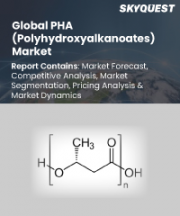
폴리하이드록시알카노에이트(PHA) 시장 규모는 2024년에 9,384만 달러로 평가되며, 2025년 9,872만 달러에서 2033년까지 1억 4,809만 달러로 성장할 전망입니다. 예측 기간(2026-2033년)의 CAGR은 5.2%로 예측됩니다.
시장 동향에 따르면 박테리아 발효를 통해 생산되는 신흥 생분해성 고분자인 폴리하이드록시알카노에이트(PHA)는 괄목할 만한 성장세를 보이고 있습니다. 이 소재들은 생분해성과 퇴비화가 가능하므로 기존의 석유 유래 플라스틱을 대체할 수 있는 지속가능한 대안이 되어 환경 부하와 플라스틱 오염을 줄이는 데 기여할 수 있습니다. PHA는 강도와 유연성에서 기존 플라스틱을 모방하여 포장재에서 의료기기까지 다양한 용도로 사용할 수 있습니다. 제조기술의 발전으로 특성과 효율성이 향상되어 경쟁력이 강화되고 있습니다. 지속가능한 소재에 대한 소비자 수요 증가를 배경으로 산업 전반의 투자와 협업이 증가하면서 PHA 시장의 성장이 더욱 가속화되고 있습니다. 그러나 폐기물 관리 인프라 강화의 필요성, 기존 플라스틱 제조에 비해 비용적인 측면에서의 불리함 등의 과제가 여전히 존재하여 보급 확대에 걸림돌이 될 수 있습니다.
PHA(폴리 하이드록시 알카노 에이트) 시장 성장 촉진요인
폴리하이드록시알카노에이트(PHA) 세계 시장은 특히 제조 기술 및 제품 개발에서 PHA 기술의 발전에 의해 크게 견인되고 있습니다. 발효 공정의 혁신으로 더 높은 수율의 PHA를 생산하는 새로운 미생물 균주를 사용할 수 있게 되었으며, 동시에 효율적이고 비용 효율적인 방법을 확립할 수 있게 되었습니다. PHA의 범용성으로 인해 포장, 섬유, 의료기기, 건설 등 다양한 분야에 적용되고 있습니다. 생분해성 식품 포장 및 3D 프린팅 재료와 같은 새로운 용도의 출현은 지속가능한 솔루션으로서의 잠재력을 부각시키고 있습니다. 또한 폐기물을 포함한 다양한 원료의 사용은 지속가능성을 높이고 비용 절감으로 이어져 시장 성장을 더욱 촉진하고 있습니다.
PHA(폴리하이드록시알카노에이트) 시장 성장 억제요인
세계 PHA(폴리하이드록시알카노에이트) 시장이 직면한 가장 큰 문제는 효과적인 PHA 폐기물 관리를 위한 인프라가 부족하다는 것입니다. PHA는 생분해성이지만, 그 분해에는 고온, 습도, 적절한 미생물 등 특정 조건이 필요합니다. 현재 PHA 폐기물을 적절히 관리하고 퇴비화할 수 있는 시설이 부족하여 PHA 기반 솔루션을 도입하고자 하는 기업이나 친환경적인 폐기 방법을 원하는 소비자들에게 장애가 되고 있습니다. 또한 PHA 폐기물에 혼입된 다른 물질이 분해 과정을 방해하여 오염을 유발할 수 있습니다. 이러한 폐기물 관리 인프라의 부재는 기업이 PHA 생산을 확대하는 동시에 소비자를 위한 책임감 있는 폐기 방법을 보장하기 위한 노력을 복잡하게 만들고 있습니다.
PHA(폴리하이드록시알카노에이트) 시장 동향
PHA(폴리하이드록시알카노에이트) 시장은 특히 포장 분야에서 두드러진 상승세를 보이고 있습니다. 이는 기존 플라스틱이 환경에 미치는 악영향에 대한 대응으로 지속가능한 소재를 찾는 소비자 수요가 증가하고 있는 것이 그 배경입니다. 플라스틱 오염에 대한 경각심이 높아지는 가운데 생분해성과 퇴비화성을 갖추고 미세 플라스틱 오염을 발생시키지 않고 분해 가능한 특성으로 인해 각 산업계는 PHA로의 전환을 추진하고 있습니다. 이러한 변화는 친환경 대체품 촉진을 위한 규제 압력에 의해 더욱 가속화되고 있습니다. PHA가 기존 플라스틱과 동등한 물리적 특성을 보이고, 응용 분야에 특화된 혁신적인 PHA 제품이 개발됨에 따라 더 많은 기업이 지속가능한 포장 솔루션에 투자할 것으로 예상되며, PHA는 친환경 소재의 미래에서 주요한 역할을 확고히할 것으로 예측됩니다.
PHA (Polyhydroxyalkanoates) Market size was valued at USD 93.84 Million in 2024 and is poised to grow from USD 98.72 Million in 2025 to USD 148.09 Million by 2033, growing at a CAGR of 5.2% during the forecast period (2026-2033).
Market insights indicate a significant growth trajectory for Polyhydroxyalkanoates (PHAs), an emerging class of biodegradable polymers produced through bacterial fermentation. These materials offer a sustainable alternative to conventional petroleum-based plastics due to their biodegradability and compostability, which mitigate environmental impact and plastic pollution. PHAs mimic traditional plastics in strength and flexibility, facilitating diverse applications, from packaging to medical devices. Advances in production technology are enhancing their competitiveness by improving properties and efficiency. Increased investment and collaboration across industries are further propelling PHA market growth, driven by rising consumer demand for sustainable materials. Nonetheless, challenges persist, notably the need for enhanced waste management infrastructure and the current cost disadvantage compared to traditional plastic manufacturing, which may impede broader adoption.
Top-down and bottom-up approaches were used to estimate and validate the size of the PHA (Polyhydroxyalkanoates) market and to estimate the size of various other dependent submarkets. The research methodology used to estimate the market size includes the following details: The key players in the market were identified through secondary research, and their market shares in the respective regions were determined through primary and secondary research. This entire procedure includes the study of the annual and financial reports of the top market players and extensive interviews for key insights from industry leaders such as CEOs, VPs, directors, and marketing executives. All percentage shares split, and breakdowns were determined using secondary sources and verified through Primary sources. All possible parameters that affect the markets covered in this research study have been accounted for, viewed in extensive detail, verified through primary research, and analyzed to get the final quantitative and qualitative data.
PHA (Polyhydroxyalkanoates) Market Segments Analysis
Global PHA (Polyhydroxyalkanoates) Market is segmented by Product, PHA Type, Production Methods, Application and region. Based on Product, the market is segmented into Short chain length, Medium chain length and Long chain length. Based on PHA Type, the market is segmented into P3H4B +PHB, PHBH and PHBV. Based on Production Methods, the market is segmented into Sugar fermentation, Vegetable oil fermentation, Heterogeneous waste streams and Others. Based on Application, the market is segmented into Packaging & food services, Biomedical, Agriculture, Biofuel, Drug delivery Carriers and Others. Based on region, the market is segmented into North America, Europe, Asia Pacific, Latin America and Middle East & Africa.
Driver of the PHA (Polyhydroxyalkanoates) Market
The global market for Polyhydroxyalkanoates (PHA) is being significantly driven by advancements in PHA technology, particularly in production and product development. Innovations in fermentation processes have led to the utilization of new microbial strains that yield higher quantities of PHA, alongside more efficient and cost-effective methods. PHA's versatility allows it to be applied in diverse sectors, including packaging, textiles, medical devices, and construction. The emergence of new applications, such as biodegradable food packaging and materials for 3D printing, highlights its potential for sustainable solutions. Additionally, using various feedstocks, including waste materials, enhances sustainability and reduces costs, further bolstering market growth.
Restraints in the PHA (Polyhydroxyalkanoates) Market
A significant challenge facing the global PHA (Polyhydroxyalkanoates) market is the insufficient infrastructure for effective PHA waste management. Although PHA is biodegradable, its decomposition necessitates specific conditions, including elevated temperatures, moisture, and suitable microorganisms. The current lack of facilities for properly managing and composting PHA waste poses obstacles for businesses eager to implement PHA-based solutions and for consumers seeking eco-friendly disposal methods. Additionally, the presence of other materials mixed with PHA waste can hinder the decomposition process, potentially leading to contamination. This inadequacy in waste management infrastructure complicates efforts for companies to scale PHA production while ensuring responsible disposal practices for consumers.
Market Trends of the PHA (Polyhydroxyalkanoates) Market
The PHA (Polyhydroxyalkanoates) market is witnessing a significant upward trend, particularly in the packaging sector, driven by an increasing consumer demand for sustainable materials in response to the detrimental environmental effects of traditional plastics. As awareness around plastic pollution heightens, industries are gravitating towards PHAs due to their biodegradable and compostable nature, which enables them to decompose without contributing to microplastic pollution. This shift is further fueled by regulatory pressures aimed at promoting eco-friendly alternatives. With PHAs demonstrating comparable physical properties to conventional plastics and the development of innovative, application-specific PHA products, more companies are expected to invest in sustainable packaging solutions, solidifying PHA's position as a key player in the future of environmentally-conscious materials.