ZED(Zero Energy Device) : 자가충전 및 후방산란 전력을 이용한 전자 및 전기기기 시장 및 기술(2024-2044년)
Zero Energy Devices ZED: Self-powered and Backscatter-Powered Electronics and Electrics Markets, Technology 2024-2044
상품코드:1444975
리서치사:Zhar Research
발행일:2024년 02월
페이지 정보:영문 408 Pages
라이선스 & 가격 (부가세 별도)
한글목차
보고서 통계
SWOT 평가:
7
장 구성:
12
2024-2044년 예측 라인:
65
기업 수:
90
인포그램, 표, 그래프:
113
이 보고서는 ZED(Zero Energy Device)의 기술 및 응용 분야를 조사하고, 기술의 정의, 배경, 성공 사례, 6G 통신에서의 ZED의 잠재력, 무선 센서, IoT 및 기타 전자기기를 위한 ZED의 발전, ZED를 위한 에너지 하베스팅 시스템 개발, 각종 연구 파이프라인의 개요 등을 정리하고 있습니다.
목차
제1장 주요 요약·결론
본 보고서의 목적과 범위
조사 방법
정의·목적
18개 주요 결론
현재 ZED 성공 사례
ZED를 향한 최적인 기술 전략
통신 세대 진보에 의한 ZED 기회가 증가
센서 ZED를 향한 진행 상황
ZED와 그 실현 기술 로드맵
시장 예측
제2장 ZED(Zero Energy Device)의 정의, 예, 향후 요구
개요
ZED로 향하는 이유
ZED의 다양한 정의
ZED의 배경: 중복 및 인접 기술, 장수명 에너지를 통한 자립의 사례
호스트 장비의 수명을 연장하는 전기적 자율성의 사례
전자기기의 전력 소비 증가와 ZED 전략
전력 소비와 배터리 문제를 줄이기 위한 전략
ZED의 온보드 에너지 수확: 경량화, 소형화, 비용 절감, 고장 모드 및 유해 물질 감소를 위해 단순화되고 있다.
그리드 기반 전력에 대한 전자제품의 수요 증가를 막는 방법
IoT: 실패의 교훈과 성공의 가능성
에너지 수확 소개
ZED 센서가 새로운 수요로 주목받는 이유
유연하고 계층화된 2D 에너지 하베스팅과 센싱의 중요성
자가 충전식 센서와 통합형 센서
통신 세대가 ZED에 대한 기회를 증가시키는 방법
제3장 6G 통신의 RIS, CPE, 클라이언트 디바이스에 의한 ZED의 기회
개요
왜 6G가 필요한가?
6G의 디스럽티브 측면
주요 기업의 반대 의견, 향후 과제, 목표
비용 문제
6G ZED 및 6G용 무선 전력 공급 IoE 옵션에 대한 3GPP의 비전
6G 전송 하드웨어가 5G보다 훨씬 더 나은 성능을 제공하는 메커니즘
6G를 지원하는 최근 하드웨어의 발전
장비와 엣지 디바이스가 ZED가 될 수 있는 6G 통신의 기회
6G 통신의 특정 ZED 요구사항
연구 파이프라인의 6G ZED
현재 알려진 6G 통신의 SWOT 평가
6G 일반 로드맵
제4장 무선 센서, IoT, 퍼스널 일렉트로닉스, 기타 일렉트로닉스에 관한 ZED의 진보
센서 ZED를 향한 기본과 발전: 개요
IoT 노드와 개념
시장의 진화: 측정되는 센서 파라미터는 다면적이고, 수요는 급변하고 있다.
센서 ZED를 향한 발전: 자가 충전 및 자가 감지 장치
스마트 센서의 구조와 목적
자가충전 센서 및 ZED 센서 연구 파이프라인의 예시
ZED를 향한 진전: 개인용 전자제품, 산업용 및 전문가용 전자기기
배터리 기반 ZED 개인용 전자기기 및 기타 전기 및 전자기기 예시
ZED 웨어러블의 발전
제5장 배터리 없이 장착하는 ZED: 실현 전략
개요
배터리 역풍
ZED 활성화
ZED를 위한 에너지 수확 시스템 설계
제6장 초저소비 전력 일렉트로닉스, 센서, 전기기기
개요
초저소비 전력 일렉트로닉스
초저소비 전력 판독 인터페이스와 다기능 일렉트로닉스
초저소비 전력 포노닉 인센서 컴퓨팅
6G 통신의 에너지 효율 향상: 유럽위원회 Hexa-X 프로젝트
ZED의 정적 컨텍스트 헤더 압축과 단편화
기타 에너지 효율적 센싱, 처리, IoT를 위한 새로운 전력 전송 옵션
초저소비 전력 집적회로
나노 파워 nPZero
Everactive: ZED IoT용 초저소비 전력 회로
2 nm 칩과 그 너머: 미국, 대만, 중국, 일본
Ericsson Research와 MIT 리튬이온 칩
Move-X의 MAMWLE : 초저소비 전력 무선 모듈
초저소비 전력 스마트폰
ZED로서의 메타물질 및 메타표면 또는 ZED 유효화
정의와 범위
메타물질 ZED 윈도우
6G RIS ZED 및 기타 목적을 위한 메타표면
6G 통신 RIS의 기회 : SWOT 평가
제7장 요청이 있을 때만 전용 디바이스에 전력을 공급 : 백스캐터, SWIPT, WIET, EAS용 WPT, RFID, IoT, 6G 통신, 기타 전자기기
개요: 백스캐터, EAS, RFID, 6G SWIPT
앰비언트 백스캐터 통신을 위한 AmBC와 군중 감지 가능한 CD-ZED
하이브리드 빔포밍 기반의 SWIPT
스토리지 제거 회로 및 인프라: SWOT 평가
추가 연구: 최근 논문 47편
제8장 전자파 하베스팅 : 태양광발전에서 전력 디바이스로
개요
주파수별 전자기 에너지 하베스팅 툴킷: 태양광 발전
단위 부피 및 단위 면적당 태양광 발전량 증가를 위한 전략
ZED 태양광 발전의 핵심 파라미터
단일 접합 효율의 한계
태양전지 효율 동향
비용 절감 경험 곡선
2024년부터 2044년까지 진화하는 몇 가지 형태 옵션
pn 접합 태양 광 발전과 다른 옵션과의 비교
페로브스카이트 태양광 발전
ZED로 태양광을 갖춘 통합 MEMS
더 많은 곳에서 실현 가능하고 저렴한 태양광 발전: 예시
배터리가 필요 없는 태양광 ZED로 가는 길: 테이프, IoT, 카메라
스마트워치의 투명 및 불투명 태양광 발전
감지 및 IoT를 위한 배터리 없는 드론 비행을 위한 태양광 발전
ZED를 위한 태양광 발전: SWOT 평가
추가 연구 논문 및 이벤트
제9장 앰비언트 전자파 하베스팅 : 기존 방사 재이용에 의한 디바이스 및 통신용 RF 하베스팅
개요
주파수별 전자 에너지 수확 툴킷 : RF
인공 앰비언트 RF 방사를 수집해 차량내 전력을 생성하는 디바이스
베이직 RF 하베스터 RFEH
RF 하베스터 개선의 길
다양한 형식의 RF 하베스터 결과
RF 하베스팅을 이용한 센서와 생체인식 액세스
웨어러블용 RF 하베스팅
RF 하베스팅의 기타 최근의 진보
제10장 전기역학, 압전, 마찰 전기 등을 사용한 디바이스용 메커니컬 하베스팅(음향·진동·직선 및 회전운동) : 열전, 초전, 증발수력발전, 미생물 연료전지(바이오 연료 하베스팅)
개요
전자 방사 하베스팅을 넘어선 ZED 에너지 수확 기술
기계 에너지원과 하베스팅 옵션
GeorgiaTech의 여러 옵션 비교
진동 하베스팅
초저주파음 하베스팅
Kinetron 및 기타 전기역학("동전학") 하베스터는 보통 초저주파음을 수집합니다
푸시 버튼 하베스팅
EnOcean 건물은 "전선 없음, 배터리 없음, 제한 없음"의 IoT를 제어합니다
제로 에너지 개발 배터리 없는 ZED
배터리가 필요 없는 센서 전원용 증발 전기 수확기
음향 수확
운동 마찰 전기 에너지 수확
SWOT 평가: 열전 발전
수력발전 하베스팅
유연한 에너지 하베스팅: 바이오 연료전지 피부 센서 시스템
2024년 이전 연구 파이프라인
제11장 디바이스의 멀티모드 에너지 수확
개요
다중 모드 및 다중 소스 하베스팅으로 간헐성을 줄이는 방법
2024년 이전의 멀티모드 하베스팅 연구 파이프라인
ZED를 위한 멀티모드 에너지 하베스팅: SWOT 평가
제12장 배터리가 필요 없는 ZED를 위한 슈퍼 커패시터, 변이체, 무질량 에너지
개요
커패시터, 슈퍼커패시터, 배터리 선택 범위
리튬이온 커패시터 특징
슈퍼커패시터와 그 파생품의 실제 및 잠재적 주요 용도
ZED를 위한 배터리 없는 에너지 저장 기술: SWOT 평가
슈퍼커패시터와 그 변이체에 의해 실현되는 ZED 사례
무질량 에네지 슈퍼커패시터 구조 일렉트로닉스
연구 파이프라인 : 슈퍼커패시터
연구 파이프라인 : 하이브리드 접근법
연구 파이프라인 : 유사 커패시터
ksm
영문 목차
영문목차
REPORT STATISTICS
SWOT appraisals:
7
Chapters:
12
Forecast lines 2024-2044:
65
Companies:
90
Infograms, tables, graphs:
113
Some of the questions answered:
How can I create a $1 billion ZED business?
Potential competitors, partners, acquisitions?
Market and technology roadmap for 2024-2044?
Technology readiness and potential improvement?
Appraisal of needs and appropriate technology options?
Market drivers and forecasts of background parameters?
Market forecasts by technology and application 2024-2044?
Deep analysis of research pipeline including 2024 with implications?
Explanation of trend to "massless energy", and other structural electronics?
Battery-free, ultra-low power electronics, non-toxic, non-flammable options emerging?
You could call a solar flashlight and an anti-theft tag "zero-energy devices" but the subject is about to take a huge leap forward well beyond these. You can create a billion-dollar business from making the next ZED materials or devices as detailed in the commerclally-oriented 408-page report, "Zero Energy Devices ZED: Self-Powered and Backscatter-Powered Electronics and Electrics Markets, Technology 2024-2044".
Dramatic advances ahead
The day is coming when you never recharge your smart watch or phone and, without need for a battery, they last longer than you do. Internet of Things will be more than a cynical renaming of existing wireless technology because the nodes will genuinely become things-collaborating-with-things and they will be affordable, much smaller, lasting decades and deployable in tens of billions year without pollution. The delights of promised 6G Communications in 2030 will be possible only with ZED metasurfaces enhancing the propagation path and it enabling edge-computing client ZED. You will live longer with ZED inside you. There is much more and you only find it in this deeply insightful, up-to-date report that even scopes research in 2024, future needs and technology evolution. The primary author has created several successful high-tech businesses, so the report is realistic, including warnings concerning dead ends and over-promising.
The big picture
The Executive Summary and Conclusions is sufficient in itself. It has 26 pages of easily- understood infograms and roadmaps followed by 65 forecast lines of ZED and allied technologies and applications. Chapter 2 (25 pages) introduces definitions, context and successes so far including the problem of increasing electricity consumption of electronics with the ZED antidote eliminating power consumption and battery issues. See how on-board energy harvesting is being simplified, saving weight, size, cost, failure modes and toxigens. Can ZED halt the increasing demand of electronics for grid-based electricity? ZED route to success with the Internet of Things? Why are ZED sensors a strong emerging need? Importance of flexible, laminar and 2D energy harvesting and sensing , even self-powered and integrated sensors 2024-2044? See how next telecommunications generations deliver more ZED opportunities.
The heart of the report
The heart of the report consists of three chapters on how to address certain important sectors with ZED then seven chapters on the important ZED enabling technologies emerging 2024-2044 to drive your success. Enjoy close examination of the latest research pipeline and realistic timescales and requirements for commercial success with much distilled into new SWOT appraisals, comparison charts and infograms. This is firm analysis of commercial opportunities not academic obscurity, rambling text or nostalgia.
ZED for 6G Communications
6G Communications is planned for 2030, with a radically improved form in 2035. The 49 pages of Chapter 3 address this, highlighting how it will both need widespread ZED in its infrastructure to succeed and it may enable huge numbers of edge computing ZED client devices.
ZED appearing as wireless sensors, IOT, personal and other electronics
Chapter 4 concerns "ZED progress with wireless sensors, IOT, personal and other electronics" so it takes a full 56 pages to interpret such a broad scope of achievements, opportunities and research approaches. The massive scope for vast numbers of fit-and-forget battery-free sensors gets particular attention. Sensor transducers that are their own source of electricity, ZED wearables including metaverse interfacing, ZED in automotive, medical and more - it is all here. Then come the technology chapters with your best opportunities to participate.
Optimal technology strategies
Chapter 5 "Strategies to achieve fit-and-forget battery-free ZED" in 30 pages presents battery headwinds 2024-2044 and ZED enablement, notably eight ZED enablers that can be combined. See self-healing materials for fit-and-forget then useful specification compromises with energy harvesting. Here is a battery-free perpetual micro-robot. Combining these approaches is brought to life with examples of "Batteryless energy harvesting with demand management" , "Quest for battery less ZED in heterogenous cellular networks", "Wireless sensor networks enable their ZED devices with severe performance compromises", "Oppo view of zero power communications and "ZED lessons from active RFID"
Energy harvesting system design for ZED
Then comes energy harvesting system design for ZED, the elements of a harvesting system and new infograms on energy harvesting system detail with improvement strategies 2024-2044 and on 13 families of energy harvesting technology considered for ZED 2024-2044 followed by more detail. Again, the approach is critical not evangelistic because companies and researchers vary in their approaches from very realistic in our 20-year timeframe to the extremely speculative and unwanted.
Next ultra-low power electronics makes new ZED feasible
Chapter 6 (39 pages) addresses the contribution to the success of ZED from "Ultra-low power electronics, sensors, and electrics". It is broad in scope but, because of their great importance, it particularly covers ultra-low power integrated circuits and metamaterials needing much less electricity so your energy harvesting and backscatter power can operate vastly more forms of device.
Backscatter on steroids
Chapter 7 (19 pages) "Powering devices only when interrogated: backscatter, SWIPT, WIET, WPT for EAS, RFID, IOT, 6G Communications and other electronics" then goes really deeply into that form of ZED enablement. This necessarily includes so-called "ambient backscatter communications AmBC", "crowd-detectable CD-ZED" and much new research. It is followed by three chapters on the all-important energy harvesting technologies evolving for ZED applications.
On-board harvesting options increase and combine
Chapter 8 (23 pages) is "Harvesting electromagnetic waves: photovoltaics to power devices" then Chapter 9 (18 pages) is "9. Harvesting ambient electromagnetic waves: RF harvesting power for devices and communication by recycling existing emissions" and the rest is covered in Chapter 10 (39 pages) "Mechanical harvesting for devices (acoustic, vibration, linear and rotational motion) using electrodynamics, piezoelectrics, triboelectrics etc. Thermoelectrics, pyroelectrics, evaporative hydrovoltaics, microbial fuel cells (biofuel harvesting)".
However, an aspect rarely addressed is the combination of these many energy harvesting technologies to reduce and sometimes eliminate the need for on-board energy storage to overcome their intermittency and inability to respond to load variations. Consequently, Chapter 11 (16 pages) covers, "Multi-mode energy harvesting for devices" including its progression into single smart materials. See examples such as "thermoelectric with photovoltaic", "photovoltaic with electrokinetic", "thermoelectric with photovoltaic and movement harvesting" and "push button harvesting with solar power and intermittency tolerant electronics". From 2024 and other research, learn how there is much more to come for smart watches through to medical implants.
Storage that batteries can never achieve
At this stage you will realise that many zero energy devices without storage have been presented throughout the report. You will accept that self-powered devices with long-life batteries can still be considered "ZED". Nonetheless, it is clear that the big opportunity ahead is where alternatives to on-board batteries are used to cover intermittency of energy harvesting and the need to respond to load variation. Chapter 12 (40 pages) therefore analyses, "Supercapacitors, variants and massless energy for battery-free ZED". It explains why supercapacitors and lithium-ion capacitors are the prime candidates but it also discusses others with few or none of the problems of batteries such as life, reliability, toxicity and flammability.
Massless energy will transform ZED
They all take more space and weight than a good battery in a ZED but two escape routes are presented. One is wide area thin formats and the other is what Imperial College London calls "massless energy". Here, a dumb load-bearing structure such as a watch case is replaced with a structural supercapacitor material incurring no increase in space or weight even if it has a photovoltaic overlayer. The report, "Zero Energy Devices ZED: Self-Powered and Backscatter-Powered Electronics and Electrics Markets, Technology 2024-2044" is your essential guide to this large new ZED opportunity.
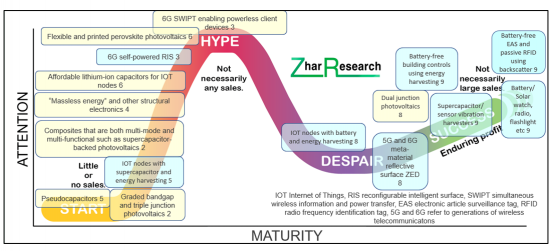
CAPTION Maturity of primary ZED enabling technologies in 2024. Indicated number is technology readiness level TRL - maturity level of a technology throughout its research, development and deployment phase progression on a scale from 1 to 9. ZED is shown blue and ZED enabling technologies are shown yellow. Source Zhar Research report, "Zero Energy Devices ZED: Self-Powered and Backscatter-Powered Electronics and Electrics Markets, Technology 2024-2044".
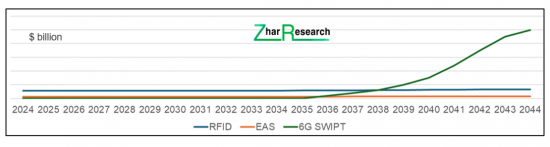
CAPTION Backscatter ZED $ billion 2024-2044. Source: Zhar Research report, "Zero Energy Devices ZED: Self-Powered and Backscatter-Powered Electronics and Electrics Markets, Technology 2024-2044".
Table of Contents
1. Executive summary and conclusions
1.1. Purpose and scope of this report
1.2. Methodology of this analysis
1.3. Definition and purpose
1.4. 18 Primary conclusions
1.5. Current ZED successes
1.6. Optimal technology strategies for ZED 2024-2044
1.7. Progress of telecommunications generations to more ZED opportunities
1.8. Progress towards sensor ZED 2024-2044
1.9. Roadmap of ZED and its enabling technologies 2024-2044
1.10. Market forecasts 2024-2044
1.10.1. Backscatter ZED units sold billion RFID, EAS, 6G SWIPT 2024-2044
6.2.3. Improved energy efficiency in 6G Communications: European Commission Hexa-X Project
6.2.4. Static context header compression and fragmentation for ZED
6.2.5. Other energy efficient sensing, processing and new power transfer options for IOT
6.3. Ultra-low power integrated circuits
6.3.1. Nanopower nPZero
6.3.2. Everactive ultra-low power circuits for ZED IOT
6.3.3. 2nm chips and beyond-USA, Taiwan, China, Japan
6.3.4. Ericsson Research and MIT Lithionic chips
6.3.5. Move-X's MAMWLE: Ultra-low-power radio module
6.4. Ultra-low-power smartphone
6.5. Metamaterials and metasurfaces as ZED or enabling ZED
6.5.1. Definitions and scope
6.5.2. Metamaterial ZED window
6.5.3. Metasurfaces for 6G RIS ZED and other purposes
6.5.4. SWOT appraisal of 6G Communications RIS opportunities
7. Powering devices only when interrogated: backscatter, SWIPT, WIET, WPT for EAS, RFID, IOT, 6G Communications and other electronics
7.1. Overview: backscatter, EAS, RFID, 6G SWIPT
7.1.1. Forms of wireless power transfer enabling batteryless and less-battery devices
7.1.2. Backscatter communications
7.1.3. Evolution of wireless electronic communication devices needing no on-board energy storage 1980-2035
7.2. Ambient backscatter communications AmBC and Crowd-detectable CD-ZED
7.2.1. View of Aalto University on AmBC and CD-ZED
7.2.2. Orange AmBC and CD-ZED
7.2.3. Battery-free AmBC: University of California San Diego
7.2.4. Crowd-detectable CD-ZED research
7.3. Hybrid beamforming-based SWIPT
7.4. SWOT appraisal of circuits and infrastructure that eliminate storage
7.5. Further research: 47 recent papers
8. Harvesting electromagnetic waves: photovoltaics to power devices
8.1. Overview
8.2. Electromagnetic energy harvesting toolkit by frequency: photovoltaics
8.3. Strategies for increasing photovoltaic output per unit volume and area 2024-2044
8.4. Some important parameters for ZED photovoltaics
8.5. Limits of single junction efficiency
8.6. PV cell efficiency trends
8.7. Experience curve of cost reduction
8.8. Some format options evolving 2024-2044
8.9. Photovoltaics by pn junction compared to other options 2024-2044
8.10. Perovskite photovoltaics
8.11. Integrated MEMS with photovoltaics as ZED
8.12. Photovoltaics feasible and affordable in more places: examples
8.13. Routes to battery-free solar ZED: tape, IOT, cameras
8.14. Transparent and opaque photovoltaics in smartwatches
8.15. Battery-free drone flight for sensing and IOT
8.16. SWOT appraisal of photovoltaics for ZED
8.17. Further research papers and events in 2024
9. Harvesting ambient electromagnetic waves: RF harvesting power for devices and communication by recycling existing emissions
9.1. Overview
9.2. Electromagnetic energy harvesting toolkit by frequency: RF
9.3. Devices harvesting ambient man-made RF emissions to produce on-board electricity
9.4. Basic RF harvester RFEH
9.5. Routes to RF harvester improvement
9.6. Results for various forms of RF harvester
9.7. Sensors and biometric access using RF harvesting
9.8. RF harvesting for wearables
9.9. Other recent advances in RF harvesting
10. Mechanical harvesting for devices (acoustic, vibration, linear and rotational motion) using electrodynamics, piezoelectrics, triboelectrics etc. Thermoelectrics, pyroelectrics, evaporative hydrovoltaics, microbial fuel cells (biofuel harvesting)
10.1. Overview
10.2. ZED energy harvesting technology beyond harvesting electromagnetic radiation 2024-2044
10.3. Sources of mechanical energy and harvesting options 2024-2044
10.4. GeorgiaTech comparison of some options
10.5. Vibration harvesting
10.5.1. General
10.5.2. Hitachi Rail battery-free ZED vibration sensor powered by electrodynamic energy harvesting
10.6. Harvesting infrasound
10.7. Kinetron and other electrodynamic ("electrokinetic") harvesters typically harvesting infrasound
10.8. Push button harvesting
10.9. EnOcean building controls "no wires, no batteries, no limits" IOT
10.10. Zero Energy Development battery-free ZED
10.11. Transpiration electrokinetic harvesting for battery-free sensor power supply
10.12. Acoustic harvesting
10.13. Triboelectric energy harvesting of motion
10.14. Thermoelectric harvesting with SWOT appraisal
10.15. Hydrovoltaic harvesting
10.16. Flexible energy harvesting: biofuel cell skin sensor system
10.16. Research pipeline in 2024 and earlier
11. Multi-mode energy harvesting for devices
11.1. Overview
11.2. Multi-mode and multiple-source harvesting to reduce intermittency
11.2.1. Thermoelectric with photovoltaic
11.2.2. Photovoltaic with electrokinetic: Ressence Model 2 watch
11.2.3. Thermoelectric with photovoltaic and movement harvesting: DCO, Wurth and Analog Devices products
11.2.4. Push button harvesting with solar power and intermittency tolerant electronics BFree
11.3. Multi-mode harvesting research pipeline 2024 and earlier
11.4. SWOT appraisal of multi-mode energy harvesting for ZED
12. Supercapacitors, variants and massless energy for battery-free ZED
12.1. Overview
12.2. Spectrum of choice-capacitor to supercapacitor to battery
12.3. Lithium-ion capacitor features
12.4. Actual and potential major applications of supercapacitors and their derivatives 2024-2044
12.5. SWOT appraisal of batteryless storage technologies for ZED
12.6. Examples of ZED enabled by supercapacitors and variants
12.6.1. Bicycle dynamo with supercapacitor or electrolytic capacitor
12.6.2. IOT ZED enabled by LIC hybrid supercapacitor