


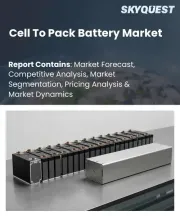
세계의 셀투팩(CTP) 배터리 시장 규모는 2024년에 243억 달러로 평가되었으며, 2025년 279억 2,000만 달러에서 2033년까지 848억 2,000만 달러로 성장할 전망입니다. 예측 기간(2026-2033년) 동안 CAGR은 14.9%로 예측됩니다.
세계 셀투팩(CTP) 배터리 시장은 제조업체들이 성능 최적화와 비용 절감을 위해 노력하면서 혁신적인 변화를 경험하고 있습니다. 리튬이온 배터리 셀을 차량용 팩에 직접 통합하는 이 구조는 중간 모듈의 필요성을 없애고, 에너지 밀도를 높이고 킬로와트시당 비용을 절감할 수 있습니다. 이러한 최적화는 주행거리와 가격이 주요 경쟁 요소인 전기자동차 및 축전 시스템에서 매우 중요합니다. 업계가 기존 팩 형태에서 셀 투 팩 솔루션으로 전환하는 가운데, 제조 규모의 확대와 설계 표준화가 효율성을 높이고 있습니다. 특히 AI는 고급 배터리 관리 시스템, 예측 열 모델, 품질 검사 자동화를 통해 안전성과 성능을 향상시킴으로써 상용 차량 및 고정식 저장 프로젝트를 포함한 다양한 응용 분야에서 신속한 도입과 생산 프로세스 개선을 지원하고 있습니다.
세계 셀투팩(CTP) 배터리 시장 촉진요인
전기자동차로의 전환이 진행됨에 따라 소형 고효율 배터리 솔루션에 대한 수요가 증가하고 있으며, 자동차 제조업체들은 패키지 밀도와 열 관리를 모두 향상시키는 셀-투-팩 구조를 채택하고 있습니다. 자동차 제조업체들이 주행거리, 안전성, 원활한 제조 통합의 최적화에 초점을 맞추고 있는 가운데, 공급업체들은 진화하는 차량 요구사항에 대응하기 위해 셀-투-팩 설계의 개발 및 구현을 가속화하고 있습니다. 차량 설계의 우선순위와 배터리 시스템이 제공하는 이점을 동기화함으로써 생산능력에 대한 투자를 촉진하고, 공급업체 간의 협력을 촉진하며, 공급망에 필요한 조정을 촉진할 수 있습니다. 이를 통해 셀 투 팩 기술은 현대 EV 전략의 필수 요소로 자리 잡으며 전체 시장 확대에 기여하고 있습니다.
세계 셀투팩(CTP) 배터리 시장의 억제요인
복잡한 조립 공정, 효과적인 열 관리, 원활한 전기적 통합과 같은 다양한 과제는 OEM 제조업체와 공급업체에 큰 기술적, 인증적 요구 사항을 부과합니다. 이러한 복잡성으로 인해 사양 결정 주기가 길어지고, 신중한 조달 결정이 필요할 수 있습니다. 효율적인 셀-투-팩 시스템에 필요한 전문적인 설계 및 생산 노하우는 개발 기간을 더욱 연장시키고, 도입에 따른 리스크 인식이 높아질 수 있습니다. 그 결과, 기업은 신기술을 전면적으로 채택하는 대신 단계적 개선을 선택할 수 있습니다. 이러한 운영상의 장벽은 결국 제조업체의 셀-투-팩 설계 채택 속도를 제한하고, 공급업체의 준비 태세를 제약하며, 보수적인 조달 접근 방식을 조장합니다. 이는 명백한 기술적 이점에도 불구하고 시장 성장을 저해하는 요인으로 작용할 수 있습니다.
세계 셀투팩(CTP) 배터리 시장 동향
세계 셀투팩(CTP) 배터리 시장에서 두드러진 추세는 전기자동차(EV) 및 재생에너지 애플리케이션의 급속한 보급에 힘입어 에너지 저장 솔루션의 고에너지 밀도 및 고효율에 대한 수요가 증가하고 있다는 점입니다. 이러한 CTP 기술로의 전환은 포장재 절감 및 배터리 시스템 내 공간 활용도 극대화를 통한 종합적인 성능 향상과 비용 절감이라는 이점이 동기가 되었습니다. 또한, 배터리 화학 및 제조 공정의 발전으로 혁신적인 CTP 설계의 생산이 가능해져 시장 성장을 더욱 가속화할 뿐만 아니라, 제조업체들이 생산 및 재활용에 있어 지속가능한 방법을 채택하도록 장려하고 있습니다.
Global Cell To Pack Battery Market size was valued at USD 24.3 Billion in 2024 and is poised to grow from USD 27.92 Billion in 2025 to USD 84.82 Billion by 2033, growing at a CAGR of 14.9% during the forecast period (2026-2033).
The global cell to pack battery market is experiencing a transformative shift as manufacturers seek to optimize performance and reduce costs. By integrating lithium-ion cells directly into vehicle packs, this architecture eliminates the need for intermediate modules, resulting in enhanced energy density and lower costs per kilowatt hour. This optimization is crucial for electric vehicles and storage systems, where range and price are key competitive factors. As the industry transitions from traditional pack formats to cell to pack solutions, manufacturing scale and design standardization drive efficiencies. Notably, AI is playing a pivotal role by enhancing safety and performance through advanced battery management systems, predictive thermal models, and quality inspection automation, thereby supporting faster adoption and improved production processes in various applications, including commercial fleets and stationary storage projects.
Top-down and bottom-up approaches were used to estimate and validate the size of the Global Cell To Pack Battery market and to estimate the size of various other dependent submarkets. The research methodology used to estimate the market size includes the following details: The key players in the market were identified through secondary research, and their market shares in the respective regions were determined through primary and secondary research. This entire procedure includes the study of the annual and financial reports of the top market players and extensive interviews for key insights from industry leaders such as CEOs, VPs, directors, and marketing executives. All percentage shares split, and breakdowns were determined using secondary sources and verified through Primary sources. All possible parameters that affect the markets covered in this research study have been accounted for, viewed in extensive detail, verified through primary research, and analyzed to get the final quantitative and qualitative data.
Global Cell To Pack Battery Market Segments Analysis
Global cell to pack battery market is segmented by form factor, chemistry type, production technology, technology, application, end use and region. Based on form factor, the market is segmented into Prismatic, Cylindrical and Pouch. Based on chemistry type, the market is segmented into Lithium-Ion, Solid State, Nickel Manganese Cobalt (NMC), Lithium Iron Phosphate (LFP) and Other Battery Types. Based on production technology, the market is segmented into Cell-to-Pack, Cell-to-Module and Traditional Battery Assembly. Based on technology, the market is segmented into Blade Battery, Liser Battery and Other Battery Technologies. Based on application, the market is segmented into Energy Storage System, Electric Vehicles and Others. Based on end use, the market is segmented into Consumer Electronics, Industrial Equipment, Automotive, Residential, Commercial, Utility and Others. Based on region, the market is segmented into North America, Europe, Asia Pacific, Latin America and Middle East & Africa.
Driver of the Global Cell To Pack Battery Market
The growing shift towards electric vehicles is driving the need for compact, highly efficient battery solutions, which has led automotive manufacturers to adopt cell to pack architectures that enhance both packaging density and thermal management. As car makers focus on optimizing range, safety, and seamless manufacturing integration, suppliers are increasingly advancing the development and implementation of cell to pack designs to align with these evolving vehicle demands. This synchronization between vehicle design priorities and the advantages offered by battery systems fuels investments in production capabilities, fosters collaborations among suppliers, and prompts necessary adjustments in the supply chain, thereby positioning cell to pack technologies as essential components in contemporary EV strategies and contributing to overall market expansion.
Restraints in the Global Cell To Pack Battery Market
Various challenges, such as intricate assembly processes, effective thermal management, and seamless electrical integration, create significant engineering and qualification demands on original equipment manufacturers and suppliers. These complexities can lengthen specification cycles and lead to cautious procurement choices. The specialized design and production knowledge needed for efficient cell to pack systems can further prolong development timelines and heighten the perceived risks associated with implementation. As a result, businesses may opt for gradual improvements instead of fully embracing new technologies. These operational hurdles ultimately restrict the pace at which manufacturers adopt cell to pack designs, limit supplier readiness, and promote conservative sourcing approaches, all of which hinder market growth despite the evident technical benefits.
Market Trends of the Global Cell To Pack Battery Market
A significant trend in the global Cell To Pack (CTP) battery market is the increasing demand for higher energy density and efficiency in energy storage solutions, driven by the rapid proliferation of electric vehicles (EVs) and renewable energy applications. This shift towards CTP technology is motivated by the advantages of reducing packaging materials and maximizing the utilization of space within battery systems, thereby enhancing overall performance and reducing costs. Additionally, advancements in battery chemistries and manufacturing processes are enabling the production of innovative CTP designs, further accelerating market growth and pushing manufacturers to adopt sustainable practices in production and recycling.