


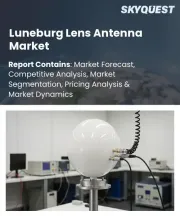
세계의 룬버그 렌즈 안테나 시장 규모는 2024년에 2억 410만 달러로 평가되며, 2025년 2억 2,451만 달러에서 2033년까지 4억 8,126만 달러로 성장할 전망입니다. 예측 기간(2026-2033년)의 CAGR은 10.0%로 예측됩니다.
세계 르네베르크 렌즈 안테나 시장은 효과적인 사이드 로브 제어를 통해 광범위한 빔 커버리지를 제공하는 구면 굴절률 그라데이션 안테나에 초점을 맞추고 있는 것이 특징입니다. 학술연구 및 국방용으로 개발된 이 기술은 위성 지상국 및 항공기 탑재 시스템을 위한 상업적으로 실현 가능한 솔루션으로 발전했습니다. 주요 장점으로는 복잡한 위상 배열 구성이 필요 없는 높은 이득을 들 수 있으며, 이를 통해 유지보수 비용을 절감할 수 있습니다. 재료, 적층제조, RF 시뮬레이션의 혁신으로 생산 효율이 향상되어 전문 방위 프로젝트에서 보다 광범위한 소비자용으로 전환할 수 있게 되었습니다. 무인 시스템 및 위성 통신과의 통합이 가속화됨에 따라 효율적이고 저렴한 추적 안테나에 대한 수요가 증가하면서 시장의 잠재력을 더욱 높이고 있습니다. AI의 발전은 통합과 성능의 효율화를 촉진하고 있으며, 루네베르크 렌즈 기술은 민수 및 국방 분야에서 점점 더 쉽게 사용할 수 있게 되었습니다.
세계 르네베르크 렌즈 안테나 시장 성장 촉진요인
위성 통신, 레이더 영상 처리, 지향성 에너지 시스템 등 다양한 응용 분야에서 정밀한 전자기 제어의 필요성이 증가함에 따라 르네베르크 렌즈 안테나의 채택이 크게 촉진되고 있습니다. 이 특징적인 집속 능력은 빔 제어 및 목표물 식별 능력을 향상시켜 신호의 무결성과 공간 해상도 향상을 원하는 시스템 설계자들에게 높은 지지를 받고 있습니다. 그 결과, 각 제조업체들은 르네버그 렌즈 솔루션의 개발 및 커스터마이징에 투자하는 한편, 공급망 확장에 박차를 가하고 있습니다. 이러한 혁신에 대한 집중적인 노력은 시장 성장을 가속할 뿐만 아니라 중요한 운영 플랫폼 전반에 걸쳐 더 넓은 응용 분야로 나아갈 수 있는 길을 열어주고 있습니다.
세계 르네베르크 렌즈 안테나 시장 성장 억제요인
세계 르네베르크 렌즈 안테나 시장의 성장은 주로 제조의 복잡성과 높은 비용이라는 문제에 직면해 있습니다. 이로 인해 공급업체는 경쟁력 있는 가격을 유지하면서 안테나를 대규모로 생산하기가 어렵습니다. 이러한 재정적 부담은 예산 제약이 최우선 순위인 용도에서 채택을 방해하고 있습니다. 특수 재료의 필요성, 복잡한 제조 기술, 정밀한 조정은 생산 기간을 연장할 뿐만 아니라 자원 수요를 증가시켜 설계자가 더 간단한 안테나 대안을 선택하는 요인이 될 수 있습니다. 그 결과 조달 주기가 길어지고, 보급형 제품 개발이 늦어지고, 이러한 안테나가 제공하는 성능상 이점에도 불구하고 결국 전체 시장 확대가 억제되는 결과를 초래합니다.
세계 르네베르크 렌즈 안테나 시장 동향
세계 르네베르크 렌즈 안테나 시장의 주요 동향은 무선 기술의 발전과 데이터 트래픽 증가에 힘입어 고성능 통신 시스템에 대한 수요가 증가하고 있다는 점입니다. 경량 설계와 왜곡이 적은 광각 방사 패턴을 제공하는 능력으로 인해 위성 통신, 레이더 시스템, 통신 등 다양한 응용 분야에서 르네베르크 렌즈 안테나의 통합이 가속화되고 있습니다. 또한 5G 기술과 IoT 기기의 채택이 증가함에 따라 효율적이고 컴팩트한 안테나 솔루션의 필요성이 더욱 커지고 있으며, 르네버그 렌즈는 제조업체와 최종사용자 모두에게 선호되는 선택이 되고 있습니다.
Global Luneburg Lens Antenna Market size was valued at USD 204.1 Million in 2024 and is poised to grow from USD 224.51 Million in 2025 to USD 481.26 Million by 2033, growing at a CAGR of 10.0% during the forecast period (2026-2033).
The global Luneburg lens antenna market is characterized by its focus on spherical gradient-index antennas that provide extensive beam coverage with effective sidelobe control. Originating from academic research and defense applications, the technology has evolved into commercially viable solutions for satellite ground stations and airborne systems. Its key advantages include high gain without the need for complex phased-array setups, resulting in reduced maintenance costs. Innovations in materials, additive manufacturing, and RF simulations have enhanced production efficiencies, enabling a shift from specialized defense projects to broader civilian applications. Growing demand for efficient, low-cost tracking antennas further propels market potential, as integration with unmanned systems and satellite communications accelerates. AI advancements are also streamlining integration and performance, making Luneburg lens technology increasingly accessible for both commercial and defense sectors.
Top-down and bottom-up approaches were used to estimate and validate the size of the Global Luneburg Lens Antenna market and to estimate the size of various other dependent submarkets. The research methodology used to estimate the market size includes the following details: The key players in the market were identified through secondary research, and their market shares in the respective regions were determined through primary and secondary research. This entire procedure includes the study of the annual and financial reports of the top market players and extensive interviews for key insights from industry leaders such as CEOs, VPs, directors, and marketing executives. All percentage shares split, and breakdowns were determined using secondary sources and verified through Primary sources. All possible parameters that affect the markets covered in this research study have been accounted for, viewed in extensive detail, verified through primary research, and analyzed to get the final quantitative and qualitative data.
Global Luneburg Lens Antenna Market Segments Analysis
Global luneburg lens antenna market is segmented by antenna type, frequency band, application, end user and region. Based on antenna type, the market is segmented into Reflective Antennas and Refractive Antennas. Based on frequency band, the market is segmented into Microwave Band and Millimeter Wave. Based on application, the market is segmented into Telecommunications and Defense. Based on end user, the market is segmented into Consumer Electronics and Industrial. Based on region, the market is segmented into North America, Europe, Asia Pacific, Latin America and Middle East & Africa.
Driver of the Global Luneburg Lens Antenna Market
The increasing need for precise electromagnetic control in various applications, including satellite communications, radar imaging, and directed-energy systems, significantly boosts the adoption of Luneburg lens antennas. Their distinctive focusing capabilities provide improved beam control and target discrimination, making them highly favored by system designers who seek to enhance signal integrity and spatial resolution. As a result, manufacturers are compelled to invest in the development and customization of Luneburg lens solutions while scaling their supply chains. This heightened focus on innovation not only drives market growth but also paves the way for a wider range of applications across critical operational platforms.
Restraints in the Global Luneburg Lens Antenna Market
The growth of the Global Luneburg Lens Antenna market faces challenges primarily due to high manufacturing complexity and costs, which hinder suppliers from producing antennas on a large scale while maintaining competitive pricing. This financial burden dissuades adoption in applications where budget sensitivity is paramount. The need for specialized materials, intricate fabrication techniques, and precise alignment not only escalates production times but also heightens resource demands, leading designers to opt for simpler antenna alternatives. As a result, procurement cycles become prolonged, and the development of more accessible entry-level products slows, ultimately dampening overall market expansion despite the inherent performance benefits these antennas provide.
Market Trends of the Global Luneburg Lens Antenna Market
A key market trend in the global Luneburg lens antenna market is the growing demand for high-performance communication systems, driven by advancements in wireless technology and increasing data traffic. The integration of Luneburg lens antennas in various applications, such as satellite communications, radar systems, and telecommunications, is gaining momentum due to their lightweight design and ability to provide wide-angle radiation patterns with minimal distortion. Additionally, the rise in the adoption of 5G technology and IoT devices is further propelling the need for efficient and compact antenna solutions, positioning Luneburg lenses as a favorable choice among manufacturers and end-users alike.