


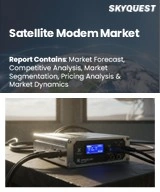
세계의 위성 모뎀 시장 규모는 2024년에 5억 5,320만 달러로 평가되었습니다. 2025년 6억 2,290만 달러에서 2033년까지 16억 964만 달러로 성장할 전망이며, 예측 기간(2026-2033년) CAGR은 12.6%를 나타낼 것으로 예측됩니다.
초고속 인터넷에 대한 수요 증가, 군용 통신, IoT 및 M2M 서비스의 보급으로 인해 세계 위성 모뎀 시장은 성장할 것으로 예측됩니다. 석유, 가스 등의 산업과 기업이 지상 인프라가 제한된 원격지에서 안정적인 통신 시스템을 필요로 하는 상황에서 위성 모뎀의 채택은 필수 불가결한 요소로 자리 잡고 있습니다. 저궤도 위성 발사가 급증하면서 연결성과 속도가 향상되고 지연이 크게 감소하고 있습니다. 그러나 업계는 높은 초기 투자 비용, 잠재적인 지연 문제, 사이버 위협에 대한 취약성 등의 문제에 직면해 있습니다. 또한, 규제 장벽과 개발도상국에서의 낮은 인지도는 보급률을 둔화시킬 수 있습니다. 이러한 요인들이 시장 역학을 형성하고, 다양한 신흥 경제국의 성장 궤도를 좌우할 것으로 예측됩니다.
세계 위성 모뎀 시장 성장 촉진요인
위성 모뎀 수요를 촉진하는 주요 요인은 서비스 취약 지역과 농촌 지역에서 안정적이고 신뢰할 수 있는 인터넷 접속에 대한 필요성이 증가하고 있다는 점입니다. 이러한 지역에서는 기존의 광대역 인프라가 비현실적인 경우가 많으며, 위성 통신이 가장 효과적인 해결책이 될 수 있습니다. 그 결과, 정부 기관과 민간 사업자 모두 위성 네트워크 확장을 위해 더 많은 자원을 투입하고 있습니다. 이번 투자는 원격지의 연결 격차를 해소할 뿐만 아니라 전체 통신 역량을 강화하고, 위성 모뎀이 디지털 격차 해소와 고립된 지역사회의 필수 서비스 접근성을 보장하는 데 중요한 역할을 한다는 것을 입증합니다.
세계 위성 모뎀 시장 성장 억제요인
지구 정지궤도에 배치된 기존 시스템은 지연 문제 및 대역폭 부족과 같은 고유한 한계가 존재하기 때문에 세계 위성 모뎀 시장은 심각한 문제에 직면해 있습니다. 이러한 제약은 화상회의 및 클라우드 통합과 같은 실시간 용도의 효율성을 저해하고 사용자 경험과 보급률에 영향을 미치고 있습니다. 저궤도(LEO) 위성이 지구상의 연결성 향상에 기여하고 있는 가운데, 기존 정지궤도 위성은 심각한 성능 부족 문제를 드러내고 있습니다. 빠르게 진화하는 디지털 환경에서 위성 모뎀의 보급과 발전을 위해서는 이러한 과제에 대한 대응이 필수적입니다.
세계 위성 모뎀 시장 동향
세계 위성 모뎀 시장은 다양한 분야의 사물인터넷(IoT) 및 기계 간 통신(M2M) 시스템에 위성 모뎀의 통합 확대에 힘입어 괄목할 만한 성장세를 보이고 있습니다. 농업, 광업, 석유 및 가스, 물류 등의 산업에서는 지상 네트워크가 구축되지 않은 원격지에서 강력한 연결 솔루션에 대한 수요가 증가하고 있습니다. 위성 모뎀은 지속적인 통신을 가능하게 하고 원격 모니터링, 자산 추적, 자동화와 같은 중요한 기능을 지원합니다. 이러한 기능이 스마트 산업 운영의 발전에 필수적이기 때문에 원활한 연결성과 업무 효율성을 보장하는 데 중요한 역할을 하는 첨단 위성 모뎀에 대한 수요가 증가할 것으로 예측됩니다.
Global Satellite Modem Market size was valued at USD 553.2 million in 2024 and is poised to grow from USD 622.9 million in 2025 to USD 1609.64 million by 2033, growing at a CAGR of 12.6% during the forecast period (2026-2033).
The global satellite modem market is poised for growth driven by heightened demand for high-speed internet, military communication, and the proliferation of IoT and M2M services. As businesses and sectors like oil and gas seek reliable communication systems in remote areas with limited terrestrial infrastructure, the adoption of satellite modems is becoming essential. The surge in low-earth-orbit satellite launches enhances connectivity and speeds, reducing latency significantly. However, the industry faces challenges, including high initial investment costs, potential latency issues, and vulnerability to cyber threats. Additionally, regulatory hurdles and a lack of awareness in underdeveloped regions may slow adoption rates. These factors will likely shape market dynamics and influence growth trajectories across various emerging economies.
Top-down and bottom-up approaches were used to estimate and validate the size of the Global Satellite Modem market and to estimate the size of various other dependent submarkets. The research methodology used to estimate the market size includes the following details: The key players in the market were identified through secondary research, and their market shares in the respective regions were determined through primary and secondary research. This entire procedure includes the study of the annual and financial reports of the top market players and extensive interviews for key insights from industry leaders such as CEOs, VPs, directors, and marketing executives. All percentage shares split, and breakdowns were determined using secondary sources and verified through Primary sources. All possible parameters that affect the markets covered in this research study have been accounted for, viewed in extensive detail, verified through primary research, and analyzed to get the final quantitative and qualitative data.
Global Satellite Modem Market Segments Analysis
Global Satellite Modem Market is segmented by Product Type, Technology, Application, End User and region. Based on Product Type, the market is segmented into SCPC Modems, MCPC Modems, VSAT Modems, Satcom-on-the-Move Modems and Other Modem Types. Based on Technology, the market is segmented into Ku-Band, Ka-Band, C-Band and Multi-Band & Hybrid. Based on Application, the market is segmented into Mobile & Backhaul, Enterprise & Broadband, IP Trunking, Offshore Communications and Tracking & Monitoring. Based on End User, the market is segmented into Telecommunications, Military & Defense, Marine & Aviation, Oil & Gas / Energy and Transportation & Logistics. Based on region, the market is segmented into North America, Europe, Asia Pacific, Latin America and Middle East & Africa.
Driver of the Global Satellite Modem Market
The increasing need for stable and reliable internet access in underserved and rural areas is a major driver for the demand for satellite modems. Traditional broadband infrastructure often proves impractical in these locations, making satellite communications the most effective solution. Consequently, both governmental agencies and private operators are directing more resources towards the expansion of satellite networks. This investment not only addresses the connectivity gap in remote regions but also enhances overall communication capabilities, demonstrating the critical role satellite modems play in bridging the digital divide and ensuring access to essential services for isolated communities.
Restraints in the Global Satellite Modem Market
The Global Satellite Modem market faces significant challenges due to the inherent limitations of legacy systems positioned in geostationary orbit, which suffer from latency issues and inadequate bandwidth. These constraints hinder the effectiveness of real-time applications such as video conferencing and cloud integration, thereby impacting user experience and adoption rates. As lower-Earth orbit (LEO) satellites emerge to enhance connectivity on Earth, the struggle of existing geostationary systems highlights critical performance deficiencies. Addressing these issues is essential for the advancement and widespread acceptance of satellite modems in a rapidly evolving digital landscape.
Market Trends of the Global Satellite Modem Market
The global satellite modem market is witnessing a significant trend driven by the rising integration of satellite modems in Internet of Things (IoT) and machine-to-machine (M2M) communication systems across various sectors. Industries such as agriculture, mining, oil and gas, and logistics increasingly require robust connectivity solutions in remote areas lacking terrestrial network access. Satellite modems facilitate continuous communication, enabling essential functions like remote monitoring, asset tracking, and automation. As these capabilities become integral to the evolution of smart industrial operations, the demand for advanced satellite modems is expected to grow, reflecting their critical role in ensuring seamless connectivity and operational efficiency.