


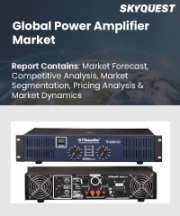
파워 앰프 시장 규모는 2024년에 300억 4,000만 달러로 평가되며, 2025년 321억 1,000만 달러에서 2033년까지 547억 6,000만 달러로 성장할 전망입니다. 예측 기간(2026-2033년)의 CAGR은 6.9%로 예측됩니다.
스마트폰에 파워 반도체의 통합이 진행되고 있으며, 5G 기술의 광범위한 보급은 전력 증폭기 시장 수요를 크게 견인하고 있습니다. 소비자들이 더 높은 데이터 속도와 스펙트럼 효율성 향상을 요구하면서 고속 모바일 브로드밴드에 대한 의존도가 높아지고 있습니다. 이러한 추세는 LTE 기술의 보급을 촉진하고 있으며, 파워앰프 시장의 확대를 더욱 가속화할 것으로 예측됩니다. 모바일 인터넷 플랫폼으로의 전환은 혼잡한 무선 주파수 환경에서 증폭된 데이터 속도에 대한 긴급한 요구를 불러일으키고 있으며, 이는 현재의 전력 증폭기 기술을 능가하는 새로운 선형성 표준을 설정하고 있습니다. 이러한 움직임은 종합적으로 진화하는 이동통신 인프라의 요구를 충족시키기 위해 필요한 혁신적인 전력 증폭 솔루션의 중요성을 강조하고 있습니다.
전력 증폭기 시장 성장 촉진요인
전자레인지, 휴대폰, 헤드폰, TV, 홈시어터 시스템, 극장 및 콘서트용 대규모 음향 증폭 시스템 등 다양한 가전제품에 파워앰프가 보급되면서 현대 기술에서 파워앰프의 필수적인 역할이 더욱 부각되고 있습니다. 고품질 시청각 경험에 대한 수요 증가는 파워 앰프 시장의 성장을 크게 견인하고 있습니다. 소비자들이 다양한 카테고리에서 고성능, 고성능의 디바이스를 요구함에 따라 효율적이고 신뢰할 수 있는 파워 앰프의 필요성이 점점 더 중요해지고 있습니다. 이러한 추세는 사용자 경험 향상을 위한 광범위한 변화를 반영하고 있으며, 기술 분야에서 파워 앰프의 중요성을 더욱 확고히 하고 있습니다.
전력 증폭기 시장 성장 억제요인
GaAs 기반 전력 증폭기 소자의 채택은 주로 틈새 응용 분야에 국한되어 있습니다. 이러한 장치는 특수한 성능을 가지고 있으므로 높은 가격이 정당화될 수 있는 상황에서만 채택이 진행되고 있습니다. GaAs 웨이퍼와 관련된 높은 제조비용은 다양한 전자기기에 광범위하게 구현하는 것을 방해하고 있습니다. 많은 제조업체들이 보다 저렴한 대안을 선택하는 경향이 있으며, GaAs 부품의 채택이 전체 장치 비용 증가로 이어지는 경우가 많기 때문에 이는 큰 장벽이 되고 있습니다. 이러한 가격 민감성은 GaAs 기술이 더 넓은 시장에서 발판을 마련할 수 있는 가능성을 제한하고 있습니다. 왜냐하면 대부분의 소비자와 기업은 전자 부품 선택에 있으며, 성능 향상보다 비용 효율성을 우선시하기 때문입니다.
파워앰프 시장 동향
전력 증폭기 시장은 스마트폰과 모바일 기기에 대한 소비자의 의존도가 높아지고 5G 셀룰러 네트워크가 광범위하게 보급됨에 따라 눈에 띄는 상승세를 보이고 있습니다. 모바일 기술이 일상 생활에 필수적인 요소로 자리 잡으면서 고효율 전력 증폭기에 대한 수요가 급증하고 있으며, 이는 고성능화로의 큰 전환을 반영하고 있습니다. 5G 기술로의 전환은 이러한 수요를 더욱 증폭시키고 있습니다. 데이터 전송 및 연결성 강화를 위해서는 최적의 신호 강도와 품질을 보장하는 고급 전력 증폭 솔루션이 필수적이기 때문입니다. 디바이스 보급과 네트워크의 발전이라는 상호의존성은 전력 증폭기 분야의 견고한 매출 성장을 가속할 것으로 예측됩니다.
Power Amplifier Market size was valued at USD 30.04 Billion in 2024 and is poised to grow from USD 32.11 Billion in 2025 to USD 54.76 Billion by 2033, growing at a CAGR of 6.9% during the forecast period (2026-2033).
The increasing integration of power semiconductors in smartphones, alongside the widespread rollout of 5G technology, is significantly driving market demand for power amplifiers. As consumers seek higher data rates and enhanced spectral efficiency, the reliance on high-speed mobile broadband intensifies. This trend is facilitating the growing adoption of LTE technology, which is poised to further accelerate the Power Amplifier market's expansion. The shift towards mobile internet platforms has created an urgent need for amplified data rates within congested radio frequency environments, thereby setting new benchmarks for linearity that challenge current power amplifier technologies. Collectively, these movements underscore the importance of innovative power amplification solutions necessary to meet the evolving demands of mobile communication infrastructure.
Top-down and bottom-up approaches were used to estimate and validate the size of the Power Amplifier market and to estimate the size of various other dependent submarkets. The research methodology used to estimate the market size includes the following details: The key players in the market were identified through secondary research, and their market shares in the respective regions were determined through primary and secondary research. This entire procedure includes the study of the annual and financial reports of the top market players and extensive interviews for key insights from industry leaders such as CEOs, VPs, directors, and marketing executives. All percentage shares split, and breakdowns were determined using secondary sources and verified through Primary sources. All possible parameters that affect the markets covered in this research study have been accounted for, viewed in extensive detail, verified through primary research, and analyzed to get the final quantitative and qualitative data.
Power Amplifier Market Segments Analysis
Global Power Amplifier Market is segmented by Product, Class, Technology, Vertical and region. Based on Product, the market is segmented into Audio Power Amplifier and RF Power Amplifier. Based on Class, the market is segmented into Class A, Class B, Class AB, Class C, Class D and Others (G, H, DG, K). Based on Technology, the market is segmented into Silicon, Silicon Germanium, Gallium Arsenide and Others (Gallium Nitride (GaN), Indium Phosphide (InP)). Based on Vertical, the market is segmented into Consumer Electronics, Industrial, Telecommunication, Automotive and Military & Defense. Based on region, the market is segmented into North America, Europe, Asia Pacific, Latin America and Middle East & Africa.
Driver of the Power Amplifier Market
The widespread integration of power amplifiers in a diverse range of consumer electronics, including microwave ovens, mobile phones, headphones, televisions, home theater systems, and large-scale sound reinforcement for theatrical and concert applications, highlights their essential role in contemporary technology. The surging demand for high-quality audio and visual experiences is significantly propelling the growth of the power amplifier market. As consumers increasingly seek high-performance, feature-laden devices in numerous categories, the necessity for efficient and dependable power amplifiers becomes ever more critical. This trend reflects the broader shift towards enhancing user experiences, further solidifying the importance of power amplifiers in the tech landscape.
Restraints in the Power Amplifier Market
The adoption of GaAs-based power amplifier devices is restricted primarily to niche applications where their specialized performance justifies the premium pricing. The high manufacturing costs associated with GaAs wafers hinder their broader implementation in various electronic devices. Many manufacturers favor more affordable alternatives, which presents a considerable obstacle, as incorporating GaAs components often leads to increased overall device costs. This price sensitivity limits the potential for GaAs technology to gain a foothold in wider markets, as most consumers and businesses prioritize cost-effectiveness over performance enhancements in their choices for electronic components.
Market Trends of the Power Amplifier Market
The power amplifier market is experiencing a notable upward trend driven by the escalating consumer reliance on smartphones and mobile devices, coupled with the extensive rollout of 5G cellular networks. As mobile technology becomes integral to everyday life, the need for advanced and efficient power amplifiers has surged, reflecting a significant shift towards high-performance capabilities. The transition to 5G technology further amplifies this demand, as the enhanced capacity for data transmission and connectivity necessitates sophisticated power amplification solutions to ensure optimal signal strength and quality. This symbiotic relationship between device proliferation and network advancement is set to fuel robust revenue growth in the power amplifier sector.