


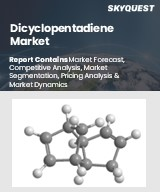
디시클로펜타디엔 시장 규모는 2024년에 9억 달러로 평가되며, 2025년 9억 6,000만 달러에서 2033년까지 15억 7,000만 달러로 성장할 전망입니다. 예측 기간(2026-2033년)의 CAGR은 6.3%로 예측됩니다.
디시클로펜타디엔 시장은 군용 고성능 연료 수요 증가, 특히 우수한 비에너지 비율과 낮은 점도를 요구하는 고고도 비행 항공기에 대한 수요 증가에 힘입어 성장할 것으로 예측됩니다. 두 가지 이성질체 형태, 즉 엑소테트라하이드로디사이클로펜타디엔은 첨단 미사일 연료 개발에 중요한 역할을 하고 있습니다. 또한 상업용 항공 분야의 확대와 여행 수요 증가로 항공기 제조가 활발해지면서 디시클로펜타디엔 시장에도 영향을 미치고 있습니다. 이 다용도한 고리형 탄화수소는 특수 화학물질, 고성능 복합재료, 실란트 및 코팅에 사용되는 지환식 수지의 제조에 있으며, 그 역할이 점점 더 인정받고 있으며, 다양한 산업 응용 분야와 석유화학 산업에서 매우 중요한 위치를 차지하고 있습니다.
디시클로펜타디엔 시장 성장 촉진요인
디시클로펜타디엔 시장은 주로 자동차, 항공우주 등 전략 분야의 경량화 소재 수요 증가로 인해 괄목할 만한 성장세를 보이고 있습니다. 디시클로펜타디엔 유래 수지는 강도를 높이면서도 무게 증가를 최소화하여 연료 효율과 시스템 전체 성능 향상으로 이어집니다. 이러한 고성능 용도에 대한 관심 증가는 현대 산업의 까다로운 요구 사항을 충족하는 첨단 소재 개발에서 디시클로펜타디엔의 중요성을 입증하고 있습니다. 제조업체들이 제품 성능의 최적화와 경량화를 추구하는 가운데, 디시클로펜타디엔의 활용은 시장에서 혁신을 촉진하고 성장을 가속하는 데 중요한 역할을 하고 있습니다.
디시클로펜타디엔 시장 성장 억제요인
원료 가격, 특히 원유 가격의 변동은 디시클로펜타디엔 시장에 심각한 문제입니다. 이러한 가격 변동은 예측할 수 없는 생산 비용을 초래하여 다양한 분야에서 디시클로펜타디엔 제품의 경쟁력 있는 가격 유지를 방해할 수 있습니다. 원료의 불안정성으로 인한 생산 비용의 상승은 수익성 저하와 시장 매력의 감소를 초래하여 궁극적으로 디시클로펜타디엔 시장의 성장과 발전을 제한할 수 있습니다. 이러한 불확실성은 잠재적인 투자를 저해하고 전체 공급망 역학에 영향을 미쳐 시장 발전과 경쟁력을 더욱 복잡하게 만들 수 있습니다.
디시클로펜타디엔 시장 동향
세계 디시클로펜타디엔(DCPD) 시장에서는 친환경 DCPD 기반 제품에 대한 수요가 급증하면서 눈에 띄는 추세를 보이고 있습니다. 업계에서는 엄격한 환경 규제와 사회적 요구에 대응하기 위해 지속가능성을 점점 더 중요시하는 경향이 있습니다. 이러한 패러다임의 변화는 특히 자동차, 건설, 도료 등의 분야에서 성능 향상과 환경 부하 감소가 최우선인 DCPD 기반 수지의 채택을 촉진하고 있습니다. 기업이 친환경 대체품 개발 및 혁신을 위해 노력하는 가운데, 시장은 성장 기반을 마련하고 있으며, 지속가능성을 중시하는 소비자와 규제 프레임워크에 대응하는 DCPD 용도에 대한 새로운 기회를 창출하고 있습니다.
Dicyclopentadiene Market size was valued at USD 0.9 Billion in 2024 and is poised to grow from USD 0.96 Billion in 2025 to USD 1.57 Billion by 2033, growing at a CAGR of 6.3% during the forecast period (2026-2033).
The market for dicyclopentadiene is poised for growth, driven by the increasing demand for high-performance fuel in military applications, particularly for aircraft operating at high altitudes that require fuels with excellent specific energy ratios and low viscosity. The dual isomeric forms, namely exo-tetrahydro dicyclopentadiene, play a crucial role in the development of advanced missile fuels. Additionally, the expansion of the commercial aviation sector, coupled with rising travel demands, has intensified aircraft manufacturing, further influencing the dicyclopentadiene market. This versatile cyclic hydrocarbon is increasingly recognized for its role in producing specialty chemicals, high-performance composites, and cycloaliphatic resins used in sealants and coatings, underscoring its pivotal importance across various industrial applications and the petrochemical industry.
Top-down and bottom-up approaches were used to estimate and validate the size of the Dicyclopentadiene market and to estimate the size of various other dependent submarkets. The research methodology used to estimate the market size includes the following details: The key players in the market were identified through secondary research, and their market shares in the respective regions were determined through primary and secondary research. This entire procedure includes the study of the annual and financial reports of the top market players and extensive interviews for key insights from industry leaders such as CEOs, VPs, directors, and marketing executives. All percentage shares split, and breakdowns were determined using secondary sources and verified through Primary sources. All possible parameters that affect the markets covered in this research study have been accounted for, viewed in extensive detail, verified through primary research, and analyzed to get the final quantitative and qualitative data.
Dicyclopentadiene Market Segments Analysis
Global Dicyclopentadiene Market is segmented by Type, End-User, Application and region. Based on Type, the market is segmented into DCPD Resin Grade, DCPD UPR Grade and DCPD High Purity. Based on End-User, the market is segmented into Building & Construction, Automotive, Marine, Electrical & Electronic and Others. Based on Application, the market is segmented into Unsaturated Polyester Resin, Hydrocarbon Resins, Ethylene Propylene Diene Monomer (EPDM) Elastomers, Cyclic Olefin Copolymer (COC) & Cyclin Olefin Polymer (COP), Poly-DCPD and Others. Based on region, the market is segmented into North America, Europe, Asia Pacific, Latin America and Middle East & Africa.
Driver of the Dicyclopentadiene Market
The dicyclopentadiene market is experiencing significant growth primarily due to the rising demand for lightweight materials, particularly in strategic sectors like automotive and aerospace. The resins derived from dicyclopentadiene enhance strength while minimizing added weight, leading to improvements in fuel efficiency and overall system performance. This increasing focus on high-performance applications underscores the importance of dicyclopentadiene in developing advanced materials that meet the stringent requirements of modern industries. As manufacturers strive to optimize product performance and reduce weight, the utilization of dicyclopentadiene becomes instrumental in fostering innovation and driving growth within the market.
Restraints in the Dicyclopentadiene Market
The fluctuations in raw material prices, particularly the cost of crude oil, pose a significant challenge to the Dicyclopentadiene market. These price variations can lead to unpredictable production costs, hindering the ability of manufacturers to maintain competitive pricing for Dicyclopentadiene products across various sectors. As production costs rise due to raw material instability, it may result in reduced profitability and market appeal, ultimately restricting the growth and advancement of the Dicyclopentadiene market. This uncertainty could deter potential investments and impact the overall supply chain dynamics, further complicating the market's progression and competitiveness.
Market Trends of the Dicyclopentadiene Market
The global dicyclopentadiene (DCPD) market is witnessing a notable trend driven by the surging demand for eco-friendly DCPD-based products. Industries are increasingly prioritizing sustainability to align with stringent environmental regulations and societal expectations. This paradigm shift is boosting the adoption of DCPD-based resins, especially in sectors such as automotive, construction, and coatings, where enhanced performance and reduced environmental impact are paramount. As companies strive to innovate and develop greener alternatives, the market is positioned for growth, fostering new opportunities for DCPD applications that cater to sustainability-conscious consumers and regulatory frameworks.