


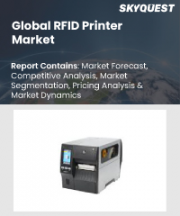
RFID 프린터 시장 규모는 2024년에 8,354만 달러로 평가되었고, 2025년 8,956만 달러에서 2033년까지 1억 5,619만 달러로 성장할 전망이며, 예측 기간(2026년-2033년) CAGR은 7.2%를 보일 것으로 예측됩니다.
모바일 RFID 프린터 세계 시장은 호텔, 소매, 의료 등의 분야에서 라벨, 티켓, 영수증 인쇄에 필수적인 역할을 수행하면서 괄목할 만한 성장을 거듭하고 있습니다. 이 프린터는 바코드, RFID 라벨, 태그 생성에 필수적인 프린터로 다양한 산업 분야의 요구에 대응하고 있습니다. 그 인기의 배경에는 가혹한 환경에서도 안정적인 성능을 보장하는 내구성과 견고성 등 편의성을 중시한 다양한 특징이 있습니다. 사용자 친화적인 디자인으로 RFID 라벨, 태그, 영수증을 쉽게 인쇄할 수 있어 실용성이 향상되었습니다. 또한, 모바일 기기와의 원활한 연결성은 사용자 경험을 더욱 풍부하게 하고, 번거롭지 않은 접근과 조작을 가능하게 함으로써 다양한 용도로의 보급을 촉진하고 있습니다.
RFID 프린터 시장 성장 촉진요인
제조업은 성장이 둔화되고 있는 가운데, 자동화 도입 확대와 생산방식 개선을 통한 폐기물 절감 및 효율화를 추진하며 적응을 지속하고 있습니다. 이러한 진화로 인해 제조 공정 전반에 걸쳐 바코드 활용이 눈에 띄게 증가하고 있습니다. 조립 라인의 각 부품에는 고유한 바코드가 할당되어 여러 스테이션에서 스캔 및 기록됩니다. 이 면밀한 추적 시스템을 통해 제품이 생산라인을 이동하는 과정에서 제품의 상태를 즉각적으로 파악할 수 있습니다. 그 결과, 생산 일정이 개선되고 있으며, 이러한 진화하는 환경에서 중요한 역할을 하는 RFID 프린터에 대한 강력한 수요가 발생하고 있습니다.
RFID 프린터 시장 성장 억제요인
RFID 프린터 시장이 직면한 큰 과제 중 하나는 작동 중 과도한 고온 설정으로 인한 바코드 오염 위험입니다. RFID 프린터의 고온 설정은 바코드가 흐려지거나 왜곡되는 등 원치 않는 결과를 초래하여 인쇄물의 가독성과 정확성을 떨어뜨릴 수 있습니다. 권장 온도를 초과하면 사용되는 잉크와 재료에 악영향을 미쳐 인쇄 품질이 저하될 수 있습니다. 바코드의 선명도와 정확성을 유지하는 것은 효과적인 재고 관리 및 추적에 필수적이기 때문에 이러한 우려는 소비자 만족도와 인쇄 신뢰성에 대한 신뢰에 영향을 미쳐 전체 시장의 성장을 저해할 수 있습니다.
RFID 프린터 시장 동향
RFID 프린터 시장은 전자 인쇄 기술 및 잉크 기술의 발전에 힘입어 눈에 띄는 상승세를 보이고 있습니다. 주요 제조업체들은 변화하는 소비자 니즈에 대응하기 위해 비용 효율적인 태그 생산에 주력하고 있으며, 이는 시장 성장을 가속하고 있습니다. RFID 레이저 인쇄 기술의 채택은 효율성 향상과 혁신적인 인쇄 솔루션을 제공하여 업계에 더 많은 변화를 가져오고 있습니다. 다양한 분야의 조직이 재고 관리 및 공급망 최적화에 RFID 기술의 이점을 인식함에 따라 시장은 지속적으로 확대될 것으로 예측됩니다. 이러한 채택 확대는 자동화 및 스마트 기술로의 광범위한 전환을 반영하며, 현대 비즈니스 운영에서 RFID 프린터의 역할을 확고히 하고 있습니다.
RFID Printer Market size was valued at USD 83.54 Million in 2024 and is poised to grow from USD 89.56 Million in 2025 to USD 156.19 Million by 2033, growing at a CAGR of 7.2% during the forecast period (2026-2033).
The global market for mobile RFID printers is witnessing significant growth, driven by their essential role in sectors like hospitality, retail, and healthcare, where they are employed for printing labels, tickets, and receipts. These printers are crucial for generating barcodes, RFID labels, and tags, catering to diverse industry needs. Their popularity is attributed to a range of features that emphasize convenience, such as durability and ruggedness, ensuring reliable performance in challenging environments. User-friendly design enhances their utility, making it easy to print RFID labels, tags, and receipts. Additionally, seamless connectivity with mobile devices further enriches user experience, enabling effortless access and operation, thereby driving their widespread adoption across various applications.
Top-down and bottom-up approaches were used to estimate and validate the size of the RFID Printer market and to estimate the size of various other dependent submarkets. The research methodology used to estimate the market size includes the following details: The key players in the market were identified through secondary research, and their market shares in the respective regions were determined through primary and secondary research. This entire procedure includes the study of the annual and financial reports of the top market players and extensive interviews for key insights from industry leaders such as CEOs, VPs, directors, and marketing executives. All percentage shares split, and breakdowns were determined using secondary sources and verified through Primary sources. All possible parameters that affect the markets covered in this research study have been accounted for, viewed in extensive detail, verified through primary research, and analyzed to get the final quantitative and qualitative data.
RFID Printer Market Segments Analysis
Global RFID Printer Market is segmented by type, price range, printing technology, frequency, application and region. Based on type, the market is segmented into industrial printers, desktop printers and mobile printers. Based on price range, the market is segmented into up to USD 2,000, USD 2,001 - USD 4,000 and above USD 4,001. Based on printing technology, the market is segmented into thermal transfer, direct thermal and inkjet. Based on frequency, the market is segmented into low frequency (LF), high frequency (HF) and ultra-high frequency (UHF). Based on application, the market is segmented into manufacturing, retail, transportation & logistics, healthcare, government, entertainment and others. Based on region, the market is segmented into North America, Europe, Asia Pacific, Latin America and Middle East & and Africa.
Driver of the RFID Printer Market
The manufacturing sector, despite experiencing slower growth, continues to adapt by increasingly integrating automation and refining production methods to reduce waste and enhance efficiency. This evolution has resulted in a marked rise in the use of barcodes throughout manufacturing processes. Each item or part on the assembly line is assigned a distinct barcode, which is scanned and recorded at multiple stations. This diligent tracking system provides instant visibility into a product's status as it moves through production. As a result, the improvements in production timelines have created a strong demand for RFID printers, which play a critical role in this evolving landscape.
Restraints in the RFID Printer Market
A significant challenge facing the RFID printer market is the risk of smudged bar lines resulting from excessive heat settings during operation. High heat levels in RFID printers can lead to undesirable outcomes, such as blurred or distorted barcodes, which can ultimately undermine the readability and precision of printed materials. When the temperature exceeds recommended thresholds, it can adversely affect the ink or material used, leading to deterioration in print quality. This concern may hinder overall market growth by affecting consumer satisfaction and trust in print reliability, as maintaining clarity and accuracy in barcodes is crucial for effective inventory management and tracking.
Market Trends of the RFID Printer Market
The RFID Printer market is experiencing a significant upward trend driven by advancements in electronic printing and ink technology. Leading manufacturers are increasingly focusing on cost-effective tag production to align with evolving consumer demands, thereby enhancing market growth. The incorporation of RFID laser printing technology is further revolutionizing the industry, offering improved efficiency and innovative printing solutions. As organizations across various sectors recognize the benefits of RFID technology in inventory management and supply chain optimization, the market is poised for continued expansion. This growing adoption reflects a broader shift toward automation and smart technology, solidifying the RFID printer's role in modern business operations.