


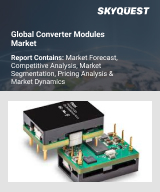
세계의 컨버터 모듈 시장 규모는 2024년에 105억 1,000만 달러로 평가되었고, 2025년 112억 3,000만 달러에서 2033년까지 191억 6,000만 달러로 성장할 전망이며, 예측 기간(2026-2033년) CAGR은 6.9%를 보일 것으로 예측됩니다.
컨버터 모듈 세계 시장은 고전압 용도에 대한 의존도 증가와 전력 인프라 개발에 대한 막대한 투자에 힘입어 괄목할 만한 성장세를 보이고 있습니다. 다양한 산업 분야의 전기화는 이 분야공급업체들에게 새로운 기회를 창출할 것으로 예측됩니다. 또한, 대체 에너지원의 보급 확대와 지속가능성에 대한 관심이 높아짐에 따라 이러한 모듈에 대한 수요가 더욱 증가할 것으로 예측됩니다. 컨버터 모듈은 전기 부품 제조업체가 제조 비용을 절감하고 회로 설계를 간소화할 수 있는 큰 이점을 제공하여 효율성을 추구하는 기업에게 매력적입니다. 전반적으로 이러한 추세는 기술 발전과 여러 산업의 에너지 패러다임 변화에 힘입어 컨버터 모듈이 탄탄한 확장 궤도에 진입할 것임을 보여줍니다.
세계 컨버터 모듈 시장 성장 촉진요인
세계 컨버터 모듈 시장은 파워 일렉트로닉스의 효과적인 운영에 있어 컨버터 모듈의 중요한 역할에 의해 크게 견인되고 있습니다. 다양한 산업 분야에서 첨단 전력 전자 시스템의 통합이 진행됨에 따라 효율적이고 신뢰할 수 있는 컨버터 모듈에 대한 수요가 급증하고 있습니다. 이러한 부품은 성능을 향상시킬 뿐만 아니라 에너지 관리 및 변환 프로세스를 개선합니다. 에너지 효율과 지속가능성에 대한 관심이 높아지면서 업계는 혁신적인 컨버터 솔루션을 채택하고 있으며, 이는 시장 성장을 더욱 가속화하고 있습니다. 컨버터 모듈의 다양한 용도의 다재다능함은 그 중요성을 더욱 높여 현대 파워 일렉트로닉스 시스템의 발전에 없어서는 안 될 존재가 되었습니다.
세계 컨버터 모듈 시장 성장 억제요인
세계 컨버터 모듈 시장이 직면한 큰 과제 중 하나는 장치 내부의 열 관리입니다. 이는 다양한 용도에서 신뢰성에 악영향을 미칠 수 있습니다. 이러한 우려로 인해 제조업체는 열 관리를 강화할 뿐만 아니라 전반적인 신뢰성을 향상시키는 솔루션 개발에 집중해야 합니다. 열 문제가 계속되는 가운데, 기업들은 다양한 조건에서 최적의 성능을 유지할 수 있는 보다 효율적인 제품을 혁신하고 창조하는 것이 필수적입니다. 열 관리를 효과적으로 처리하면 제품 수명을 연장하고 고객 만족도를 높여 궁극적으로 경쟁이 치열한 시장에서 비즈니스 성공에 기여할 수 있습니다.
세계 컨버터 모듈 시장 동향
세계 컨버터 모듈 시장은 다양한 산업분야에서 전자기기의 소형화에 힘입어 괄목할 만한 성장세를 보이고 있습니다. 디바이스가 소형화, 소형화됨에 따라 이러한 디바이스에 원활한 전력 변환을 효율적으로 통합할 수 있는 컨버터 모듈에 대한 수요가 증가하고 있습니다. 이러한 추세는 소형 폼팩터를 구현할 수 있는 혁신적인 디자인과 기술의 필요성을 강조할 뿐만 아니라, 시장 기업에게 고효율 및 공간 절약형 솔루션을 개발할 수 있는 좋은 기회를 제공합니다. 따라서 소형화된 전자기기와의 호환성 향상에 주력하는 기업들은 이러한 변화하는 시장 상황을 최대한 활용하여 컨버터 모듈 분야의 성장과 기술 진보를 주도할 수 있는 좋은 위치에 있습니다.
Global Converter Modules Market size was valued at USD 10.51 Billion in 2024 and is poised to grow from USD 11.23 Billion in 2025 to USD 19.16 Billion by 2033, growing at a CAGR of 6.9% during the forecast period (2026-2033).
The global market for converter modules is experiencing notable growth driven by an increasing reliance on high-voltage applications and substantial investments in power infrastructure development. The electrification of various industry sectors is poised to create new opportunities for suppliers in this domain. Furthermore, the rising popularity of alternative energy sources and a heightened emphasis on sustainability are expected to further enhance demand for these modules. Converter modules offer significant advantages, enabling electrical component manufacturers to lower manufacturing costs and streamline circuit designs, which appeals to businesses aiming for efficiency. Overall, these trends indicate a robust expansion trajectory for converter modules, driven by technological advancements and changing energy paradigms across multiple industries.
Top-down and bottom-up approaches were used to estimate and validate the size of the Global Converter Modules market and to estimate the size of various other dependent submarkets. The research methodology used to estimate the market size includes the following details: The key players in the market were identified through secondary research, and their market shares in the respective regions were determined through primary and secondary research. This entire procedure includes the study of the annual and financial reports of the top market players and extensive interviews for key insights from industry leaders such as CEOs, VPs, directors, and marketing executives. All percentage shares split, and breakdowns were determined using secondary sources and verified through Primary sources. All possible parameters that affect the markets covered in this research study have been accounted for, viewed in extensive detail, verified through primary research, and analyzed to get the final quantitative and qualitative data.
Global Converter Modules Market Segments Analysis
Global Converter Modules Market is segmented by Type, Power Rating, Technology, Application and region. Based on Type, the market is segmented into DC-DC Converters, AC-DC Converters and DC-AC Converters. Based on Power Rating, the market is segmented into Low Power, Medium Power and High Power. Based on Technology, the market is segmented into Digital Converter Modules and Analog Converter Modules. Based on Application, the market is segmented into Automotive, Industrial, Consumer Electronics, IT & telecommunication, Renewable Energy, Transportation & logistics, Aerospace & defense and Others. Based on region, the market is segmented into North America, Europe, Asia Pacific, Latin America and Middle East & Africa.
Driver of the Global Converter Modules Market
The Global Converter Modules market is significantly driven by the essential role these modules play in the effective operation of power electronics. As various industry sectors increasingly integrate advanced power electronic systems, the demand for efficient and reliable converter modules has surged. These components not only enhance performance but also improve energy management and conversion processes. With the growing emphasis on energy efficiency and sustainability, industries are leaning towards adopting innovative converter solutions, further propelling market growth. The versatility of converter modules across applications amplifies their importance, making them integral to the evolution of modern power electronic systems.
Restraints in the Global Converter Modules Market
One significant challenge faced by the global converter modules market is the management of heat within these devices, which can negatively impact their reliability across various applications. This concern necessitates that manufacturers focus on developing solutions that not only enhance thermal management but also ensure greater overall reliability. As thermal issues persist, it becomes imperative for companies to innovate and create more efficient products that can maintain optimal performance under varying conditions. Addressing heat management effectively can lead to improved product longevity and customer satisfaction, ultimately contributing to the success of businesses in this competitive market.
Market Trends of the Global Converter Modules Market
The global converter modules market is experiencing a notable trend driven by the miniaturization of electronics across various industry sectors. As devices become smaller and more compact, there is a growing demand for converter modules that can efficiently integrate seamless power conversion in these devices. This trend not only highlights the need for innovative designs and technologies that facilitate these smaller form factors but also presents lucrative opportunities for market players to develop highly efficient, space-saving solutions. Consequently, companies focusing on enhancing compatibility with miniaturized electronics are well-positioned to capitalize on this evolving market landscape, driving growth and technological advancements in the converter modules sector.