


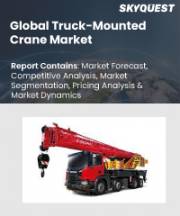
트럭 탑재형 크레인 시장 규모는 2024년에 127억 8,000만 달러로 평가되었고, 2025년 134억 9,000만 달러에서 2033년까지 208억 7,000만 달러로 성장할 전망이며, 예측 기간(2026-2033년) CAGR은 5.6%를 보일 것으로 예측됩니다.
트럭 탑재형 크레인 시장은 운송, 물류 등 다양한 분야의 건설 및 인프라 개발 확대에 힘입어 괄목할 만한 성장을 거듭하고 있습니다. 인프라 투자가 증가함에 따라 효율적인 하역 및 자재관리 솔루션에 대한 수요도 증가하고 있으며, 트럭 탑재형 크레인은 필수적인 장비로 자리매김하고 있습니다. 그러나 각 제조업체들은 엄격한 배출가스 규제와 안전기준에 대응해야 하는 과제를 안고 있으며, 컴플라이언스와 성능의 균형이 요구되고 있습니다. 또한, 이러한 크레인 도입에는 많은 초기 투자가 필요하기 때문에 중소기업에게는 도입 장벽이 될 수 있습니다. 그러나 산업이 진화하고 업무 효율성 향상에 초점을 맞추고 있는 가운데, 트럭 탑재형 크레인 시장은 새로운 요구에 부응하기 위한 전략적 발전과 혁신을 이룰 준비가 되어 있습니다.
트럭 탑재형 크레인 시장 성장 촉진요인
도시 환경과 인프라 개발의 지속적인 성장은 효과적인 리프팅 및 자재관리 솔루션의 필요성을 촉진하고 있으며, 이러한 상황에서 트럭 탑재형 크레인은 필수적인 도구로 자리 매김하고 있습니다. 또한, 성숙 시장과 개발도상국 시장 모두에서 호황을 누리고 있는 건설 부문의 확장도 이러한 적응력이 높은 크레인에 대한 수요 증가에 크게 기여하고 있습니다. 프로젝트가 점점 더 복잡해지고 작업 효율성 향상에 초점을 맞추면서, 트럭 탑재형 크레인은 다양한 현장의 워크플로우를 최적화하고 생산성을 높이고자 하는 계약업체와 건설업체에게 필수적인 장비가 되고 있습니다.
트럭 탑재 크레인 시장 성장 억제요인
트럭 탑재형 크레인 시장은 성장 잠재력에 영향을 미치는 몇 가지 중요한 제약에 직면해 있습니다. 첫째, 제조업체는 점점 더 엄격해지는 배출가스 규제와 안전 기준에 대응해야 하며, 이는 생산 공정의 복잡성과 비용 증가를 초래할 수 있습니다. 이러한 규제 부담은 운영 효율성과 수익성을 저해할 수 있습니다. 또한, 트럭 탑재형 크레인 구매에 필요한 고가의 초기 투자비용은 특히 중소기업에게 큰 부담으로 작용합니다. 이러한 장비에 필요한 막대한 자금 투입은 이들 기업이 시장에 진입하거나 기존 차량군에 필요한 업그레이드를 하는 것을 방해할 수 있으며, 궁극적으로 시장 확대와 혁신의 기회를 제한할 수 있습니다.
트럭 탑재 크레인 시장 동향
트럭 탑재형 크레인 시장에서는 텔레매틱스 기술의 통합을 향한 뚜렷한 전환이 진행되고 있습니다. 이를 통해 실시간 추적, 예지보전 경보, 성능 최적화가 가능해져 운영 효율성이 크게 향상됩니다. 동시에 환경 지속가능성에 대한 관심이 높아지면서 업계 내 하이브리드 및 전기 솔루션의 도입을 촉진하고 있습니다. 배출가스 규제가 강화됨에 따라 제조업체들은 점점 더 많은 친환경 기술을 설계에 통합하여 규제 요건과 환경 친화적인 운영에 대한 시장의 기대에 부응하고 있습니다. 이러한 첨단 기술과 지속 가능한 관행의 결합은 트럭 탑재형 크레인 산업을 변화시키는 환경을 형성하고 있으며, 진화하는 소비자 선호도와 컴플라이언스 요구 사항을 충족시키고 있습니다.
Truck-Mounted Crane Market size was valued at USD 12.78 Billion in 2024 and is poised to grow from USD 13.49 Billion in 2025 to USD 20.87 Billion by 2033, growing at a CAGR of 5.6% during the forecast period (2026-2033).
The Truck-Mounted Crane market is experiencing significant growth driven by escalating construction and infrastructure development across diverse sectors, including transportation and logistics. As investments in infrastructure rise, the demand for efficient lifting and material handling solutions is also increasing, positioning truck-mounted cranes as essential equipment. However, manufacturers face challenges meeting stringent emissions and safety regulations, necessitating a balance between compliance and performance. Additionally, the high initial investment required for acquiring these cranes may limit accessibility for small and medium-sized enterprises. Nevertheless, as industries evolve and focus on enhancing operational efficiency, the market for truck-mounted cranes remains poised for strategic advancements and innovation to meet emerging needs.
Top-down and bottom-up approaches were used to estimate and validate the size of the Truck-Mounted Crane market and to estimate the size of various other dependent submarkets. The research methodology used to estimate the market size includes the following details: The key players in the market were identified through secondary research, and their market shares in the respective regions were determined through primary and secondary research. This entire procedure includes the study of the annual and financial reports of the top market players and extensive interviews for key insights from industry leaders such as CEOs, VPs, directors, and marketing executives. All percentage shares split, and breakdowns were determined using secondary sources and verified through Primary sources. All possible parameters that affect the markets covered in this research study have been accounted for, viewed in extensive detail, verified through primary research, and analyzed to get the final quantitative and qualitative data.
Truck-Mounted Crane Market Segments Analysis
Global Truck-Mounted Crane Market is segmented by Product Type, Drive, Terrain Type, Lifting Capacity, End Use and region. Based on Product Type, the market is segmented into Stiff Boom and Knuckle Boom. Based on Drive, the market is segmented into Electrical, Mechanical and Hydraulic. Based on Terrain Type, the market is segmented into On road, Rough terrain and All terrain. Based on Lifting Capacity, the market is segmented into Below 15 Ton, 15 to 30 Ton, 30 to 50 Ton and Above 50 Ton. Based on End Use, the market is segmented into Industrial, Commercial, Infrastructure and Others. Based on region, the market is segmented into North America, Europe, Asia Pacific, Latin America and Middle East & Africa.
Driver of the Truck-Mounted Crane Market
The ongoing growth of urban environments and infrastructure development is driving the need for effective lifting and material handling solutions, positioning truck-mounted cranes as essential tools in this landscape. Additionally, the expansion of the construction sector, which is thriving in both established and developing markets, significantly contributes to the increased demand for these adaptable cranes. As projects become more complex and the focus shifts toward improved efficiency in operations, truck-mounted cranes are becoming indispensable for contractors and builders looking to optimize their workflows and enhance productivity on various job sites.
Restraints in the Truck-Mounted Crane Market
The truck-mounted crane market faces several significant restraints that impact its growth potential. Firstly, manufacturers must navigate increasingly stringent emissions and safety regulations, which can complicate production processes and inflate costs. This regulatory burden can hinder operational efficiency and profitability. Additionally, the high upfront investment needed to purchase truck-mounted cranes poses a challenge, particularly for small and medium-sized enterprises. The substantial financial commitment required for such equipment may deter these businesses from entering the market or from making necessary upgrades to their existing fleet, ultimately limiting market expansion and innovation opportunities.
Market Trends of the Truck-Mounted Crane Market
The Truck-Mounted Crane market is witnessing a notable shift towards the integration of telematics technology, which facilitates real-time tracking, predictive maintenance alerts, and performance optimization, thus significantly enhancing operational efficiency. Concurrently, there is a growing emphasis on environmental sustainability that propels the adoption of hybrid and electric solutions within the sector. As regulations surrounding emissions tighten, manufacturers are increasingly incorporating eco-friendly technologies in their designs, addressing both regulatory demands and market expectations for greener operations. This combination of advanced technology and sustainable practices is shaping a transformative landscape for the truck-mounted crane industry, catering to evolving consumer preferences and compliance needs.