


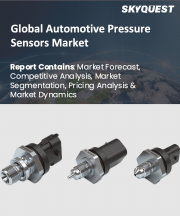
자동차용 압력 센서 시장 규모는 2024년에 210억 2,000만 달러로 평가되었으며, 2025년 228억 9,000만 달러에서 2033년까지 452억 7,000만 달러로 성장할 전망입니다. 예측 기간(2026-2033년) 동안 CAGR은 8.9%로 예측됩니다.
자동차용 압력 센서 시장은 기술 발전과 안전 규제 강화에 힘입어 괄목할 만한 성장세를 보이고 있습니다. 타이어 공기압 모니터링 시스템(TPMS)은 최적의 타이어 공기압을 유지하여 승용차의 안전성을 높이고 충돌 위험을 줄여줍니다. 비접촉식 3D 마그네틱 센서와 같은 혁신 기술은 압력 센서의 정밀도와 내구성을 향상시켜 자동차 제조업체의 진화하는 요구에 부응하고 있습니다. 자동차 배기가스 규제 및 안전기준이 강화됨에 따라 엔진 모니터링, 타이어 공기압 관리 등 자동차 애플리케이션에서 본 센서의 수요가 급증하고 있습니다. 또한, 전기자동차(EV) 시장의 확대는 배터리 및 난방 시스템용 압력 센서에 대한 새로운 기회를 창출하고 있습니다. 자율주행 기술의 발전은 중요한 안전 기능을 지원하는 첨단 압력 센서의 필요성을 더욱 강조하고 있으며, 시장 확대가 확실시되고 있습니다.
자동차용 압력 센서 시장 촉진요인
자동차용 압력 센서 시장은 탑승자의 안전을 강화하는 사이드 에어백 압력 장치를 함께 사용하는 첨단 구속 시스템의 도입으로 견인되고 있습니다. 사이드 도어에 내장된 이 센서들은 사고 관련 디지털 신호를 중앙 에어백 유닛에 전달하여 충돌 시 반응 시간과 효과를 향상시키는 중요한 역할을 합니다. 또한, 이 압력 센서는 가솔린과 디젤 엔진 모두에서 점화 과정을 최적화하여 엔진 성능 향상에 기여합니다. 안전과 엔진 효율을 중심으로 다양한 자동차 애플리케이션에서 압력 센서의 채택이 확대되면서 시장 성장이 크게 촉진될 것으로 예상됩니다.
자동차용 압력 센서 시장 억제요인
자동차용 압력 센서 시장은 소형화 추세로 인해 도전에 직면해 있습니다. 이러한 추세는 ADAS(첨단 운전자 보조 시스템)에 활용되는 센서의 비용 절감 노력을 복잡하게 만들고 있습니다. 이러한 센서의 대부분은 신호 대역폭과 측정 범위에 제한이 있어 실제 신호와 도로상의 장애물 등으로 인한 시스템 노이즈를 구분하는 능력이 떨어집니다. 이러한 제한은 시스템의 성능과 신뢰성에 영향을 미칠 뿐만 아니라, 제조업체들이 이러한 기술적 제약 속에서 비용과 기능적 목표를 달성하기 위해 노력하면서 시장 성장을 저해할 것으로 예상됩니다.
자동차용 압력 센서 시장 동향
자동차용 압력 센서 시장에서는 기존의 전위차계나 광학식 차량 위치 측정 시스템을 대신하여 비접촉식 3D 자기 센서의 채택이 눈에 띄게 증가하고 있습니다. 이 혁신적인 센서는 손상과 오염의 위험을 제거하여 신뢰성을 높이고, 혹독한 온도 조건에서도 정확한 측정을 가능하게 합니다. 이러한 기술적 진보는 공간 효율성을 최적화할 뿐만 아니라 보다 복잡한 차량 개조와 성능 향상을 가능하게 합니다. 제조업체들이 이러한 첨단 센싱 솔루션을 채택함에 따라 시장은 첨단 센서 기술의 통합에 점점 더 집중하고 있으며, 이는 자동차의 디자인과 기능에 큰 변화를 가져오고 있습니다.
Automotive Pressure Sensors Market size was valued at USD 21.02 Billion in 2024 and is poised to grow from USD 22.89 Billion in 2025 to USD 45.27 Billion by 2033, growing at a CAGR of 8.9% during the forecast period (2026-2033).
The automotive pressure sensors market is experiencing significant growth driven by advancements in technology and heightened safety regulations. Tire Pressure Monitoring Systems (TPMS) enhance safety in passenger vehicles by ensuring optimal tire pressure, thereby reducing collision risks. Innovations such as non-contact 3D magnetic sensors are enhancing accuracy and durability of pressure sensors, catering to the evolving demands of automakers. Increasingly stringent regulations around vehicle emissions and safety are prompting a surge in demand for these sensors in automotive applications, including engine monitoring and tire pressure management. Furthermore, the expanding electric vehicle (EV) market is creating new opportunities for pressure sensors in battery and heating systems. The rise of autonomous driving technology further underscores the necessity for advanced pressure sensors to support critical safety functions, ensuring market expansion.
Top-down and bottom-up approaches were used to estimate and validate the size of the Automotive Pressure Sensors market and to estimate the size of various other dependent submarkets. The research methodology used to estimate the market size includes the following details: The key players in the market were identified through secondary research, and their market shares in the respective regions were determined through primary and secondary research. This entire procedure includes the study of the annual and financial reports of the top market players and extensive interviews for key insights from industry leaders such as CEOs, VPs, directors, and marketing executives. All percentage shares split, and breakdowns were determined using secondary sources and verified through Primary sources. All possible parameters that affect the markets covered in this research study have been accounted for, viewed in extensive detail, verified through primary research, and analyzed to get the final quantitative and qualitative data.
Automotive Pressure Sensors Market Segments Analysis
Global Automotive Pressure Sensors Market is segmented by Vehicle Type, Vehicle Type, Application, Transduction Type, Technology, and Region. Based on Vehicle Type, the market is segmented into Passenger Cars, and Commercial Vehicles. Based on Application, the market is segmented into Antilock Braking System (ABS), Airbag System, Direct Tire Pressure Monitoring System, HVAC System, Power Steering, Transmission System. Based on Transduction Type, the market is segmented into Piezoresistive Pressure Sensors, Capacitive Pressure Sensors, Resonant Pressure Sensors, Optical Pressor Sensor, Other Pressure Sensors. Based on Technology, the market is segmented into Pressure Sensor, MEMS Pressure Sensor Strain Gauge Pressure Senior. Based on Region, the market is segmented into North America, Europe, Asia Pacific, Latin America and Middle East & and Africa.
Driver of the Automotive Pressure Sensors Market
The automotive pressure sensors market is driven by the implementation of advanced restraint systems that utilize side-by-side airbag pressure devices, ensuring enhanced safety for passengers in vehicles. These sensors, embedded in the side doors, play a crucial role in relaying digital signals concerning accidents to the central airbag unit, thereby improving response times and effectiveness during collisions. Moreover, these pressure sensors contribute to enhanced engine performance by optimizing the ignition process in both petrol and diesel engines. The growing adoption of pressure sensors in various automotive applications, particularly in safety and engine efficiency, is expected to significantly boost market growth.
Restraints in the Automotive Pressure Sensors Market
The automotive pressure sensors market faces challenges due to the trend of miniaturization, which complicates efforts to lower costs for sensors utilized in advanced driver assistance systems. Many of these sensors are limited in terms of signal bandwidth and measurement range, which hampers the ability to differentiate between actual signals and system noise, such as that caused by road obstacles. This limitation not only affects the performance and reliability of the systems but is also anticipated to hinder market growth, as manufacturers strive to meet cost and functionality targets amidst these technological constraints.
Market Trends of the Automotive Pressure Sensors Market
The automotive pressure sensors market is witnessing a notable shift towards the adoption of non-interacting 3D magnetic sensors, which are being favored over traditional potentiometers and optical systems for vehicle positioning. These innovative sensors enhance reliability by eliminating damage and contamination risks, while providing accurate measurements even in extreme temperature conditions. This technological advancement not only optimizes space but also allows for more intricate vehicle modifications and improved performance. As manufacturers embrace these enhanced sensing solutions, the market is becoming increasingly focused on integrating advanced sensor technologies, driving a significant transformation in automotive design and functionality.