


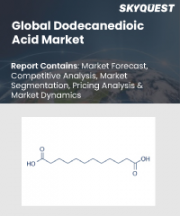
도데칸이산 시장 규모는 2024년에 6억 3,487만 달러로 평가되었고, 2025년 6억 7,042만 달러에서 2033년까지 10억 3,672만 달러로 성장할 전망입니다. 예측 기간(2026-2033년)의 CAGR은 5.6%를 나타낼 것으로 예상됩니다.
도데칸이산 시장은 특히 자동차산업이 확대되고 있는 신흥경제국의 나일론 수요 증가에 따라 크게 성장할 것으로 전망됩니다. 유연성, 내열성, 내상성과 같은 나일론의 뛰어난 특성은 자동차 용도에서 선호되는 옵션이 되어 DDDA 수요를 견인하고 있습니다. 또한 다양한 산업에서 윤활제와 접착제 수요 증가도 시장의 밝은 전망에 기여하고 있습니다. 나일론 생산자의 연구 개발에 대한 지속적인 투자는 제품 혁신을 더욱 촉진하고 DDDA의 사용을 지원합니다. 또한 나사나 섬유 등의 용도에 대한 나일론에 대한 강한 수요와 이러한 지역에서의 견조한 제조업 섹터 및 급속한 산업화가 결합되어 특히 도료, 코팅, 건설 업계에서 도데칸이산 시장 성장을 가속하고 있습니다.
도데칸이산 시장 성장 촉진요인
도데칸이산 시장은 이 화합물의 우수한 특성에 의해 견인되고 있으며, 그 특성이 수많은 용도에 있어서 높은 매력을 낳고 있습니다. 유연성, 열 안정성 및 탁월한 내화학성은 시장 장소에서 수요의 높이에 기여합니다. DDDA를 배합한 제품은 우수한 인장 강도와 내충격성을 포함한 탁월한 기계적 특성을 나타내며 엔지니어링 플라스틱의 이상적인 후보로 자리매김하고 있습니다. 또한 DDDA의 무용제 특성과 휘발성 유기화합물(VOC)의 저배출량은 환경면에서의 매력을 높여 배출에 관한 엄격한 규제기준에 적합하며 다양한 산업에 대한 수요를 더욱 촉진하고 있습니다.
도데칸이산 시장 성장 억제요인
도데칸이산 시장은 생산에 필요한 주요 원료에 대한 접근이 제한되어 있기 때문에 문제에 직면하고 있습니다. 부타디엔과 같은 주요 원료는 석유와 천연가스로부터 조달되기 때문에 가용성은 원유 가격 변동과 지정학적 상황의 영향을 받기 쉽습니다. 이 공급 부족은 공급망의 심각한 혼란을 초래하여 궁극적으로 시장 성장과 확장을 방해할 수 있습니다. 결과적으로 제조업체는 안정적인 생산 수준을 유지하는 데 어려움을 겪고 잠재적 지연과 비용 증가로 이어질 수 있습니다. 향후 안정적이고 견조한 시장 환경을 확보하기 위해서는 이러한 공급 제약에 대한 대응이 매우 중요합니다.
도데칸이산 시장 동향
도데칸이산 시장은 다양한 산업분야에서 지속가능한 솔루션에 대한 관심이 증가함에 따라 상승세를 보이고 있습니다. 친환경적 이니셔티브에 대한 관심이 강해지고 있는 가운데, DDDA는 용매를 포함하지 않고, 휘발성 유기 화합물(VOC)의 배출량이 최소한이라는 환경 친화적인 특성이 평가되고 있습니다. 이에 따라 지속가능성을 중시하는 분체도료나 접착제 등의 용도에 있어서 DDDA는 우선적으로 선택되는 옵션으로 자리매김하고 있습니다. 기업이 보다 환경에 배려한 제품을 요구하는 소비자 요구에 대응하려고 하고 있는 가운데, DDDA 수요는 증가가 전망되고, 현대의 제조에 있어서 실현 가능하고 책임 있는 재료 선택으로서의 지위를 강화하고 있습니다.
Dodecanedioic Acid Market size was valued at USD 634.87 Million in 2024 and is poised to grow from USD 670.42 Million in 2025 to USD 1036.72 Million by 2033, growing at a CAGR of 5.6% during the forecast period (2026-2033).
The Dodecanedioic Acid (DDDA) market is poised for significant growth due to the increasing demand for nylon, particularly in emerging economies where the automotive sector is expanding. Nylon's beneficial attributes-such as flexibility, heat stability, and resistance to scratching-make it a preferred choice in automotive applications, driving the demand for DDDA. In addition, the rising need for lubricants and adhesives across various industries is contributing to the market's positive outlook. Ongoing investments by nylon producers in research and development further enhance product innovations, supporting DDDA utilization. Moreover, strong demand for nylon in applications like screws and fabrics, coupled with the robust manufacturing sectors and swift industrialization in these regions, is fueling the growth of the DDDA market, particularly in paints, coatings, and the construction industry.
Top-down and bottom-up approaches were used to estimate and validate the size of the Dodecanedioic Acid market and to estimate the size of various other dependent submarkets. The research methodology used to estimate the market size includes the following details: The key players in the market were identified through secondary research, and their market shares in the respective regions were determined through primary and secondary research. This entire procedure includes the study of the annual and financial reports of the top market players and extensive interviews for key insights from industry leaders such as CEOs, VPs, directors, and marketing executives. All percentage shares split, and breakdowns were determined using secondary sources and verified through Primary sources. All possible parameters that affect the markets covered in this research study have been accounted for, viewed in extensive detail, verified through primary research, and analyzed to get the final quantitative and qualitative data.
Dodecanedioic Acid Market Segments Analysis
Global Dodecanedioic Acid Market is segmented by Purity, Production Process, Application and region. Based on Purity, the market is segmented into 95% to 99% and More than 99%. Based on Production Process, the market is segmented into Synthetic Production and Biotech Production Dosage Technique. Based on Application, the market is segmented into Antiseptics, Nylon, Adhesives, Painting Materials, Corrosion Inhibitors, Automotivelubricants, Surfactants, Engineering Plastics and Others. Based on region, the market is segmented into North America, Europe, Asia Pacific, Latin America and Middle East & Africa.
Driver of the Dodecanedioic Acid Market
The Dodecanedioic Acid (DDDA) market is driven by the compound's advantageous characteristics, which render it highly appealing for a multitude of applications. Its flexibility, thermal stability, and exceptional resistance to chemicals contribute to its desirability in the marketplace. Products formulated with DDDA demonstrate outstanding mechanical properties, including impressive tensile strength and impact resistance, positioning them as ideal candidates for engineering plastics. Additionally, the solvent-free nature of DDDA combined with its low emissions of volatile organic compounds (VOCs) enhances its environmental appeal, aligning with strict regulatory standards regarding emissions and further propelling its demand across various industries.
Restraints in the Dodecanedioic Acid Market
The Dodecanedioic Acid market faces challenges due to the restricted access to essential raw materials necessary for its production. Key inputs, such as butadiene, are sourced from petroleum or natural gas, making their availability susceptible to fluctuations in oil prices and geopolitical circumstances. This scarcity can result in significant supply chain disruptions, ultimately impeding the growth and expansion of the market. As a consequence, manufacturers may encounter difficulties in maintaining consistent production levels, leading to potential delays and increased costs. Addressing these supply limitations is crucial for ensuring a stable and robust market environment moving forward.
Market Trends of the Dodecanedioic Acid Market
The Dodecanedioic Acid (DDDA) market is experiencing an upward trend driven by an increasing emphasis on sustainable solutions across various industries. With a growing commitment to environmentally friendly practices, DDDA is being recognized for its eco-friendly properties, including being solvent-free and generating minimal emissions of volatile organic compounds (VOCs). This positions DDDA as a preferred choice in applications such as powder coatings and adhesives that prioritize sustainability. As companies seek to align with consumer demand for greener products, the demand for DDDA is anticipated to rise, reinforcing its status as a viable and responsible material option in modern manufacturing.