


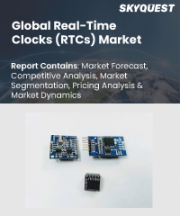
실시간 클락(RTC) 시장 규모는 2024년에 45억 2,000만 달러로 평가되며, 2025년 47억 5,000만 달러에서 2033년까지 70억 7,000만 달러로 성장할 전망입니다. 예측 기간(2026-2033년)의 CAGR은 5.1%로 예측됩니다.
실시간 클락(RTC)은 전용 집적회로를 통해 정확한 시간 관리를 제공함으로써 자동차, 항공우주, 가전제품 등 다양한 분야에서 중요한 역할을 하고 있습니다. 이 RTC 집적회로는 초, 분, 윤년 조정을 포함한 시간을 지속적으로 추적하고 단일 리튬 배터리로 장시간 작동할 수 있습니다. 주전원이 손실된 경우에도 일관된 시간 관리를 유지합니다. 최근 RTC 기술의 발전으로 Bluetooth Low Energy 지원, 내장형 온도 센서 등의 기능이 도입되어 현대 디바이스의 기능성이 향상되고 있습니다. RTC는 POS 시스템에서 게임기, 보안 시스템에 이르기까지 다양한 용도에 필수적이며, 광대역 연결을 가능하게 하는 차량용 라디오에도 내장되어 있습니다. 이러한 편재성은 여러 산업 분야에서 정확한 시간 관리에 대한 수요 증가를 지원하고 있습니다.
실시간 시계(RTC) 시장 성장 촉진요인
실시간 시계(RTC) 시장은 다양한 전자기기 및 시스템에서 정밀한 시간 관리의 필요성이 증가함에 따라 괄목할 만한 성장세를 보이고 있습니다. 사물인터넷(IoT), 웨어러블 기술, 자동차 시스템, 산업 자동화 등 다양한 용도이 진화하면서 신뢰할 수 있고 정확한 시간 관리 솔루션에 대한 수요가 점점 더 중요해지고 있습니다. 이러한 RTC에 대한 요구는 빠르게 발전하는 기술 환경에서 제조업체들이 성능과 효율성을 향상시키기 위해 노력하는 가운데, RTC가 상호 연결된 장치와 첨단 시스템의 원활한 작동을 보장하는 데 있으며, 중요한 역할을 하고 있다는 것을 보여줍니다.
실시간 시계(RTC) 시장 성장 억제요인
실시간 시계(RTC) 시장은 주로 배터리에 대한 의존성으로 인해 상당한 문제에 직면해 있습니다. 배터리는 일반적으로 수명이 한정되어 있으므로 특히 효율성이 최우선인 웨어러블 기술에서 긴 수명의 배터리가 필수적인 시나리오에서는 어려움이 발생합니다. 또한 RTC와 관련된 비용은 다른 전자 부품에 비해 높은 경향이 있으며, 예산이 중요한 용도에서 보급을 방해할 수 있습니다. 이러한 요인들은 제조업체와 개발자가 극복해야 할 제약조건을 만들어내고, 다양한 기술 환경에서 RTC의 성장과 보급을 제한하고 있습니다. 이러한 문제를 해결하는 것은 시장의 발전과 제품 제공을 강화하는 데 있으며, 매우 중요합니다.
실시간 시계(RTC) 시장 동향
실시간 시계(RTC) 시장은 전 세계 스마트 시티 구상의 추진을 배경으로 괄목할 만한 성장세를 보이고 있습니다. 스마트 조명, 교통 시스템, 보안 시스템에 RTC를 통합하면 도시 인프라의 효율성과 연계성을 높일 수 있습니다. 지자체들이 자원 관리의 최적화와 시민 안전 향상을 위해 첨단 기술에 투자하는 가운데, 정확한 시간 관리 솔루션에 대한 수요가 급증하고 있습니다. 이러한 수요 증가는 RTC 분야의 혁신을 촉진할 뿐만 아니라, 다양한 IoT 기기에서 정밀한 타이밍을 활용하는 고급 애플리케이션 개발을 촉진하고, 치열한 경쟁 시장 상황을 형성하고 있습니다.
Real-Time Clocks (RTCs) Market size was valued at USD 4.52 Billion in 2024 and is poised to grow from USD 4.75 Billion in 2025 to USD 7.07 Billion by 2033, growing at a CAGR of 5.1% during the forecast period (2026-2033).
Real-Time Clocks (RTCs) play a crucial role across diverse sectors such as automotive, aerospace, and consumer electronics by providing accurate timekeeping through dedicated integrated circuits. These RTC ICs continuously track time, including seconds, minutes, and leap-year adjustments, while operating on a single lithium cell for extended periods. Even when the primary power is lost, they maintain consistent timekeeping. Recent advancements in RTC technology have introduced features like Bluetooth Low Energy compatibility and built-in temperature sensors, enhancing their functionality for modern devices. RTCs are integral to various applications, from Point-of-Sale systems to gaming devices and security systems, and are also embedded in vehicle radios to facilitate broadband connectivity. Their ubiquitous presence underscores the growing demand for precise timekeeping across multiple industry verticals.
Top-down and bottom-up approaches were used to estimate and validate the size of the Real-Time Clocks (RTCs) market and to estimate the size of various other dependent submarkets. The research methodology used to estimate the market size includes the following details: The key players in the market were identified through secondary research, and their market shares in the respective regions were determined through primary and secondary research. This entire procedure includes the study of the annual and financial reports of the top market players and extensive interviews for key insights from industry leaders such as CEOs, VPs, directors, and marketing executives. All percentage shares split, and breakdowns were determined using secondary sources and verified through Primary sources. All possible parameters that affect the markets covered in this research study have been accounted for, viewed in extensive detail, verified through primary research, and analyzed to get the final quantitative and qualitative data.
Real-Time Clocks (RTCs) Market Segments Analysis
Global Real-Time Clocks (RTCs) Market is segmented by Interface, Mounting Type, Operating Voltage, End-use Industry and region. Based on Interface, the market is segmented into Inter-Integrated Circuit (I2C) and Serial Peripheral Interface (SPI). Based on Mounting Type, the market is segmented into Surface Mount and Through Hole. Based on Operating Voltage, the market is segmented into 1V - 2V, 2.1V - 3.5V and 3.6V - 6V. Based on End-use Industry, the market is segmented into Energy & Utility, Consumer Electronics, Automotive, Industrial, IT & Telecommunication and Others. Based on region, the market is segmented into North America, Europe, Asia Pacific, Latin America and Middle East & Africa.
Driver of the Real-Time Clocks (RTCs) Market
The Real-Time Clocks (RTCs) market is experiencing significant growth driven by the rising need for precise timekeeping across a wide range of electronic devices and systems. As various applications, including the Internet of Things (IoT), wearable technology, automotive systems, and industrial automation, continue to evolve, the demand for reliable and accurate timekeeping solutions is becoming increasingly critical. This escalating requirement for RTCs highlights their essential role in ensuring the smooth operation of interconnected devices and sophisticated systems, as manufacturers strive to enhance performance and efficiency in a rapidly advancing technological landscape.
Restraints in the Real-Time Clocks (RTCs) Market
The Real-Time Clocks (RTCs) market faces notable challenges primarily due to the reliance on batteries, which often come with a finite operational lifespan. This limitation poses difficulties in scenarios where extended battery longevity is essential, particularly in wearable technology where efficiency is paramount. Additionally, the cost associated with RTCs tends to be higher compared to other electronic components, potentially hindering wider adoption in budget-sensitive applications. These factors create constraints that manufacturers and developers must navigate, limiting the growth and accessibility of RTCs in various technological environments. Addressing these issues is crucial for advancing the market and enhancing product offerings.
Market Trends of the Real-Time Clocks (RTCs) Market
The Real-Time Clocks (RTCs) market is experiencing a notable upward trend, fueled by the increasing implementation of smart city initiatives worldwide. The integration of RTCs into smart lighting, transportation, and security systems enhances the efficiency and coordination of urban infrastructure. As municipalities invest in advanced technologies to optimize resource management and improve citizen safety, the demand for accurate timekeeping solutions is surging. This surge not only propels innovation within the RTC sector but also encourages the development of more sophisticated applications that leverage precise timing for various IoT devices, ultimately shaping a vibrant and competitive market landscape.