커넥티드 약물전달 디바이스 시장(제3판) : 디바이스 유형별, 접속 방식별, 투여 경로별, 치료 영역별, 지역별 - 동향과 예측(-2035년)
Connected Drug Delivery Devices Market (3rd Edition): Distribution by Type of Device, Mode of Connectivity, Route of Administration, Therapeutic Area & Geographical Regions - Trends and Forecast Till 2035
상품코드:1958586
리서치사:Roots Analysis
발행일:2026년 02월
페이지 정보:영문 500 Pages
라이선스 & 가격 (부가세 별도)
한글목차
커넥티드 약물전달 디바이스 시장 - 개요
세계의 커넥티드 약물전달 디바이스 시장 규모는 현재 53억 달러에서 2035년까지 127억 달러로 성장하며, 예측 기간(-2035년)의 CAGR은 10.2%로 추정되고 있습니다.
커넥티드 약물전달 장치 시장 - 성장 및 동향
수년 동안 처방약의 낮은 복약 순응도는 의료 분야에서 심각한 문제로 대두되어 왔으며, 질병의 진행, 입원율 증가, 사망률 증가, 의료비 증가로 이어져 왔습니다. 조사에 따르면 미국에서는 약 66%의 개인이 적어도 한 가지 이상의 처방전을 가지고 있음에도 불구하고 약 50%가 의사의 지시대로 약을 사용하지 못하는 것으로 나타났습니다. 이러한 복약 순응도 문제는 복잡한 투약 계획, 약물에 대한 접근성 제한, 환자 지원 부족 등 여러 가지 요인으로 인해 발생합니다. 이러한 문제를 해결하기 위해 의료 전문가와 기술 프로바이더들은 투약 계획의 간소화, 개별화된 투약 스케줄 제공, 환자 교육 개선 등 다양한 전략을 시행하고 있습니다.
커넥티드 약물전달 장치는 전통적 투약 방법과 디지털 헬스 기술을 통합하여 복약 순응도를 향상시키는 효과적인 솔루션입니다. 이 기기들은 첨단 기능, 센서, 무선 연결 기능을 갖추고 있으며, 모바일 앱, 디지털 헬스 플랫폼, 전자건강기록(EHR)과의 원활한 연계를 가능하게 합니다. 또한 연동형 약물 투여 시스템은 약물 섭취 상황과 환자의 건강 상태를 실시간으로 추적할 수 있으며, 신속한 임상적 개입과 맞춤 치료 변경을 촉진합니다. 환자 참여와 복약 순응도를 향상시킴으로써 치료 결과를 향상시킬 뿐만 아니라 총 의료비 절감에도 기여할 수 있습니다.
또한 센서 기술의 통합으로 전통적 약물 투여 시스템의 기능이 변화하고 있으며, 지능형 상호 연결 솔루션으로 진화하고 있습니다. 원격의료 통합의 지속적인 발전과 디지털 건강 툴의 광범위한 수용은 향후 수년간 커넥티드 약물전달 장치 시장의 지속적인 성장을 가속할 것으로 예측됩니다.
성장 요인 - 시장 확대의 전략적 원동력
당뇨병, 천식, 만성폐쇄성폐질환(COPD), 자가면역질환 등 만성질환의 유병률 증가가 수요를 견인하고 있습니다. 이는 커넥티드 약물전달 장치가 정밀한 용량 관리와 장기적인 치료 관리를 가능하게 하기 때문입니다. 센서 기술, 블루투스 저에너지, AI 분석, IoT 통합의 기술 발전으로 원격 모니터링, 의료 서비스 프로바이더와의 데이터 공유, 개별화된 개입이 가능해져 복약 순응도와 치료 결과를 개선할 수 있습니다. 환자 참여와 고령화 인구 증가는 성장을 더욱 가속화하고 있으며, 원격의료와의 시너지 효과와 정밀의료로의 전환으로 인해 시장 예측은 더 높은 CAGR을 예상하고 있습니다.
시장 과제 - 발전을 가로막는 심각한 장애물
당뇨병, 천식 등 만성질환에서 센서와 앱을 통합하여 실시간 복약 순응도 추적 및 원격 모니터링을 가능하게 하는 커넥티드 약물전달 장치는 보급을 가로막는 다각적인 시장 과제에 직면해 있습니다. 첨단 센서, 연구개발, 정밀 조립, 공급망 문제로 인한 높은 개발 및 제조 비용으로 인해 기존 장치보다 높은 가격을 책정하고 있습니다. 여기에 지속적인 클라우드 사용료, 관세, 보험 환급의 갭이 겹쳐져 있습니다. 또한 의약품과 의료기기의 조합에 대한 엄격한 규제 장벽과 전 세계 컴플라이언스 대응의 지연은 빠른 기술 발전과 충돌하며 AI 혁신을 제한하고 있습니다. 또한 사이버 보안 및 데이터 프라이버시 위험은 사용자들의 신뢰를 떨어뜨리고 데이터 공유를 제한하고 있습니다. 또한 사용 편의성 문제 등 이용 장벽도 여전히 존재합니다.
커넥티드 약물전달 장치 시장 - 주요 인사이트
이 보고서는 커넥티드 약물전달 장치 시장 현황을 상세하게 분석하고 업계내 잠재적인 성장 기회를 파악합니다. 주요 조사 결과는 다음과 같습니다.
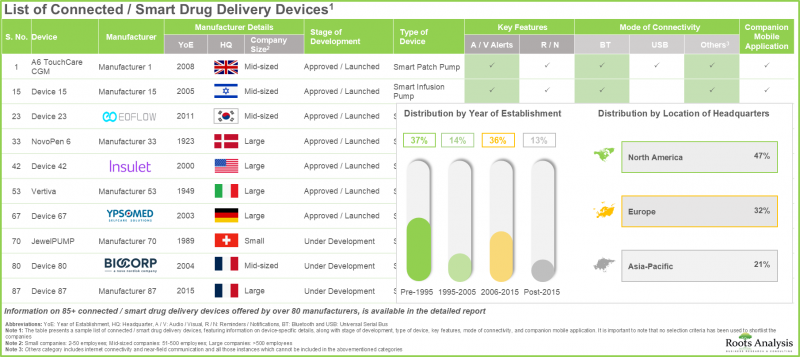
현재 시장 상황에서는 80개 이상의 제조업체가 다양한 커넥티드 약물 투여 장치를 제공하고 있으며, 대부분 북미에 본사를 두고 있습니다.
현재 약 75%의 커넥티드/스마트 약물 투여 디바이스가 시판되고 있으며, 특히 이들 디바이스의 대부분은 피하 투여 경로를 통한 약물 투여를 목적으로 하고 있습니다.
현재 기존 약물전달 장치와 통합 가능한 30가지 이상의 혁신적인 애드온 센서가 사용 가능/개발 중입니다. 대부분의 애드온 센서 제조업체는 유럽에 기반을 둔 신생 기업입니다.
애드온 센서의 55% 이상이 흡입별 약물 투여를 위해 설계되었으며, 그 중 85% 이상의 센서가 블루투스 연결을 지원할 수 있습니다.
지금까지 이 분야에 등록된 대부분의 임상시험은 다양한 커넥티드 약물전달 장치의 안전성과 유효성을 평가하기 위한 것이며, 이러한 연구들은 대부분 미국내 여러 기관에서 진행되고 있습니다.
이 시장에 대한 이해관계자들의 관심이 높아지면서 최근 다양한 이해관계자들간의 제휴가 증가하고 있습니다. 실제로 지난 3년간 약 70%의 거래가 체결되었습니다.
투자자들은 커넥티드 약물전달 장치 시장에 자본을 집중 투입하여 업계의 발전을 가속화할 수 있는 첨단 장치 개발에 집중하고 있습니다.
커넥티드/스마트 약물전달 디바이스 개발 프로세스에는 계획, 설계, 엔지니어링, 공정 검증, 제조, 조립, 상품화까지 다양한 단계가 포함됩니다.
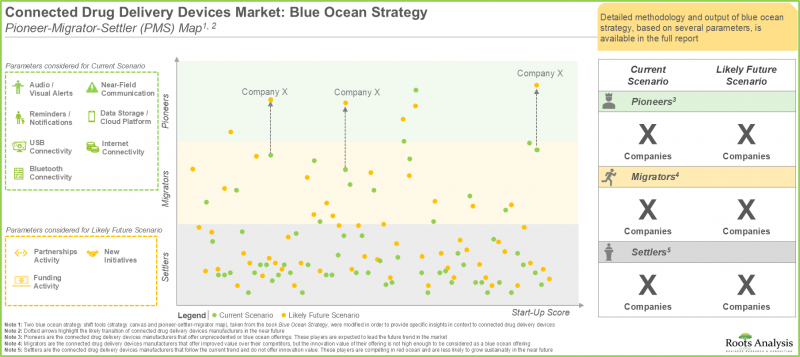
블루오션 전략 분석의 개발자, 이주자, 정착자 지도에 따르면 제품 강화에 주력하는 여러 커넥티드 약물전달 장치 제조업체가 향후 수년간 개발자로 부상할 가능성이 높다고 합니다.
커넥티드 약물전달 장치가 정밀한 투약 및 원격 환자 모니터링 기능을 제공함에 따라 향후 10년간 커넥티드 약물전달 장치 시장은 연평균 10.2%의 괄목할 만한 성장세를 보일 것으로 예측됩니다.
북미 커넥티드 약물전달 장치 시장은 2035년까지 가장 큰 점유율을 차지할 것으로 예측됩니다. 또한 약물전달을 위해 제조되는 대부분의 장치는 대사성 질환을 대상으로 합니다.
커넥티드 약물전달 장치 시장은 미국내 스마트 및 커넥티드 약물전달 솔루션의 채택 확대에 힘입어 예측 기간 중 더 높은 CAGR로 성장할 것으로 예측됩니다.
첨단 약물전달 장치에 대한 수요 급증과 만성질환 유병률 증가에 따라 커넥티드 약물전달 장치 시장은 꾸준히 확대될 것으로 예측됩니다.
커넥티드 드럭 딜리버리 디바이스 시장
시장 규모 및 기회 분석은 다음 매개 변수를 기반으로 세분화됩니다.
장치 유형별
커넥티드/스마트 웨어러블 주사기
연결형/스마트 흡입기
연결형/스마트펜형 주사기
커넥티드/스마트 자동 주사기
커넥티드/스마트 무침 주사 시스템
연결 방식별
블루투스 지원 장치
근거리 무선통신 지원 장치
셀룰러 지원 장치
광역 네트워크 지원 장치
투여 경로별
비경구 투여
흡입
치료 영역별
대사성 질환
호흡기 질환
자가면역질환
기타 질환
지역별
북미
미국
캐나다
유럽
영국
독일
프랑스
이탈리아
스페인
기타 유럽
아시아태평양
중국
인도
일본
기타 아시아태평양
커넥티드 약물전달 장치 시장 - 주요 부문
커넥티드/스마트 웨어러블 주사기가 가장 큰 시장 점유율을 차지합니다.
올해 커넥티드/스마트 웨어러블 주사기가 가장 큰 시장 점유율을 차지하고 있으며, 이러한 추세는 향후 수년간 지속될 것으로 예측됩니다. 이는 만성질환의 유병률이 증가하고, 이해관계자들이 커넥티드 약물전달 장치에 첨단 기능을 통합하기 위한 노력을 지속하고 있기 때문입니다. 이러한 개선을 통해 모니터링이 강화되고, 환자의 순응도가 향상되며, 의료 전문가와의 데이터 교환이 가능해집니다.
향후 블루투스 지원 커넥티드/스마트 기기가 가장 큰 점유율을 차지할 것으로 예측됩니다.
현재 블루투스를 지원하는 커넥티드/스마트 디바이스는 커넥티드 드럭 딜리버리 디바이스 시장에서 더 큰 점유율을 차지할 것으로 예측됩니다. 또한 이 부문은 예측 기간 중 상당한 성장을 이룰 것으로 예측됩니다. 그 이유는 블루투스 연결이 설정이 쉽고, 모든 스마트폰에서 광범위하게 사용할 수 있으며, 추가 장치 없이도 작동하기 때문입니다.
비경구 투여 부문이 올해 커넥티드 약물전달 장치에서 가장 큰 점유율을 차지할 것으로 예측됩니다.
당사의 추정에 따르면 올해에는 비경구 투여 부문이 더 큰 시장 점유율을 차지할 것으로 예측됩니다. 이는 생물제제 및 만성질환을 위한 고가 치료제의 투여 경로로 선호되기 때문입니다. 또한 흡입 부문은 예측 기간 중 높은 CAGR을 나타낼 것으로 예측됩니다. 이는 이 방법에 의한 약물전달의 용이성, 범용성, 무통성, 그리고 지속적인 국소 치료 효과를 발휘할 수 있는 능력 때문인 것으로 분석됩니다.
북미가 가장 큰 점유율을 확보하며 시장을 독점합니다.
당사의 예측에 따르면 올해 북미는 커넥티드 약물전달 장치 시장 점유율에서 선두를 유지할 것으로 예측됩니다. 또한 아시아태평양 시장은 2035년까지 비교적 높은 성장률로 확대될 것으로 예측됩니다. 이러한 성장은 바이오 제약 분야 스타트업 증가, 혁신적인 약물전달 시스템을 위한 연구개발 활성화, 다양한 질병 치료용 기기 승인 증가에 힘입어 성장세를 보이고 있습니다.
커넥티드 드럭 딜리버리 디바이스 디바이스 시장의 대표적인 진출 기업
Bigfoot Biomedical
BIOCORP
Eitan Medical
E3D Elcam Drug Delivery Device
EoFlow
Gerresheimer
Insulet
Medtronic
Medtrum
Nemera
Phillips-Medisize
Roche
Sonceboz
SOOIL Development
Tandem Diabetes Care
West Pharmaceutical Services
Ypsomed
커넥티드 드럭 딜리버리 디바이스 시장 - 조사 범위
시장 규모 및 기회 분석 : 이 보고서는 커넥티드 약물전달 장치 시장에 대해(A) 장치 유형,(B) 연결 모드,(C) 투여 경로,(D) 치료 영역,(E) 지역적 지역 등 주요 시장 부문에 초점을 맞춘 상세한 분석을 담고 있습니다.
커넥티드/스마트 약물전달 장치 시장 현황: 통합형 커넥티드 약물전달 장치 시장 현황에 대해 상세하게 분석했으며,(A) 개발 단계,(B) 장치 출시 연도,(C) 통합 장치 유형,(D) 투여 경로,(E) 대상 적응증 및 치료 영역,(F) 주요 기능,(G) 연결 모드,(H) 지원되는 모바일 애플리케이션 및 데이터 저장/클라우드 플랫폼 여부,(I) 설립 연도,(J) 지원되는 모바일 애플리케이션 및 데이터 저장/클라우드 플랫폼 여부,(I) 지원되는 데이터 저장/클라우드 플랫폼 여부,(J) 지원되는 데이터 저장/클라우드 플랫폼 여부 기능,(G)연결 모드,(H)지원 모바일 애플리케이션 유무 및 데이터 저장/클라우드 플랫폼 유무,(I)설립연도,(J)기업 규모,(K)본사 소재지,(H)가장 활발하게 진출한 기업 관련 정보를 제공합니다.
애드온 센서 시장 현황: 애드온 센서 시장의 전반적인 시장 현황을 다음과 같은 관련 파라미터에 대한 자세한 정보와 함께 개괄적으로 설명합니다. (A)개발 단계,(B)기기 출시 연도,(C)호환 기기,(D)투여 경로,(E)대상 적응증, 치료 영역,(F)치료 영역,(G)대상 적응증,(H)주요 특징,(I)연결 방식,(J)지원되는 모바일 애플리케이션 여부 H)주요 특징,(I)연결 방식,(J)지원 모바일 애플리케이션 유무,(K)데이터 스토리지/클라우드 플랫폼 유무,(L)설립연도,(M)기업 규모,(N)본사 소재지,(O)가장 활발하게 진출한 기업 관련 정보를 제공합니다.
제품 경쟁력 분석 : 커넥티드 약물전달 장치 및 추가 센서에 대한(A) 제조업체의 강점과(B) 제품 포트폴리오의 강점을 기반으로 한 인사이트 분석.
기업 개요: 북미, 유럽, 아시아태평양의 커넥티드 드럭 딜리버리 디바이스를 제조하는 주요 기업 개요을(A) 설립연도,(B) 본사 소재지,(C) 제품 포트폴리오,(D) 최근 동향,(E) 향후 전망에 따라 상세하게 분석합니다.
임상시험 분석 : 커넥티드 약물전달 장치와 관련된 완료 및 진행 중인 임상시험을(A) 임상시험 등록 연도,(B) 등록 환자 수,(C) 임상시험 현황,(D) 스폰서/협력기관 유형,(E) 연구 설계,(F) 지역 등 여러 관련 파라미터를 기준으로 분석합니다. 분석합니다.
제휴 및 협력 관계: 이해관계자간 체결된 제휴 및 협력 관계를(A) 제휴 연도,(B) 제휴 형태,(C) 기기 분류,(D) 통합 기기 유형,(E) 가장 활발한 진출기업 등 관련 매개 변수를 기준으로 분석합니다.
자금조달 및 투자 분석 : 해당 분야의 자금조달 및 투자 계약을(A) 자금조달 연도,(B) 자금조달 유형,(C) 투자 금액,(D) 지역,(E) 주요 진출기업 등 관련 파라미터를 기준으로 분석합니다.
밸류체인 분석 : 커넥티드/스마트 드럭 딜리버리 디바이스 개발에 관련된 다양한 단계(연구개발, 제품 제조/조립, 제품 유통, 마케팅/판매, 시판 후 조사 등)에 대한 상세한 밸류체인 분석과 함께 각 단계별 비용 요구사항에 대한 정보를 제시합니다.
규제 현황: 주요 규제기관이 각 국가 및 지역에서 수립 및 발행한 커넥티드 약물전달 장치 승인에 관한 각종 가이드라인을 요약하여 설명합니다.
사례 연구: 가장 흔한 두 가지 적응증(천식과 당뇨병)에 대한 상세한 사례 연구. 질환 개요, 역학, 경제적 부담(처방 치료 순응도별), 해당 적응증 환자의 치료 순응도 향상에 초점을 맞춘 약물전달 장치 및 기타 전략의 발전 현황에 대한 요약이 포함되어 있습니다.
블루오션 분석 : 블루오션 전략에 기반한 현재 및 미래 시장에 대한 심층 분석. 이 보고서는 신생 커넥티드 약물전달 장치 기업에게 경쟁 없는 시장을 개발하기 위한 전략적 계획/가이드를 제공하고, 시장에서 경쟁 우위를 확보하기 위해 블루오션으로 전환하는 데 도움이 되는 전략적 툴을 제공합니다.
SWOT 분석 : 산업 관련 동향, 기회, 과제에 대해 SWOT 분석에 따라 자세히 논의합니다. 이는 커넥티드 드럭 딜리버리 디바이스 시장의 발전에 영향을 미칠 가능성이 높은 것입니다.
목차
제1장 서문
제2장 조사 방법
제3장 시장 역학
제4장 거시경제 지표
제5장 개요
제6장 서론
제7장 시장 구도 : 커넥티드/스마트 약물전달 디바이스
제8장 시장 구도 : 애드온 센서
제9장 제품 경쟁력 분석
제10장 기업 개요 : 북미에 기반을 둔 커넥티드/스마트 약물전달 디바이스 제조업체
제11장 기업 개요 : 유럽에 기반을 둔 커넥티드/스마트 약물전달 디바이스 제조업체
제12장 기업 개요 : 아시아태평양 및 기타 지역에 기반을 둔 커넥티드/스마트 약물전달 디바이스 제조업체
제13장 임상시험 분석
제14장 파트너십과 협업
제15장 자금조달과 투자 분석
제16장 밸류체인 분석
제17장 커넥티드/스마트 약물전달 디바이스의 규제 상황
제18장 사례 연구 : 복약 준수의 개선을 향한 커넥티드 약물전달 디바이스의 응용
제19장 SWOT 분석
제20장 블루 오션 전략
제21장 세계의 커넥티드 약물전달 디바이스 시장
제22장 커넥티드 약물전달 디바이스 시장(디바이스 유형별)
제23장 커넥티드 약물전달 디바이스 시장(접속 방식별)
제24장 커넥티드 약물전달 디바이스 시장(투여 경로별)
제25장 커넥티드 약물전달 디바이스 시장(치료 영역별)
제26장 커넥티드 약물전달 디바이스 시장(지역별)
제27장 커넥티드 약물전달 디바이스 시장(주요 기업별)
제28장 결론
제29장 이그제큐티브 인사이트
제30장 부록 1 : 표형식 데이터
제31장 부록 2 : 기업·단체 리스트
제32장 부록 3 : 파트너십과 협력, 2015-2020년
KSA
영문 목차
영문목차
Connected Drug Delivery Devices Market: Overview
As per Roots Analysis, the global connected drug delivery market is estimated to grow from USD 5.3 billion in the current year to USD 12.7 billion by 2035, at a CAGR of 10.2% during the forecast period, till 2035.
Connected Drug Delivery Devices Market: Growth and Trends
Over the years, poor compliance to prescribed medications continues to be a significant issue in the healthcare field, leading to disease progression, increased hospitalization rates, mortality, and rising healthcare expenses. Studies indicate that approximately 66% of individuals in the United States receive at least one prescription, yet nearly 50% fail to adhere to their physicians' instructions for medication use. This challenge of non-adherence arises from multiple factors, such as complicated dosing regimens, restricted access to medications, and inadequate patient assistance. To address this, healthcare professionals and technology providers are using various strategies to streamline dosage plans, provide individualized medication schedules, and improve patient education.
Connected drug delivery devices represent a viable solution as these devices integrate traditional delivery methods with digital health technologies to improve adherence. These devices come with advanced features, sensors, and wireless connectivity that allow for smooth integration with mobile apps, digital health platforms, and electronic health records. Additionally, the linked drug delivery system allows for real-time tracking of medication consumption and patient health conditions, thus facilitating prompt clinical interventions and customized therapy modifications. By enhancing patient involvement and adherence, these devices not only bolster patient results but also help in reducing total healthcare costs.
Further, the integration of sensor technologies has transformed the capabilities of conventional drug delivery systems, allowing them to evolve into intelligent, interconnected solutions. Ongoing advancements in telehealth integration and broader acceptance of digital health tools are anticipated to fuel consistent growth in the connected drug delivery device market in the upcoming years.
Growth Drivers: Strategic Enablers of Market Expansion
Rising chronic disease prevalence, including diabetes, asthma, chronic obstructive pulmonary disease (COPD), and autoimmune disorders, fuels demand. This is due to the fact that connected drug delivery devices enable precise dosing and long-term therapy management. Technological advances in sensors, Bluetooth Low Energy, AI analytics, and IoT integration allow remote monitoring, data sharing with providers, and personalized interventions, boosting adherence and outcomes. Patient engagement and aging populations further accelerate growth, with market projections showing a higher CAGR driven by telehealth synergies and precision medicine shifts.
Connected drug delivery devices, which integrate sensors and apps for real-time adherence tracking and remote monitoring in chronic conditions like diabetes and asthma, face multifaceted market challenges that hinder their widespread adoption. High development and manufacturing costs driven by advanced sensors, R&D, precision assembly, and supply chain issues elevate prices above traditional devices, compounded by ongoing cloud fees, tariffs, and payer reimbursement gaps. Further, stringent regulatory hurdles for drug-device combinations and global compliance delays, clash with rapid tech evolution and limit AI innovations. In addition, cybersecurity and data privacy risks hamper user trust and restrict data sharing, while usage barriers like usability issues persist.
Connected Drug Delivery Devices Market: Key Insights
The report delves into the current state of the connected drug delivery devices market and identifies potential growth opportunities within industry. Some key findings from the report include:
The current market landscape features the presence of more than 80 manufacturers that offer various connected drug delivery devices; of these, majority are headquartered in North America.
Nearly 75% of the connected / smart drug delivery devices are currently commercially available; notably, most of these devices are intended for the administration of medications via subcutaneous route.
At present, over 30 innovative add-on sensors are available / under development for integration with conventional drug delivery devices; numerous add-on sensor manufacturers are start-ups based in Europe.
More than 55% of the add-on sensors are designed for drug delivery via inhalation; of these, over 85% of the sensors can support Bluetooth connectivity.
The majority of clinical trials registered in this domain till date have evaluated the safety and efficacy of various connected drug delivery devices; most of these studies have been conducted across multiple sites in the US.
The growing interest of stakeholders in this market is reflected from the rising partnerships established among various stakeholders in the recent past; in fact, close to 70% of the deals were inked in the last three years.
Investors are increasingly channelizing capital into connected drug delivery devices market for the development of advanced devices which are accelerating industry advancements.
The development process of a connected / smart drug delivery device involves various steps, ranging from planning, designing, engineering, process validation, manufacturing and assembly to commercialization.
The pioneer-migrator-settler map in blue ocean strategy analysis suggests that several connected drug delivery devices manufacturers focused on enhancing their products are likely to emerge as pioneers in the coming years.
Owing to the ability of connected drug delivery devices to provide precise dosing and remote patient monitoring, the market is anticipated to witness a notable growth (CAGR of 10.2%) over the next decade.
The connected drug delivery devices market in North America is expected to capture maximum share by 2035; further, majority of the devices manufactured for drug delivery are intended for metabolic disorders.
Driven by the growing adoption of smart and connected drug delivery solutions in the US, the connected drug delivery devices market is poised to grow at a higher CAGR over the forecast period.
Given the surge in demand for advanced drug delivery devices and the rising prevalence of chronic diseases, the connected drug delivery devices market is anticipated to rise steadily.
Connected Drug Delivery Devices Market
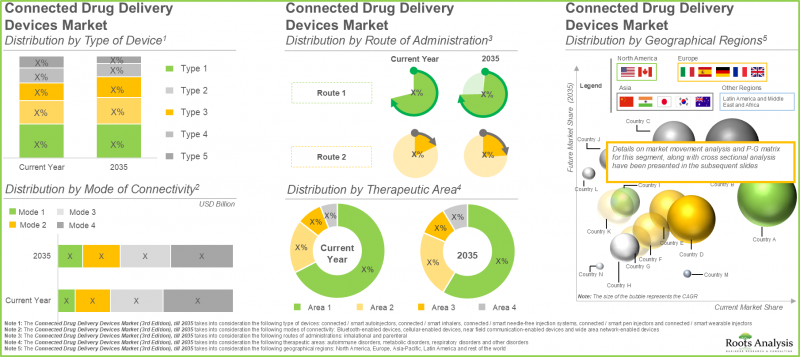
The market sizing and opportunity analysis has been segmented across the following parameters:
By Type of Device
Connected / Smart Wearable Injectors
Connected / Smart Inhalers
Connected / Smart Pen Injectors
Connected / Smart Autoinjectors
Connected / Smart Needle-free Injection Systems
By Mode of Connectivity
Bluetooth-enabled Devices
Near Field Communication-enabled Devices
Cellular-enabled Devices
Wide Area Network-enabled Devices
By Route of Administration
Parenteral
Inhalational
By Therapeutic Area
Metabolic Disorders
Respiratory Disorders
Autoimmune Disorders
Other Disorders
By Geographical Regions
North America
US
Canada
Europe
UK
Germany
France
Italy
Spain
Rest of Europe
Asia-Pacific
China
India
Japan
Rest of Asia-Pacific
Connected Drug Delivery Devices Market: Key Segments
Connected / Smart Wearable Injectors Account for the Largest Market Share
In the current year, the connected / smart wearable injectors holds the largest market share, and this trend is expected to persist in the coming years. This is due to the increasing prevalence of chronic diseases and the ongoing initiatives of stakeholders to incorporate enhanced features into their connected drug delivery devices. These improvements enhance monitoring, strengthen patient compliance, and allow data exchange with healthcare professionals.
Bluetooth-Enabled Connected / Smart Devices Hold the Highest Share in the Future
At present, Bluetooth-enabled connected / smart devices are expected to capture a larger share of the connected drug delivery devices market. Moreover, this segment is expected to experience substantial growth during the forecasted period. This is because Bluetooth connectivity is simple to set up, widely accessible on all smartphones, and operates without requiring any additional devices.
Parenteral Segment Holds the Highest Connected Drug Delivery Devices Market Share in the Current Year
According to our estimates, in the current year, the parenteral segment is likely to hold a larger market share. This is because it is the favored route for administering biologics and high-value treatments for chronic conditions. Further, the inhalation segment is expected to experience a higher CAGR over the forecast period, owing to the ease, versatility, and painless nature of drug delivery through this method, along with its ability for prolonged localized therapeutic effect.
North America Dominates the Market by Securing Highest Share
According to our estimates, North America is expected to dominate the connected drug delivery devices market share this year. Further, the Asia-Pacific market is expected to expand at a comparatively higher rate till 2035. The growth is driven by a rising number of biopharmaceutical start-ups, significant research and development efforts for innovative drug delivery systems, and an increase in device approvals for various disease therapies in this area.
Primary Research Overview
Discussions with multiple stakeholders in this domain influenced the opinions and insights presented in this study. The market report includes transcripts of the following other third-party discussions:
Senior Director, Global Strategic Marketing, Medical, Large Company, US
Co-Founder and Chief Executive Officer, Small Company, US
Chief Executive Officer, Small Company, US
Chief Executive Officer and President, Mid-sized Company, US
Chief Executive Officer, Small Company, Italy
Vice President and Chief Scientist, Large Company, Israel
Director of Global Communications, and Former Vice President of Strategic Partnerships and Business Development, Mid-sized Company, US
Former Chief Executive Officer, Small Company, US
Former Director of Front-end Innovation and Head of Connected Health, Large Company, US
Former Vice President, Marketing and Alliance Management, Mid-sized Company, US
Advisor of Strategy and Business Development, Small Company, US
Example Players in Connected Drug Delivery Devices Market
Bigfoot Biomedical
BIOCORP
Eitan Medical
E3D Elcam Drug Delivery Device
EoFlow
Gerresheimer
Insulet
Medtronic
Medtrum
Nemera
Phillips-Medisize
Roche
Sonceboz
SOOIL Development
Tandem Diabetes Care
West Pharmaceutical Services
Ypsomed
Connected Drug Delivery Devices Market: Research Coverage
Market Sizing and Opportunity Analysis: The report features an in-depth analysis of the connected drug delivery devices market, focusing on key market segments, including [A] type of device [B] mode of connectivity, [C] route of administration, [D] therapeutic area, and [E] geographical regions.
Connected / Smart Drug Delivery Devices Market Landscape: A detailed overview of the overall market landscape of integrated connected drug delivery devices, along with information on several relevant parameters, such as [A] stage of development, [B] launch year of device, [C] type of integrated device, [D] route of administration, [E] target indication, therapeutic area, [F] key features, [G] mode of connectivity, [H] availability of companion mobile application and availability of data storage / cloud platform, [I] year of establishment, [J] company size, [K] location of headquarters and [H] most active players.
Add-On Sensors Market Landscape: : A detailed overview overall market landscape of add-on sensors market landscape, along with information on several relevant parameters, such as [A] stage of development, [B] launch year of device, [C] compatible device, [D] route of administration, [E] target indication, [F] therapeutic area, [G] target indication, [H] key features, [I] mode of connectivity, [J] availability of companion mobile application and [K] availability of data storage / cloud platform, [L] year of establishment, [M] company size, [N] location of headquarters and [O] most active players.
Product Competitiveness Analysis: An insightful analysis of connected drug delivery devices and add-on sensors based on the [A] manufacturer strength and [B] portfolio strength.
Company Profiles: In-depth profiles of leading players manufacturing connected drug delivery devices in North America, Europe and Asia-Pacific based on [A] year of establishment, [B] location of headquarters, [C] product portfolio, [D] recent developments and [E] an informed future outlook.
Clinical Trial Analysis: An analysis of completed and ongoing clinical trials related to connected drug delivery devices, based on several relevant parameters, such as [A] trial registration year, [B] enrolled patient population, [C] trial status, [D] type of sponsor / collaborator, [E] study design [F] and geography.
Partnerships and Collaborations: An analysis of partnerships and collaborations inked between stakeholders, based on several relevant parameters, such as [A] year of partnership, [B] type of partnership, [C] class of device, [D] type of integrated device, [E] most active players.
Funding and Investment Analysis: An analysis of funding and investment signed in the domain based on several relevant parameters, such as [A] year of funding, [B] type of funding, [C] amount invested, [D] geography, [E] and most active players.
Value Chain Analysis: An in-depth value chain analysis featuring a discussion on various steps involved in the development of connected / smart drug delivery devices, including research and development (R&D), product manufacturing and assembly, product distribution, marketing and sales, and post-market surveillance, along with the information on cost requirements across each of the aforementioned stages.
Regulatory Landscape: An informative summary of various guidelines established and issued by major regulatory bodies for the approval of connected drug delivery devices, across different countries / geographical regions.
Case Studies: Detailed case studies on two most common indications (namely asthma and diabetes), featuring a brief description of the disease, its epidemiology, economic burden (imposed due to non-adherence to prescribed treatments), and a summary of the evolution of drug delivery devices and other strategies focused on improving therapy adherence among patients suffering from the indication.
Blue Ocean Analysis: A detailed analysis of the current and future market based on blue ocean strategy, covering a strategic plan / guide for emerging connected drug delivery device companies to help unlock an uncontested market, featuring strategic tools that can help them to shift towards a blue ocean in order to gain a competitive edge in the market.
SWOT Analysis: A detailed discussion on industry affiliated trends, opportunities and challenges, under a SWOT analysis, which are likely to impact the evolution of connected drug delivery devices market.
Key Questions Answered in this Report
Which are the leading companies in connected drug delivery devices market?
Which region dominates the connected drug delivery devices market?
What are the key trends observed in the connected drug delivery devices market?
What factors are likely to influence the evolution of this market?
What are the primary challenges faced by connected drug delivery device developers?
What is the current and future market size?
What is the CAGR of this market?
How is the current and future market opportunity likely to be distributed across key market segments?
Reasons to Buy this Report
The report provides a comprehensive market analysis, offering detailed revenue projections of the overall market and its specific sub-segments. This information is valuable to both established market leaders and emerging entrants.
The report offers stakeholders a comprehensive overview of the market, including key drivers, barriers, opportunities, and challenges. This information empowers stakeholders to stay abreast of market trends and make data-driven decisions to capitalize on growth prospects.
The report can aid businesses in identifying future opportunities in any sector. It also helps in understanding if those opportunities are worth pursuing.
The report helps in identifying customer demand by understanding the needs, preferences, and behavior of the target audience in order to tailor products or services effectively.
The report equips new entrants with requisite information regarding a particular market to help them build successful business strategies.
The report allows for more effective communication with the audience and in building strong business relations.
Additional Benefits
Complementary PPT Insights Pack
Complimentary Excel Data Packs for all Analytical Modules in the Report
15% Free Content Customization
Detailed Report Walkthrough Session with Research Team
Free Updated report if the report is 6-12 months old or older
TABLE OF CONTENTS
1. PREFACE
1.1. Introduction
1.2. Market Share Insights
1.3. Key Market Insights
1.4. Report Coverage
1.5. Key Questions Answered
1.6. Chapter Outlines
2. RESEARCH METHODOLOGY
2.1. Chapter Overview
2.2. Research Assumptions
2.2.1. Market Landscape and Market Trends
2.2.2. Market Forecast and Opportunity Analysis
2.2.3. Comparative Analysis
2.3. Database Building
2.3.1. Data Collection
2.3.2. Data Validation
2.3.3. Data Analysis
2.4. Project Methodology
2.4.1. Secondary Research
2.4.1.1. Annual Reports
2.4.1.2. Academic Research Papers
2.4.1.3. Company Websites
2.4.1.4. Investor Presentations
2.4.1.5. Regulatory Filings
2.4.1.6. White Papers
2.4.1.7. Industry Publications
2.4.1.8. Conferences and Seminars
2.4.1.9. Government Portals
2.4.1.10. Media and Press Releases
2.4.1.11. Newsletters
2.4.1.12. Industry Databases
2.4.1.13. Roots Proprietary Databases
2.4.1.14. Paid Databases and Sources
2.4.1.15. Social Media Portals
2.4.1.16. Other Secondary Sources
2.4.2. Primary Research
2.4.2.1. Types of Primary Research
2.4.2.1.1. Qualitative Research
2.4.2.1.2. Quantitative Research
2.4.2.1.3. Hybrid Approach
2.4.2.2. Advantages of Primary Research
2.4.2.3. Techniques for Primary Research
2.4.2.3.1. Interviews
2.4.2.3.2. Surveys
2.4.2.3.3. Focus Groups
2.4.2.3.4. Observational Research
2.4.2.3.5. Social Media Interactions
2.4.2.4. Key Opinion Leaders Considered in Primary Research
2.4.2.4.1. Company Executives (CXOs)
2.4.2.4.2. Board of Directors
2.4.2.4.3. Company Presidents and Vice Presidents
2.4.2.4.4. Research and Development Heads
2.4.2.4.5. Technical Experts
2.4.2.4.6. Subject Matter Experts
2.4.2.4.7. Scientists
2.4.2.4.8. Doctors and Other Healthcare Providers
2.4.2.5. Ethics and Integrity
2.4.2.5.1. Research Ethics
2.4.2.5.2. Data Integrity
2.4.3. Analytical Tools and Databases
2.5. Robust Quality Control
3. MARKET DYNAMICS
3.1. Chapter Overview
3.2. Forecast Methodology
3.2.1. Top-down Approach
3.2.2. Bottom-up Approach
3.2.3. Hybrid Approach
3.3. Market Assessment Framework
3.3.1. Total Addressable Market (TAM)
3.3.2. Serviceable Addressable Market (SAM)
3.3.3. Serviceable Obtainable Market (SOM)
3.3.4. Currently Acquired Market (CAM)
3.4. Forecasting Tools and Techniques
3.4.1. Qualitative Forecasting
3.4.2. Correlation
3.4.3. Regression
3.4.4. Extrapolation
3.4.5. Convergence
3.4.6. Sensitivity Analysis
3.4.7. Scenario Planning
3.4.8. Data Visualization
3.4.9. Time Series Analysis
3.4.10. Forecast Error Analysis
3.5. Key Considerations
3.5.1. Demographics
3.5.2. Government Regulations
3.5.3. Reimbursement Scenarios
3.5.4. Market Access
3.5.5. Supply Chain
3.5.6. Industry Consolidation
3.5.7. Pandemic / Unforeseen Disruptions Impact
3.6. Limitations
4. MACRO-ECONOMIC INDICATORS
4.1. Chapter Overview
4.2. Market Dynamics
4.2.1. Time Period
4.2.1.1. Historical Trends
4.2.1.2. Current and Forecasted Estimates
4.2.2. Currency Coverage
4.2.2.1. Major Currencies Affecting the Market
4.2.2.2. Factors Affecting Currency Fluctuations on the Industry
4.2.2.3. Impact of Currency Fluctuations on the Industry
4.2.3. Foreign Currency Exchange Rate
4.2.3.1. Impact of Foreign Exchange Rate Volatility on the Market
4.2.3.2. Strategies for Mitigating Foreign Exchange Risk
4.2.4. Recession
4.2.4.1. Assessment of Current Economic Conditions and Potential Impact on the Market
4.2.4.2. Historical Analysis of Past Recessions and Lessons Learnt
4.2.5. Inflation
4.2.5.1. Measurement and Analysis of Inflationary Pressures in the Economy
4.2.5.2. Potential Impact of Inflation on the Market Evolution
4.2.6. Interest Rates
4.2.6.1. Interest Rates and Their Impact on the Market
4.2.6.2. Strategies for Managing Interest Rate Risk
4.2.7. Commodity Flow Analysis
4.2.7.1. Type of Commodity
4.2.7.2. Origins and Destinations
4.2.7.3. Values and Weights
4.2.7.4. Modes of Transportation
4.2.8. Global Trade Dynamics
4.2.8.1. Import Scenario
4.2.8.2. Export Scenario
4.2.8.3. Trade Policies
4.2.8.4. Strategies for Mitigating the Risks Associated with Trade Barriers
4.2.8.5. Impact of Trade Barriers on the Market
4.2.9. War Impact Analysis
4.2.9.1. Russian-Ukraine War
4.2.9.2. Israel-Hamas War
4.2.10. COVID Impact / Related Factors
4.2.10.1. Global Economic Impact
4.2.10.2. Industry-specific Impact
4.2.10.3. Government Response and Stimulus Measures
4.2.10.4. Future Outlook and Adaptation Strategies
4.2.11. Other Indicators
4.2.11.1. Fiscal Policy
4.2.11.2. Consumer Spending
4.2.11.3. Gross Domestic Product
4.2.11.4. Employment
4.2.11.5. Taxes
4.2.11.6. Stock Market Performance
4.2.11.7. Cross Border Dynamics
4.3. Conclusion
5. EXECUTIVE SUMMARY
6. INTRODUCTION
6.1. Chapter Overview
6.2. Medication Adherence
6.2.1. Digital Tools for Improving Medication Adherence
6.3. Overview of Connected / Smart Drug Delivery Devices
6.4. Key Design Features and Development Process
6.5. Classification of Connected / Smart Drug Delivery Devices
6.5.1. Type of Device
6.5.1.1. Connected Inhalers
6.5.1.2. Connected Handheld Injectors
6.5.1.3. Smart Pills
6.5.1.4. Smart Implantable Devices
6.5.2. Type of Technology
6.6. Regulatory Guidelines for Connected / Smart Drug Delivery Devices
6.7. Advantages and Limitations of Connected / Smart Drug Delivery Devices
6.8. Impact of COVID-19 on Connected / Smart Drug Delivery Devices Domain
6.9. Future Perspective
7. MARKET LANDSCAPE: CONNECTED / SMART DRUG DELIVERY DEVICES
7.1. Chapter Overview
7.2. Connected / Smart Drug Delivery Devices: Overall Market Landscape
7.2.1. Analysis by Stage of Development
7.2.2. Analysis by Launch Year
7.2.3. Analysis by Type of Integrated Device
7.2.4. Analysis by Route of Administration
7.2.5. Analysis by Target Indication
7.2.6. Analysis by Therapeutic Area
7.2.7. Analysis by Key Features
7.2.8. Analysis by Mode of Connectivity
7.2.9. Analysis by Availability of Companion Mobile Application
7.2.10. Analysis by Availability of Data Storage / Cloud Platform
8.3.4. Analysis by Year of Establishment and Location of Headquarters
8.3.5. Analysis by Company Size and Location of Headquarters
8.3.6. Most Active Players: Analysis by Number of Add-on Sensors Manufactured
9. PRODUCT COMPETITIVENESS ANALYSIS
9.1. Chapter Overview
9.2. Assumptions and Key Parameters
9.3. Methodology
9.4. Connected Drug Delivery Devices and Add-on Sensors: Product Competitiveness Analysis
9.4.1. Connected / Smart Drug Delivery Devices
9.4.1.1. Smart Handheld Injectors (Peer Group 1a)
9.4.1.2. Smart Wearable Injectors (Peer Group 1b)
9.4.1.3. Other Integrated Devices (Peer Group 1c)
9.4.2. Add-on Sensors (Peer Group 2)
10. COMPANY PROFILES: CONNECTED / SMART DRUG DELIVERY DEVICE MANUFACTURERS BASED IN NORTH AMERICA
10.1. Chapter Overview
10.2. Leading Connected / Smart Drug Delivery Device Manufacturers
10.2.1. Medtronic
10.2.1.1. Company Overview
10.2.1.2. Financial Information
10.2.1.3. Connected / Smart Drug Delivery Devices Portfolio
10.2.1.4. Recent Developments and Future Outlook
10.2.2. Insulet
10.2.2.1. Company Overview
10.2.2.2. Financial Information
10.2.2.3. Connected / Smart Drug Delivery Devices Portfolio
10.2.2.4. Recent Developments and Future Outlook
10.2.3. Tandem Diabetes Care
10.2.3.1. Company Overview
10.2.3.2. Financial Information
10.2.3.3. Connected / Smart Drug Delivery Devices Portfolio
10.2.3.4. Recent Developments and Future Outlook
10.3. Other Prominent Connected / Smart Drug Delivery Device Manufacturers
10.3.1. Bigfoot Biomedical
10.3.1.1. Company Overview
10.3.1.2. Connected / Smart Drug Delivery Devices Portfolio
10.3.2. Phillips Medisize (a subsidiary of Molex)
10.3.2.1. Company Overview
10.3.2.2. Connected / Smart Drug Delivery Devices Portfolio
10.3.3. West Pharmaceutical Services
10.3.3.1. Company Overview
10.3.3.2. Connected / Smart Drug Delivery Devices Portfolio
11. COMPANY PROFILES: CONNECTED / SMART DRUG DELIVERY DEVICE MANUFACTURERS BASED IN EUROPE
11.1. Chapter Overview
11.2. Leading Connected / Smart Drug Delivery Device Manufacturers
11.2.1. BIOCORP
11.2.1.1. Company Overview
11.2.1.2. Financial Information
11.2.1.3. Connected / Smart Drug Delivery Devices Portfolio
11.2.1.4. Recent Developments and Future Outlook
11.2.2. Gerresheimer
11.2.2.1. Company Overview
11.2.2.2. Financial Information
11.2.2.3. Connected / Smart Drug Delivery Devices Portfolio
11.2.2.4. Recent Developments and Future Outlook
11.2.3. Roche
11.2.3.1. Company Overview
11.2.3.2. Financial Information
11.2.3.3. Connected / Smart Drug Delivery Devices Portfolio
11.2.3.4. Recent Developments and Future Outlook
11.2.4. Ypsomed
11.2.4.1. Company Overview
11.2.4.2. Financial Information
11.2.4.3. Connected / Smart Drug Delivery Devices Portfolio
11.2.4.4. Recent Developments and Future Outlook
11.3. Other Prominent Connected / Smart Drug Delivery Device Manufacturers
11.3.1. Nemera
11.3.1.1. Company Overview
11.3.1.2. Connected / Smart Drug Delivery Devices Portfolio
11.3.2. Sonceboz
11.3.2.1. Company Overview
11.3.2.2. Connected / Smart Drug Delivery Devices Portfolio
12. COMPANY PROFILES: CONNECTED / SMART DRUG DELIVERY DEVICE MANUFACTURERS BASED IN ASIA-PACIFIC AND REST OF THE WORLD
12.1. Chapter Overview
12.2. Leading Connected / Smart Drug Delivery Device Manufacturers
12.2.1. Medtrum
12.2.1.1. Company Overview
12.2.1.2. Connected / Smart Drug Delivery Devices Portfolio
12.2.1.3. Recent Developments and Future Outlook
12.2.2. SOOIL Development
12.2.2.1. Company Overview
12.2.2.2. Connected / Smart Drug Delivery Devices Portfolio
12.2.2.3. Recent Developments and Future Outlook
12.2.3. EOFlow
12.2.3.1. Company Overview
12.2.3.2. Financial Information
12.2.3.3. Connected / Smart Drug Delivery Devices Portfolio
12.2.3.4. Recent Developments and Future Outlook
12.3. Other Prominent Connected / Smart Drug Delivery Device Manufacturers
12.3.1. Eitan Medical
12.3.1.1. Company Overview
12.3.1.2. Connected / Smart Drug Delivery Devices Portfolio
12.3.2. E3D Elcam Drug Delivery Device
12.3.2.1. Company Overview
12.3.2.2. Connected / Smart Drug Delivery Devices Portfolio
13. CLINICAL TRIAL ANALYSIS
13.1. Chapter Overview
13.2. Scope and Methodology
13.3. Connected / Smart Drug Delivery Devices and Add-on Sensors: Clinical Trial Analysis
13.3.1. Analysis by Trial Registration Year
13.3.2. Analysis of Enrolled Patient Population by Trial Registration Year
13.3.3. Analysis by Trial Status
10.3.4. Analysis by Trial Registration Year and Trial Status
13.3.5. Analysis of Number of Enrolled Patients Population by Trial Status
13.3.6. Analysis by Target Patient Population
13.3.7. Analysis by Type of Sponsor / Collaborator
13.3.8. Analysis by Study Design
10.3.8.1. Analysis by Type of Allocation
10.3.8.2. Analysis by Type of Intervention Model
10.3.8.3. Analysis by Type of Masking
10.3.8.4. Analysis by Trial Purpose
13.3.9. Leading Players: Analysis by Number of Registered Trials
13.3.10. Leading Connected / Smart Drug Delivery Devices and Add-on Sensors: Analysis by Number of Registered Trials
13.3.11. Analysis by Geography
13.3.11.1. Analysis of Clinical Trials by Geography
13.3.11.2. Analysis of Number of Registered Trials by Trial Status and Geography
13.3.11.3. Analysis of Number of Enrolled Patient Population by Geography
14. PARTNERSHIPS AND COLLABORATIONS
14.1. Chapter Overview
14.2. Partnership Models
14.3. Connected / Smart Drug Delivery Devices: Partnerships and Collaborations
14.3.1. Analysis by Year of Partnership
14.3.2. Analysis by Type of Partnership
14.3.3. Analysis by Year and Type of Partnership
14.3.4. Analysis by Class of Device
14.3.5. Analysis by Type of Integrated Device
14.3.6. Most Active Players: Analysis by Number of Partnerships
14.3.7. Analysis by Geography
14.3.7.1. Intracontinental and Intercontinental Deals
14.3.7.2. Local and International Deals
15. FUNDING AND INVESTMENT ANALYSIS
15.1. Chapter Overview
15.2. Funding Models
15.3. Connected / Smart Drug Delivery Devices: Funding and Investments
15.3.1. Analysis by Year of Funding
15.3.2. Analysis by Type of Funding
15.3.3. Analysis by Year and Type of Funding
15.3.4. Analysis of Amount Invested by Year of Funding
15.3.5. Analysis of Amount Invested by Type of Funding
15.3.6. Analysis by Geography
15.3.7. Most Active Players: Analysis by Number of Funding Instances
15.3.8. Most Active Players: Analysis by Amount Raised
16. VALUE CHAIN ANALYSIS
16.1. Chapter Overview
16.2. Connected / Smart Drug Delivery Devices: Value Chain
16.3. Cost Distribution across the Value Chain
16.3.1. Concept Development and Proof of Concept
16.3.2. Research and Product Development
16.3.3. Conduct of Clinical Trials
16.3.4. Regulatory Approvals
16.3.5. Manufacturing and Product Assembly
16.3.6. Application Development
16.3.7. Marketing and Sales
17. REGULATORY LANDSCAPE FOR CONNECTED / SMART DRUG DELIVERY DEVICES
17.1. Chapter Overview
17.2. Regulatory Approval of Combination Products in North America
17.2.1. Regulatory Approval of Combination Products in the US
17.2.1.1. Overview
17.2.1.2. Historical Background
17.2.1.3. Role of Regulatory Bodies in Product Approval
17.2.2. Regulatory Approval of Combination Products in Canada
17.2.2.1. Overview
17.2.2.2. Role of Regulatory Bodies in Product Approval
17.2.3. Regulatory Approval of Combination Products in Mexico
17.2.3.1. Overview
17.2.3.2. Role of Regulatory Bodies in Product Approval
17.3. Regulatory Approval of Combination Products in Europe
17.3.1. Regulatory Approval of Combination Products in EU5 Countries
17.3.1.1. Overview
17.3.1.2. Role of Regulatory Bodies in Product Approval
17.4. Regulatory Approval of Combination Products in Asia-Pacific
17.4.1. Regulatory Approval of Combination Products in Japan
17.4.1.1. Overview
17.4.1.2. Role of Regulatory Bodies in Product Approval
17.4.2. Regulatory Approval of Combination Products in China
17.4.2.1. Overview
17.4.2.2. Role of Regulatory Bodies in Product Approval
17.4.3. Regulatory Approval of Combination Products in India
17.4.3.1. Overview
17.4.3.2. Role of Regulatory Bodies in Product Approval
17.4.4. Regulatory Approval of Combination Products in South Korea
17.4.4.1. Overview
17.4.4.2. Role of Regulatory Bodies in Product Approval
17.4.5. Regulatory Approval of Combination Products in Australia
17.4.5.1. Overview
17.4.5.2. Role of Regulatory Bodies in Product Approval
17.5. Regulatory Approval of Combination Products in Middle East and North Africa
17.5.1. Regulatory Approval of Combination Products in Saudi Arabia
17.5.1.1. Overview
17.5.1.2. Role of Regulatory Bodies in Product Approval
17.5.2. Regulatory Approval of Combination Products in United Arab Emirates
17.5.2.1. Overview
17.5.2.2. Role of Regulatory Bodies in Product Approval
17.6. Regulatory Approval of Combination Products in Latin America
17.6.1. Regulatory Approval of Combination Products in Brazil
17.6.1.1. Overview
17.6.1.2. Role of Regulatory Bodies in Product Approval
17.6.2. Regulatory Approval of Combination Products in Argentina
17.6.2.1. Overview
17.6.2.2. Role of Regulatory Bodies in Product Approval
17.7. Connected Devices: Other Measures for Testing Safety, Effectiveness and Performance
17.8. Ensuring Security of Data Captured
17.9. Concluding Remarks
18. CASE STUDIES: APPLICATION OF CONNECTED DRUG DELIVERY DEVICES TO IMPROVE MEDICATION ADHERENCE
18.1. Chapter Overview
18.2. Case Study I: Diabetes
18.2.1. Disease Overview
18.2.2. Key Statistics
18.2.3. Economic Burden due to Non-Adherence
18.2.4. Evolution of Connected / Smart Drug Delivery Devices for Improving Adherence
18.3. Case Study II: Asthma
18.3.1. Disease Overview
18.3.2. Key Statistics
18.3.3. Economic Burden due to Non-Adherence
18.3.4. Evolution of Connected / Smart Drug Delivery Devices for Improving Adherence
19. SWOT ANALYSIS
19.1. Chapter Overview
19.2. Strengths
19.2.1. Ability to Minimize / Eliminate Medication Errors
19.2.2. Economic Advantages
19.2.3. Technological Advancements
19.3. Weaknesses
19.3.1. Cybersecurity
19.3.2. Stringent Regulatory Approvals
19.3.3. High Developmental Costs
19.4. Opportunities
19.4.1. Growing Prevalence of Chronic Disorders
19.4.2. Increasing Adoption of Digital Health Technologies
19.4.3. Rising Partnership and Investment Activity
19.5. Threats
19.5.1. Material Compatibility Issues
19.5.2. Availability of Alternative Drug Delivery Devices
19.5.3. Concern Related to Product Recalls in Past
19.6. Comparison of SWOT Factors
20. BLUE OCEAN STRATEGY
20.1. Overview of Blue Ocean Strategy
20.1.1. Red Oceans
20.1.2. Blue Oceans
20.1.3. Comparison of Red Ocean Strategy and Blue Ocean Strategy
20.1.4. Connected Drug Delivery Devices: Blue Ocean Strategy and Shift Tools
20.1.4.1. Strategy Canvas
20.1.4.2. Pioneer-Migrator-Settler (PMS) Map
21. GLOBAL CONNECTED DRUG DELIVERY DEVICES MARKET
21.1. Chapter Overview
21.2. Assumptions and Methodology
21.3. Global Connected Drug Delivery Devices Market: Historical Trends (since 2020) and Forecasted Estimates (till 2035)
21.3.1. Scenario Analysis
21.3.1.1. Conservative Scenario
21.3.1.2. Optimistic Scenario
21.4. Key Market Segmentations
22. CONNECTED DRUG DELIVERY DEVICES MARKET, BY TYPE OF DEVICE
22.1. Chapter Overview
22.2. Assumptions and Methodology
22.3. Connected Drug Delivery Devices Market: Distribution by Type of Device
22.3.1. Connected Drug Delivery Devices Market for Connected / Smart Wearable Injectors: Historical Trends (since 2020) and Forecasted Estimates (till 2035)
22.3.2. Connected Drug Delivery Devices Market for Connected / Smart Inhalers: Historical Trends (since 2020) and Forecasted Estimates (till 2035)
22.3.3. Connected Drug Delivery Devices Market for Connected / Smart Pen Injectors: Historical Trends (since 2020) and Forecasted Estimates (till 2035)
22.3.4. Connected Drug Delivery Devices Market for Connected / Smart Autoinjectors: Historical Trends (since 2020) and Forecasted Estimates (till 2035)
22.3.5. Connected Drug Delivery Devices Market for Connected / Smart Needle-free Injection Systems: Historical Trends (since 2020) and Forecasted Estimates (till 2035)
22.4. Data Triangulation and Validation
23. CONNECTED DRUG DELIVERY DEVICES MARKET, BY MODE OF CONNECTIVITY
23.1. Chapter Overview
23.2. Assumptions and Methodology
23.3. Connected Drug Delivery Devices Market: Distribution by Mode of Connectivity
23.3.1. Connected Drug Delivery Devices Market for Bluetooth-enabled Devices: Historical Trends (since 2020) and Forecasted Estimates (till 2035)
23.3.2. Connected Drug Delivery Devices Market for Near-field Communication-enabled Devices: Historical Trends (since 2020) and Forecasted Estimates (till 2035)
23.3.3. Connected Drug Delivery Devices Market for Cellular-enabled Devices: Historical Trends (since 2020) and Forecasted Estimates (till 2035)
23.3.4. Connected Drug Delivery Devices Market for Wide Area Network-enabled Devices: Historical Trends (since 2020) and Forecasted Estimates (till 2035)
23.4. Data Triangulation and Validation
24. CONNECTED DRUG DELIVERY DEVICES MARKET, BY ROUTE OF ADMINISTRATION
24.1. Chapter Overview
24.2. Assumptions and Methodology
24.3. Connected Drug Delivery Devices Market: Distribution by Route of Administration
24.3.1. Connected Drug Delivery Devices Market for Parenteral Administration: Historical Trends (since 2020) and Forecasted Estimates (till 2035)
24.3.2. Connected Drug Delivery Devices Market for Inhalational Administration: Historical Trends (since 2020) and Forecasted Estimates (till 2035)
24.4. Data Triangulation and Validation
25. CONNECTED DRUG DELIVERY DEVICES MARKET, BY THERAPEUTIC AREA
25.1. Chapter Overview
25.2. Assumptions and Methodology
25.3. Connected Drug Delivery Devices Market: Distribution by Therapeutic Area
25.3.1. Connected Drug Delivery Devices Market for Metabolic Disorders: Historical Trends (since 2020) and Forecasted Estimates (till 2035)
25.3.2. Connected Drug Delivery Devices Market for Respiratory Disorders: Historical Trends (since 2020) and Forecasted Estimates (till 2035)
25.3.3. Connected Drug Delivery Devices Market for Autoimmune Disorders: Historical Trends (since 2020) and Forecasted Estimates (till 2035)
25.3.4. Connected Drug Delivery Devices Market for Other Disorders: Historical Trends (since 2020) and Forecasted Estimates (till 2035)
25.4. Data Triangulation and Validation
26. CONNECTED DRUG DELIVERY DEVICES MARKET, BY GEOGRAPHICAL REGIONS
26.1. Chapter Overview
26.2. Assumptions and Methodology
26.3. Connected Drug Delivery Devices Market: Distribution by Geographical Regions
26.3.1. Connected Drug Delivery Devices Market in North America: Historical Trends (since 2020) and Forecasted Estimates (till 2035)
26.3.1.1. Connected Drug Delivery Devices Market in the US: Historical Trends (since 2020) and Forecasted Estimates (till 2035)
26.3.1.2. Connected Drug Delivery Devices Market in Canada: Historical Trends (since 2020) and Forecasted Estimates (till 2035)
26.3.2. Connected Drug Delivery Devices Market in Europe: Historical Trends (since 2020) and Forecasted Estimates (till 2035)
26.3.2.1. Connected Drug Delivery Devices Market in the UK: Historical Trends (since 2020) and Forecasted Estimates (till 2035)
26.3.2.2. Connected Drug Delivery Devices Market in Germany: Historical Trends (since 2020) and Forecasted Estimates (till 2035)
26.3.2.3. Connected Drug Delivery Devices Market in France: Historical Trends (since 2020) and Forecasted Estimates (till 2035)
26.3.2.4. Connected Drug Delivery Devices Market in Italy: Historical Trends (since 2020) and Forecasted Estimates (till 2035)
26.3.2.5. Connected Drug Delivery Devices Market in Spain: Historical Trends (since 2020) and Forecasted Estimates (till 2035)
26.3.2.6. Connected Drug Delivery Devices Market in Rest of Europe: Historical Trends (since 2020) and Forecasted Estimates (till 2035)
26.3.3. Connected Drug Delivery Devices Market in Asia-Pacific: Historical Trends (since 2020) and Forecasted Estimates (till 2035)
26.3.3.1. Connected Drug Delivery Devices Market in China: Historical Trends (since 2020) and Forecasted Estimates (till 2035)
26.3.3.2. Connected Drug Delivery Devices Market in India: Historical Trends (since 2020) and Forecasted Estimates (till 2035)
26.3.3.3. Connected Drug Delivery Devices Market in Japan: Historical Trends (since 2020) and Forecasted Estimates (till 2035)
26.3.3.4. Connected Drug Delivery Devices Market in Rest of Asia-Pacific: Historical Trends (since 2020) and Forecasted Estimates (till 2035)
26.3.4. Connected Drug Delivery Devices Market in Middle East and North Africa: Historical Trends (since 2020) and Forecasted Estimates (till 2035)
26.3.4.1. Connected Drug Delivery Devices Market in Egypt: Historical Trends (since 2020) and Forecasted Estimates (till 2035)
26.3.4.2. Connected Drug Delivery Devices Market in Israel: Historical Trends (since 2020) and Forecasted Estimates (till 2035)
26.3.4.3. Connected Drug Delivery Devices Market in Saudi Arabia: Historical Trends (since 2020) and Forecasted Estimates (till 2035)
26.3.4.4. Connected Drug Delivery Devices Market in Rest of Middle East and North Africa: Historical Trends (since 2020) and Forecasted Estimates (till 2035)
26.3.5. Connected Drug Delivery Devices Market in Latin America and Rest of the World: Historical Trends (since 2020) and Forecasted Estimates (till 2035)
26.3.5.1. Connected Drug Delivery Devices Market in Brazil: Historical Trends (since 2020) and Forecasted Estimates (till 2035)
26.3.5.2. Connected Drug Delivery Devices Market in Argentina: Historical Trends (since 2020) and Forecasted Estimates (till 2035)
26.3.5.3. Connected Drug Delivery Devices Market in Other Countries: Historical Trends (since 2020) and Forecasted Estimates (till 2035)
26.4. Data Triangulation and Validation
27. CONNECTED DRUG DELIVERY DEVICES MARKET, BY LEADING PLAYERS
28. CONCLUDING REMARKS
29. EXECUTIVE INSIGHTS
30. APPENDIX 1: TABULATED DATA
31. APPENDIX 2: LIST OF COMPANIES AND ORGANIZATIONS
32. APPENDIX 3: PARTNERSHIPS AND COLLABORATIONS, 2015-2020