AI 기반 디지털 병리학 시장 : 업계 동향과 세계 예측(-2035년) - 신경망 유형별, 어세이 유형별, 최종사용자 유형별, 응용 분야별, 대상 질환별, 주요 지역별
AI-based Digital Pathology Market: Industry Trends and Global Forecasts, Till 2035 - Distribution by Type of Neural Network, Type of Assay, Type of End-User, Area of Application, Target Disease Indication and Key Geographies
상품코드:1883723
리서치사:Roots Analysis
발행일:2025년 12월
페이지 정보:영문 212 Pages
라이선스 & 가격 (부가세 별도)
한글목차
AI 기반 디지털 병리학 시장 - 개요
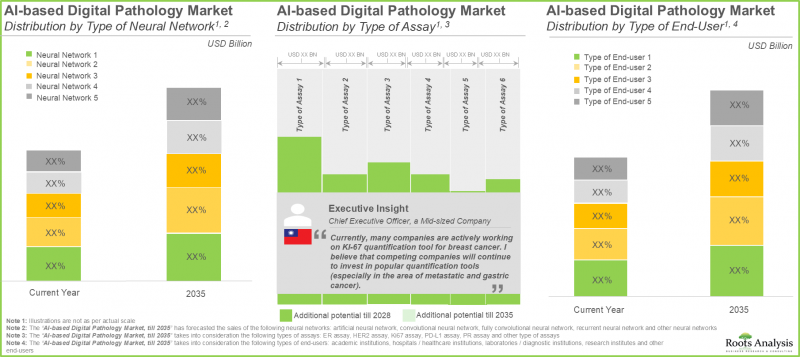
Roots Analysis의 조사에 따르면 세계의 AI 기반 디지털 병리학 시장 규모는 현재 10억 1,000만 달러에서 2035년까지 23억 2,000만 달러로 성장하며, 예측 기간(-2035년)의 CAGR은 8.7%로 추정되고 있습니다.
신경망 유형
인공신경망
컨볼루션 신경망
완전 컨볼루션형 네트워크
재귀 신경망
기타
분석 유형
ER 분석
HER2 분석
KI67, PR Assay
기타
최종사용자 유형
학술기관
병원/의료기관
연구소/진단기관
연구기관
기타
응용 분야
진단
연구
기타
대상 질환
유방암
대장암
자궁경부암
소화기암
폐암
전립선암
기타
주요 지역
북미
유럽
아시아태평양
중동 및 북아프리카
라틴아메리카
AI 기반 디지털 병리 시장 - 성장 및 동향
최근 기술의 발전과 정밀의료에 대한 관심으로 인공지능(AI)의 발전이 가속화되면서 시료의 정량적, 정성적 평가를 위한 디지털 병리 기술이 촉진되고 있습니다. 이 기술의 향상으로 기존의 현미경 접근 방식 대신 컴퓨터 디스플레이를 통한 슬라이드 검사가 가능해졌습니다. 또한 유리 슬라이드를 이미지로 변환하여 진단센터에서 병리과 의사에게 검체 전달이 크게 빨라지고 있습니다. 특히 강조해야 할 점은 AI의 통합이 조직의 미시적 환경에 대한 이해를 크게 향상시켰습니다는 점입니다. AI가 진단에 관여함으로써 환자 프로파일에 적합한 최적의 치료 전략을 결정할 수 있게 되었으며, 환자 분류 및 진단 평가 대상자 선정에 디지털 기법이 활용되고 있습니다.
병리학 분야에서 생성되는 방대한 양의 데이터를 고려할 때, AI는 병리학의 모든 하위 영역에서 혁신의 기회를 제공하고, 영상 진단과 비영상 진단 영역 모두에서 의료 제공의 혁신적 모델을 실현할 수 있을 것으로 기대됩니다. 위와 같은 기존 병리학적 방법론에 대한 장점으로 인해 AI 기반 디지털 병리학 분야는 최근 수년간 괄목할 만한 성장을 이루었으며, 이러한 솔루션은 연구, 개발 및 임상 현장에서 점점 더 널리 보급되고 있습니다.
AI 기반 디지털 병리학 시장 - 주요 연구 결과
이 보고서는 AI 기반 디지털 병리학 시장의 현황을 상세하게 분석하고 업계내 잠재적인 성장 기회를 파악합니다. 보고서의 주요 내용은 다음과 같습니다.
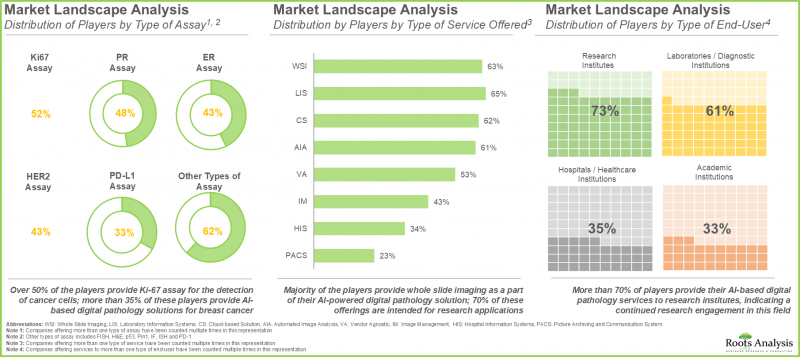
현재 약 80개 기업이 지역적으로 분산된 여러 최종사용자에게 AI 기반 디지털 병리 서비스를 제공하고 있다고 주장하고 있습니다.
이해관계자들은 전문 지식을 활용하여 병리학을 위한 다양한 AI 기반 서비스를 제공하고 있으며, 이러한 솔루션은 주로 연구기관과 검사 및 진단 기관에서 채택하고 있습니다.
이 분야에 종사하는 기업은 조사 용도와 진단 용도 모두를 대상으로 하는 독자적인 제품을 통해 다양한 기능을 제공합니다.
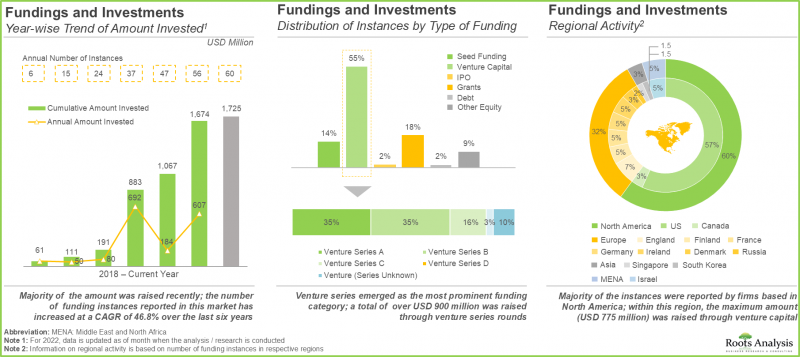
이 분야의 비즈니스 기회를 인식한 투자자들은 60건의 펀딩 사례를 통해 총 20억 달러를 투자했습니다.
연구 분야로의 도입과 임상 워크플로우에 AI를 통합하는 등 여러 요인이 복합적으로 작용하여 전 세계에서 AI 기반 디지털 병리 툴의 채택이 증가하고 있습니다.
AI 기반 디지털 병리 솔루션에 대한 수요 증가와 접근성 높은 의료 서비스에 대한 선호도가 높아짐에 따라 이 시장은 2035년까지 연평균 8.70%의 성장률을 보일 것으로 예측됩니다.
AI 기반 디지털 병리학 시장 - 주요 분야
예측 기간 중 컨볼루션 신경망이 AI 기반 디지털 병리학 시장을 장악할 것으로 예측됩니다.
신경망 유형별 시장 세분화에서는 인공신경망, 컨볼루션 신경망, 완전 컨볼루션 신경망, 순환 신경망, 기타 신경망으로 분류됩니다. AI 기반 디지털 병리 시장에서 가장 큰 비중을 차지하는 것은 컨볼루션 신경망입니다. 인공신경망용 AI 기반 디지털 병리학 시장은 더 높은 CAGR로 성장할 가능성이 높다는 점에 주목해야 합니다.
현재 Ki67 분석은 AI 기반 디지털 병리 시장에서 가장 큰 점유율을 차지하고 있습니다.
분석 유형별로 시장은 ER 분석, HER2 분석, Ki67 분석, PR 분석, 기타 분석으로 분류됩니다. AI 기반 디지털 병리 시장 점유율의 대부분은 Ki67 분석이 차지하고 있습니다. 이는 Ki67 분석의 발현이 세포 증식과 밀접한 관련이 있으며, 일상적인 병리 검사에서 인간 악성 종양에서 세포의 증식 비율을 정량화하는 증식 마커로 자주 사용되기 때문입니다.
현재 AI 기반 디지털 병리 시장에서 가장 큰 점유율을 차지하고 있는 기관은 연구기관입니다.
최종사용자 유형별 시장 세분화에서는 학술기관, 병원/의료기관, 검사기관/진단기관, 연구기관, 기타 최종사용자로 시장이 구분됩니다. 현재 연구기관이 AI 기반 디지털 병리 시장에서 가장 큰 점유율을 차지하고 있으며, 이러한 추세는 향후 수년간 지속될 것으로 예측됩니다.
예측 기간 중 진단 분야는 AI 기반 디지털 병리학 시장에서 가장 빠르게 성장하는 분야입니다.
응용 분야별로 시장은 진단, 조사, 기타 응용 분야로 분류됩니다. 현재 AI 기반 디지털 병리학 시장에서 조사 분야가 더 큰 점유율을 차지하고 있다는 점은 주목할 만합니다. 그러나 진단용 AI 기반 디지털 병리 시장은 더 높은 CAGR로 성장할 것으로 예측됩니다.
예측 기간 중 유방암이 AI 기반 디지털 병리학 시장을 주도할 것으로 예측됩니다.
대상 질환별로는 유방암, 대장암, 자궁경부암, 소화기암, 폐암, 전립선암, 기타 적응증으로 분류됩니다. 현재 AI 기반 디지털 병리 시장의 대부분을 유방암이 차지하고 있다는 점이 주목할 만합니다. 이러한 추세는 향후 10년간 지속될 것으로 보입니다.
북미가 시장에서 가장 큰 점유율을 차지합니다.
주요 지역별로 북미, 유럽, 아시아태평양, 라틴아메리카, 중동 및 북아프리카, 기타 지역으로 구분됩니다. 시장 점유율의 대부분은 북미에 기반을 둔 기업이 차지할 것으로 예측됩니다. 주목할 만한 점은 유럽 시장이 향후 수년간 더 높은 CAGR로 성장할 것으로 예상된다는 점입니다.
AI 기반 디지털 병리 시장의 대표적인 기업
Aiforia Technologies
Akoya Biosciences
Ibex Medical Analytics
Indica Labs
Paige
PathAI
PROSCIA
Roche Tissue Diagnostics
Visiopharm
1차 조사 개요
본 조사에서 제시된 견해와 인사이트는 여러 이해관계자와의 논의를 바탕으로 한 것입니다. 이 보고서에는 아래 업계 관계자와의 인터뷰 내용을 상세하게 수록했습니다.
A사 대표이사 회장 겸 최고경영자(CEO)
B사 연구소장 겸 주임병리사
C사 부사장(연구-기술 담당)
D사 영업 및 마케팅 담당 부사장
AI 기반 디지털 병리 시장 - 조사 범위
시장 규모 및 기회 분석 : 이 보고서는 AI 기반 디지털 병리학 시장에 대해(A) 신경망 유형,(B) 분석 유형,(C) 최종사용자 유형,(D) 응용 분야,(E) 대상 질환,(F) 주요 지역 등 주요 시장 부문에 초점을 맞춘 상세한 분석을 제공합니다. 상세하게 분석했습니다.
시장 상황: AI 기반 디지털 병리학 기업을 종합적으로 평가하여(A) 지역적 확장 범위,(B) 설립 연도,(C) 기업 규모(직원 수),(D) 본사 소재지,(E) 제품 유형,(F) 서비스 유형,(G) 기능 유형,(H) 추가 기능,(I) 응용 분야,(J) 대상 질환 적응증,(K) 분석 유형,(L) 최종사용자 유형,(M) 사용 가능한 소프트웨어 수를 고려한 종합적인 평가입니다. 분석 유형,(L) 최종사용자 유형,(M) 사용 가능한 소프트웨어 수에 대한 정보를 고려한 종합적인 평가입니다.
주요 분석 결과:(A) 서비스 유형 및 적용 분야별 분포,(B) 기능 유형 및 적용 분야별 분포,(C) 제품 유형 및 적용 분야별 분포,(D) 제품 유형 및 본사 소재지 기반 분포,(E) 기업 규모 및(F) 본사 소재지 기반의 인공지능(AI) 기반 디지털 병리학 기업의 인사이트 있는 하이브리드 표현.
기업 개요: AI 기반 디지털 병리 서비스를 제공하는 주요 기업의 상세 프로파일.(A) 기업 개요,(B) 최근 동향,(C) 미래 전망에 초점을 맞추었습니다.
기업 경쟁력 분석 : AI 기반 디지털 병리 기업에 대한 종합적인 경쟁력 분석. 포트폴리오의 강점, 자금 조달 활동 등의 요소를 검증합니다.
자금 조달 및 투자 분석 : 디지털 병리학 시장에 대한 투자를(A) 투자 사례 수,(B) 투자 금액,(C) 자금 조달 형태,(D) 응용 분야,(E) 지역,(F) AI 기반 디지털 병리학 분야에서 가장 활발한 기업 등 관련 매개 변수를 기반으로 상세하게 평가합니다.
수요 분석 :(A) 지역(북미, 유럽, 아시아, 라틴아메리카, 중동 및 북아프리카, 기타 지역) 및(B) 최종사용자(병원, 연구기관, 기타 최종사용자)와 같은 관련 매개 변수를 기반으로 AI 기반 디지털 병리학에 대한 연간 수요를 추정합니다.
목차
제1장 서문
제2장 개요
제3장 서론
챕터 개요
디지털 병리학용 인공지능
AI 기반 디지털 병리학 워크플로우
AI 기반 디지털 병리학 솔루션의 응용
AI 기반 디지털 병리학에 초점을 맞춘 규제 요건
디지털 병리학에서 AI 활용에 수반하는 과제
향후 전망
제4장 AI 기반 디지털 병리학 : 시장 구도
챕터 개요
AI 기반 디지털 병리학 프로바이더 : 개발자 전망
AI 기반 디지털 병리학 프로바이더 : 시장 구도
제5장 AI 기반 디지털 병리학 시장 - 주요 인사이트
제6장 기업 개요
챕터 개요
PathAI
Paige
Akoya Biosciences
PROSCIA
Visiopharm
Roche Tissue Diagnostics
Aiforia Technologies
Indica Labs
Ibex Medical Analytics
제7장 기업 경쟁력 분석
제8장 자금조달과 투자
챕터 개요
자금조달의 유형
AI 기반 디지털 병리학 : 자금조달과 투자 리스트
결론
제9장 수요 분석
챕터 개요
범위와 조사 방법
2035년까지 AI 기반 디지털 병리학에 대한 세계의 수요
AI 기반 디지털 병리학의 수요 : 지역별 분석
북미에서 AI 기반 디지털 병리학의 수요
유럽에서 AI 기반 디지털 병리학의 수요
아시아에서 AI 기반 디지털 병리학의 수요
라틴아메리카에서 AI 기반 디지털 병리학의 수요
MENA에서 AI 기반 디지털 병리학의 수요
기타 지역에서 AI 기반 디지털 병리학의 수요
AI 기반 디지털 병리학의 수요 : 최종사용자 유형별 분석
병원에서 AI 기반 디지털 병리학의 수요
연구기관에서 AI 기반 디지털 병리학의 수요
기타에서 AI 기반 디지털 병리학의 수요
결론
제10장 시장 규모 평가와 기회 분석
챕터 개요
예측 조사 방법과 주요 전제조건
2035년까지의 세계 AI 기반 디지털 병리학 시장
AI 기반 디지털 병리학 시장 - 신경망 유형별 분석, 현재 및 2035년
AI 기반 디지털 병리학 시장 - 어세이 유형별 분석, 현재 및 2035년
AI 기반 디지털 병리학 시장 - 최종사용자 유형별 분석, 현재 및 2035년
AI 기반 디지털 병리학 시장 - 응용 분야별, 현재 및 2035년까지의 분석
AI 기반 디지털 병리학 시장 - 대상 질환별, 현재 및 2035년까지의 분석
AI 기반 디지털 병리학 시장 - 주요 지역별, 현재 및 2035년까지의 분석
제11장 결론
제12장 이그제큐티브 인사이트
제13장 부록 1 : 표형식 데이터
제14장 부록 II : 기업 및 조직 리스트
KSA
영문 목차
영문목차
AI-based Digital Pathology Market: Overview
As per Roots Analysis, the global AI-based digital pathology market is estimated to grow from USD 1.01 billion in the current year to USD 2.32 billion by 2035, at a CAGR of 8.7% during the forecast period, till 2035.
Type of Neural Network
Artificial Neural Network
Convolutional Neural Network
Fully Convolutional Network,
Recurrent Neural Network
Other Neural Network
Type of Assay
ER Assay
HER2 Assay
KI67, PR Assay
Other Type of Assay
Type of End-User
Academic Institutions
Hospitals / Healthcare Institutions
Laboratories / Diagnostic Institutions
Research Institutes
Other End-Users
Area of Application
Diagnostics
Research
Other Areas of Application
Target Disease Indication
Breast Cancer
Colorectal Cancer
Cervical Cancer
Gastrointestinal Cancer
Lung Cancer
Prostate Cancer
Other Indications
Key Geographical Regions
North America
Europe
Asia-Pacific
Middle East and North Africa
Latin America
AI-based Digital Pathology Market: Growth and Trends
In recent years, advancements in technology and an emphasis on precision medicine have paved the way for the development of artificial intelligence (AI), which has spurred digital pathology techniques for both quantitative and qualitative assessment of samples. The improved technique allows for the examination of slides via computer displays, replacing conventional microscopic approaches. Additionally, converting glass slides into images allows for samples to be transmitted from diagnostic centers to pathologists much more quickly. It is essential to highlight that the integration of AI has significantly enhanced the understanding of tissue micro-environment. AI involvement in diagnosis enables the determination of optimal treatment strategies suited to patient profiles, utilizing digital methods for categorizing patients and selecting individuals for diagnostic evaluations.
Given the vast amount of data generated in pathology, AI is expected to offer an opportunity for innovation across all pathology subdomains, enabling a transformative model for care delivery in both imaging and non-imaging areas. As a result of the aforementioned advantages over conventional techniques in pathology, the AI-based digital pathology sector has seen significant growth in recent times, with these solutions becoming increasingly popular in research, development, and clinical settings.
AI-based Digital Pathology Market: Key Insights
The report delves into the current state of the AI-based digital pathology market and identifies potential growth opportunities within the industry. Some key findings from the report include:
Presently, close to 80 players claim to provide AI-based digital pathology services to multiple end-users located across different geographical locations.
Leveraging their expertise, stakeholders are offering a range of AI-based services for pathology applications; such solutions are primarily being employed by research institutes and laboratory / diagnostic institutions.
Companies engaged in this domain are offering a range of features through their proprietary products, intended for both research and diagnostic applications.
Having realized the opportunity associated with this segment, investors have collectively invested ~USD 2 billion, across 60 funding instances.
A number of factors, such as inclusion of research, as well as the incorporation of AI in the clinical workflow, have led to a rise in the adoption of AI-based digital pathology tools, on a global scale.
Driven by the rise in demand for AI-based digital pathology solutions and the growing preference for more accessible healthcare services, this market is anticipated to grow at an annualized rate of 8.70% till 2035.
AI-based Digital Pathology Market: Key Segments
Convolutional Neural Network is Likely to Dominate the AI-based Digital Pathology Market During the Forecast Period
In terms of the type of neural network, the market is segmented into artificial neural network, convolutional neural network, fully convolutional network, recurrent neural network and other neural network. The maximum share of the AI-based digital pathology market is captured by convolutional neural network. It is worth highlighting that the AI-based digital pathology market for artificial neural networks is likely to grow at a higher CAGR.
Currently, Ki67 Assays Occupy the Largest Share of the AI-based Digital Pathology Market
In terms of type of assay, the market is segmented into ER assay, HER2 assay, Ki67 assay, PR assay and other type of assay. The majority of the AI-based digital pathology market share is captured by Ki67 assay. This is due to the fact that the expression of Ki67 assays is highly related to cell proliferation and hence, is frequently employed in routine pathology, as a proliferation marker to quantify the growth fraction of cells in human malignancies.
Currently, Research Institutes Occupy the Largest Share of the AI-based Digital Pathology Market
In terms of type of end-user, the market is segmented into academic institutions, hospitals/ healthcare institutions, laboratories / diagnostic institutions, research institutes and other end-users. Currently, research institutes hold the maximum share of the AI-based digital pathology market and the trend will be similar in the coming years.
Diagnostics Segment is the Fastest Growing Segment of the AI-based Digital Pathology Market During the Forecast Period
In terms of area of application, the market is segmented into diagnostics, research and other areas of application. It is worth highlighting that, at present, the research segment holds a larger share of the AI-based digital pathology market. However, the AI-based digital pathology market for diagnostics is likely to grow at a higher CAGR.
Breast Cancer is Likely to Dominate the AI-based Digital Pathology Market During the Forecast Period
In terms of the target disease indication, the market is segmented into breast cancer, colorectal cancer, cervical cancer, gastrointestinal cancer, lung cancer, prostate cancer and other indications. It is worth highlighting that majority of the current AI-based digital pathology market is captured by breast cancer. This trend is likely to remain the same in the coming decade.
North America Accounts for the Largest Share of the Market
In terms of key geographical regions, the market is segmented into North America, Europe, Asia Pacific, Latin America, Middle East and North Africa, and the Rest of the World. The majority of the share is expected to be captured by players based in North America. It is worth highlighting that, over the years, the market in Europe is expected to grow at a higher CAGR.
Example Players in the AI-based Digital Pathology Market
Aiforia Technologies
Akoya Biosciences
Ibex Medical Analytics
Indica Labs
Paige
PathAI
PROSCIA
Roche Tissue Diagnostics
Visiopharm
Primary Research Overview
The opinions and insights presented in this study were influenced by discussions conducted with multiple stakeholders. The research report features detailed transcripts of interviews held with the following industry stakeholders:
Chief Executive Officer and Chairman, Company A
Laboratory Director and Chief Pathologist, Company B
Vice President (Research and Technology), Company C
Vice President (Sales and Marketing), Company D
AI-based Digital Pathology Market: Research Coverage
Market Sizing and Opportunity Analysis: The report features an in-depth analysis of the AI-based digital pathology market, focusing on key market segments, including [A] type of neural network, [B] type of assay, [C] type of end-user, [D] area of application, [E] target disease indication and [F] key geographical regions.
Market Landscape: A comprehensive evaluation of AI-based digital pathology companies, considering various parameters, such as [A] geographical reach, [B] year of establishment, [C] company size (in terms of number of employees), [D] location of headquarters, [E] type of product, [F] type of service, [G] type of feature, [H] additional features, [I] area of application, [J] target disease indication, [K] type of assay, [L] type of end-user and [M] information on number of available software.
Key Insights: An in-depth analysis, highlighting the contemporary market trends, including [A] distribution based on type of service and area of application, [B] distribution based on type of feature and area of application, [C] distribution based on type of product and area of application, [D] type of product and location of headquarters, as well as an insightful hybrid representation of AI-based digital pathology companies based on [E] company size and [F] location of headquarters.
Company Profiles: In-depth profiles of key AI-based digital pathology companies offering AI-based digital pathology services, focusing on [A] company overviews, [B] recent developments and [C] an informed future outlook.
Company Competitiveness Analysis: A comprehensive competitive analysis of AI-based digital pathology companies, examining factors, such as portfolio strength and funding activity.
Funding and Investment Analysis: A detailed evaluation of the investments made in digital pathology market based on several relevant parameters, such as [A] number of instances, [B] amount invested, [C] type of funding, [D] area of application, [E] geography and [F] most active players engaged in the AI-based digital pathology domain.
Demand Analysis: Informed estimates of the annual demand for AI-based digital pathology based on several relevant parameters, such as [A] geography (North America, Europe, Asia, Latin America, MENA and Rest of the World) and [B] end-users (hospitals, research and other end-users).
Key Questions Answered in this Report
How many companies are currently engaged in this market?
Which are the leading companies in this market?
What factors are likely to influence the evolution of this market?
What is the current and future market size?
What is the CAGR of this market?
How is the current and future market opportunity likely to be distributed across key market segments?
Reasons to Buy this Report
The report provides a comprehensive market analysis, offering detailed revenue projections of the overall market and its specific sub-segments. This information is valuable to both established market leaders and emerging entrants.
Stakeholders can leverage the report to gain a deeper understanding of the competitive dynamics within the market. By analyzing the competitive landscape, businesses can make informed decisions to optimize their market positioning and develop effective go-to-market strategies.
The report offers stakeholders a comprehensive overview of the market, including key drivers, barriers, opportunities, and challenges. This information empowers stakeholders to stay abreast of market trends and make data-driven decisions to capitalize on growth prospects.
Additional Benefits
Complimentary PPT Insights Packs
Complimentary Excel Data Packs for all Analytical Modules in the Report
15% Free Content Customization
Detailed Report Walkthrough Session with Research Team
Free Updated report if the report is 6-12 months old or older
TABLE OF CONTENTS
1. PREFACE
1.1. Chapter Overview
1.2. Market Segmentations
1.3. Research Methodology
1.4. Key Questions Answered
1.5. Chapter Outlines
2. EXECUTIVE SUMMARY
3. INTRODUCTION
3.1. Chapter Overview
3.2. Artificial Intelligence in Digital Pathology
3.3. Workflow of AI-based Digital Pathology
3.4. Applications of AI-based Digital Pathology Solutions
3.5. Regulatory Requirements Focused on AI-based Digital Pathology:
3.6. Challenges Associated with the Use of AI in Digital Pathology
3.7. Future Perspectives
4. AI-BASED DIGITAL PATHOLOGY: MARKET LANDSCAPE
4.1. Chapter Overview
4.2. AI-based Digital Pathology Providers: Developers Landscape
4.2.1. Analysis by Year of Establishment
4.2.2. Analysis by Company Size
4.2.3. Analysis by Location of Headquarters
4.2.4. Analysis by Geographical Reach
4.3. AI-based Digital Pathology Providers: Market Landscape
4.3.1. Analysis by Type of Product
4.3.2. Analysis by Type of Service Offered
4.3.3. Analysis by Type of Feature
4.3.4. Analysis by Additional Features
4.3.5. Analysis by Target Disease Indication
4.3.6. Analysis by Type of Assay
4.3.7. Analysis by Area of Application
4.3.8. Analysis by Type of End-user
4.3.9. Analysis by Number of Available Software
5. AI-BASED DIGITAL PATHOLOGY MARKET: KEY INSIGHTS
5.1. Chapter Overview
5.1.1. Analysis by Type of Service and Area of Application
5.1.2. Analysis by Type of Feature and Area of Application
5.1.3. Analysis by Type of Product and Area of Application
5.1.4. Analysis by Type of Product and Location of Headquarters
5.1.5. Analysis by Company Size and Location of Headquarters
6. COMPANY PROFILES
6.1. Chapter Overview
6.2. PathAI
6.2.1. Company Overview
6.2.2. Recent Developments and Future Outlook
6.3. Paige
6.3.1. Company Overview
6.3.2. Recent Developments and Future Outlook
6.4. Akoya Biosciences
6.4.1. Company Overview
6.4.2. Recent Developments and Future Outlook
6.5. PROSCIA
6.5.1. Company Overview
6.5.2. Recent Developments and Future Outlook
6.6. Visiopharm
6.6.1. Company Overview
6.6.2. Recent Developments and Future Outlook
6.7. Roche Tissue Diagnostics
6.7.1. Company Overview
6.7.2. Recent Developments and Future Outlook
6.8. Aiforia Technologies
6.8.1. Company Overview
6.8.2. Recent Developments and Future Outlook
6.9. Indica Labs
6.9.1. Company Overview
6.9.2. Recent Developments and Future Outlook
6.10. Ibex Medical Analytics
6.10.1. Company Overview
6.10.2. Recent Developments and Future Outlook
7. COMPANY COMPETITIVENESS ANALYSIS
7.1. Chapter Overview
7.2. Assumptions and Key Parameters
7.3. Methodology
7.4. Benchmarking of Portfolio Strength
7.5. Benchmarking of Funding Strength
7.6. Company Competitiveness Analysis: Small Players
7.7. Company Competitiveness Analysis: Mid-sized Players
7.8. Company Competitiveness Analysis: Large Players
8. FUNDING AND INVESTMENTS
8.1. Chapter Overview
8.2. Types of Funding
8.3. AI-based Digital Pathology: List of Funding and Investments
8.3.1. Cumulative Year-wise Trend by Number of Instances
8.3.2. Cumulative Year-wise Trend by Amount Invested
8.3.3. Analysis by Type of Funding
8.3.4. Analysis by Type of Funding and Amount Invested
8.3.5. Analysis by Area of Application
8.3.6. Analysis by Type of Funding and Area of Application
8.3.7. Analysis by Geography
8.3.8. Most Active Players: Analysis by Number of Funding Instances
8.3.9. Most Active Players: Analysis by Amount Raised
8.4. Concluding Remarks
9. DEMAND ANALYSIS
9.1. Chapter Overview
9.2. Scope and Methodology
9.3. Global Demand for AI-based Digital Pathology, till 2035
9.4. Demand for AI-based Digital Pathology: Analysis by Geography
9.4.1. Demand for AI-based Digital Pathology in North America
9.4.1.1 Demand for AI-based Digital Pathology in the US
9.4.1.2 Demand for AI-based Digital Pathology in Canada
9.4.2. Demand for AI-based Digital Pathology in Europe
9.4.2.1. Demand for AI-based Digital Pathology in UK
9.4.2.2. Demand for AI-based Digital Pathology in Germany
9.4.2.3. Demand for AI-based Digital Pathology in Spain
9.4.2.4. Demand for AI-based Digital Pathology in Italy
9.4.2.5. Demand for AI-based Digital Pathology in France
9.4.3. Demand for AI-based Digital Pathology in Asia
9.4.3.1. Demand for AI-based Digital Pathology in China
9.4.3.2. Demand for AI-based Digital Pathology in Japan
9.4.3.3. Demand for AI-based Digital Pathology in South Korea
9.4.4. Demand for AI-based Digital Pathology in Latin America
9.4.4.1. Demand for AI-based Digital Pathology in Brazil
9.4.5. Demand for AI-based Digital Pathology in MENA
9.4.5.1. Demand for AI-based Digital Pathology in Saudi Arabia
9.4.6. Demand for AI-based Digital Pathology in Rest of the World
9.4.6.1. Demand for AI-based Digital Pathology in Australia
9.5. Demand for AI-based Digital Pathology: Analysis by Type of End-user
9.5.1 Demand for AI-based Digital Pathology in Hospitals
9.5.2. Demand for AI-based Digital Pathology in Research Institutes
9.5.3. Demand for AI-based Digital Pathology in Other End-users
9.6. Concluding Remarks
10. MARKET SIZING AND OPPORTUNITY ANALYSIS
10.1. Chapter Overview
10.2. Forecast Methodology and Key Assumptions
10.3. Global AI-based Digital Pathology Market, till 2035
10.4. AI-based Digital Pathology Market: Analysis by Type of Neural Network, Current Year and 2035
10.4.1. AI-based Digital Pathology Market for Artificial Neural Network, till 2035
10.4.2. AI-based Digital Pathology Market for Convolutional Neural Network, till 2035
10.4.3. AI-based Digital Pathology Market for Fully Convolutional Network, till 2035
10.4.4. AI-based Digital Pathology Market for Recurrent Neural Network, till 2035
10.4.5. AI-based Digital Pathology Market for Other Neural Networks, till 2035
10.5. AI-based Digital Pathology Market: Analysis by Type of Assay, Current Year and 2035
10.5.1. AI-based Digital Pathology Market for ER Assay, till 2035
10.5.2. AI-based Digital Pathology Market for HER2 Assay, till 2035
10.5.3. AI-based Digital Pathology Market for Ki67 Assay, till 2035
10.5.4. AI-based Digital Pathology Market for PD-L1 Assay, till 2035
10.5.5. AI-based Digital Pathology Market for PR Assay, till 2035
10.5.6. AI-based Digital Pathology Market for Other Type of Assays, till 2035
10.6. AI-based Digital Pathology Market: Analysis by Type of End-user, Current Year and 2035
10.6.1. AI-based Digital Pathology Market for Academic Institutions, till 2035
10.6.2. AI-based Digital Pathology Market for Hospitals / Healthcare Institutions, till 2035
10.6.3. AI-based Digital Pathology Market for Laboratories / Diagnostic Institutions, till 2035
10.6.4. AI-based Digital Pathology Market for Research Institutes, till 2035
10.6.5. AI-based Digital Pathology Market for Other End-users, till 2035
10.7. AI-based Digital Pathology Market: Analysis by Area of Application, Current Year and 2035
10.7.1. AI-based Digital Pathology Market for Diagnostics, till 2035
10.7.2. AI-based Digital Pathology Market for Research, till 2035
10.7.3. AI-based Digital Pathology Market for Other Areas of Application, till 2035
10.8. AI-based Digital Pathology Market: Analysis by Target Disease Indication, Current Year and 2035
10.8.1. AI-based Digital Pathology Market for Breast Cancer, till 2035
10.8.2. AI-based Digital Pathology Market for Colorectal Cancer, till 2035
10.8.3. AI-based Digital Pathology Market for Cervical Cancer, till 2035
10.8.4. AI-based Digital Pathology Market for Gastrointestinal Cancer, till 2035
10.8.5. AI-based Digital Pathology Market for Lung Cancer, till 2035
10.8.6. AI-based Digital Pathology Market for Prostate Cancer, till 2035
10.8.7. AI-based Digital Pathology Market for Other Indications, till 2035
10.9. AI-based Digital Pathology Market: Analysis by Key Geographies, Current Year and 2035
10.9.1. AI-based Digital Pathology Market in North America, till 2035
10.9.1.1. AI-based Digital Pathology Market in the US, till 2035
10.9.1.2. AI-based Digital Pathology Market in Canada, till 2035
10.9.2. AI-based Digital Pathology Market in Europe, till 2035
10.9.2.1. AI-based Digital Pathology Market in UK, till 2035
10.9.2.2. AI-based Digital Pathology Market in Germany, till 2035
10.9.2.3. AI-based Digital Pathology Market in Spain, till 2035
10.9.2.4. AI-based Digital Pathology Market in Italy, till 2035
10.9.2.5. AI-based Digital Pathology Market in France, till 2035
10.9.3. AI-based Digital Pathology Market in Asia, till 2035
10.9.3.1. AI-based Digital Pathology Market in China, till 2035
10.9.3.2. AI-based Digital Pathology Market in Japan, till 2035
10.9.3.3. AI-based Digital Pathology Market in South Korea, till 2035
10.9.4. AI-based Digital Pathology Market in Latin America, till 2035
10.9.4.1. AI-based Digital Pathology Market in Brazil, till 2035
10.9.5. AI-based Digital Pathology Market in MENA, till 2035
10.9.5.1. AI-based Digital Pathology Market in Saudi Arabia, till 2035
10.9.6. AI-based Digital Pathology Market in Rest of the World, till 2035
10.9.6.1. AI-based Digital Pathology Market in Australia, till 2035
11. CONCLUDING REMARKS
12. EXECUTIVE INSIGHTS
12.1. Chapter Overview
12.2. Company A
12.2.1. Company Snapshot
12.2.2. Interview Transcript: Chief Executive Officer and Chairman
12.3. Company B
12.3.1. Company Snapshot
12.3.2. Interview Transcript: Laboratory Director and Chief Pathologist
12.4. Company C
12.4.1. Company Snapshot
12.4.2. Interview Transcript: Vice President, Research and Technology
12.5. Company D
12.5.1. Company Snapshot
12.5.2. Interview Transcript: Vice President, Sales and Marketing
12.6. Company E
12.6.1. Company Snapshot
12.6.2. Interview Transcript: Vice President, Business Development and Strategic Partnerships
13. APPENDIX 1: TABULATED DATA
14. APPENDIX II: LIST OF COMPANIES AND ORGANIZATION