원격 환자 모니터링 시장 : 업계 동향과 세계 예측 - 소프트웨어 유형별, 용도별, 치료 영역별, 제품/소프트웨어 목적별, 비즈니스 모델별, 주요 지역별
Remote Patient Monitoring Market: Industry Trends and Global Forecasts -Distribution by Type of Software, Application Area, Therapeutic Area, Product / Software Purpose, Type of Business Model, and Key Geographical Regions
상품코드:1762527
리서치사:Roots Analysis
발행일:2025년 07월
페이지 정보:영문 190 Pages
라이선스 & 가격 (부가세 별도)
한글목차
원격 환자 모니터링 시장 : 개요
세계의 원격 환자 모니터링 시장 규모는 2035년까지의 예측 기간 중 25CAGR로 확대하며, 현재 94억 달러에서 2035년까지 880억 달러로 성장할 것으로 예측됩니다.
시장 규모 및 기회 분석은 다음과 같은 매개 변수로 세분화됩니다.
소프트웨어 유형
소프트웨어로서의 시스템
서비스로서의 시스템
용도
혈당
혈압
체온
심전도
산소포화도
호흡수
기타
치료 영역
심혈관 질환
감염성 질환
대사성 질환
종양학 질환
호흡기 질환
기타
제품/소프트웨어 목적
상업적 목적
임상 목적
비즈니스 모델
B2B
B2C
주요 지역
북미
유럽
아시아태평양
중동 및 북아프리카
라틴아메리카
원격 환자 모니터링 시장 : 성장과 동향
수년 동안 당뇨병, 자가면역질환, 심장병, 암과 같은 만성질환의 발병률이 눈에 띄게 증가하고 있습니다. 실제로 미시간대학교 만성질환관리센터(Center for Managing Chronic Disease)가 최근 발표한 보고서에 따르면 미국 인구의 50% 이상이 만성질환을 앓고 있다고 합니다. 따라서 질병의 징후를 관리하기 위한 빈번한 모니터링이 절실히 요구되고 있습니다. 그러나 일부 환자들은 건강 문제를 제때에 의료 서비스 프로바이더에게 보고하지 못해 심각한 결과와 의료비 증가로 이어지기도 합니다. 이러한 배경에서 원격 환자 모니터링은 의료 서비스 프로바이더가 재택치료 현장에서 환자의 활력 징후를 모니터링할 수 있는 잠재적인 솔루션으로 부상하고 있습니다.
원격 환자 모니터링 시스템(RPM)의 개념이 시작된 것은 지금으로부터 거의 200년 전인 1800년대입니다. 그러나 클라우드 컴퓨팅이 도입되기 전까지 이 분야는 매우 빠른 속도로 발전해 왔습니다. 실제로 원격 환자 모니터링 시스템 솔루션은 특히 COVID-19로 인한 봉쇄 기간 중 원격 환자 모니터링 시스템 솔루션이 점차 의료계의 주류로 통합되고 있습니다. 이러한 첨단 툴와 소프트웨어 솔루션은 이 기간 중 환자의 건강 상태를 모니터링할 수 있게 해 주었고, 환자의 불편을 크게 완화시켜 주었습니다. 이러한 첨단 장비는 AI와 바이오 센서를 활용하여 산소 농도, 혈압, 심박수, 호흡수, 혈당 및 기타 중요한 징후와 같은 활력 징후를 실시간으로 모니터링합니다. 현재 여러 기업이 원격 환자 모니터링 시스템 개발에 주력하고 있습니다.
원격 환자 모니터링 시장 : 주요 인사이트
이 보고서는 원격 환자 모니터링 시장의 현황을 조사하고 업계내 잠재적인 성장 기회를 파악합니다. 주요 조사 결과는 다음과 같습니다.
현재 170개 이상의 기업이 다양한 용도에서 사용되는 원격 환자 모니터링 솔루션을 제공하는 데 필요한 역량을 보유하고 있다고 주장하고 있습니다.
원격 환자 모니터링을 위한 툴/소프트웨어 솔루션은 다양한 유형의 소프트웨어로 연구되고 있으며, 다양한 치료 분야를 대상으로 설계되었습니다.
경쟁 우위를 확보하기 위해 원격 환자 모니터링 솔루션 개발사들은 각 솔루션 및 제휴 제품에 고급 기능을 통합하는 노력을 적극적으로 하고 있습니다.
수년 동안 업계 기업은 자체 소프트웨어 솔루션의 개발을 더욱 발전시키고 개선하기 위해 여러 가지 거래를 진행했습니다.
이 분야의 지속적인 기술 혁신을 지원하기 위해 민간 및 공공 투자자들은 25억 달러 상당의 대규모 자본을 투자했습니다.
COVID-19 팬데믹 기간 중 다양한 원격 환자 모니터링 솔루션에 대한 수요가 증가함에 따라 전체 시장은 2030년까지 연평균 25% 이상 성장할 것으로 예측됩니다.
예측된 기회는 다양한 용도, 비즈니스 모델 유형, 주요 지역적 지역에 잘 분산될 것으로 예측됩니다.
원격 환자 모니터링 시장 : 주요 부문
소프트웨어 유형에 따라 시장은 소프트웨어로서의 시스템과 서비스로서의 시스템으로 구분됩니다. 현재, 소프트웨어로서의 시스템 부문이 세계 원격 환자 모니터링 시장에서 가장 큰 점유율을 차지하고 있습니다. 또한 클라우드 기반 솔루션에 대한 수요가 증가함에 따라 서비스형 시스템 부문 원격 환자 모니터링 시장은 예측 기간 중 가장 높은 시장 성장률을 보일 것으로 예측됩니다.
용도별로 시장은 혈당, 혈압, 체온, 심전도, 산소포화도, 호흡수, 기타로 구분됩니다. 현재 심전도 분야가 전 세계 원격 환자 모니터링 시장에서 가장 큰 점유율을 차지하고 있습니다. 이는 생체 건강 파라미터의 상시 모니터링이 필요한 심혈관계 질환의 유병률이 증가하고 있기 때문입니다. 또한 심전도 분야 시장은 예측 기간 중 더 높은 CAGR로 성장할 것으로 예측됩니다.
시장은 치료 영역별로 심혈관질환, 감염질환, 대사질환, 종양질환, 호흡기질환, 기타로 구분됩니다. 현재 전 세계 원격 환자 모니터링 시장에서 가장 높은 비중을 차지하고 있는 분야는 대사성 질환 분야입니다. 그러나 예측 기간 중 종양 질환 부문은 더 높은 CAGR로 성장할 것으로 예측됩니다.
제품/소프트웨어 목적에 따라 시장은 상업적 목적과 임상적 목적으로 구분됩니다. 현재 원격 환자 모니터링 시장에서 상업적 목적 부문이 가장 큰 점유율을 차지하고 있습니다. 그러나 예측 기간 중 임상 목적 부문이 가장 높은 성장성을 보이며 다른 부문에 비해 높은 CAGR로 성장할 것으로 예측됩니다.
비즈니스 모델 유형에 따라 세계 시장은 B2C 모델과 B2B 모델로 구분됩니다. 현재 B2C와 B2B 두 부문은 비슷한 시장 점유율을 차지하고 있습니다. 그러나 B2C용 원격 환자 모니터링은 향후 수년간 큰 폭의 성장이 예상됩니다.
주요 지역별로 시장은 북미, 유럽, 아시아태평양, 중동 및 북아프리카, 라틴아메리카로 구분됩니다. 현재 유럽은 전 세계 원격 환자 모니터링 시장을 독점하고 있으며, 가장 큰 매출 점유율을 차지하고 있습니다. 또한 아시아태평양 시장은 향후 더 높은 CAGR로 성장할 가능성이 높습니다.
원격 환자 모니터링 시장의 기업 예
BioTelemetry
Braster
LeewayHertz
LifeWatch
Masimo
Medtronic
Siemens Healthineers
Transtek Medical.
목차
제1장 서문
제2장 개요
제3장 서론
챕터 개요
서론
원격 환자 모니터링의 이점
원격 환자 모니터링에 수반하는 제한
원격 환자 모니터링 솔루션에 관한 규제상 고려 사항
결론
제4장 시장 구도
챕터 개요
원격 환자 모니터링 상담 툴과 소프트웨어 : 시장 구도
원격 환자 모니터링 상담 툴과 소프트웨어 : 솔루션 프로바이더의 상황
제5장 기업 개요
챕터 개요
북미에 기반을 둔 기업
BioTelemetry
LeewayHertz
Masimo
유럽에 기반을 둔 기업
Braster
LifeWatch
Medtronic
Siemens Healthineers
아시아태평양에 기반을 둔 기업
Transtek Medical
제6장 파트너십과 협업
챕터 개요
파트너십 모델
원격 환자 모니터링 상담 툴과 소프트웨어 프로바이더 : 최근 파트너십과 협업
제7장 자금조달과 투자 분석
챕터 개요
자금조달의 유형
원격 환자 모니터링 상담 툴 및 소프트웨어 프로바이더 : 자금조달과 투자 분석
결론
제8장 제품 경쟁력 분석
제9장 비용 삭감 분석
챕터 개요
주요 전제와 조사 방법
원격 환자 모니터링 솔루션 : 전체적인 비용 삭감 가능성
결론
제10장 시장 예측
챕터 개요
예측 조사 방법과 주요 전제조건
2035년까지의 세계 원격 환자 모니터링 상담 툴 및 소프트웨어 프로바이더 시장
세계의 원격 환자 모니터링 상담 툴 및 소프트웨어 프로바이더 시장 : 용도별
세계의 원격 환자 모니터링 상담 툴 및 소프트웨어 프로바이더 시장 : 치료 영역별
세계의 원격 환자 모니터링 상담 툴 및 소프트웨어 프로바이더 시장 : 소프트웨어 목적별
세계의 원격 환자 모니터링 상담 툴 및 소프트웨어 프로바이더 시장 : 비즈니스 모델별
세계의 원격 환자 모니터링 상담 툴 및 소프트웨어 프로바이더 시장 : 지역별
제11장 바이오마커용 디지털 솔루션 시장에 대한 COVID-19 팬데믹의 영향
제12장 SWOT 분석
챕터 개요
강점
약점
기회
위협
SWOT 요인의 비교
제13장 결론
제14장 인터뷰 기록
제15장 부록 I : 표형식 데이터
제16장 부록 II : 기업 및 조직 리스트
KSA
영문 목차
영문목차
REMOTE PATIENT MONITORING MARKET: OVERVIEW
As per Roots Analysis, the global remote patient monitoring market is estimated to grow from USD 9.4 billion in the current year to USD 88.0 billion by 2035, at a CAGR of 25% during the forecast period, till 2035.
The market sizing and opportunity analysis has been segmented across the following parameters:
Type of Software
System as a Software
System as a Service
Application Area
Blood Glucose
Blood Pressure
Body Temperature
Electrocardiogram
Oxygen Saturation
Respiration Rate
Others
Therapeutic Area
Cardiovascular Disorders
Infectious Diseases
Metabolic Disorders
Oncological Disorders
Respiratory Disorders
Others
Product / Software Purpose
Commercial Purpose
Clinical Purpose
Type of Business Model
B2B
B2C
Key Geographical Regions
North America
Europe
Asia-Pacific
Middle East and North Africa
Latin America
REMOTE PATIENT MONITORING MARKET: GROWTH AND TRENDS
Over the years, the incidence of chronic conditions, such as diabetes, autoimmune diseases, heart diseases, and cancer has risen significantly. In fact, a recent report from the Center for Managing Chronic Disease at the University of Michigan reported that over 50% of the US population is affected by some form of chronic disease. Consequently, there is an urgent need for frequent monitoring to manage disease indications. However, some patients fail to report health issues to healthcare providers in time, which can lead to severe consequences and increased healthcare costs. In this context, remote patient monitoring has emerged as a potential solution for healthcare providers that enables them to monitor vital health signs in home care settings.
The initiation of the concept of remote patient monitoring system (RPM) started nearly 200 years ago in 1800s. However, it wasn't until the introduction of cloud computing that the domain evolved at a significant pace. In fact, remote patient monitoring system solutions were gradually integrated into mainstream healthcare, specifically during the COVID-19 induced lockdown. These advanced tools and software solutions enabled and eased monitoring of patient health significantly during that period. These advanced devices utilize AI and biosensors to monitor vital signs like oxygen levels, blood pressure, heart rate, respiratory rate, blood glucose level, and other key signs in real time. Presently, several companies are focused on the development of remote patient monitoring systems.
REMOTE PATIENT MONITORING MARKET: KEY INSIGHTS
The report delves into the current state of the remote patient monitoring market and identifies potential growth opportunities within industry. Some key findings from the report include:
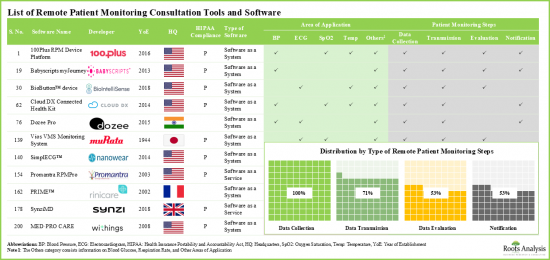
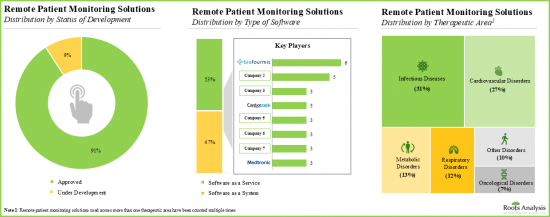
At present, more than 170 players claim to have the required capabilities to offer remote patient monitoring solutions for use across a range of application areas.
Tools / software solutions for remote patient monitoring are being investigated across different types of software and are designed to target different therapeutic areas.
In order to gain a competitive edge, remote patient monitoring solution developers are actively undertaking initiatives to integrate advanced features in their respective solutions and affiliated offerings.
Over the years, industry players have established several deals to further advance the development / enable the improvement of their proprietary software solutions.
To support the ongoing innovation in this field, private and public investors have made substantial capital investments of worth USD 2.5 billion.
Given the favourable increase in demand for various remote patient monitoring solutions during the COVID-19 pandemic, the overall market is poised to grow at a CAGR of over 25%, till 2030.
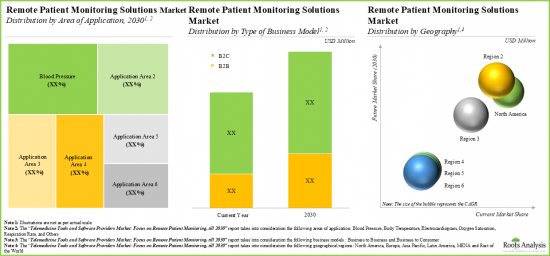
The projected opportunity is expected to be well distributed across different areas of application, types of business model and key geographical regions.
REMOTE PATIENT MONITORING MARKET: KEY SEGMENTS
System as a Software Segment holds the Largest Share of the Remote Patient Monitoring Market
Based on the type of software, the market is segmented into a system as a software and system as a service type of software. At present, the system as a software segment holds the maximum share of the global remote patient monitoring market. Further, the remote patient monitoring market for system as a service segment is expected to show the highest market growth potential during the forecast period owing to the growing demand for cloud-based solutions.
By Application Area, Electrocardiogram is the Fastest Growing Segment of the Global Remote Patient Monitoring Market
Based on the application area, the market is segmented into blood glucose, blood pressure, body temperature, electrocardiogram, oxygen saturation, respiration rate and others. At present, the electrocardiogram segment holds the maximum share of the global remote patient monitoring market. This can be attributed to the growing prevalence of cardiovascular disorders that require constant monitoring of vital health parameters. Moreover, the market for electrocardiogram segment is expected to grow at a higher CAGR during the forecast period.
By Therapeutic Area, Metabolic Disorders Segment Accounts for the Largest Share of the Global Remote Patient Monitoring Market
Based on the therapeutic area, the market is segmented into cardiovascular disorders, infectious diseases, metabolic disorders, oncological disorders, respiratory disorders, and others. Currently, the metabolic disorders segment captures the highest proportion of the global remote patient monitoring market. However, the oncological disorders segment is expected to grow at a higher CAGR during the forecast period.
By Product / Software Purpose, Commercial Purpose Segment is Likely to Dominate the Remote Patient Monitoring Market
Based on the product / software purpose, the market is segmented into commercial purpose and clinical purpose. At present, the commercial purpose segment holds the maximum share of the remote patient monitoring market. However, the clinical purpose segment is expected to show the highest growth potential during the forecast period, growing at a higher CAGR, compared to the other segments.
B2C is the Fastest Growing Segment of the Global Remote Patient Monitoring Market
Based on the type of business model, the global market is segmented into B2C and B2B models. Currently, both B2C and B2B segments hold equal market share. However, the remote patient monitoring for B2C segment is expected to witness substantial growth in the coming years.
Europe Accounts for the Largest Share of the Market
Based on key geographical regions, the market is segmented into North America, Europe, Asia-Pacific, Middle East and North Africa, and Latin America. Currently, Europe dominates the global remote patient monitoring market and accounts for the largest revenue share. Further, the market in Asia-Pacific is likely to grow at a higher CAGR in the coming future.
Example Players in the Remote Patient Monitoring Market
BioTelemetry
Braster
LeewayHertz
LifeWatch
Masimo
Medtronic
Siemens Healthineers
Transtek Medical.
REMOTE PATIENT MONITORING MARKET: RESEARCH COVERAGE
Market Sizing and Opportunity Analysis: The report features an in-depth analysis of the global remote patient monitoring market, focusing on key market segments, including [A] type of software, [B] application area, [C] therapeutic area, [D] product / software purpose, [E] type of business model and [F] key geographical regions.
Market Landscape: A comprehensive evaluation of the companies engaged in providing remote patient monitoring consultation tools and software, based on several relevant parameters, such as [A] year of establishment, [B] company size and [C] location of headquarters. Additionally, a comprehensive evaluation of consultation tools and software, based on several relevant parameters, such as [A] type of software, [B] area of application, [C] therapeutic areas, [D] product / software purpose, [E] type of telemedicine operation, [F] type of remote patient monitoring service and [G] type of business model.
Company Profiles: In-depth profiles of key players that are engaged in the development of remote patient monitoring software, focusing on [A] overview of the company, [B] financial information (if available), [C] product portfolio and [D] recent developments and an informed future outlook.
Partnerships and Collaborations: An insightful analysis of the deals inked by stakeholders in the remote patient monitoring market, based on several parameters, such as [A] year of partnership, [B] type of partnership, [C] type of partner, [D] type of software, [E] most active players and [F] geographical distribution of the partnership activity.
Funding and Investments: An in-depth analysis of the fundings raised by remote patient monitoring companies, based on relevant parameters, such as [A] year of funding instances, [B] amount invested, [C] type of funding, [D] geographical analysis, [E] most active players and [F] most active investors.
Product Competitiveness Analysis: A comprehensive competitive analysis of remote patient monitoring software, examining factors, such as [A] supplier power and [B] key product-related specifications.
Cost Saving Analysis: A comprehensive analysis of cost saving potential associated with the use of remote patient monitoring consultation tools and software solutions, examining factors, such as [A] number of patient visits and [B] increase in efficiency by adoption of remote patient monitoring software solutions.
Case Study: An insightful discussion on how the COVID-19 pandemic impacted the remote patient monitoring software market, accompanied by information on the important initiatives that were undertaken by players to overcome the challenges faced due to the pandemic.
SWOT Analysis: An analysis of industry affiliated trends, opportunities and challenges, which are likely to impact the evolution of remote patient monitoring market; it includes a Harvey ball analysis, assessing the relative impact of each SWOT parameter on industry dynamics.
KEY QUESTIONS ANSWERED IN THIS REPORT
How many companies are currently engaged in this market?
Which are the leading companies in this market?
What factors are likely to influence the evolution of this market?
What is the current and future market size?
What is the CAGR of this market?
How is the current and future market opportunity likely to be distributed across key market segments?
REASONS TO BUY THIS REPORT
The report provides a comprehensive market analysis, offering detailed revenue projections of the overall market and its specific sub-segments. This information is valuable to both established market leaders and emerging entrants.
Stakeholders can leverage the report to gain a deeper understanding of the competitive dynamics within the market. By analyzing the competitive landscape, businesses can make informed decisions to optimize their market positioning and develop effective go-to-market strategies.
The report offers stakeholders a comprehensive overview of the market, including key drivers, barriers, opportunities, and challenges. This information empowers stakeholders to stay abreast of market trends and make data-driven decisions to capitalize on growth prospects.
ADDITIONAL BENEFITS
Complimentary PPT Insights Packs
Complimentary Excel Data Packs for all Analytical Modules in the Report
15% Free Content Customization
Detailed Report Walkthrough Session with Research Team
Free Updated report if the report is 6-12 months old or older
TABLE OF CONTENTS
1. PREFACE
1.1. Scope of the Report
1.2. Research Methodology
1.2.1. Research Assumptions
1.2.2. Project Methodology
1.2.3. Forecast Methodology
1.2.4. Robust Quality Control
1.2.5. Key Considerations
1.2.5.1. Demographics
1.2.5.2. Economic Factors
1.2.5.3. Government Regulations
1.2.5.4. Supply Chain
1.2.5.5. COVID Impact / Related Factors
1.2.5.6. Market Access
1.2.5.7. Healthcare Policies
1.2.5.8. Industry Consolidation
1.3 Key Questions Answered
1.4. Chapter Outlines
2. EXECUTIVE SUMMARY
3. INTRODUCTION
3.1. Chapter Overview
3.2. Introduction to Telemedicine
3.2.1. Store-and-Forward Telemedicine
3.2.2. Real-Time Telemedicine
3.2.3. Telemedicine in Remote Patient Monitoring
3.3. Advantages of Remote Patient Monitoring
3.4. Limitations Associated with Remote Patient Monitoring
3.5. Regulatory Considerations for Remote Patient Monitoring Solutions