초음파 시장 : 제공 제품 유형별, 장비 휴대성별, 장비 디스플레이별, 기술 유형별, 응용 분야별, 최종사용자별, 지역별, 주요 기업별 - 업계 동향 및 세계 예측(-2035년)
Ultrasound Market by Type of Product Offered, Device Portability, Device Display, Type of Technology, Application Area, End User, Geographical Regions and Key Players: Industry Trends and Global Forecasts, Till 2035
상품코드:1677739
리서치사:Roots Analysis
발행일:2025년 03월
페이지 정보:영문 234 Pages
라이선스 & 가격 (부가세 별도)
한글목차
세계 초음파 시장 규모는 2035년까지 예측 기간 동안 5.4의 CAGR로 확대되어 현재 89억 달러에서 2035년까지 160억 달러로 성장할 것으로 예상됩니다.
초음파는 비침습적 진단을 목적으로 고주파 음파 펄스(2-20MHz)를 프로브를 통해 체내 조직에 전달하여 비침습적으로 진단하는 의료용 영상 진단 기술입니다. 의료진에 따라 혈관 스캔, 암 검진, 비뇨기 스캔, 폐 스캔 등 다양한 신체 부위의 평가에 사용되고 있습니다. 특히, 초음파 이미징은 태아의 성장과 발달을 모니터링하고 특정 임신 합병증을 감지하기 위해 산부인과 의사가 주로 사용합니다. 지난 수십 년 동안 의료 평가 기술의 최전선으로 여겨지는 초음파 검사는 크게 발전하여 근골격계 병리, 유도하 생검, 종양 절제술, 천자 등 다양한 증상을 치료/관리할 수 있는 능력을 갖추게 되었습니다.
특히, 의료 기술 업계에서는 기존 초음파 진단 시스템의 문제점(높은 유지보수 및 운영 비용, 방사선과로 환자 이송의 어려움, 하드 드라이브 고장 및 배터리 성능 저하 위험, 숙련된 기술자 필요, 개발도상국에서의 낮은 보급률 등)에 대응하기 위해 휴대용 초음파 진단 시스템의 개발로 크게 전환되고 있습니다. 한편, 휴대용 초음파 진단 장비는 트롤리/카트 기반 초음파 진단 장비와 핸드헬드/POC(Point-of-Care) 초음파 진단 장비로 분류되며, 환자의 침대 옆에서 평가하고 스마트폰이나 태블릿으로 이미지를 전송하여 시각화할 수 있습니다.
최근 몇 년 동안 인공지능과 머신러닝과 영상 기술의 통합은 실시간 정확한 진단을 위한 초음파 시스템의 사용을 가속화하고 기술 혁신을 촉진하여 향후 몇 년 동안 시장이 크게 성장할 수 있는 위치에 놓여 있습니다. 또한, 연구 개발 이니셔티브의 증가와 정확한 영상 기반 임상 진단에 대한 수요 증가로 인해 초음파 시장은 향후 꾸준히 성장할 것으로 예상됩니다.
세계의 초음파 시장에 대해 조사했으며, 시장 개요와 함께 제공 제품 유형별, 장치 휴대성별, 장치 디스플레이별, 기술 유형별, 응용 분야별, 최종사용자별, 주요 기업별, 지역별 동향, 시장 진출 기업 프로파일 등의 정보를 전해드립니다.
목차
제1장 배경
제2장 조사 방법
제3장 시장 역학
제4장 경제 및 기타 프로젝트 특유의 고려사항
제5장 주요 요약
제6장 소개
제7장 시장 영향 분석
시장 촉진요인
시장 억제요인
시장 기회
시장 과제
제8장 세계의 초음파 시장
주요 가정과 조사 방법
세계의 초음파 시장, 역사적 동향(2019년 이후) 및 예측(2035년까지)
주요 시장 세분화
제9장 초음파 시장, 제공 제품 유형별
제10장 초음파 시장, 장비 휴대성별
제11장 초음파 시장, 장비 디스플레이별
제12장 초음파 시장, 기술 유형별
제13장 초음파 시장, 응용 분야별
제14장 초음파 시장, 최종사용자별
제15장 초음파 시장, 지역별
제16장 초음파 시장, 주요 기업별
제17장 시장 상황 : 초음파 진단 장비
제18장 기업 경쟁력 분석 : 주요 초음파 프로바이더
제19장 기업 개요 : 북미에 본사를 두는 주요 초음파 프로바이더
제20장 기업 개요 : 유럽에 본사를 두는 주요 초음파 프로바이더
제21장 기업 개요 : 아시아태평양에 본사를 두는 주요 초음파 프로바이더
제22장 초음파 분야의 신제품 발매
제23장 출판물 분석
제24장 Porter's Five Forces 분석
제25장 밸류체인 분석 : 초음파 시장
제26장 이그제큐티브 인사이트
제27장 부록 1 : 표형식 데이터
제28장 부록 2 : 기업·단체 리스트
ksm
영문 목차
영문목차
ULTRASOUND MARKET
As per Roots Analysis, the global ultrasound market size is estimated to grow from USD 8.9 billion in the current year to USD 16.0 billion by 2035, at a CAGR of 5.4% during the forecast period, till 2035.
The opportunity for ultrasound market has been distributed across the following segments:
Type of Product Offered
Diagnostic Ultrasound Systems
Therapeutic Ultrasound Systems
Device Portability
Trolley / Cart-based Ultrasound Devices
Handheld / Point-of-Care Ultrasound Devices
Device Display
Colored Display
Black / White Display
Type of Technology
2D Technology
3D / 4D Technology
Doppler Imaging Technology
Contrast Enhanced Ultrasound Technology
High Intensity Focused Ultrasound Technology
Extracorporeal Shockwave Lithotripsy Technology
Application Area
Radiology / General Imaging
Cardiology
Obstetrics / Gynecology
Urology
Musculoskeletal Systems
Other Application Areas
End User
Hospitals
Diagnostic Centers
Ambulatory and Surgical Centers
Research and Academic Centers
Geographical Regions
North America
Europe
Asia-Pacific
Latin America
Middle East and North Africa
Leading Players
ULTRASOUND MARKET: GROWTH AND TRENDS
Ultrasound is a medical imaging technique, which transmits high frequency sound pulses (between 2 and 20 MHz) into the body's internal tissues using a probe, for the purpose of non-invasive diagnosis. It is used by healthcare providers in the assessment of various body parts, such as vascular scanning, cancer screening, urologic scanning, and pulmonary scanning. Notably, ultrasound imaging is predominantly being used by obstetricians to monitor the growth and development of the fetus and detect certain pregnancy complications. Over the past decades, ultrasound, often regarded as the first line of medical evaluation technique, has evolved significantly and possesses the ability to treat / manage various conditions, including musculoskeletal pathologies, guided biopsies, tumor ablation and puncture.
Notably, the Medtech industry has been witnessing a significant shift towards the development of portable ultrasound systems, in response to the challenges associated with conventional ultrasound systems, including their high maintenance and operating costs, the difficulty of transporting patients to radiology departments, the high risk of hard drive failure and battery degradation, the requirement for highly skilled personnel, and their limited uptake in developing nations. On the other hand, portable ultrasound systems, further classified as trolley / cart-based ultrasound systems and handheld / point-of-care ultrasound systems, allow patients' bedside assessment and image transmission to smartphones or tablets for visualization.
It is worth noting that, in recent years, the integration of artificial intelligence and machine learning with imaging technologies has accelerated the use of ultrasound systems for real-time accurate diagnosis, driving innovation and positioning the market for substantial growth in the forthcoming years. Further, driven by the growing research and development initiatives and the rising demand for precise imaging-based clinical diagnosis, the ultrasound market is anticipated to grow steadily in the foreseen future.
ULTRASOUND MARKET: KEY INSIGHTS
The report delves into the current state of the ultrasound market and identifies potential growth opportunities within the industry. Some key findings from the report include:
Several companies claim to have the required expertise and capabilities to develop various diagnostic and therapeutic ultrasound devices in order to cater to the evolving needs of different end users.
Both cart-based and point-of-care ultrasound devices utilize various types of technologies to enhance the medical imaging and / or automate the diagnosis process.
More than 490 scientific articles have been published recently, signifying the efforts being led by researchers to identify and develop ultrasound devices.
The growing demand for point-of-care ultrasound devices and advancements in imaging technology have emerged as key driving factors supporting the rapid evolution of the ultrasound market.
With the rising preference for advanced imaging solutions for medical imaging, the market opportunity associated with ultrasound devices is anticipated to witness an annualized growth of 5.4% over the next decade.
ULTRASOUND MARKET: KEY SEGMENTS
Diagnostic Ultrasound Systems are Likely to Hold the Largest Share of the Ultrasound Market During the Forecast Period
Based on the type of product offered, the global market is segmented into diagnostic ultrasound systems and therapeutic ultrasound systems. Currently, diagnostic ultrasound systems are likely to dominate and drive the overall market growth. This can be attributed to the ability of this system to generate real-time diagnostic imaging of body parts at a rapid rate.
Handheld Ultrasound Market Segment is the Fastest Growing Segment of the Ultrasound Market
Based on the type of portability, the global ultrasound market is distributed into trolley / cart-based ultrasound devices and handheld / point-of-care ultrasound devices. Whilst the trolley / cart-based segment holds the majority of the market share, it is worth noting that the handheld segment is likely to grow at a relatively higher CAGR during the forecast period. This is due to the fact that handled ultrasound systems offer an easy user interface and improved image processing capabilities.
By Device Display, Colored Display Segment is Likely to Dominate the Market During the Forecast Period
Based on the device display, the global ultrasound market is segmented into colored, and black / white display. Notably, owing to the capability of providing improved visualization of blood flow and tissue perfusion compared to black and white displays, it is likely to dominate the ultrasound market during the forecast period.
Ultrasound Market for 3D / 4D Technology is Likely to Grow at a Higher CAGR During the Forecast Period
Based on the type of technology, the global market is segmented across 2D technology, 3D / 4D technology, doppler imaging technology, contrast enhanced ultrasound technology, high intensity focused ultrasound technology and extracorporeal shockwave lithotripsy technology. Currently, 2D technology holds a larger share of the overall market. However, this trend is likely to change during the forecast period, owing to the capability of 3D / 4D imaging to provide a comprehensive view of anatomy, allowing for better identification of abnormalities and improved diagnostic accuracy.
By Application Area, Ultrasound Systems for Radiology / General Imaging are Likely to Dominate the Market During the Forecast Period
Based on the application area, the global market for ultrasound is distributed across different application areas, such as radiology / general imaging, cardiology, obstetrics / gynecology, urology, musculoskeletal systems and other application areas. It is worth highlighting that the radiology / general imaging segment holds the maximum share, and this trend is likely to remain unchanged in the future. This can be attributed to the fact that the combination of wide applicability, safety, affordability, and real-time imaging capabilities makes ultrasound systems a preferred choice for radiology and general imaging.
Currently, Hospitals Hold the Largest Share of the Ultrasound Market
Based on the end users, the global ultrasound market is segmented into hospitals, diagnostic centers, ambulatory and surgical centers, and research and academic centers. Currently, hospitals hold the largest market share. This can be attributed to the fact that ultrasound plays a critical role in facilitating quick decision-making in emergency rooms and intensive care units, thereby increasing its demand within these settings. Further, the high market share for ultrasound technology in hospitals is driven by their high patients' count across multiple specialties.
North America Accounts for the Largest Share of the Market
Based on geographical regions, the market is segmented into North America, Europe, Asia-Pacific, Middle East and North Africa, and Latin America. In the current scenario, North America is likely to capture the largest market share, and this trend is likely to remain unchanged in the future. The vast adoption of ultrasound systems in North America can be attributed to the rising prevalence of chronic diseases, advanced healthcare infrastructure, along with high healthcare spending in this region.
Example Players in the Ultrasound Market
CHISON Medical Technologies
Clarius
Dawei Medical
Draminski
Edan Instruments
Esaote
FUJIFILM
GE HealthCare
Hologic
Konica Minolta Healthcare Americas
Lepu Medical
MedGyn
MEDITECH
Narang Medical
Philips
Promed Technology
Samsung Healthcare
Shenzhen Mindray Bio-Medical Electronics
Siemens Healthineers
SIUI
SonoScape
ULTRASOUND MARKET: RESEARCH COVERAGE
The report on Ultrasound Market features insights on various sections, including:
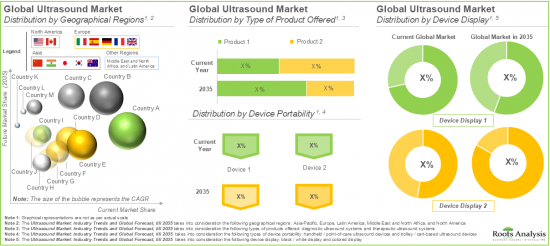
Market Sizing and Opportunity Analysis: An in-depth analysis of the ultrasound market, focusing on key market segments, including [A] type of product offered, [B] device portability, [C] device display, [D] type of technology, [E] application area, [F] end user, [G] geographical regions and [H] leading players.
Market Impact Analysis: A thorough analysis of various factors, such as drivers, restraints, opportunities, and existing challenges that are likely to impact market growth.
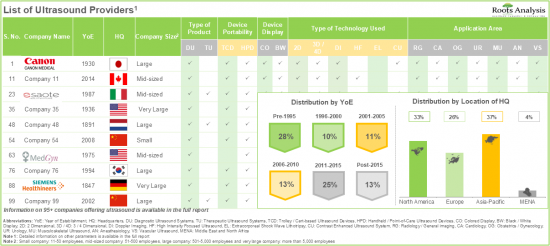
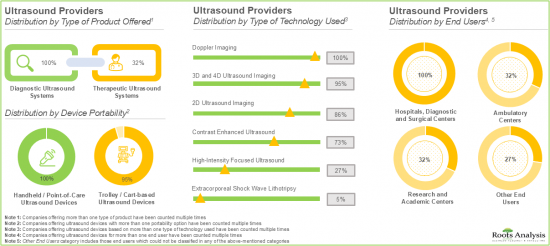
Ultrasound Market Landscape: The report features a list of ultrasound providers, along with analyses, based on several relevant parameters, such as [A] type of product offered, [B] device portability, [C] device display, [D] type of technology, [E] application area, [F] end user, [G] year of establishment, [H] company size, and [I] location of headquarters.
Competitiveness Analysis: A detailed competitive analysis of the leading players engaged in the ultrasound market based on [A] company strength, [B] portfolio strength. The section also features a relative benchmarking of the leading players, focusing on [A] company strength, [B] device portability, [C] type of technology, [D] application areas, and [E] end users.
Company Profiles: In-depth profiles of key industry players offering ultrasound devices across various geographies, focusing on [A] company overviews, [B] financial information (if available), [C] ultrasound portfolio, [D] recent developments and [E] an informed future outlook.
New Product Launches: A general overview of the recent launches of ultrasound devices by various industry stakeholders, with a focus on their key features.
Publication Analysis: A detailed analysis of peer-reviewed, scientific articles related to the ultrasound domain, based on a number of relevant parameters, such as [A] year of publication, [B] type of publication, [C] key copyright holders, [D] most active publishers, and [E] key journals.
Porter's Five Forces Analysis: An analysis of five competitive forces prevailing in the ultrasound market, including threats of new entrants, bargaining power of buyers, bargaining power of ultrasound providers, threats of substitute products and rivalry among existing competitors.
Value Chain Analysis: An in-depth analysis of various steps of developing ultrasound systems, highlighting the opportunities to improve efficiency / gain a competitive edge over competitors.
KEY QUESTIONS ANSWERED IN THIS REPORT
How many companies are currently engaged in this market?
Which are the leading companies in this market?
What factors are likely to influence the evolution of this market?
What is the current and future market size?
What is the CAGR of this market?
How is the current and future market opportunity likely to be distributed across key market segments?
REASONS TO BUY THIS REPORT
The report provides a comprehensive market analysis, offering detailed revenue projections of the overall market and its specific sub-segments. This information is valuable to both established market leaders and emerging entrants.
Stakeholders can leverage the report to gain a deeper understanding of the competitive dynamics within the market. By analyzing the competitive landscape, businesses can make informed decisions to optimize their market positioning and develop effective go-to-market strategies.
The report offers stakeholders a comprehensive overview of the market, including key drivers, barriers, opportunities, and challenges. This information empowers stakeholders to stay abreast of market trends and make data-driven decisions to capitalize on growth prospects.
ADDITIONAL BENEFITS
Complimentary PPT Insights Packs
Complimentary Excel Data Packs for all Analytical Modules in the Report
10% Free Content Customization
Detailed Report Walkthrough Session with Research Team
Free Updated report if the report is 6-12 months old or older
TABLE OF CONTENTS
1. BACKGROUND
1.1. Context
1.2. Project Objectives
2. RESEARCH METHODOLOGY
3. MARKET DYNAMICS
4. ECONOMIC AND OTHER PROJECT SPECIFIC CONSIDERATIONS
5. EXECUTIVE SUMMARY
6. INTRODUCTION
6.1. Overview of Ultrasound
6.2. Schematic Mechanism of Action of Ultrasound
6.3. Types of Ultrasound Systems
6.3.1. Trolley / Cart-based Ultrasound Systems
6.3.2. Handheld Ultrasound Systems
6.4. Primary Applications of Ultrasound Systems
6.5. Advantages of Ultrasound Systems
6.6. Recent Trends in Ultrasound Domain
7. MARKET IMPACT ANALYSIS
7.1. Market Drivers
7.2. Market Restraints
7.3. Market Opportunities
7.4. Market Challenges
8. GLOBAL ULTRASOUND MARKET
8.1. Key Assumptions and Methodology
8.2. Global Ultrasound Market, Historical Trends (since 2019) and Forecasted Estimates (till 2035)
8.2.1. Scenario Analysis
8.2.1.1. Conversative Scenario
8.2.1.2. Optimistic Scenario
8.3. Key Market Segmentations
9. ULTRASOUND MARKET, BY TYPE OF PRODUCT OFFERED
9.1. Key Assumptions and Methodology
9.2. Ultrasound Market: Distribution by Type of Product Offered
9.2.1. Ultrasound Market for Diagnostic Ultrasound Systems: Historical Trends (since 2019) and Forecasted Estimates (till 2035)
9.2.2. Ultrasound Market for Therapeutic Ultrasound Systems: Historical Trends (since 2019) and Forecasted Estimates (till 2035)
9.3. Data Triangulation and Validation
10. ULTRASOUND MARKET, BY DEVICE PORTABILITY
10.1. Key Assumptions and Methodology
10.2. Ultrasound Market: Distribution by Device Portability
10.2.1. Ultrasound Market for Trolley / Cart based Ultrasound Devices: Historical Trends (since 2019) and Forecasted Estimates (till 2035)
10.2.2. Ultrasound Market for Handheld / Point-of-Care Ultrasound Devices: Historical Trends (since 2019) and Forecasted Estimates (till 2035)
10.3. Data Triangulation and Validation
11. ULTRASOUND MARKET, BY TYPE OF DEVICE DISPLAY
11.1. Key Assumptions and Methodology
11.2. Ultrasound Market: Distribution by Type of Device Display
11.2.1. Ultrasound Market for Colored Display: Historical Trends (since 2019) and Forecasted Estimates (till 2035)
11.2.2. Ultrasound Market for Black / White Display: Historical Trends (since 2019) and Forecasted Estimates (till 2035)
11.3. Data Triangulation and Validation
12. ULTRASOUND MARKET, BY TYPE OF TECHNOLOGY
12.1. Key Assumptions and Methodology
12.2. Ultrasound Market: Distribution by Type of Technology
12.2.1. Ultrasound Market for 2D Technology: Historical Trends (since 2019) and Forecasted Estimates (till 2035)
12.2.2. Ultrasound Market for 3D / 4D Technology: Historical Trends (since 2019) and Forecasted Estimates (till 2035)
12.2.3. Ultrasound Market for Doppler Imaging Technology: Historical Trends (since 2019) and Forecasted Estimates (till 2035)
12.2.4. Ultrasound Market for Contrast Enhanced Ultrasound Technology: Historical Trends (since 2019) and Forecasted Estimates (till 2035)
12.2.5. Ultrasound Market for High Intensity Focused Ultrasound Technology: Historical Trends (since 2019) and Forecasted Estimates (till 2035)
12.2.6. Ultrasound Market for Extracorporeal Shock Wave Lithotripsy Technology: Historical Trends (since 2019) and Forecasted Estimates (till 2035)
12.3. Data Triangulation and Validation
13. ULTRASOUND MARKET, BY APPLICATION AREA
13.1. Key Assumptions and Methodology
13.2. Ultrasound Market: Distribution by Application Area
13.2.1. Ultrasound Market for Radiology / General Imaging: Historical Trends (since 2019) and Forecasted Estimates (till 2035)
13.2.2. Ultrasound Market for Cardiology: Historical Trends (since 2019) and Forecasted Estimates (till 2035)
13.2.3. Ultrasound Market for Obstetrics / Gynecology: Historical Trends (since 2019) and Forecasted Estimates (till 2035)
13.2.4. Ultrasound Market for Urology: Historical Trends (since 2019) and Forecasted Estimates (till 2035)
13.2.5. Ultrasound Market for Musculoskeletal Systems: Historical Trends (since 2019) and Forecasted Estimates (till 2035)
13.2.6. Ultrasound Market for Other Application Areas: Historical Trends (since 2019) and Forecasted Estimates (till 2035)
13.3. Data Triangulation and Validation
14. ULTRASOUND MARKET, BY END USER
14.1. Key Assumptions and Methodology
14.2. Ultrasound Market: Distribution by End User
14.2.1. Ultrasound Market for Hospitals: Historical Trends (since 2019) and Forecasted Estimates (till 2035)
14.2.2. Ultrasound Market for Diagnostic Centers: Historical Trends (since 2019) and Forecasted Estimates (till 2035)
14.2.3. Ultrasound Market for Ambulatory and Surgical Centers: Historical Trends (since 2019) and Forecasted Estimates (till 2035)
14.2.4. Ultrasound Market for Maternity Centers: Historical Trends (since 2019) and Forecasted Estimates (till 2035)
14.2.5. Ultrasound Market for Research and Academic Centers: Historical Trends (since 2019) and Forecasted Estimates (till 2035)
14.3. Data Triangulation and Validation
15. ULTRASOUND MARKET, BY GEOGRAPHICAL REGIONS
15.1. Key Assumptions and Methodology
15.2. Ultrasound Market: Distribution by Geographical Regions
15.2.1. Ultrasound Market in North America: Historical Trends (since 2019) and Forecasted Estimates (till 2035)
15.2.1.1. Ultrasound Market in the US: Historical Trends (since 2019) and Forecasted Estimates (till 2035)
15.2.1.2. Ultrasound Market in Canada: Historical Trends (since 2019) and Forecasted Estimates (till 2035)
15.2.2. Ultrasound Market in Europe: Historical Trends (since 2019) and Forecasted Estimates (till 2035)
15.2.2.1. Ultrasound Market in Germany: Historical Trends (since 2019) and Forecasted Estimates (till 2035)
15.2.2.2. Ultrasound Market in France: Historical Trends (since 2019) and Forecasted Estimates (till 2035)
15.2.2.3. Ultrasound Market in Italy: Historical Trends (since 2019) and Forecasted Estimates (till 2035)
15.2.2.4. Ultrasound Market in Spain: Historical Trends (since 2019) and Forecasted Estimates (till 2035)
15.2.2.5. Ultrasound Market in the UK: Historical Trends (since 2019) and Forecasted Estimates (till 2035)
15.2.2.6. Ultrasound Market in Switzerland: Historical Trends (since 2019) and Forecasted Estimates (till 2035)
15.2.2.7. Ultrasound Market in Rest of Europe: Historical Trends (since 2019) and Forecasted Estimates (till 2035)
15.2.3. Ultrasound Market in Asia-Pacific: Historical Trends (since 2019) and Forecasted Estimates (till 2035)
15.2.3.1. Ultrasound Market in Japan: Historical Trends (since 2019) and Forecasted Estimates (till 2035)
15.2.3.2. Ultrasound Market in China: Historical Trends (since 2019) and Forecasted Estimates (till 2035)
15.2.3.3. Ultrasound Market in India: Historical Trends (since 2019) and Forecasted Estimates (till 2035)
15.2.3.4. Ultrasound Market in South Korea: Historical Trends (since 2019) and Forecasted Estimates (till 2035)
15.2.3.5. Ultrasound Market in Australia: Historical Trends (since 2019) and Forecasted Estimates (till 2035)
15.2.3.6. Ultrasound Market in Rest of Asia-Pacific: Historical Trends (since 2019) and Forecasted Estimates (till 2035)
15.2.4. Ultrasound Market in Middle East and North Africa: Historical Trends (since 2019) and Forecasted Estimates (till 2035)
15.2.4.1. Ultrasound Market in Saudi Arabia: Historical Trends (since 2019) and Forecasted Estimates (till 2035)
15.2.4.2. Ultrasound Market in Egypt: Historical Trends (since 2019) and Forecasted Estimates (till 2035)
15.2.4.3. Ultrasound Market in Israel: Historical Trends (since 2019) and Forecasted Estimates (till 2035)
15.2.4.4. Ultrasound Market in Rest of Middle East and North Africa: Historical Trends (since 2019) and Forecasted Estimates (till 2035)
15.2.5. Ultrasound Market in Latin America: Historical Trends (since 2019) and Forecasted Estimates (till 2035)
15.2.5.1. Ultrasound Market in Brazil: Historical Trends (since 2019) and Forecasted Estimates (till 2035)
15.2.5.2. Ultrasound Market in Mexico: Historical Trends (since 2019) and Forecasted Estimates (till 2035)
15.2.5.3. Ultrasound Market in Argentina: Historical Trends (since 2019) and Forecasted Estimates (till 2035)
15.2.5.4. Ultrasound Market in Rest of Latin America: Historical Trends (since 2019) and Forecasted Estimates (till 2035)
15.3. Ultrasound Market, by Geographical Regions: Market Dynamics Assessment
15.3.1. Penetration-Growth (P-G) Matrix
15.3.2. Market Movement Analysis
15.3.3. Data Triangulation and Validation
16. ULTRASOUND MARKET, BY KEY PLAYERS
17. MARKET LANDSCAPE: ULTRASOUND PROVIDERS
17.1. Chapter Overview
17.2. Leading Ultrasound Providers: Market Landscape
17.2.1. Analysis by Type of Product Offered
17.2.2. Analysis by Device Portability
17.2.3. Analysis by Type of Device Display
17.2.4. Analysis by Type of Technology
17.2.5. Analysis by Application Area
17.2.6. Analysis by End User
17.3. Ultrasound Providers: Developer Landscape
17.3.1. Analysis by Year of Establishment
17.3.2. Analysis by Location of Headquarters
17.3.3. Analysis by Company Size
18. COMPANY COMPETITIVENESS ANALYSIS: LEADING ULTRASOUND PROVIDERS
18.1. Key Parameters and Methodology
18.2. Company Competitiveness Analysis: Leading Ultrasound Providers
18.3. Parameter-wise Benchmarking of Top Five Leading Players
19. COMPANY PROFILES: LEADING ULTRASOUND PROVIDERS HEADQUARTERED IN NORTH AMERICA
19.1. Chapter Overview
19.2. Leading Ultrasound Providers Headquartered in North America
19.2.1. GE HealthCare
19.2.1.1. Company Overview
19.2.1.2. Ultrasound Portfolio
19.2.1.3. Financial Details
19.2.1.4. Recent Developments and Future Outlook
19.2.2. Hologic
19.2.3. Konica Minolta Healthcare Americas
19.3. Other Leading Ultrasound Providers Headquartered in North America
19.3.1. Clarius
19.3.2. MedGyn
20. COMPANY PROFILES: LEADING ULTRASOUND PROVIDERS HEADQUARTERED IN EUROPE
20.1. Chapter Overview
20.2. Leading Ultrasound Providers Headquartered in Europe
20.2.1. Philips
20.2.1.1. Company Overview
20.2.1.2. Ultrasound Portfolio
20.2.1.3. Financial Details
20.2.1.4. Recent Developments and Future Outlook
20.2.2. Siemens Healthineers
20.3. Other Leading Ultrasound Providers Headquartered in Europe
20.3.1. Draminski
20.3.2. Esaote
21. COMPANY PROFILES: LEADING ULTRASOUND PROVIDERS HEADQUARTERED IN ASIA-PACIFIC
21.1. Chapter Overview
21.2. Leading Ultrasound Providers Headquartered in Asia-Pacific
21.2.1. Canon Medical Systems
21.2.1.1. Company Overview
21.2.1.2. Ultrasound Portfolio
21.2.1.3. Financial Details
21.2.1.4. Recent Developments and Future Outlook
21.2.2. FUJIFILM
21.2.3. Lepu Medical
21.2.4. Shenzhen Mindray Bio-Medical Electronics
21.3. Other Leading Ultrasound Providers Headquartered in Asia-Pacific
21.3.1. CHISON Medical Technologies
21.3.2. Dawei Medical
21.3.3. Edan Instruments
21.3.4. Narang Medical
21.3.5. Meditech Equipment
21.3.6. Promed Technology
21.3.7. Samsung Healthcare
21.3.8. SIUI
21.3.9. Sonoscape
22. NEW PRODUCT LAUNCHES IN ULTRASOUND DOMAIN
22.1. Chapter Overview
22.2. Historical Trends in Ultrasound Domain
22.3. Recent Products
22.3.1. Aplio Me
22.3.2. Butterfly IQ3
22.3.3. HERA Z20
22.3.4. LOGIQ E10 and LOGIQ Fortis
22.3.5. My LabTM 80
23. PUBLICATION ANALYSIS
23.1. Chapter Overview
23.2. Scope and Methodology
23.3. Publication Analysis: Ultrasound Domain
23.3.1. Analysis by Year of Publication
23.3.2. Analysis by Type of Publication
23.3.3. Analysis by Copyright Holders
23.3.4. Most Active Publishers: Analysis by Number of Publications
23.3.5. Key Journals: Analysis by Number of Publications
23.3.6. Key Journals: Analysis by Impact Factor
24. PORTER'S FIVE FORCES ANALYSIS
24.1. Methodology and Assumptions
24.2. Key Parameters
24.2.1. Threats of New Entrants
24.2.2. Bargaining Power of Buyers
24.2.3. Bargaining Power of Suppliers
24.2.4. Threats of Substitute Products
24.2.5. Rivalry among Existing Competitors
24.3. Porter's Five Force Analysis: Harvey Ball Analysis
24.4. Concluding Remarks
25. VALUE CHAIN ANALYSIS: ULTRASOUND MARKET
25.1. Overview of Ultrasound Process and Stakeholders Involved
25.2. Schematic Representation of Ultrasound from Conception to Usage
26. EXECUTIVE INSIGHTS
27. APPENDIX 1: TABULATED DATA
28. APPENDIX 2: LIST OF COMPANIES AND ORGANIZATIONS