



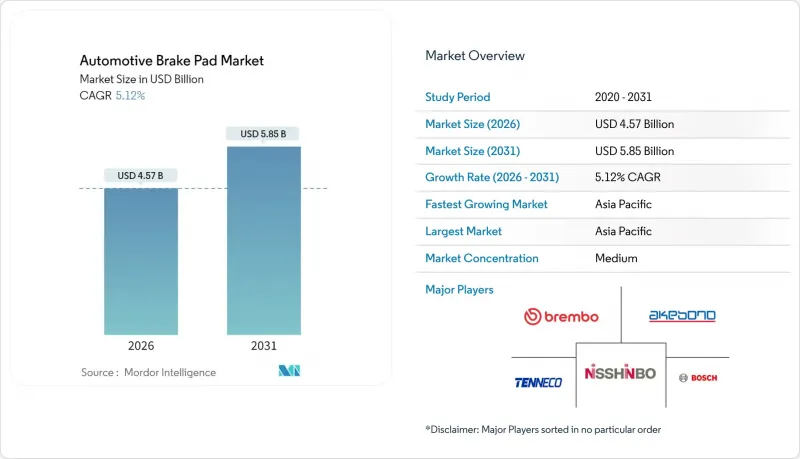
자동차 브레이크 패드 시장은 2025년 43억 5,000만 달러에서 2026년에는 45억 7,000만 달러에 이르고, 2026-2031년 CAGR 5.12%로 성장을 지속하여 2031년까지 58억 5,000만 달러에 달할 것으로 예측됩니다.
이러한 꾸준한 확대는 전 세계 배출가스 규제 강화, 전기자동차 증가, 제동 안전성을 유지하면서 미립자 물질 배출을 줄이는 마찰 재료 과학의 발전에 힘입은 바 큽니다. 아시아태평양의 두꺼운 제조거점, 교체 부품 채널의 전자상거래로의 전환, 저소음 세라믹 복합재에 대한 고객 수요가 성장을 더욱 촉진하고 있습니다. 한편, 철강 및 페놀 수지공급망 불안정성이 수익률을 압박하고 있으며, 제조업체들은 공정 자동화 및 AI 기반 배합 도구에 대한 투자를 촉진하고 있습니다. 프리미엄 브랜드들이 패드에 마모 센서와 소프트웨어를 내장하고, 새로운 수익원이 될 예지보전 서비스를 기반으로 하는 가운데, 경쟁 압력이 높아지고 있습니다.
유로7 규제는 2025년부터 브레이크 미립자 배출량을 7mg/km로 제한하고, 구리 함량을 중량 대비 0.5% 미만으로 의무화하기 때문에 기존의 페놀수지-구리 혼합재는 더 이상 쓸모없게 됩니다. 중국도 EU 기준에 준하는 규제를 수립 중에 있으며, 세계 양대 자동차 시장에서 통일된 적합성 기준이 확립될 것입니다. 일찍이 무동 인증을 완료한 제조업체는 분명한 판매 우위를 누리는 반면, 대응이 늦어진 기업은 고비용의 배합 변경과 생산 라인 중단에 직면하게 됩니다. 이 규정은 세라믹 및 NAO(비유기체)의 채택을 가속화하고, OEM 제조업체가 전 세계 플랫폼에서 마찰재 팩을 표준화하도록 장려하고 있습니다. 2025년부터 시행되는 캘리포니아주의 '더 나은 브레이크 규정'과 같은 미국의 선례는 주정부 차원의 노력이 전국적인 공급망으로 빠르게 확산될 수 있다는 것을 보여줍니다.
OEM 제조업체와 Tier 1 공급업체들은 구리 프리 화합물을 규제 대응 도구가 아닌 성능 향상 수단으로 인식하고 있습니다. 브렘보의 시멘트 매트릭스 '프로젝트 코브라'는 포름알데히드를 제거하고 미립자를 20% 감소시키면서 ECE-R90 인증을 획득했습니다. 세라믹 섬유와 개량 페놀 수지의 조합으로 정숙한 제동과 깨끗한 휠을 실현. 엔진 소음으로 인한 차폐효과가 없는 EV 오너들로부터 높은 평가를 받고 있습니다. 생산 전환에 따라 특수 아라미드 섬유와 유리섬유 조달에 대한 압박이 발생하여 현물 가격의 선택적 설정과 공급업체 감사 강화로 이어지고 있습니다. 공구 변경(고온 프레스기 및 혼합 정밀도 향상)에는 수백만 달러 규모의 설비 투자가 필요하지만, 고가의 패드를 요구하는 프리미엄 모델에서는 빠른 투자 회수를 기대할 수 있습니다.
배터리 구동 전기 세단 운전자는 눈에 띄는 장점이 있습니다. 기존 차량에 비해 브레이크 패드의 교체 빈도가 크게 줄어든다는 점입니다. 회생 제동 시스템 덕분에 전기 세단 운전자는 일반적으로 첫 번째 브레이크 패드 교체까지의 주행 거리가 기존보다 2배 이상 길어 시스템의 효율성과 마모 감소를 강조합니다. 서비스 간격이 짧아지면 차량 당 애프터마켓 수익이 감소합니다. 그러나 특수 내식성 코팅으로 인해 각 패드 세트의 단가가 높아집니다. 차량 사업자는 서비스 계약 기간을 연장하고 대량 구매를 미루기 때문에 공급업체의 수주 전망은 불투명합니다. 판매량 감소는 우선 지역 유통업체에 영향을 미치고, 사업 통합이나 타이어, 와이퍼 블레이드 등 다른 소모품으로 사업 전환을 강요받게 됩니다.
2025년 기준 자동차 브레이크 패드 시장 규모에서 세미메탈 패드가 46.34%로 가장 큰 점유율을 차지했습니다. 철분이나 구리 분말이 고속 정지 시 열을 효율적으로 발산하기 때문에 여전히 높은 인기를 유지하고 있습니다. 한편, 세라믹 복합재는 구리 사용 금지 규제와 저분진 휠에 대한 소비자 수요로 인해 2031년까지 연평균 복합 성장률(CAGR) 5.68%를 나타낼 것으로 예측됩니다. 이러한 성장은 가격 탄력성이 높은 고급 SUV와 고성능 세단에서 특히 두드러집니다.
세라믹의 대중화에는 높은 원자재 비용, 전용 소성로의 필요성, 제한된 공급원을 제공하는 미립자 알루미나 분말에 대한 요구 등 장벽이 존재합니다. 그러나 브렘보와 같은 제조업체들은 구리 프리 세라믹이 페이드 저항성을 유지할 수 있다는 것을 입증하여 틈새 스포츠카를 넘어서는 가능성을 보여주고 있습니다. 비석면 유기 패드는 초기 가격이 내구성을 능가하는 라틴아메리카와 아프리카의 저가형 차량에 계속 채택되고 있습니다. 모든 카테고리에서 세미 메탈릭은 대형 트럭에 필수적인 요소로 남을 것입니다. 왜냐하면 로터의 대폭적인 개선 없이는 그 열용량에 필적할 만한 세라믹 블렌드는 아직 존재하지 않기 때문입니다.
프론트 어셈블리는 2025년 기준 자동차 브레이크 패드 시장 규모의 65.10%를 차지하고 있으며, 이는 물리적으로 프론트 액슬에 부하가 걸리는 경향을 반영하고 있습니다. 전자 제어식 제동력 분배 시스템과 첨단 안정성 제어 프로그램을 통해 제동 에너지가 후륜 축에 더 많이 분배되어 후륜 패드의 마모율이 증가합니다. 이로 인해 후륜 패드 하위 부문의 CAGR은 2031년까지 5.98%를 나타낼 것으로 예측됩니다. 자동차 제조업체는 커브에서 소프트웨어 제어에 의한 토크 벡터링을 지원하기 위해 후륜 브레이크에 고급 캘리퍼를 장착하고 있습니다.
하이브리드 및 전기자동차 모델에서 엔지니어들은 종종 후륜에 재생 브레이크 모터를 장착하여 배터리 잔량이 부족할 때 후륜 유압 브레이크를 선택적으로 사용합니다. 이 전환으로 인해 열적 특성이 변화하고, 정지 간격이 길어진 뒷바퀴 패드에는 내식성 코팅이 요구됩니다. 애프터마켓 정비소들은 이에 따라 재고 비율을 조정하고, 서비스 지연을 피하기 위해 지난 10년보다 더 많은 후륜 패드를 주문하고 있습니다.
아시아태평양은 2025년 자동차 브레이크 패드 시장에서 47.80%의 점유율을 차지할 것으로 예상되며, 중국, 인도, 아세안 국가들의 자동차 생산 확대와 공급업체 집적지 육성으로 2031년까지 연평균 5.75%의 성장을 견인할 것으로 예측됩니다. 중국의 유로6에서 유로7 표준으로의 전환은 국내 패드 제조업체에 과제와 기회를 가져다주며, 구리 프리화가 시급한 과제입니다. 인도의 이륜차 붐은 주조공장과 컴파운드 배합시설을 통합한 현지 우량기업으로 성장을 이끌며 수입 의존도를 낮추고 있습니다. 한국 기업들은 세라믹 및 아라미드 섬유 기술의 최첨단을 추진하고 있으며, 그 노하우를 현지 자회사에 수출하고 있습니다.
북미의 경우 차량 평균 사용 연한이 길고, 성숙한 교체 수요 시장이 안정적인 애프터마켓 수익을 뒷받침하고 있습니다. 캘리포니아와 워싱턴주의 주정부 차원의 구리 사용 금지 조치는 공급업체들의 조기 투자를 유도했고, 현재 미국 전역에 걸쳐 성과를 내고 있습니다. 멕시코에서는 차량 조립라인 확대에 따라 지역 조달을 촉진하는 USMCA 관세 규정에 따라 상당량의 부품이 현지에서 조달되고 있습니다. 캐나다와 미국 북부의 혹독한 겨울은 내식성 백플레이트와 염해로 인한 박리를 견딜 수 있는 특수 저온용 바인더에 대한 수요를 키우고 있습니다.
유럽은 규제의 선구자적 역할을 하고 있으며, 유로 7은 입자상 물질 배출 제한에 대한 세계 표준을 정립하고 있습니다. 독일 고급 브랜드가 세라믹 제품 채택을 주도하는 한편, 이탈리아와 스페인공급업체들은 이륜차 및 고성능 자동차 분야에서 뛰어난 기술력을 발휘하고 있습니다. 환율 변동과 에너지 가격 급등으로 생산비용이 상승하는 반면, EU 역내 결속력이 국경을 초월한 규제의 복잡성을 상쇄하고, 폴란드에서 포르투갈까지 부품이 자유롭게 유통되고 있습니다. 동유럽 공장은 낮은 인건비와 EU에 부합하는 품질 관리 체계로 인해 새로운 브레이크 패드 계약을 수주하는 사례가 증가하고 있습니다.
The automotive brake pad market is expected to grow from USD 4.35 billion in 2025 to USD 4.57 billion in 2026 and is forecast to reach USD 5.85 billion by 2031 at 5.12% CAGR over 2026-2031.
This steady expansion is anchored in stricter global emission rules, growing electrified-vehicle volumes, and advances in friction-material science that lower particulate output without sacrificing braking safety. Asia-Pacific's manufacturing depth, the shift to e-commerce in the replacement parts channel, and customer demand for low-noise ceramic compounds add further momentum. At the same time, supply-chain volatility in steel and phenolic resins squeezes margins, prompting makers to invest in process automation and AI-driven formulation tools. Competitive pressure rises as premium brands embed wear sensors and software into pads, underpinning predictive-maintenance services that create new revenue streams.
Euro 7 rules cap brake particulate emissions at 7 mg/km from 2025 and force copper content below 0.5% by weight, making legacy phenolic-copper blends obsolete . China is drafting parallel limits that mirror the EU threshold, creating a unified compliance bar across the two largest vehicle markets. Makers that completed copper-free validation early now enjoy a clear sales edge, whereas late movers face costly reformulation and line downtime. The rule set accelerates ceramic and NAO adoption, pushing OEMs to standardize friction packs across global platforms. U.S. precedents such as California's "Better Brake Rule," in force since 2025, underscore how state-level action can quickly spread to nationwide supply chains.
OEMs and tier-one suppliers now treat copper-free compounds as performance upgrades, not compliance tools. Brembo's cement-matrix "Project Cobra" won ECE-R90 approval while eliminating formaldehyde and cutting fine particulates by 20% . Ceramic fibers paired with modified phenolic alternatives enable quieter stops and cleaner wheels, which are prized by EV owners whose cabins lack engine masking noise. Production transitions have strained sourcing of specialized aramid and glass fibers, leading to selective spot pricing and tighter supplier audits. Tooling changes-higher-temperature presses and finer mixing tolerances-require multi-million-dollar capex, but the payback arrives quickly in premium models that command higher pad prices.
Drivers of battery electric sedans enjoy a notable advantage: they replace their brake pads far less frequently than those in conventional vehicles. Thanks to regenerative braking systems, electric sedan drivers can typically go over twice the distance before their first brake pad change, underscoring the system's efficiency and reduced wear. Fewer service intervals shrink aftermarket revenue per vehicle, although each pad set sells at a higher unit price due to specialized corrosion coatings. Fleet operators extend service contracts longer, deferring large-lot pad purchases, which softens order visibility for suppliers. Volume declines hit regional distributors first, forcing consolidation or shifts into other wear parts such as tires and wiper blades.
Other drivers and restraints analyzed in the detailed report include:
For complete list of drivers and restraints, kindly check the Table Of Contents.
Semi-metallic pads generated the most significant slice with 46.34% of the automotive brake pad market size in 2025. They remain popular because iron and copper shavings dissipate heat efficiently during repeated high-speed stops. Ceramic compounds, however, are advancing at a 5.68% CAGR through 2031 thanks to copper bans and consumer demand for low-dust wheels. This growth is most visible in premium SUVs and performance sedans with higher price elasticity.
Ceramic uptake faces hurdles: higher raw-material costs, different curing ovens, and the need for fine-grained alumina powders that only a few suppliers provide. Nonetheless, makers like Brembo demonstrated that copper-free ceramics can retain fade resistance, expanding potential beyond niche sports cars. Non-asbestos organic pads continue to serve budget cars in Latin America and Africa, where upfront price trumps longevity. Across all groups, semi-metallic will remain vital for heavy-duty trucks because no ceramic blend yet matches its thermal capacity without significant rotor upgrades.
Front assemblies held 65.10% of the automotive brake pad market size in 2025, reflecting physics-driven front-axle loading. Electronic brake-force distribution and advanced stability programs now redirect more stopping energy to the rear axle, elevating rear-pad wear rates and pushing that subsegment's 5.98% CAGR through 2031. Automakers equip rear brakes with more sophisticated calipers to support software-controlled torque vectoring in curves.
In hybrid and EV models, engineers often mount regenerative motors on rear wheels, selectively using rear hydraulic brakes when batteries are near complete. This switch changes heat profiles, requiring corrosion-resistant coatings on rear pads, which now sit idle longer between stops. Aftermarket workshops adjust stocking ratios accordingly, ordering higher rear-pad volumes than in the past decade to avoid service delays.
The Automotive Brake Pad Market Report is Segmented by Material Type (Semi-Metallic, Non-Asbestos Organic, Low-Metallic NAO, and Ceramic), Position (Front and Rear), Sales Channel (OEM and Aftermarket), Vehicle Type (Passenger Cars, and More), Propulsion Type (ICE, Hybrid, and Battery Electric), and Geography. The Market Forecasts are Provided in Terms of Value (USD).
Asia-Pacific led the automotive brake pad market with a 47.80% share in 2025, growing at a CAGR of 5.75% through 2031, as China, India, and ASEAN nations scaled vehicle output and nurtured dense supplier clusters. China's transition from Euro 6 to Euro 7 standards compels rapid copper-free conversions, creating challenges and opportunities for domestic pad makers. India's two-wheeler boom channels growth to local champions integrating foundries and compound kitchens under one roof, reducing import reliance. Japanese and Korean firms push the frontier of ceramic and aramid fiber technology, exporting recipes to regional affiliates.
North America shows a mature replacement landscape where high vehicle age supports stable aftermarket revenue. State-level copper bans in California and Washington forced early supplier investments that now pay dividends nationwide. Mexico's expanding vehicle assembly lines source a significant volume of parts locally, thanks to USMCA tariff rules that favor regional content. Severe winters in Canada and northern states nurture demand for corrosion-proof back-plates and special low-temperature binders that resist salt-induced delamination.
Europe acts as a regulatory pacesetter, with Euro 7 setting the global template for particulate limits. Premium German marques pull ceramic adoption upward, while Italian and Spanish suppliers excel in motorcycle and performance sectors. Currency swings and energy-price shocks elevate production costs, yet EU cohesion offsets cross-border rule complexity, letting parts flow freely from Poland to Portugal. Eastern European plants increasingly win new pad contracts due to lower labor costs and EU-compliant quality regimes.