



붕소 시장은 2025년 509만 톤에서 2026년에는 529만 톤으로 성장하여 2026년부터 2031년까지 CAGR 4.01%를 기록하며 2031년까지 644만 톤에 달할 것으로 예측됩니다.
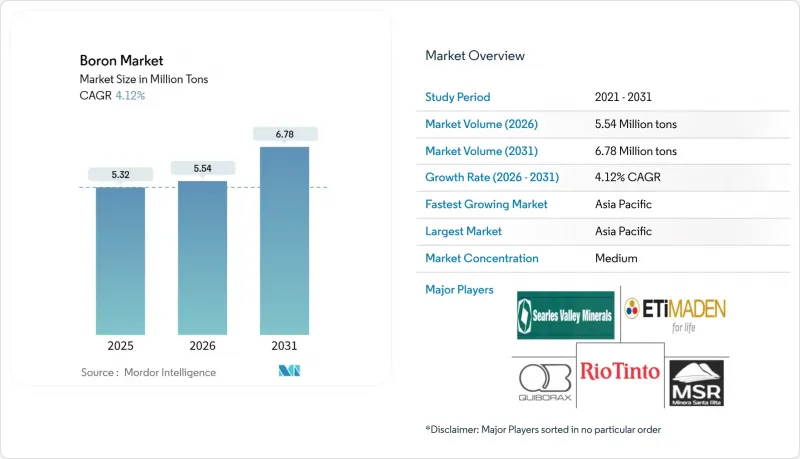
시장 확대는 안정적인 유리 수요와 반도체, 그린 수소 저장, 첨단 세라믹 분야에서의 고순도 붕소 화합물 채용 확대에 힘입은 바 큽니다. 튀르키예의 에티마덴(Eti Madden)을 중심으로 한 공급 집중이 가격 형성에 계속 영향을 미치고 있지만, 새로운 리튬-붕소 공동 생산 프로젝트가 대체 공급량을 도입하고 있습니다. 에너지 절약형 건축 기준, 전기자동차로의 전환, 농업용 미량영양소에 대한 관심 증가와 함께 최종 용도의 다양화가 지속되고 있습니다. 주요 광산업체 및 화학업체들의 기술 중심의 수직계열화는 환경 규제가 강화되는 상황에서도 경쟁력을 유지할 수 있는 기반이 되고 있습니다.
자동차 경량화, 풍력 터빈 블레이드 제조, 고성능 단열재 수요 확대가 맞물려 붕소 강화유리섬유에 대한 추가 수요를 견인하고 있습니다. 전기자동차 배터리 하우징은 열 안정성 향상을 위해 붕소 강화 복합재가 지정되어 지속적인 수요 증가를 뒷받침하고 있습니다. 풍력발전 대기업들은 주기적인 스트레스를 견딜 수 있는 붕규산 유리를 채택하여 해상 풍력발전소에 설치되는 블레이드의 수명을 연장하고 있습니다. 에너지 절약을 우선시하는 건축 기준에 따라 단열재로 붕소 강화유리솜으로의 전환이 가속화되고 있습니다. SCHOTT의 내스크래치성 유리세라믹 '미라듀어'는 10GPa의 마르텐 경도를 자랑하며, 고성능을 중시하는 프리미엄 부문의 트렌드를 보여주고 있습니다. 전반적으로, 유리섬유의 채택 확대는 장기 사이클의 인프라와 모빌리티의 메가 트렌드를 결합하여 붕소 시장을 강화하고 있습니다.
정밀농업 플랫폼에 의한 토양 붕소의 정밀 측정은 정밀 시비를 촉진하고, 정제 붕산염의 안정적인 수요를 창출하고 있습니다. 사붕산나트륨 5수화물은 40주 동안 거의 완벽한 붕소 방출을 실현하여 시험 재배에서 우레크사이트계 대체제를 능가하는 성능을 보여주었습니다. 개화기에 맞춘 엽면 살포는 활엽수 작물의 결핍과 과잉 사이의 간극을 완화합니다. 브라질의 세라도 지역에서는 콩 생산자들이 수확량을 높이기 위해 붕소를 균형 잡힌 미량영양소 패키지에 포함시켜 수확량을 향상시키고 있습니다. 특수 비료 제조업체는 효과 저하 없이 총 시용량을 줄이는 수송 자극형 배합제를 도입했습니다. 이러한 개선으로 농업은 붕소 시장의 지속적인 수요처로 자리매김하고 있습니다.
물 사용 제한, 서식지 보호구역 지정, 온실가스 보고 기준 등으로 인해 신규 광산의 컴플라이언스 비용이 증가하고 있습니다. 수명주기 평가에서 정제된 붕소의 탄소발자국은 1톤당 최대 1,702kg CO2로 계산되어 규제 당국의 감시 대상이 되고 있습니다. 폐기물 처리 비용은 톤당 50달러가 추가될 수 있으며, 이는 수익률을 압박하고 프로젝트 승인을 지연시키고 있습니다. 사막 생태계에서 튀르키예의 운영은 특히 지하수 채취에 대한 억제 압력에 직면해 있습니다. 조건부 허가는 종종 고액의 수리 보증금 공탁을 의무화하여 건설 일정을 연장하고 수요에 대한 단기적인 공급 증가를 제한하고 있습니다.
2025년 붕소 시장에서는 반도체 제조 공장, 세라믹 미세구조, 특수 화학제품을 위해 99.9% 이상의 순도가 요구되는 테크니컬 그레이드 제품이 52.18%를 차지했습니다. 이 분야는 2031년까지 CAGR 4.12%로 성장할 것으로 예상됩니다. 반도체 도펀트 소비량만으로도 기술 등급 매출의 3분의 1 이상을 차지하고 있으며, 파운드리가 실리콘 카바이드(SiC) 및 질화갈륨(GaN) 라인을 확장하고 있기 때문입니다. 질화붕소 나노튜브에 대한 연구는 항공우주용 열 차폐를 위한 파일럿 계약을 창출하고 있습니다. 반면, 표준 유리 및 비료용 산업용 소재는 마진이 축소되는 가운데 3.02%의 완만한 성장에 직면해 있습니다. 붕소 시장의 기술 분야에서는 오염 관리에 대한 공급업체와 고객의 긴밀한 협력으로 가격 결정력을 확보하고 있습니다.
기술 등급 생산자는 폐액에서 붕소를 회수하기 위해 폐액에서 폐쇄 루프 재활용을 활용하여 실질적 현금 비용을 절감하고 ESG 감사에 부합하도록 노력하고 있습니다. 산업용 등급 공급업체는 특히 아시아태평양의 건축용 유리 공장용 벌크 물류에서 규모의 우위를 유지하고 있습니다. 공정의 점진적인 개선으로 불순물 허용치가 감소하는 추세이지만, 두 등급 간의 명확한 가격 차이는 여전히 존재합니다. 차세대 칩이 3nm 이하 공정 노드로 전환됨에 따라 초순수 붕소 수요가 급증하고 붕소 시장의 등급 양극화가 더욱 심화될 것으로 예상됩니다.
붕소 시장 보고서는 등급별(기술 및 산업용), 용도별(유리, 세라믹, 농업, 세제 및 세정제, 기타 용도), 지역별(아시아태평양, 북미, 유럽, 남미, 중동 및 아프리카)로 분류됩니다. 시장 예측은 톤 단위로 제공됩니다.
아시아태평양은 2025년 출하량의 52.21%를 차지했으며, 중국이 전자기기, 태양전지용 유리, 건축용 단열재 분야에서 가장 큰 점유율을 차지했습니다. 이 지역의 CAGR은 4.18%로 예상되며, 지속적인 팹 확장과 인프라 투자에 힘입어 성장세를 이어갈 것으로 전망됩니다. 인도에서는 면화 및 유지 종자 수확량 향상을 위한 노력으로 미량영양소 수입이 두 자릿수 성장세를 보이고 있습니다. 일본과 한국은 성숙한 시장이지만, 정밀 전자기기와 첨단 세라믹에 대한 안정적인 수요를 유지하고 있습니다.
북미는 생산량 2위를 차지하고 있으며, 캘리포니아와 네바다주의 채굴부터 정제까지 통합 생산 체제가 이를 뒷받침하고 있습니다. 라이오라이트 리지 프로젝트는 2025년 건설이 시작되며, 새로운 기술 등급 제품 공급과 공급 안정성 강화가 기대됩니다. 재생에너지 보조금이 붕규산 태양광 커버와 풍력 블레이드용 유리섬유에 대한 수요를 자극하여 2031년까지 CAGR 4.02%의 예측을 뒷받침하고 있습니다. 멕시코의 자동차 및 가전 산업 클러스터는 붕소 시장의 산업용 제품 수요 확대를 더욱 촉진할 것입니다.
유럽에서는 자동차 경량화, 풍력에너지 부품, 특수화학 분야에서 수요가 균형을 이루고 있습니다. 엄격한 탄소 국경 조치로 인해 스페인, 튀르키예 등 지중해 건너편에 있는 공급처에서 현지 조달이 이루어지고 있습니다. 성장률은 3.12%로 완만하지만, 고순도 부문의 부가가치 향상이 두드러집니다. 브라질 농업이 주도하는 남미 지역과 건설 메가 프로젝트에 힘입은 중동 및 아프리카이 전체 붕소 시장의 7.88%를 차지하며, 새로운 산업 및 인프라 투자로 인해 세계 평균을 상회하는 성장이 예상됩니다.
The Boron market is expected to grow from 5.09 Million tons in 2025 to 5.29 Million tons in 2026 and is forecast to reach 6.44 Million tons by 2031 at 4.01% CAGR over 2026-2031.
Market expansion is anchored in steady glass demand and widening uptake of high-purity boron compounds in semiconductors, green-hydrogen storage, and advanced ceramics. Supply concentration around Turkey's Eti Maden continues to shape pricing, yet new lithium-boron co-production projects are introducing alternative volumes. Energy-efficient building norms, the shift to electric vehicles, and rising agricultural micronutrient awareness collectively sustain end-use diversification. Technology-driven vertical integration by leading miners and chemical producers underpins competitive resilience as environmental rules tighten.
Automotive light-weighting, wind-blade fabrication, and high-performance insulation collectively pull additional volumes of boron-reinforced glass fibers. Electric-vehicle battery housings now specify boron-enhanced composites for thermal stability, supporting persistent demand growth. Wind-energy majors adopt borosilicate variants that withstand cyclic stress, extending service life of blades deployed in offshore farms. Building codes that prioritize energy savings are accelerating the shift to boron-enriched glass wool for insulation. SCHOTT's Miradur scratch-resistant glass-ceramic, posting 10 GPa Martens hardness, highlights the premium segment's focus on performance. Overall, fiberglass uptake strengthens the boron market by binding long-cycle infrastructure and mobility megatrends.
Precision-farming platforms quantify soil boron more accurately, prompting targeted application and steady demand for refined borates. Sodium tetraborate pentahydrate delivers near-complete boron release across a 40-week window, outperforming ulexite alternatives in controlled trials. Foliar sprays timed to flowering mitigate the narrow gap between deficiency and toxicity in broadleaf crops. In the Brazilian Cerrado, soybean growers integrate boron into balanced micronutrient packages to secure yield gains. Specialty fertilizer suppliers have introduced transport-stimulated formulations that lower total application rates without sacrificing efficacy. Such refinements keep agriculture an enduring offtake channel for the boron market.
Water-use restrictions, habitat-protection zoning, and greenhouse-gas reporting standards elevate compliance costs for new mines. Life-cycle assessments place refined boron's carbon footprint at up to 1,702 kg CO2-equivalent per ton, drawing regulator scrutiny. Waste-treatment expenses can add USD 50 per ton, narrowing margins and slowing project approvals. Turkish operations in desert ecosystems face particular pressure to curtail groundwater extraction. Conditional permits often mandate costly remediation bonds, lengthening construction timelines and limiting near-term supply growth relative to demand.
Other drivers and restraints analyzed in the detailed report include:
For complete list of drivers and restraints, kindly check the Table Of Contents.
Technical-grade volumes dominated the boron market in 2025 at 52.18% as fabs, ceramic microstructures, and specialty chemicals demanded >=99.9% purity. This slice is projected to log a 4.12% CAGR through 2031. Semiconductor dopant consumption alone underpins over one-third of technical sales as foundries ramp silicon-carbide and gallium-nitride lines. Boron nitride nanotube research is spawning pilot contracts for aerospace heat shields. By contrast, industrial-grade material-geared toward standard glass and fertilizer-faces slower 3.02% growth with tighter margins. Close supplier-customer collaboration around contamination control secures pricing power in the technical tranche of the boron market.
Technical-grade producers leverage closed-loop recycling to reclaim boron from effluents, trimming effective cash costs and aligning with ESG audits. Industrial-grade suppliers retain scale advantages in bulk logistics, particularly into construction glass plants across Asia-Pacific. Gradual process upgrades are narrowing impurity tolerances, but a clear pricing gulf between the two grades persists. As next-generation chips move to sub-3 nm nodes, demand for hyper-clean boron will intensify, reinforcing grade bifurcation within the boron market.
The Boron Market Report is Segmented by Grade (Technical and Industrial), Application (Glass, Ceramics, Agriculture, Detergent and Cleaning, and Other Applications), and Geography (Asia-Pacific, North America, Europe, South America, and Middle East and Africa). The Market Forecasts are Provided in Terms of Volume (Tons).
Asia-Pacific commanded 52.21% of 2025 shipments, with China absorbing the lion's share for electronics, solar glass, and construction insulation. Regional CAGR is forecast at 4.18%, sustained by continuous fab expansions and infrastructure investment. India's push for higher cotton and oilseed yields supports a double-digit rise in micronutrient imports. Japan and South Korea, while mature, maintain stable offtake for precision electronics and advanced ceramics.
North America ranked second in volume, supported by integrated mining and refining in California and Nevada. The Rhyolite Ridge project enters construction in 2025, promising fresh technical-grade output and bolstering supply security. Renewable-energy subsidies spur demand for borosilicate solar covers and wind-blade glass fibers, feeding a forecast 4.02% CAGR through 2031. Mexico's automotive and appliance clusters further widen industrial-grade pull within the boron market.
Europe exhibits balanced demand across automotive lightweighting, wind-energy components, and specialty chemicals. Strict carbon-border measures encourage local sourcing from Spanish and Turkish trans-Mediterranean suppliers. While growth is slower at 3.12%, value addition in high-purity segments remains notable. South America, led by Brazil's agriculture, and the Middle East and Africa, buoyed by construction megaprojects, together represent 7.88% of the boron market and are expected to grow above the global pace through new industrial and infrastructure investments.