



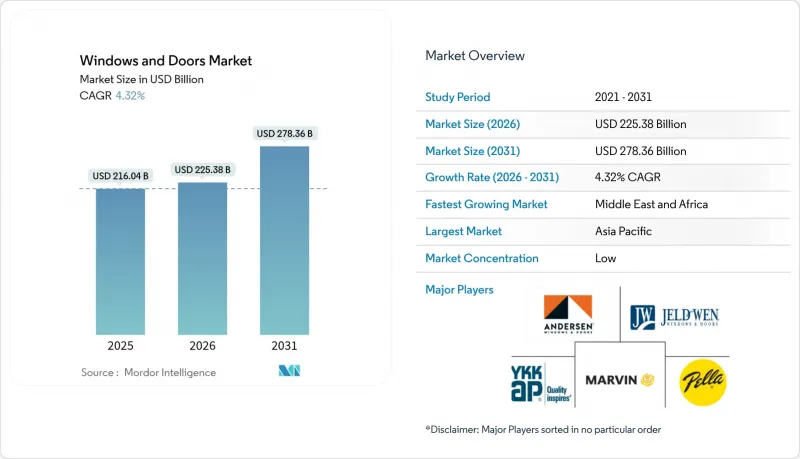
창호 시장은 2025년 2,160억 4,000만 달러에서 2026년에는 2,253억 8,000만 달러에 이르고, 2026-2031년 CAGR 4.32%로 성장을 지속하여 2031년까지 2,783억 6,000만 달러에 달할 것으로 예측됩니다.
에너지 절약형 건물 외피에 대한 강한 수요, 더 엄격한 성능 기준, 안정적인 리노베이션 지출이 이러한 성장을 뒷받침하고 있습니다. ENERGY STAR 버전 7.0 업데이트에 따라 미국의 추운 지역에서는 이미 U값의 한계가 0.22로 상향 조정되어 3중 유리창과 첨단 프레임워크의 채택을 촉진하고 있습니다. EU의 건물 에너지 성능 지침(EPBD)의 병행 움직임은 2030년까지 제로 에미션 건축물을 목표로 하는 사양으로 이어지고 있으며, 주거 및 상업용 프로젝트 모두에서 고성능 창호 채택을 가속화하고 있습니다. 공급 측면의 변화, 특히 경량 프레임 옵션, 모듈 건축, 스마트 유리로의 업그레이드는 알루미늄과 인력 부족이 여전히 지속적인 역풍으로 작용하고 있음에도 불구하고 디자인 선택의 폭을 넓히고 리드 타임을 단축하고 있습니다. 소재 혁신, 자동화된 제조, 지역별 공급 체계를 결합할 수 있는 제조업체는 창호 시장의 다음 단계인 사양 중심 수요를 포착할 준비가 되어 있습니다.
대출 비용의 상승으로 많은 주택 소유주들은 유리한 이자율로 고정되어 있으며, 이전이 아닌 개조에 여유 자금을 투입하고 있습니다. 리노베이션 지출은 2024년에 급증하고 2025년에도 5%의 성장률을 유지할 것으로 예측됩니다. 이는 북미와 유럽의 주택 재고의 노후화에 따른 것으로, 대부분 창호 교체 최적 시기인 20-39년 된 주택이 많기 때문입니다. 미국 해안 카운티의 거의 절반의 허리케인 복구 프로젝트에서 창문과 문을 업그레이드하여 보호 기능과 에너지 절약 기능의 이중 가치를 강조하고 있습니다. 리모델링 전문가들은 또한'재택 고령화' 수요가 급증하고 있으며, 넓은 개구부, 낮은 문턱 높이, 인체공학적 하드웨어가 요구되고 있다고 지적했습니다. 이러한 사용 패턴으로 인해 창호 시장은 소비자의 건강과 회복력에 대한 우선순위와 밀접한 관련이 있습니다.
주요 경제권에서 성능 표준이 공동으로 강화되고 있습니다. 미국에서는 ENERGY STAR V7.0을 통해 U값이 전 사이클 대비 15% 감소하여 추운 지역에서는 사실상 삼중유리 구조가 표준화되었습니다. 2024년 국제 에너지 절약 기준(IECC)은 기밀 성능을 0.35 cfm/ft2로 제한하고, 웨더스트립과 프레임 설계의 개선을 요구하고 있습니다. 유럽에서는 개정된 EPBD에 따라 2030년 이후 신축 건물에 대해 제로 배출 요건을 의무화하고, 기존 건물에 대해서는 단계적 개보수 목표를 설정했습니다. 매력적인 세액공제 및 공공요금 환급제도를 통해 초기 비용의 일부를 상쇄하여 투자 회수 기간을 단축하고 창호 시장에서의 제품 차별화를 도모하고 있습니다.
에너지 비용 급등과 제련소 가동 축소로 인해 팬데믹 이후 수요 회복기에 알루미늄 공급이 감소. 평균 프리미엄이 상승하고 리드타임이 길어지고 있습니다. PVC 제조업체는 특히 환경 감시가 엄격한 유럽에서 원료 비용 상승과 염소 제조 규제 강화에 직면하고 있습니다. 변동 리스크를 헤지하기 위해 제조업체들은 재생 빌릿, 열가소성 수지 강화 프로파일, 지역 조달 계약으로 전환을 추진하고 있습니다. 강도는 유지하면서 금속 사용량을 줄인 경량 복합재 프레임의 점유율은 지속적으로 확대되고 있습니다. 그러나 가격 변동이 중소 제조업체의 수익률을 압박하고, 프로젝트 수주 둔화 및 창호 시장 일부의 성장 억제요인으로 작용하고 있습니다.
2025년 매출의 58.02%를 차지한 도어 부문은 모든 건축 유형에서 기초적인 역할을 확고히 하고 있습니다. 방범문, 내화 어셈블리, 스마트 잠금장치는 경기 침체기에도 비교적 안정적인 교체 주기를 유지하며 수요를 유지하고 있습니다. 반면, 창호는 엄격한 열획득 제한과 유리를 통해 직접 태양광 에너지를 포집하는 건축용 태양광발전(BIPV)의 보급으로 CAGR 7.35%로 높은 성장률을 보이고 있습니다. 이러한 풀스루 효과로 창호는 창호 시장의 기술 선도자로서의 입지를 다지고 있습니다.
도어 제조업체들은 다점 잠금장치, 내충격 패널, 원활한 스마트홈 연계에 투자하고 있지만, 가장 높은 수익률은 전색성 코팅과 태양광 수확 중간막을 융합한 첨단 창호 솔루션으로 전환하고 있습니다. 로렌스 버클리 국립연구소(Lawrence Berkeley National Laboratory)의 연구에 따르면, 이러한 설치는 건물 전체 에너지 소비를 최대 15.9%까지 절감할 수 있으며, 이 지표는 프리미엄 가격 책정 및 단기간의 투자 회수를 촉진합니다. 그 결과, 윈도우 부문 시장 규모는 2025년 890억 달러에서 2031년까지 1,360억 달러로 확대될 것으로 예측됩니다. 그러나 수량 기준으로는 도어 부문이 여전히 우위를 점하고 있습니다.
금속 프레임, 특히 알루미늄은 우수한 중량 대비 강도, 슬림한 시선, 재활용성 등으로 인해 2025년 매출의 46.15%를 차지할 것으로 예측됩니다. 커튼월식 고층 빌딩, 병원, 교통 거점에서는 거의 항상 문과 유리로 된 외관 모두 알루미늄 프레임이 지정됩니다. 그러나 예산과 신속한 시공이 가장 요구되는 급성장하는 교외 및 도시 주변 주거지역에서는 플라스틱/uPVC 프로파일이 8.59%의 연평균 복합 성장률(CAGR)로 가장 빠른 시장 점유율을 보이고 있습니다. 유리섬유와 강철의 미세 보강재를 포함한 개선된 배합으로 강성을 유지하면서 단열 성능을 실현하여 기존 PVC의 구조적 한계에 대한 비판에 대응하고 있습니다.
라이프사이클 평가가 엄격해짐에 따라 제조업체들은 프탈레이트 프리, 무연 안정제 사용과 폐품을 새로운 압출재로 재생하는 클로즈드 루프 리사이클에 대한 노력을 추진하고 있습니다. 한편, 새로운 목재-플라스틱 복합재와 유리섬유 강화 프레임은 알루미늄의 강성과 비닐의 단열성을 모두 갖춘 중간적인 선택지를 제공합니다. 이러한 배경에서 PVC 시스템을 이용한 창호 시장 규모는 2026년부터 2031년까지 136억 달러로 증가할 것으로 예측됩니다. 한편, 금속품의 성장은 1차 알루미늄의 생산능력 제약으로 인해 완만해질 것으로 예측됩니다. EU의 2030년 이후 PVC 단계적 퇴출 가능성에 대한 규제 논의는 전략적 리스크를 초래하는 한편, 재활용 및 바이오 폴리머 블렌드 기술 혁신을 촉진하고 있습니다.
창호 시장은 제품 유형(문, 창문), 소재 유형(목재, 금속, 플라스틱/UPVC/복합재), 용도(여닫이문, 미닫이문 등), 최종 사용자(주거용, 비주거용(상업용, 산업용, 공공기관)), 설치 유형(신축, 교체/개보수), 지역별로 세분화되어 있습니다. 시장 예측은 금액(USD) 및 수량(단위)으로 제공됩니다.
아시아태평양은 급속한 도시 개발과 에너지 절약 및 기후 변화 대응 건축에 대한 정책적 인센티브에 힘입어 2025년 매출의 41.72%를 차지했습니다. 중국, 인도, 인도네시아의 국가 건축 기준은 허용 U값을 단계적으로 낮추어 단열 프레임과 저방사율(Low-E) 단열 유리에 유리한 기반을 마련하고 있습니다. 현지 제조업체들은 유닛화 파사드의 인근 시장으로의 수출을 확대하고 있으며, 지역 내 공급망 강화와 창호 시장의 물류 비용 절감에 기여하고 있습니다.
북미 시장은 규모면에서 두 번째로 큰 시장으로, 견조한 리노베이션 지출과 성숙한 오프사이트 주택 부문에 의해 주도되고 있습니다. 주택 착공 건수의 변동에도 불구하고, ENERGY STAR 세액 공제 및 주정부 차원의 내풍화 보조금에 힘입어 수요는 견조하게 유지되고 있습니다. 숙련된 인력 부족은 여전히 성장의 주요 병목 현상이지만, 주요 공장의 자동화율 향상과 통합 설치 프로그램으로 인해 사이클 지연이 완화되고 있습니다. 캐나다와 미국 북부에서는 난방부하를 줄이기 위한 공동주택 프로젝트에서 삼중유리가 빠르게 표준 사양으로 자리 잡고 있습니다.
유럽은 절대적인 시장 규모는 작지만, 2030년부터 신축 건물에 대한 배출량 제로 목표를 의무화하는 유럽 건축물 에너지 성능 지침(EPBD)으로 인해 높은 수익률의 잠재력을 가지고 있습니다. 최저 에너지 성능 기준도 같은 해까지 비주택 재고 중 하위 16%의 개보수를 의무화하고 있어 안정적인 개보수 수요 파이프라인을 확보하고 있습니다. 검증 가능한 환경 제품 선언(EPD)과 순환 경제 프레임워크를 보유한 제조업체는 우선 조달 점수를 획득할 것으로 예측됩니다. 창호 시장에서는 파리, 베를린 등 고밀도 도시에서 방음 성능이 우수한 제품에 대한 프리미엄 수요가 증가하고 있습니다. 한편, 지중해 연안의 휴양지에서는 가변형 차양 시스템이 표준으로 자리 잡고 있습니다.
중동 및 아프리카은 2031년까지 7.02%의 가장 빠른 CAGR을 나타낼 것으로 예상되며, 대규모 접객, 의료, 교육 프로젝트가 이를 뒷받침하고 있습니다. 폭염 지역에서는 실내와 실외의 혼합 사용 패턴에 대응하는 와이드 스윙 도어 시스템과 결합된 차열유리가 요구됩니다. 정부의 그린빌딩 인증 의무화와 에너지 요금의 상승으로 저방사능 코팅으로의 전환이 가속화되고 있습니다. 걸프 지역 현지 조립 거점이 동 아프리카 회랑에 공급을 시작하여 리드타임 단축과 창호 시장에서의 지역 탄력성 강화에 기여하고 있습니다.
남미에서는 브라질, 콜롬비아, 칠레의 도시 고밀도화를 배경으로 보다 안정적인 성장세를 보이고 있습니다. 고인플레이션으로 인해 단기적인 임의 지출은 억제되고 있지만, 장기적인 인프라 사업권 계약으로 인해 공공 프로젝트는 지속되고 있습니다. 칠레와 페루에서는 개정된 성능기준에 따라 신규 고지대 건축물에 단열유리 채택이 의무화되어 에너지 절약형 창호의 잠재적 시장이 더욱 확대되고 있습니다.
The Windows And Doors Market market is expected to grow from USD 216.04 billion in 2025 to USD 225.38 billion in 2026 and is forecast to reach USD 278.36 billion by 2031 at 4.32% CAGR over 2026-2031.
Strong demand for energy-efficient building envelopes, tighter performance codes, and steady renovation spend underpin this growth. The ENERGY STAR Version 7.0 update is already pushing U-factor limits toward 0.22 in colder U.S. zones, motivating triple-pane glazing and advanced framing. Parallel momentum in the EU's Energy Performance of Buildings Directive (EPBD) is steering specifications toward zero-emission buildings by 2030, accelerating adoption of high-performance fenestration across both residential and commercial projects. Supply-side shifts-especially light-weight framing options, modular construction, and smart-glass upgrades-continue to widen design choices and shorten lead times, even as aluminum and labor shortages remain persistent headwinds. Manufacturers able to combine material innovation, automated fabrication, and regional fulfillment are positioned to capture the next wave of specification-driven demand in the windows and doors market.
Elevated borrowing costs have locked most homeowners into favorable rates, channeling discretionary capital toward upgrades rather than relocation. Remodel spending grew sharply in 2024 and is projected to maintain 5% growth in 2025, supported by an aging North American and European housing base, much of which crosses the 20- to 39-year prime replacement window for fenestration. Nearly half of hurricane recovery projects in coastal U.S. counties now include window or door upgrades, highlighting the dual value of protective and energy-saving features. Remodeling professionals also note a surge in "aging-in-place" requests that favor wider clear openings, lower sill heights, and ergonomic hardware. These usage patterns keep the windows and doors market firmly aligned with consumer wellness and resilience priorities.
Performance codes are tightening in a coordinated fashion across major economies. In the United States, ENERGY STAR V7.0 pushes U-factors down 15% from the previous cycle, practically standardizing triple-pane construction in cold climates. The 2024 International Energy Conservation Code now caps air leakage at 0.35 cfm/ft2, demanding improved weather-stripping and frame design. Europe's revised EPBD locks in zero-emission requirements for new buildings starting 2030, along with staged renovation targets for the existing stock. Attractive tax credits and utility rebates offset part of the upfront cost, fostering faster payback and heightening product differentiation within the windows and doors market.
Energy cost spikes and smelter curtailments have trimmed aluminum supply just as post-pandemic demand recovered, lifting average premiums and lengthening lead times. PVC producers also struggle with higher input costs and stricter chlorine-production rules, especially in Europe, where environmental scrutiny is intense. To hedge volatility, manufacturers are pivoting toward recycled billet, thermoplastic-reinforced profiles, and regional sourcing agreements. Lightweight composite frames, which reduce metal use without sacrificing strength, continue to gain share. Nonetheless, price swings squeeze smaller fabricators' margins, slowing project awards and tempering growth in parts of the windows and doors market.
Other drivers and restraints analyzed in the detailed report include:
For complete list of drivers and restraints, kindly check the Table Of Contents.
Doors generated the majority of 2025 revenue at 58.02%, confirming their foundational role in every building type. Security doors, fire-rated assemblies, and smart locks sustain a replacement cadence that keeps demand relatively stable even during cyclical slowdowns. Conversely, windows outpace in growth at a 7.35% CAGR thanks to stringent heat-gain limits and the rise of building-integrated photovoltaics, which capture solar energy directly through glass. This pull-through effect positions windows as the technological spearhead of the windows and doors market.
Door makers invest in multi-point locking, impact-rated panels, and seamless smart-home integration; however, the highest margins are migrating to advanced window solutions that fuse electro-chromic coatings with solar-harvesting interlayers. Lawrence Berkeley National Laboratory recorded up to 15.9% whole-building energy savings from such installations, a metric that drives premium pricing and short paybacks. As a result, the windows and doors market size for the window segment is projected to rise from USD 89 billion in 2025 to USD 136 billion by 2031, even though the door segment will still dominate on volume.
Metal frames, particularly aluminum, held 46.15% revenue in 2025 because of their favorable strength-to-weight ratio, slim sightlines, and recyclability. Curtain-wall high-rises, hospitals, and transport hubs nearly always specify aluminum frames for both doors and glazed facades. Yet plastic/uPVC profiles are capturing the fastest gains, 8.59% CAGR, inside fast-growing suburban and peri-urban housing corridors where budget sensitivity and quick installation matter most. Updated formulations featuring embedded fiberglass or steel micro-reinforcements deliver thermal performance without compromising rigidity, answering earlier criticisms of PVC's structural limits.
Lifecycle scrutiny is pushing producers toward phthalate-free, lead-free stabilizers and closed-loop recycling commitments that turn profile off-cuts into new extrusions. Meanwhile, emerging wood-plastic composites and fiberglass frames offer a middle ground between aluminum's stiffness and vinyl's insulative edge. Against this backdrop, the windows and doors market size for PVC systems is projected to add USD 13.6 billion between 2026 and 2031, while metal growth moderates in line with primary-aluminum capacity constraints. Regulatory debates in the EU about potential PVC phase-downs beyond 2030 create strategic risk but also encourage innovation in recyclable and bio-based polymer blends.
The Windows and Doors Market is Segmented by Product Type (Doors, Windows), Material Type (Wood, Metal, Plastic / UPVC / Composite), Application (Swinging, Sliding, and More), End User (Residential and Non-Residential (Commercial, Industrial, Institutional)), Installation Type (New Construction, Replacement / Retrofit), Geography. The Market Forecasts are Provided in Terms of Value (USD) and Volume (Units).
Asia-Pacific held 41.72% of 2025 revenue, anchored by rapid urban build-outs and policy incentives for energy-conserving, climate-resilient construction. National building codes in China, India, and Indonesia have progressively lowered allowable U-values, setting a lucrative baseline for thermally broken frames and low-e insulated glass. Indigenous fabricators increasingly export unitised facades to neighboring markets, strengthening intra-regional supply chains and shaving logistics costs for the windows and doors market.
North America ranks second in size, propelled by strong renovation expenditure and a maturing off-site housing segment. ENERGY STAR tax credits and state-level storm hardening grants keep demand solid despite fluctuating housing starts. Skilled-labor scarcity remains the main growth bottleneck; however, rising automation rates at major plants, plus integrated installation programs, are mitigating cycle delays. Across Canada and the northern United States, triple glazing is fast becoming the baseline for multi-family projects seeking lower heating loads.
Europe commands a smaller absolute slice but offers high margin potential because the EPBD mandates zero-emission targets for new builds from 2030. Minimum energy performance standards also force upgrades of the worst 16% of non-residential stock by that same year, ensuring a steady retrofit pipeline. Manufacturers with verifiable environmental product declarations and circular-economy frameworks stand to gain preferential procurement scores. The windows and doors market sees premium demand for noise-attenuating units in dense cities such as Paris and Berlin, while adaptive shading packages become standard in Mediterranean resorts.
Middle East & Africa records the fastest CAGR at 7.02% through 2031, underpinned by large-scale hospitality, healthcare, and education projects. Extreme heat zones require solar-control glazing paired with wide-swing door systems that accommodate mixed indoor-outdoor occupancy patterns. Government mandates for green-building certifications, plus rising energy tariffs, hasten the shift to low-emissivity coatings. Local assembly hubs in the Gulf are beginning to serve East African corridors, reducing lead times and bolstering regional resilience within the windows and doors market.
South America shows a steadier climb, supported by urban densification in Brazil, Colombia, and Chile. High inflation limits short-term discretionary spend, yet long-term infrastructure concessions keep institutional projects moving forward. Revised performance codes in Chile and Peru now prescribe double-glazing for new high-altitude construction, further enlarging the addressable market for energy-conscious fenestration.