



혈액 배양 검사 시장은 2025년에 33억 9,000만 달러로 평가되었으며, 2026년 36억 7,000만 달러에서 2031년까지 54억 2,000만 달러에 달할 것으로 예측됩니다.
예측 기간(2026-2031년) 동안 CAGR은 8.14%로 예상됩니다.
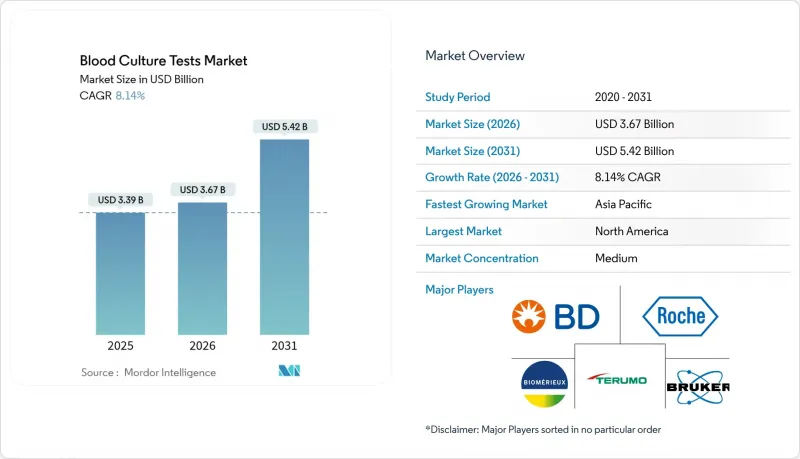
이러한 성장 궤적은 주로 혈류감염증(BSI) 및 패혈증에 대한 임상적 부담의 증가, 신속한 분자진단의 꾸준한 도입, 의료 보험사의 성과 기반 상환으로의 전환에 의해 뒷받침되고 있습니다. 이 분야를 주시하는 경영진은 5년 내 16억 4,000만 달러 규모의 시장 확대가 예상되는 이 시장이 인접한 비즈니스 모델(예: 미생물 수준의 출력을 실시간으로 해석하여 항균제 적정사용 관리 대시보드에 반영하는 데이터 분석 레이어 등)에도 암묵적인 인센티브를 부여하며 기존 장비 벤더를 넘어선 경쟁 영역의 확장을 촉진하고 있음을 알 수 있습니다. 2024년 현재 북미가 38%의 시장 점유율을 차지하고 있지만, 아시아태평양은 2025년부터 2030년까지 8.8%의 더 높은 CAGR로 성장하고 있어 향후 물량 성장이 현재 수익이 집중된 지역과 지리적으로 분리될 수 있음을 시사합니다.
전 세계 모니터링 데이터에 따르면, 중심정맥 카테터 관련 혈류 감염은 여전히 심각한 임상적 문제임이 확인되었습니다. 미국 질병예방통제센터(CDC)의 보고에 따르면, 미국 급성기 병원에서는 연간 약 25만 건의 사례가 발생하고 있습니다. 미국 국립보건원(NIH)의 지원을 받은 2023년 메타분석에 따르면, 미국 내 의료현장에서의 감염으로 인해 연간 170만 건의 패혈증 사례와 약 35만 명의 사망자가 발생하는 것으로 추정됩니다. 이러한 수치는 진단 결과 보고 시간을 단축한 의료기관을 평가하는 지불자 측의 품질 지표에 영향을 미치고 있으며, 이러한 연관성은 신속 배양 보조제의 상업적 매력을 미묘하게 증가시키고 있습니다.
임상 군유전체학 및 매트릭스 지원 레이저 탈이온화 이온화 비행시간형 질량 분석법(MALDI-TOF MS)은 진단의 속도와 폭을 재정의하고 있습니다. 최근 연구에 따르면, 메타유전체 분석 파이프라인은 9-12시간 내에 1-5 CFU/mL의 세균 DNA를 검출할 수 있는 것으로 나타났습니다. 이 수치는 초기 단계의 평가에 근거한 것이지만, 그 전략적 의미는 분명합니다. 검출 감도가 배양 기반 기준값에 수렴하면 실험실은 단일 워크플로우 분자 솔루션을 선호하기 시작하여 소모품에서 소프트웨어로 조정된 분석 도구로 혼합 이동을 일으킬 수 있습니다. 투자자들에게 중요한 점은, 수익 풀이 범용 배양병을 공급하는 기업이 아닌 독자적인 바이오인포매틱스 알고리즘을 소유한 기업으로 옮겨갈 가능성이 있다는 것입니다.
기존의 배양법은 실용적인 결과를 얻기까지 24-72시간이 소요되며, 이러한 시간적 지연으로 인해 임상의는 경험적 광역학 치료를 시작해야 합니다. 예산 관리자의 관점에서 볼 때, 경험적 치료가 지속될 때마다 약제비 증가, 클로스트리디움 디피실 감염의 위험, 그리고 다운스트림 항균제 내성 문제 등 숨겨진 비용이 발생합니다. 이러한 역학은 규제상 익숙한 증식 기반 탐지 방법을 유지하면서 거의 실시간 식별 도구를 통합한 하이브리드 시스템에 높은 가치를 부여합니다. 미묘한 관점에서, 경험적 치료 기간 단축을 보여주는 성능 데이터를 패키지화할 수 있는 제조업체는 항균제 적정 사용의 주요 성과 평가 지표와 가치 제안을 일치시킬 수 있습니다. 이러한 정합성은 기존의 총소유비용 계산 도구에서는 거의 포착하지 못했습니다.
소모품은 2025년 매출의 63.60%를 차지해 '면도날' 경제 모델을 여실히 보여주고 있습니다. 각 장비의 도입은 병, 배지, 검사 패널의 장기적인 구매를 유도하여 높은 가시성을 가진 수익원을 창출합니다. 이 특성은 사모펀드 투자자들이 종종 프리미엄 배수로 평가하는 요소입니다. 이차적인 관점에서, 분자진단법의 보급에 따라 소모품은 물리적 배지에서 동결건조 시약이 내장된 일회용 카트리지로 전환될 가능성이 있습니다. 이에 따라 매출총이익률은 미묘하게 달라지지만, 경영진이 중시하는 연금과 같은 수익 패턴은 유지됩니다.
자동화 검사는 현재 검사량의 70.50%를 차지하고 있으나, 비용 제약 환경에서의 채택 확대로 인해 수동 방식은 연평균 9.92%의 성장이 예상됩니다. 따라서 성공적인 포트폴리오는 자동화 연속체의 양쪽 끝을 포괄하고 고객의 초기 투자를 보호할 수 있는 확장 가능한 업그레이드 경로를 제공하는 것이 중요합니다. 수동 계층을 경시하는 벤더는 예산 확대 시 모듈형 자동화를 교차 판매할 수 있는 경쟁사에게 발판을 내어줄 위험이 있습니다.
북미의 37.60%의 점유율은 탄탄한 상환 제도, 엄격한 감염 관리 의무, 광범위한 자동화 시스템 도입 기반에 기인합니다. CDC의 오염 방지 이니셔티브는 혈액 배양의 정확성을 품질 지표로 설정하여 정책 주도의 장비 업데이트 촉진요인을 효과적으로 창출했습니다. 경영진은 이러한 규제 강화가 결제자 측의 조정에 선행하는 경향이 있다는 점을 염두에 두어야 하며, 이는 거래량과 가격의 추가 상승을 시사합니다.
유럽은 통일된 항균제 적정사용 프레임워크의 혜택을 받고 있지만, 국가별 조달방식의 차이로 인해 도입 속도에 편차가 발생하고 있습니다. 공급업체에게 실질적인 결과로서, 기술 기준이 가격을 능가하는 시장에서는 다기관 평가에서 장비의 견고성을 입증하는 것이 입찰을 결정하는 요인이 될 수 있습니다. 바이오메뤼의 본거지인 프랑스에 현지 생산기지를 두고 있어, 경쟁사 대비 지역적 근접성이 애프터서비스 측면에서 우위를 점할 수 있다는 점을 시사하고 있습니다.
아시아태평양의 예측 CAGR 8.69%는 중국과 인도의 지방 도시(Tier 2, Tier 3)에 큰 미개척 시장이 존재한다는 것을 보여줍니다. 세계보건기구(WHO)의 보고에 따르면, 조사 대상 병원의 병원내 감염 유병률은 8.7%에 육박합니다. 이러한 환경에서 공급이 불안정한 전력망에 대응할 수 있는 소형 자동화 시스템으로 직접 전환하는 의료기관이 많아지고 있으며, 이는 제품의 견고성이 분석 감도와 마찬가지로 결정적인 요인이 될 수 있다는 것을 입증하고 있습니다.
The blood culture tests market was valued at USD 3.39 billion in 2025 and estimated to grow from USD 3.67 billion in 2026 to reach USD 5.42 billion by 2031, at a CAGR of 8.14% during the forecast period (2026-2031).
This trajectory is primarily underpinned by the rising clinical burden of bloodstream infections (BSIs) and sepsis, the steady introduction of rapid molecular diagnostics, and the shift by healthcare payers toward outcome-based reimbursement. Executives monitoring this space will appreciate that a market capable of expanding USD 1.64 billion in five years is also implicitly incentivising adjacent business models-such as data-analytics layers that interpret organism-level outputs in real time and feed them into antimicrobial stewardship dashboards-thereby broadening the competitive arena beyond traditional instrument vendors. North America currently commands a 38 % market share in 2024, while Asia-Pacific is on a faster 8.8 % CAGR path between 2025 and 2030, evidence that future volume growth may be geographically decoupled from present revenue concentration.
Global surveillance confirms that central line-associated bloodstream infections remain a persistent clinical challenge: the Centers for Disease Control and Prevention reports roughly 250 000 events each year in U.S. acute-care hospitals. A 2023 meta-analysis funded by the National Institutes of Health attributes 1.7 million annual sepsis cases and nearly 350 000 deaths to infection progression across U.S. care settings. These numbers are shaping payer quality metrics that reward institutions for shaving hours off diagnostic turnaround, a linkage that subtly heightens the commercial appeal of rapid culture adjuncts.
Clinical metagenomics and matrix-assisted laser desorption ionization time-of-flight mass spectrometry (MALDI-TOF MS) are redefining diagnostic speed and breadth. Recent studies show that metagenomic pipelines can detect bacterial DNA at 1-5 CFU/mL within 9-12 hours. Though these figures derive from early-stage evaluations, their strategic meaning is clear: once detection sensitivity converges on culture-based baselines, laboratories may begin favouring single-workflow molecular solutions, triggering a mix-shift from consumables to software-orchestrated analytics. The investor takeaway is that profit pools may migrate toward companies owning proprietary bioinformatics algorithms rather than those supplying commodity culture bottles.
Conventional culture methods require 24-72 hours for actionable results, and that lag compels clinicians to initiate empiric broad-spectrum therapy. From a budget-holder perspective, every hour of empiric coverage carries a hidden cost: higher drug spend, risk of Clostridioides difficile infection, and downstream antimicrobial resistance. This dynamic sets a premium on hybrid systems that preserve the regulatory familiarity of growth-based detection while embedding near-real-time identification tools. A nuanced angle is that manufacturers able to package performance data showing reduced empiric-therapy windows can align their value proposition with antimicrobial stewardship key performance indicators-an alignment scarcely captured in conventional total-cost-of-ownership calculators.
Other drivers and restraints analyzed in the detailed report include:
For complete list of drivers and restraints, kindly check the Table Of Contents.
Consumables represent 63.60% of 2025 revenue, illustrating the razor-blade economic model. Each instrument placement seeds years of bottle, media, and panel purchases, producing high-visibility revenue streams that private-equity sponsors often value at premium multiples. A second-order consideration is that as molecular methods scale, consumables may transition from physical media to single-use cartridges embedding lyophilized reagents, subtly shifting gross-margin profiles while retaining the annuity-like pattern executives prize.
Automated testing accounts for 70.50% of current volume, yet manual methods are projected to advance at a 9.92% CAGR due to uptake in cost-constrained environments. The implication is that winning portfolios will likely straddle both ends of the automation continuum, offering a scalable upgrade path that protects clients' initial investments. Vendors neglecting the manual tier risk conceding a foothold to rivals that can later cross-sell modular automation when budgets expand.
The Blood Culture Tests Market Report Segments the Industry Into by Product (Instruments, Consumables, and More), by Type (Manual Blood Culture Testing, Automated Blood Culture Testing), by Technology (Culture-Based, and More), by Culture Type (Bacterial, Fungal, and More), by End User (Hospital Laboratories, Diagnostic Laboratories, and More), and Geography. The Market Sizes and Forecasts are Provided in Terms of Value (USD).
North America's 37.60% share stems from robust reimbursement structures, stringent infection-control mandates, and large installed bases of automated systems. The CDC's contamination-prevention initiatives have positioned blood culture accuracy as a quality metric, effectively creating a policy-driven catalyst for instrument upgrades. Executives should note that such regulatory nudges often precede payer adjustments, implying further volume and pricing uplift.
Europe benefits from unified antimicrobial stewardship frameworks, but procurement heterogeneity across countries yields divergent adoption speeds. A practical corollary for suppliers is that demonstrating instrument robustness in multi-center evaluations can tip tenders in markets where technical criteria outweigh price. France, being home to bioMerieux, enjoys a local manufacturing hub, reminding competitors that regional proximity can translate into after-sales service advantages.
Asia-Pacific's forecast 8.69% CAGR reveals substantial white-space opportunity across tier-two and tier-three cities in China and India. The World Health Organization reports nosocomial infection prevalence approaching 8.7% in surveyed hospitals. Providers in these settings often leapfrog directly to compact automated systems compatible with fluctuating power supply, underscoring that product ruggedness can be as decisive as analytic sensitivity.