



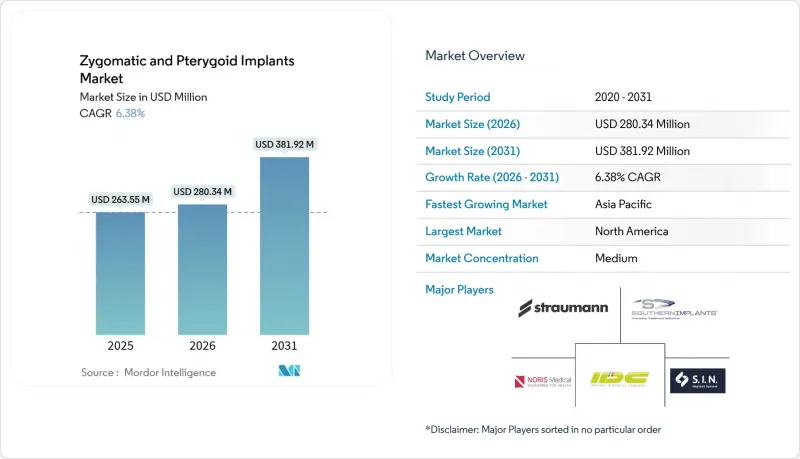
광대골 및 익상골 임플란트 시장은 2025년 2억 6,355만 달러에서 2026년에는 2억 8,034만 달러에 이르고, 2026-2031년 CAGR 6.38%로 성장을 지속하여 2031년까지 3억 8,192만 달러에 달할 것으로 예측됩니다.

외과 의사의 지속적인 수용성, 환자의 조기 회복, 뼈 이식 수술을 피할 수 있다는 점에서 광대골 및 익상골 임플란트 시장은 복잡한 상악 재건에서 우선적인 선택으로 자리매김하고 있습니다. 즉각적인 부하가 수요의 대부분을 차지하고, 디지털 워크플로우가 임플란트 정확도를 향상시키며, 2024년 10월 FDA 지침에 따른 규제 명확화로 인해 신제품 승인이 가속화되고 있습니다. 경쟁 환경에서는 장기적인 임상적 증거와 AI 기반 탐색 도구, 그리고 풍부한 교육 네트워크를 결합한 공급업체가 우위를 점할 수 있습니다. 신흥 재생의료 기술 및 지속적인 비용 장벽은 성장을 억제하는 요인으로, 자이그매틱 및 페트리고이드 임플란트 시장의 장기적인 성장 궤도에 악영향을 미치지 않을 것으로 보입니다.
심한 상악골 흡수는 기존의 이식 의존적 프로토콜이 많은 노인 환자에서 불충분하기 때문에 특수 임플란트에 대한 수요가 지속적으로 증가하고 있습니다. 임상 추적조사에 따르면, 위축된 상악 후방에서 날개돌기 임플란트 성공률은 90.7%에 달하며, 이는 시누스 리프트에 따른 합병증 위험을 제거하고 치료 시간을 단축할 수 있습니다. 인구 고령화로 무치악 환자 증가가 가속화되고 있는 가운데, 콘빔 CT 연구 결과, 검사 대상 120명 중 116명의 위축된 치조궁에서 가상 날개돌기 임플란트 식립이 가능함을 확인하여 폭넓은 해부학적 적응성을 입증하였습니다. 디지털 플래닝은 각도와 깊이 매핑을 통해 해부학적 타당성을 보완하고, 수술 중 추측을 줄이고, 광대골 및 익상골 임플란트 시장에서 1차적 안정성을 향상시킬 수 있습니다. 외과의사는 치유 과정의 혼란을 최소화하기 위해 이식재가 필요 없는 접근법을 중시하고, 환자는 치료 주기가 단축되는 것을 높이 평가하기 때문에 이러한 복잡한 임플란트의 지속적인 채택이 촉진되고 있습니다.
65세 이상 인구 비율이 증가함에 따라 보철치료에 대한 기대가 최소침습적 치료로 옮겨가고 있습니다. 초고령자를 위해 설계된 임플란트 치료는 이식 부위에서 뼈를 채취하지 않기 때문에 전신적 위험을 감소시킨다는 증거가 있습니다. 광대뼈 임플란트는 상악동 거상술에 따른 합병증 위험을 피할 수 있어 치유 기능이 저하된 고령 환자층에게 임상적으로 매력적인 선택이 될 수 있습니다. 디지털 워크플로는 24시간 이내에 수복물 장착을 가능하게 하여 예측 가능성을 더욱 높여줍니다. 이는 당일에 씹는 기능과 말하기 기능을 회복시키는 즉각적인 프로토콜에 의해 입증되었습니다. 이러한 인구 통계학적 변화로 인해 광대뼈 및 날개뼈 임플란트 시장은 노인 케어의 확대 경로와 보조를 맞출 수 있을 것으로 보입니다.
풀 아치 수복 비용은 6만-9만 달러에 달하고, 많은 환자들이 치료를 망설이는 장벽이 되고 있습니다. 미국 연방 보험 프로그램은 임플란트 혜택을 적용하지 않으며, 메디케어 어드밴티지 플랜의 일부만 연간 최대 1,500달러의 낮은 금액으로 부분적인 환급을 제공합니다. 민간 보험사는 '결손 치아'에 대한 제외 조항을 두고 있어, 환자들은 할부 플랜이나 회원제 할인 네트워크를 통해 자부담으로 자금을 조달해야 하는 상황입니다. 1인당 평균 소득이 낮은 신흥국에서는 높은 본인 부담금이 보급의 걸림돌로 작용하고 있으며, 임상적 우위에도 불구하고 자이그마틱 및 페트리고이드 임플란트의 세계 성장을 저해하는 요인으로 작용하고 있습니다.
광대뼈 임플란트는 NobelZygoma와 같은 시스템에서 96.1%의 10년 생존율을 확인한 수십 년간의 종단적 증거를 바탕으로 2025년 사이고매틱 및 페트리고이드 임플란트 시장 규모의 71.85%를 차지할 것으로 예측됩니다. 이러한 장점은 외과 의사의 숙련도와 수술 시간을 단축하는 종합적인 기구 세트에 의해 더욱 강화됩니다. 그러나 익상편 임플란트는 부비동 해부를 피하고 익상편 부위의 피질골 고정을 가능하게 하는 특성으로 인해 2031년까지 8.39%의 연평균 복합 성장률(CAGR)을 보일 것으로 예측됩니다. 'VIV 컨셉'은 전방 3개와 날개돌기 2개 임플란트를 결합하여 캔틸레버 힘을 감소시키고 응력 분산을 확대하여 심한 골흡수 환자를 치료하는 임상의에게 선호되고 있습니다.
디지털 플래닝 툴은 임플란트의 궤적과 길이를 시뮬레이션하여 안전 마진을 개선하고 해부학적 제약을 시각화하는 데 도움을 줍니다. 연구에 따르면, 평균 7.1mm의 골접합이 날개돌기 접합부를 넘어서는 것으로 확인되었으며, 이 매개변수는 우수한 1차적 안정성을 예측합니다. 이러한 특성이 결합되어 광대골 및 익상골 임플란트 시장을 강화하고 있으며, 두 가지 유형의 임플란트가 서로를 보완하고 치료 가능한 환자층을 확대하고 있습니다.
2025년에는 30-50mm 임플란트가 광대골 및 익상골 임플란트 시장의 46.10%를 차지할 것으로 예측됩니다. 이는 일반적인 상악골 흡수 케이스에 적합하고 시중에서 판매되는 드릴 키트와 호환되기 때문입니다. 50mm 이상 길이의 임플란트는 8.53%의 연평균 복합 성장률(CAGR)로 성장하고 있습니다. 이는 치밀한 협측골 피질이나 날개판에 고정되어 토크 값을 증가시켜 극한의 경우에도 즉각적인 가철물 장착이 가능하기 때문입니다. 길이를 연장함으로써 원위 보철 유닛에 대한 캔틸레버 응력을 더욱 감소시켜 장기적인 안정성을 향상시킬 수 있습니다.
산성 에칭이나 UV 활성화와 같은 표면 개질은 골아세포의 활성을 자극하고, 즉각적인 하중에 필수적인 골유착 속도를 향상시킵니다. 한편, 30mm 미만의 임플란트는 경증에서 중등도의 위축에 초점을 맞추고 있지만, 임상의가 더 다재다능한 중간 길이를 선호하기 때문에 그 채택이 여전히 지연되고 있습니다. 그 결과, 광대골 및 익상골 임플란트 시장에서는 다양한 해부학적 상황에 대응하는 균형 잡힌 제품 포트폴리오가 형성되어 있습니다.
북미는 2025년 기준 41.95%의 시장 점유율을 유지했습니다. 이는 예측 가능한 치료 결과를 원하는 환자들의 요구에 부응하기 위해 고도의 시술과 교육을 강화한 결과입니다. AI 내비게이션의 도입과 2024년 10월 FDA 지침에 대한 엄격한 준수가 임상의들의 신뢰를 뒷받침하고 있지만, 스트라우만은 임플란트 보급률이 성숙 단계에 접어들면서 매출 성장이 둔화되고 있다고 보고하고 있습니다. 현재 성장의 중심은 평균 판매 가격이 높은 복잡한 재건 수술로 이동하고 있으며, 이는 광대골 및 익상골 임플란트 시장이 이 지역에서 가치 주도권을 유지할 수 있도록 보장합니다.
아시아태평양은 적극적인 의료 투자, 의료관광 활성화, 기술 보급에 힘입어 7.43%의 연평균 복합 성장률(CAGR)로 가장 높은 성장세를 보이고 있습니다. 스트라우만은 2024년 1분기 중국 수요 회복과 동남아시아 클리닉의 비용 효율적인 첨단 치료 프로세스 추진으로 82%의 유기적 매출 성장을 기록했습니다. 수입 승인 속도를 높이는 규제 개혁은 제조업체들이 자이그매틱 및 페트리고이드 임플란트 시스템을 APAC 지역에 우선적으로 배치하는 데 더욱 힘을 실어주고 있습니다.
유럽에서는 ITI 유럽 캠퍼스 등 탄탄한 교육 체계와 시장 진입을 용이하게 하는 CE 마킹의 조화 등을 통해 안정적인 한 자릿수 중반의 성장세를 유지하고 있습니다. 임상의들은 잘 정비된 보험제도를 활용하고 있지만, 일부 국가의 비용 억제 정책으로 인해 환자들이 인근 저비용 지역으로 이동하는 경향도 보입니다. 라틴아메리카와 중동 및 아프리카은 아직 미성숙한 시장이지만, 인식이 높아지고 단계적인 인프라 구축이 진행되면서 자이그마틱 및 페트리고이드 임플란트 시장에 대한 기회가 점차 확대되고 있습니다.
The zygomatic & pterygoid implants market is expected to grow from USD 263.55 million in 2025 to USD 280.34 million in 2026 and is forecast to reach USD 381.92 million by 2031 at 6.38% CAGR over 2026-2031.
Sustained acceptance among surgeons, faster patient rehabilitation, and the ability to avoid bone-grafting procedures position the Zygomatic & Pterygoid Implants market as the preferred option for complex maxillary reconstruction. Immediate loading dominates demand, digital workflows improve placement accuracy, and regulatory clarity from the October 2024 FDA guidance accelerates new product clearances. Competitive dynamics favor suppliers that combine long-term clinical evidence with AI-enabled navigation tools and robust training networks. Emerging regenerative therapies and persistent cost barriers moderate expansion yet do not offset the favorable long-term trajectory of the Zygomatic & Pterygoid Implants market.
Severe maxillary bone loss continues to stimulate demand for specialized implants because conventional graft-dependent protocols prove inadequate in many elderly cases. Clinical follow-ups indicate 90.7% success for pterygoid fixtures in atrophic posterior maxillae, which eliminates sinus-lift morbidity and shortens chair time. Population aging intensifies the prevalence of edentulism, and cone-beam studies show that 116 of 120 examined atrophic arches can accommodate virtual pterygoid placement, validating broad anatomical applicability. Digital planning complements anatomical feasibility by mapping angulation and depth, thereby reducing intraoperative guesswork and enhancing primary stability for the Zygomatic & Pterygoid Implants market. Surgeons emphasize graftless approaches to minimize healing disruptions, and patients appreciate shorter treatment cycles, reinforcing sustained uptake of these complex fixtures.
The share of individuals above 65 years is rising, and their prosthetic expectations evolve toward minimally invasive therapy. Evidence shows implant therapies designed for ultra-aged profiles reduce systemic risk because they avoid donor-site graft harvesting. Zygomatic constructs sidestep the morbidity linked with sinus augmentation, making them clinically attractive for elderly cohorts with compromised healing. Digital workflows further enhance predictability by enabling restorative loading within 24 hours, as validated by immediate protocols that restore mastication and speech on the same day. These demographic shifts ensure that the Zygomatic & Pterygoid Implants market remains aligned with expanding geriatric care pathways.
Full-arch rehabilitation costs range from USD 60,000 to USD 90,000, a barrier that deters many candidates from seeking care. U.S. federal insurance programs exclude implant benefits, and only a subset of Medicare Advantage plans provide partial reimbursement with annual caps as low as USD 1,500. Private carriers impose "missing-tooth" exclusions, obligating patients to self-finance via payment plans or membership-based discount networks. Out-of-pocket liabilities slow uptake in emerging economies where average per-capita income is lower, thereby restraining global growth for the Zygomatic & Pterygoid Implants market despite clinical advantages.
Other drivers and restraints analyzed in the detailed report include:
For complete list of drivers and restraints, kindly check the Table Of Contents.
Zygomatic fixtures delivered 71.85% of the 2025 Zygomatic & Pterygoid Implants market size following decades of longitudinal evidence that confirms 96.1% ten-year survival for systems such as NobelZygoma. This dominance is reinforced by surgeon familiarity and comprehensive instrumentation sets that shorten operating time. Nonetheless, pterygoid devices post an 8.39% CAGR to 2031, reflecting their ability to bypass sinus anatomy and secure cortical bone in the pterygoid process. The "VIV" concept, which combines three anterior with two pterygoid implants, reduces cantilever forces and widens stress distribution, thus appealing to clinicians treating extreme atrophy.
Digital planning tools simulate implant trajectory and length, improving safety margins and helping practitioners visualize anatomical constraints. Studies reveal 7.1 mm average bone engagement beyond the pterygoid junction, a parameter that predicts superior primary stability. Together, these attributes strengthen the Zygomatic & Pterygoid Implants market, where both implant types complement each other to broaden the treatable patient population.
Implants measuring 30-50 mm held 46.10% Zygomatic & Pterygoid Implants market share during 2025 because they suit common maxillary atrophy scenarios and fit within commercially available drill kits. Devices exceeding 50 mm length accelerate at an 8.53% CAGR because they anchor into dense zygomatic cortex or pterygoid plates, increasing torque values and allowing immediate provisionalization in extreme cases. Extended lengths further decrease cantilever stress on distal prosthetic units, thereby boosting long-term stability.
Surface modifications, including acid etching and UV activation, stimulate osteoblast activity and improve osseointegration speed, which is critical for immediate loading. Conversely, implants shorter than 30 mm focus on mild to moderate atrophy, but their adoption remains slower as clinicians gravitate toward more versatile intermediate lengths. The result is a balanced portfolio within the Zygomatic & Pterygoid Implants market that caters to varying anatomical presentations.
The Zygomatic & Pterygoid Implants Market Report is Segmented by Implant Type (Zygomatic Implants, and More), Product Length (Up To 30 Mm, and More), Procedure Type (Immediate Loading, and More), End User (Hospitals, and More), Application (Maxillary Sinus Reconstruction, and More), and Geography (North America, Europe, Asia-Pacific, Middle East & Africa, South America). The Market Forecasts are Provided in Terms of Value (USD).
North America retained 41.95% market share in 2025 as premium procedures and training intensity aligned to patient demand for predictable outcomes. Adoption of AI navigation and strict adherence to the October 2024 FDA guidance sustain clinician confidence, although Straumann reported soft implantology sales as penetration levels approach maturity. Growth now centers on complex reconstructions that carry higher average selling prices, ensuring the Zygomatic & Pterygoid Implants market maintains value leadership within the region.
Asia-Pacific posts the highest trajectory at a 7.43% CAGR, buoyed by aggressive health-care investments, medical-tourism incentives, and technological diffusion. Straumann logged 82% organic sales growth in Q1 2024 as Chinese demand recovered and Southeast Asian clinics promoted cost-effective yet sophisticated care pathways. Regulatory reforms that expedite import approvals further encourage manufacturers to prioritize APAC rollouts of zygomatic and pterygoid systems.
Europe delivers steady mid-single-digit growth supported by robust training frameworks such as ITI's European Campus and harmonized CE marking that streamlines market entry. Clinicians leverage well-developed insurance schemes, although cost containment measures in certain countries nudge some patients toward neighboring lower-cost destinations. Latin America and the Middle East & Africa remain nascent markets but display increasing awareness and incremental infrastructure upgrades that unlock gradual opportunities for the Zygomatic & Pterygoid Implants market.