



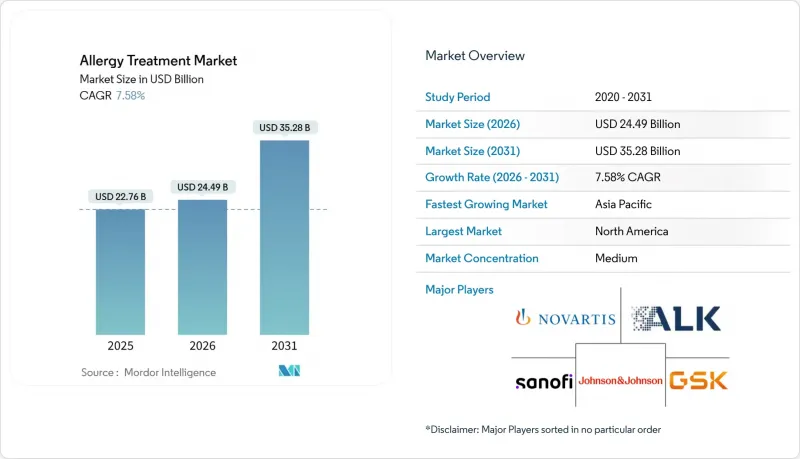
알레르기 치료 시장은 2025년에 227억 6,000만 달러로 평가되었으며, 2026년 244억 9,000만 달러에서 2031년까지 352억 4,000만 달러에 달할 것으로 예측됩니다.
예측 기간(2026-2031년) 동안 CAGR은 7.58%로 예상됩니다.
질병 유병률의 가속화, 기후 변화로 인한 알레르겐의 증폭, 획기적인 생물학적 제제들이 결합하여 수요를 증가시키고 있으며, 새로운 디지털 헬스 모델이 접근성과 치료 순응도를 높이고 있습니다. 오말리주맙이 최초의 다중 식품 적응증을 획득한 이후 경쟁은 더욱 치열해지고 있으며, 대형 제약회사와 민첩한 생명공학 스타트업이 직접 경쟁에 뛰어들었습니다. 바이오시밀러 대체를 촉진하는 규제 조치는 가격 압력으로 작용하는 한편, 전달 기술, 면역 치료의 개인화, 환자 중심 치료의 혁신을 동시에 자극하고 있습니다. 지역 간 격차는 여전히 뚜렷합니다: 북미가 생물학적 제제 지출의 주도권을 유지하는 반면, 아시아태평양은 도시화가 진행됨에 따라 감작 수준이 높아져 면역요법 도입이 가장 빠르게 진행되고 있습니다.
도시 대기오염의 급격한 증가는 산화 스트레스를 촉진하고 면역반응을 TH2형으로 전환시킵니다. 이에 따라 알레르기 치료 시장에서 처방용 항히스타민제, 류코트리엔 길항제, 생물학적 제제에 대한 수요가 꾸준히 증가하고 있습니다. 베이징에서 델리에 이르는 대도시 지역에서는 감작률이 50%를 초과하는 것으로 보고되고 있으며, 미국 내 연간 비용 부담은 이미 34억 달러를 넘어섰습니다. 비염은 전 세계 성인의 최대 30%, 소아의 40%가 앓고 있는 질환으로 가장 큰 환자층과 안정적인 수익 기반을 형성하고 있습니다.
내약성이 개선된 2세대 항히스타민제 및 비강내 코르티코스테로이드가 처방약에서 OTC 의약품으로 전환되면서 소비자의 접근성이 확대되고, 알레르기 치료 시장 전체 거래량이 증가하고 있습니다. 소매점 진열대에 눈에 잘 띄는 진열과 디지털 증상 진단 도구의 연계로 경증 환자들은 자가 관리 및 충혈 제거제 혼합 약물을 선택하는 경향이 증가하고 있습니다. 특히 북미와 서유럽에서는 지역 약국에서의 짧은 진단 대기 시간이 이러한 추세를 더욱 부추기고 있습니다.
오말리주맙과 우스테키누맙의 바이오시밀러의 등장으로 단가가 최대 40%까지 하락하면서 알레르기 치료제 시장에서 오리지널 의약품의 매출 성장을 압박하고 있습니다. 유럽의 입찰제도가 보급을 가속화하는 한편, 신흥 경제국에서는 비용절감이 생물학적 제제에 대한 접근 수단으로 받아들여지고 있습니다. 선발업체들은 프리미엄 가격 책정을 정당화하기 위해 기기 업그레이드와 실제 데이터에 기반한 근거 자료로 대응하고 있습니다.
2025년 비염은 알레르기 치료 시장 점유율의 41.08%를 차지했습니다. 이는 전 세계적으로 높은 유병률과 다각적인 치료 툴킷을 배경으로 하고 있습니다. 치료의 주축은 시판되는 항히스타민제, 경구용 코르티코스테로이드, 설하 면역요법(SLIT) 정제가 있으며, 중증 다감작 환자군에서는 생물학적 제제의 채택이 증가하고 있습니다. 계절성 및 통년성 모두 처방 기반을 폭넓게 지원하며, 신흥 치료군에 관계없이 기반 수요를 보장합니다.
식품 알레르기는 2031년까지 CAGR 9.22%로 가장 빠르게 성장하는 분야로, 최초의 질병 변형 생물학적 제제 승인과 다양한 경구용 면역치료제 조합 파이프라인의 혜택을 받고 있습니다. 성인 발병 알레르기에 대한 역학적 인식 확대로 적응증 환자군이 확대되고, 학교 내 아나필락시스 대응 프로토콜로 인해 예방적 처방이 증가하고 있습니다. 안과, 피부, 천식, 기타 틈새 알레르기 분야가 부문 구성을 보완하고 있으며, 각 분야는 진단 정확도 향상과 생물학적 제제의 적응증 확대에 따라 처방량이 증가하고 있습니다.
항알레르기 약물은 유리한 상환 제도, OTC(일반의약품)의 보급, 성숙한 제네릭 의약품에 힘입어 2025년 알레르기 치료 시장 점유율 64.89%를 유지할 것으로 예상됩니다. 2세대 항히스타민제, 외용 코르티코스테로이드, 류코트리엔 억제제는 새로운 카테고리의 가격 변동을 완화하는 안정적인 수익원을 형성하고 있습니다.
면역요법은 2031년까지 연평균 10.12%로 성장할 것으로 예상되며, 이는 지불자의 장기적인 비용 효과에 대한 인식과 재택 설하 면역요법(SLIT) 요법에 대한 환자 선호도 증가를 반영하고 있습니다. 임상 가이드라인을 통해 용량과 치료 기간이 표준화되어 편차를 최소화하고 임상의의 신뢰도를 높이고 있습니다. 고위험군 환자에서 효과를 극대화하기 위해서는 피하투여 프로토콜이 여전히 표준이지만, 복잡한 다감작 사례에 대해서는 생물학적 제제와 SLIT의 병용 전략이 등장하여 알레르기 치료 시장의 규모를 확대하고 있습니다.
북미가 2025년 알레르기 치료 시장에서 37.84%의 점유율을 차지할 것으로 예상되는 배경에는 광범위한 보험 적용 범위, 바이오 제제의 조기 도입, 전문의 네트워크의 집중화 등이 있습니다. 미국은 규제 측면에서 선구적인 노력을 주도하고 있으며, 이는 다른 지역으로 확산되어 국내 제조사들이 조기에 수익을 창출하고 라이프사이클 우위를 지속할 수 있도록 돕고 있습니다. 바이오시밀러의 침투율은 대체에 대한 주저와 REMS(위험 평가 및 완화 전략)의 제약으로 인해 여전히 완만하게 유지되고 있으며, 신약개발 기업 입장에서는 가격 유지를 위해 노력하고 있습니다.
아시아태평양은 도시화에 따른 감수성 증가, 가처분 소득 증가, 특정 면역요법을 보장하는 공공 의료 보험의 확대 등으로 인해 2031년까지 9.31%의 CAGR을 기록해 다른 모든 지역보다 높은 성장률을 기록할 것으로 예상됩니다. 아토피 환자군의 집먼지진드기 감작률이 90%를 넘어 지역 맞춤형 알레르겐 추출물의 수요를 견인하고 있으며, ALK-Abbello와 Abbott의 제휴 등 공동 유통 계약을 추진하고 있습니다. 모바일 퍼스트 헬스케어의 도입으로 대도시 지역의 SLIT 원격의료가 가속화되고 치료 범위가 확대되고 있습니다.
유럽에서는 보급이 성숙해졌지만, 바이오시밀러에 유리한 입찰제도로 인해 가격 압박에 직면해 있습니다. 이 지역은 면역요법 품질 및 의약품 안전성 모니터링의 표준화를 주도하고 있으며, 지속적이긴 하지만 억제적인 매출 성장에 기여하고 있습니다. 중동, 아프리카 및 남미에서는 전문 의료 인프라가 점차 개선되고 있으며, 새로운 기회가 창출되고 있습니다. 그러나 경제 및 공급망의 불안정성으로 인해 단기적으로는 그 기세가 억제되고 있습니다.
The Allergy treatment market was valued at USD 22.76 billion in 2025 and estimated to grow from USD 24.49 billion in 2026 to reach USD 35.24 billion by 2031, at a CAGR of 7.58% during the forecast period (2026-2031).
Accelerated disease prevalence, climate-driven allergen amplification, and breakthrough biologics are collectively lifting demand, while new digital-health models broaden access and adherence. Competitive intensity has sharpened since omalizumab won the first multi-food indication, drawing both large pharmaceutical firms and nimble biotech entrants into direct rivalry. Regulatory initiatives that speed biosimilar substitution add price pressure yet simultaneously stimulate innovation in delivery technology, immunotherapy personalization, and patient-centric care. Geographic divergence remains pronounced: North America sustains spending leadership on biologics, whereas Asia-Pacific records the fastest uptake of immunotherapy as urbanization deepens sensitization levels.
Surging urban air pollution fuels oxidative stress that flips immune responses toward a TH2 profile, anchoring demand for prescription antihistamines, leukotriene antagonists, and biologics in the Allergy treatment market. Megacities from Beijing to Delhi report sensitization rates exceeding 50%, while cost burdens in the United States already surpass USD 3.4 billion annually. The global scope of rhinitis, affecting up to 30% of adults and 40% of children, makes it the single largest patient pool and a reliable revenue base.
Better tolerated second-generation antihistamines and intranasal corticosteroids have migrated from prescription to OTC status, widening consumer reach and lifting overall transaction volumes in the Allergy treatment market. Retail shelf prominence aligns with digital symptom checkers, steering mild sufferers toward self-directed care and decongestant combinations. Short diagnostic wait times in community pharmacies further cement this behavior, especially across North America and Western Europe.
Interchangeable omalizumab and a wave of ustekinumab biosimilars cut unit prices by up to 40%, compressing top-line growth for originators within the Allergy treatment market. Europe's tender systems hasten penetration, while emerging economies embrace cost-relief as gateways to biologic access. Originators respond with device upgrades and real-world-evidence dossiers to justify premium positioning.
Other drivers and restraints analyzed in the detailed report include:
For complete list of drivers and restraints, kindly check the Table Of Contents.
Rhinitis contributed 41.08% to the Allergy treatment market share in 2025, capitalizing on its high global prevalence and multi-modal therapy toolkit. Over-the-counter antihistamines, intranasal corticosteroids, and SLIT tablets form the therapeutic spine, while biologics gain traction in severe poly-sensitized cohorts. Seasonal and perennial variants jointly sustain an expansive prescription base, guaranteeing baseline demand regardless of emergent treatment classes.
Food allergy, the fastest-growing segment at 9.22% CAGR to 2031, benefits from the first disease-modifying biologic clearance and a broad pipeline of oral immunotherapy combinations. Epidemiological recognition of adult-onset allergy enlarges eligibility pools, and school-based anaphylaxis protocols amplify prophylactic prescriptions. Eye, skin, asthma, and other niche allergies round out the segment landscape, each adding volume through fortified diagnostic vigilance and cross-indication biologic use.
Anti-allergy drugs maintained 64.89% of the Allergy treatment market share in 2025, bolstered by favorable reimbursement, OTC prominence, and maturing generics. Second-generation antihistamines, topical corticosteroids, and leukotriene blockers together form a stable revenue stream that cushions price swings in novel categories.
Immunotherapy is slated for a 10.12% CAGR through 2031, reflecting payer recognition of long-term cost efficiency and rising patient preference for home-based SLIT regimens. Clinical guidelines standardize dosing and duration, minimizing variability and elevating clinician confidence. Subcutaneous protocols remain the gold standard for maximized efficacy in high-risk patients, while combination biologic-SLIT strategies emerge for complex multi-sensitizations, strengthening the Allergy treatment market size proposition.
The Allergy Treatment Market Report is Segmented by Allergy Type (Eye Allergy, Rhinitis, Asthma, Skin Allergy, Food Allergy, and More), Treatment (Anti-Allergy Drugs and Immunotherapy), Dosage Form (Tablets & Capsules, Nasal Sprays, and More), Distribution Channel (Hospital Pharmacies, Online Pharmacies, and More), and Geography (North America, Europe, and More). The Market Forecasts are Provided in Terms of Value (USD).
North America's 37.84% Allergy treatment market share in 2025 stems from extensive insurance coverage, early biologic adoption, and concentrated specialist networks. The United States spearheads regulatory firsts that propagate to other regions, positioning domestic manufacturers for early revenues and prolonging lifecycle advantages. Biosimilar penetration remains moderate given substitution hesitancy and REMS constraints, preserving price integrity for innovators.
Asia-Pacific's 9.31% CAGR through 2031 outpaces all other regions, driven by urbanization-linked sensitization surges, rising disposable incomes, and expanded public-health insurance that covers select immunotherapies. House-dust-mite sensitization exceeds 90% in atopic cohorts, steering demand for region-matched allergen extracts and fueling collaborative distribution deals such as ALK-Abbello's tie-up with Abbott. Mobile-first healthcare adoption accelerates SLIT tele-care in metropolitan clusters, broadening therapy reach.
Europe shows mature penetration but faces price compression under biosimilar-friendly tender frameworks. The region leads standardization of immunotherapy quality and pharmacovigilance, contributing to sustainable but restrained revenue growth. Middle East & Africa and South America present emergent opportunities with gradually improving specialty-care infrastructure, though economic and supply-chain volatility temper near-term traction.