



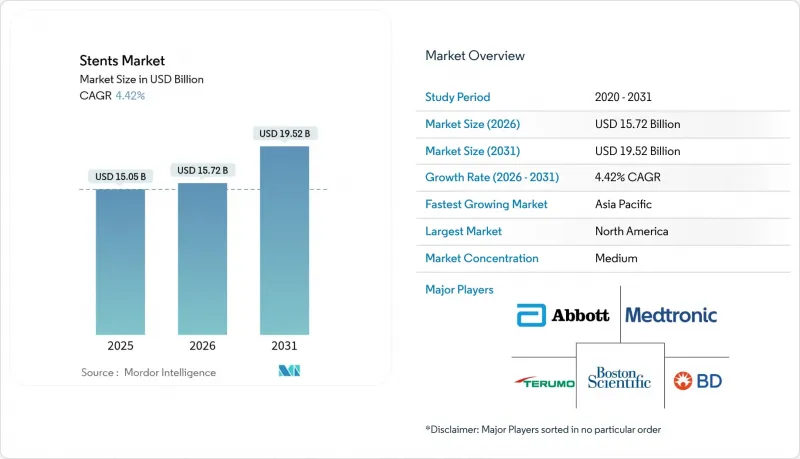
2026년 스텐트 시장 규모는 157억 2,000만 달러로 추정되며, 2025년 150억 5,000만 달러에서 계속 성장하고 있습니다.
2031년에는 195억 2,000만 달러에 달할 전망이며, 2026-2031년에 CAGR 4.42%로 확대할 전망입니다.
관상동맥질환의 지속적인 수술 건수 증가, 저침습적 말초혈관 중재시술의 보급 확대, 그리고 꾸준한 제품 출시로 매출 상승세를 유지하고 있습니다. 주요 제조업체 간의 통합으로 세계 진출과 유통 효율성이 향상되는 한편, 의료 시스템의 외래 진료로의 전환이 조달 동향을 재구성하고 있습니다. 조기 퇴원 및 포괄수가제에 대한 정책적 지원으로 입원 기간을 단축하는 의료기기의 구매가 가속화되고 병원과 외래수술센터(ASC)는 스텐트 재고를 갱신하고 있습니다. 이와 함께 혈관 크기 측정 및 실시간 의사결정 지원을 위한 인공지능 툴은 스텐트 삽입 정확도를 높이고 고비용 합병증을 감소시켜 스텐트 시장의 장기적인 수요를 강화시키고 있습니다.
말초동맥질환은 전 세계에서 약 2억-2억 5,000만 명이 앓고 있는 것으로 추산되며, 지역에 따라 발병률에 큰 차이가 있습니다. 북미는 5.6%, 중앙아시아 남부는 14.5%로 차이가 있습니다. 인구 고령화와 말초질환 위험의 45.6%와 35.1%를 차지하는 흡연율과 고혈압의 지속적 증가로 인해 혈관중재술의 적응증 환자층이 크게 유지되고 있습니다. 신흥 국가의 진단 기술 향상과 인지도가 높아짐에 따라 관상동맥 스텐트와 말초 스텐트 모두에 대한 수요가 증가하고 있으며, 질병 유병률은 스텐트 시장의 장기적인 성장을 가속하는 주요 요인으로 작용할 것으로 보입니다.
경요골동맥 접근법의 채택률은 최근 연구 기간 중 15.9%에서 69.1%로 증가하여 출혈 발생을 감소시키고 당일 퇴원 프로토콜을 실현할 수 있게 되었습니다. 미국심장학회는 2025년 말초혈관 중재시술에서 경요골 접근법을 권장하며 임상 적용 범위를 확대했습니다. PCI를 청구하는 외래 수술센터는 2019년 30개소에서 2023년 65개소로 증가하여 입원 환경에서 수술이 전환되고 있음을 알 수 있습니다. 이러한 추세는 외래 환자들의 의료기기 수요를 가속화하고, 스텐트 시장의 가치 기반 의료 구상을 강화하는 데 기여하고 있습니다.
FDA가 품질 시스템 규제 개정안을 ISO 13485와 일치시키는 한편, 유럽에서는 의료기기 규제가 시행되면서 제조업체들은 서로 다른 규제 경로를 조정해야 하고, 시장 출시 시간을 연장하고 있습니다. 신흥 국가에서는 추가적인 임상적 증거 요구사항이 도입되고, 기업은 출시 시기를 늦춰야 하며, 컴플라이언스 비용이 증가하고 있습니다. 강력한 규제팀을 보유한 기존 대기업은 지연을 흡수할 수 있지만, 중소 혁신기업은 장벽에 부딪혀 스텐트 시장 진입이 늦어질 수 있습니다.
다발성 질환의 수술 건수 증가를 배경으로 관상동맥 스텐트는 2025년 스텐트 시장 점유율의 54.60%를 차지할 것으로 예측됩니다. 초미세 스트럿과 생분해성 폴리머를 특징으로 하는 약제용출형 모델이 여전히 기본 선택이지만, 베어메탈 디자인은 더 짧은 기간의 이중 항혈소판 요법을 필요로 하는 틈새 수요를 충족시킵니다. 그러나 말초 스텐트는 장골 및 대퇴 슬와 동맥 병변의 치료 적응증 확대와 굴곡진 해부학적 구조에서 장치의 추적성 향상으로 인해 7.18%의 연평균 복합 성장률(CAGR)을 나타낼 전망입니다. 애보트의 무릎 하부 생체흡수성 스텐트 FDA 승인은 말초 질환에서 '아무것도 남기지 않는' 선택에 대한 모멘텀을 보여주고 있습니다.
신흥 국가에서의 스크리닝 프로그램 및 이중초음파 검사의 보급으로 말초혈관 중재시술용 스텐트 시장 규모는 꾸준히 확대될 것으로 예측됩니다. 복잡한 대동맥류용 스텐트 그라프트는 엔드리리 위험을 감소시키는 분기형 및 개방형 디자인으로 계속 진화하고 있으며, 신경혈관류분류기는 경부동맥류에서 주목받고 있습니다. 제조업체는 어려운 혈관 부위의 치료 결과를 개선하기 위해 친수성 코팅과 AI 지원 배포 피드백을 통합하고 있습니다.
금속계 바이오소재는 코발트 크롬 합금이 높은 방사방향 강도와 내식성을 가지고 있으며, 2025년에도 시장 매출의 62.70%를 차지하며 스텐트 시장의 근간을 이루고 있습니다. 스테인리스강은 가격에 민감한 부문에서 비용 우위를 유지하고 있습니다. 그러나 생분해성 솔루션을 통한 만성 염증 최소화에 대한 임상 현장의 기대를 반영하여, 고분자 스캐폴드는 8.54%의 연평균 복합 성장률(CAGR)로 가장 빠르게 성장하고 있는 카테고리입니다. 마그네슘계 구조체는 전임상 모델에서 스테인리스강의 5.8% 대비 2.8%의 혈소판 부착률을 보여 혈전 형성성이 낮다는 것을 시사하고 있습니다.
재조합 인간화 콜라겐과 같은 천연 바이오소재 코팅은 빠른 내피화를 촉진하고, 약물을 포함하지 않는 장치를 위한 전문적 틈새 시장을 개발할 가능성이 높습니다. 제어 방출형 고분자 매트릭스는 스캐폴드 흡수와 동기화된 약제용출을 가능하게 하여 기존의 기계적 무결성에 대한 우려를 해소했습니다. 규모의 경제와 제조기술의 발전으로 생산비용은 계속 낮아질 것이며, 고품질 폴리머로 만든 스텐트가 스텐트 시장의 주류로 진입하는 데 도움이 될 것입니다.
북미 스텐트 시장 규모는 2026년 53억 6,000만 달러에 달할 것으로 예상되며, 연간 50만 건의 PCI 시술, 첨단 카테터 검사실, AI 가이드형 사이즈 선택 툴의 조기 도입이 견인차 역할을 할 것으로 보입니다. 유리한 상환 제도와 당일 PCI를 권장하는 업데이트된 임상 가이드라인이 지속적인 기기 업데이트 주기를 지원하고 있습니다. 캐나다에서는 보편적 의료보험제도와 병원 자본 예산이 보다 신중하게 운용되고 있지만, 인구 고령화와 당뇨병 유병률 증가로 인해 시술 건수는 증가 추세에 있습니다.
유럽에서는 의료기기 지침(MDR) 준수에 따른 높은 제품 품질과 각국의 의료제도가 비용 대비 효과 지표를 중시하는 자세로 인해 안정적인 한 자릿수 매출 성장세를 보이고 있습니다. 독일, 프랑스, 영국이 주요 지출국이며, 남유럽 및 동유럽 국가에서는 EU 인프라 기금을 통해 카테터 검사실 시설의 업데이트가 진행되고 있습니다. 서유럽 국가에서의 스텐트 시장 점유율은 가격 통제로 인해 억제되고 있지만, 가치 기반 조달을 통해 이중 항혈소판 치료 기간 단축과 재입원율 감소를 실현하는 기술에 대한 평가가 높아지고 있습니다.
아시아태평양은 향후 수요 증가에 가장 큰 기여를 할 지역으로, 중국에서만 2024년 100만 건 이상의 관상동맥 중재시술이 시행될 것으로 예측됩니다. 혁신 의료기기의 국내 승인 효율화 개혁으로 시장 출시 기간이 단축되고 있지만, 각 지방별 카탈로그 가격 책정으로 인해 이익률이 압박을 받고 있습니다. 인도의 국민보험제도는 PCI에 대한 접근성을 확대하는 반면, 일본에서는 급속한 고령화를 배경으로 폴리머 프리 및 초저두께형 스텐트의 고가 유지가 지속되고 있습니다. 동남아시아 국가에서는 심장센터가 확대되고 있으며, 인도네시아와 베트남의 민관 협력으로 인프라 구축이 가속화되고 있습니다. 이러한 추세와 함께 아시아태평양은 스텐트 시장에서 가장 빠르게 성장하는 지역으로 확고히 자리매김하고 있습니다.
The stents market size in 2026 is estimated at USD 15.72 billion, growing from 2025 value of USD 15.05 billion with 2031 projections showing USD 19.52 billion, growing at 4.42% CAGR over 2026-2031.
Sustained procedure volumes in coronary artery disease, wider adoption of minimally invasive peripheral interventions and steady product launches are keeping revenue on an upward trajectory. Consolidation among leading manufacturers is improving global reach and distribution efficiency, while health-system migration toward outpatient settings is reshaping procurement dynamics. Policymaker support for early discharge and bundled payments is accelerating purchases of devices that shorten hospital stays, driving hospitals and ambulatory surgical centers to upgrade stent inventories. In parallel, artificial-intelligence tools for vessel sizing and real-time decision support are enhancing implantation accuracy and reducing costly complications, reinforcing long-term demand in the stents market.
Peripheral arterial disease affects an estimated 200-250 million people worldwide and shows marked variation in regional prevalence, ranging from 5.6% in North America to 14.5% in South-Central Asia. Demographic aging and persistent smoking and hypertension rates-contributing 45.6% and 35.1% of peripheral disease risk respectively-are sustaining a large pool of candidates for vascular interventions. As diagnostics improve and awareness rises in emerging economies, demand for both coronary and peripheral stents strengthens, positioning disease prevalence as the prime long-term growth catalyst for the stents market.
Transradial access adoption climbed from 15.9% to 69.1% across recent study periods, reducing bleeding events and enabling same-day discharge protocols. The American Heart Association endorsed transradial approaches for peripheral interventions in 2025, broadening clinical applications. Ambulatory surgical centers billing for PCI increased from 30 sites in 2019 to 65 in 2023, illustrating procedure migration away from inpatient settings.These patterns are accelerating device demand among outpatient providers and reinforcing value-based care initiatives in the stents market.
Manufacturers must reconcile divergent regulatory pathways as the FDA aligns Quality System Regulation amendments with ISO 13485 while Europe enforces Medical Device Regulation, extending time-to-market. Emerging countries introduce additional clinical evidence requirements, forcing companies to stagger launches and increasing compliance costs. Large incumbents with robust regulatory teams can absorb delays, but smaller innovators face barriers that may slow new entrants into the stents market.
Other drivers and restraints analyzed in the detailed report include:
For complete list of drivers and restraints, kindly check the Table Of Contents.
Coronary stents accounted for 54.60% of stents market share in 2025 on the back of entrenched procedure volumes in multivessel disease. Drug-eluting models featuring ultrathin struts and biodegradable polymers remain the default choice, while bare-metal designs fulfill niche needs that require shorter dual antiplatelet therapy. Peripheral stents, however, are forecast to grow at a 7.18% CAGR, driven by expanding treatment indications for iliac and femoropopliteal lesions and better device trackability in tortuous anatomy. Abbott's FDA nod for a bioresorbable scaffold below the knee illustrates momentum toward "leave nothing behind" options in peripheral disease.
The stents market size for peripheral interventions is projected to expand steadily as screening programs and duplex ultrasound accessibility improve in emerging economies. Stent grafts for complex aortic aneurysms continue to evolve with branched and fenestrated designs that reduce endoleak risk, while neurovascular flow-diverters capture attention for wide-necked aneurysms. Manufacturers are integrating hydrophilic coatings and AI-enabled deployment feedback to improve outcomes in difficult vascular territories.
Metallic biomaterials remained the backbone of the stents market, claiming 62.70% revenue in 2025 because cobalt-chromium alloys offer high radial strength and corrosion resistance. Stainless steel retains a cost advantage in price-sensitive segments. Nonetheless, polymeric scaffolds are the fastest-advancing category at an 8.54% CAGR, reflecting clinical enthusiasm for biodegradable solutions that minimize chronic inflammation. Magnesium-based constructs exhibit 2.8% platelet adherence versus 5.8% for stainless steel in preclinical models, indicating lower thrombogenicity.
Natural biomaterial coatings such as recombinant humanized collagen foster rapid endothelialization and are likely to carve out specialized niches for drug-free devices. Controlled-release polymer matrices now enable synchronized drug elution with scaffold resorption, addressing previous concerns over mechanical integrity. Economies of scale and manufacturing advances will continue to lower production costs, helping premium polymeric devices penetrate mainstream segments of the stents market.
The Stents Market Report is Segmented by Product (Coronary Stents [Drug-Eluting Stents and More], Peripheral Stents, and Stent Grafts & Implants), Material (Metallic Biomaterials, Polymeric Biomaterials, and More), Application (Coronary Artery Disease, Peripheral Artery Disease and More), End User (Hospitals, Ambulatory Surgical Centers and More) and Geography. The Market Forecasts are Provided in Terms of Value (USD).
North America's stents market size stood at USD 5.36 billion in 2026, driven by 500,000 annual PCI procedures, sophisticated catheter laboratories and early adoption of AI-guided sizing tools. Favorable reimbursement and clinical guideline updates that endorse day-case PCI support continuous device refresh cycles. Canada's universal coverage and hospital capital budgets are more measured, yet procedure volumes benefit from aging demographics and rising diabetes prevalence.
Europe displays steady single-digit revenue growth as MDR compliance ensures high product quality and as national health systems favour cost-effectiveness metrics. Germany, France and the United Kingdom remain top spenders, while Southern and Eastern European countries are upgrading cath-lab fleets through EU infrastructure funds. The stents market share across Western Europe is tempered by price controls, but value-based procurement is beginning to reward technologies that shorten dual antiplatelet therapy and reduce rehospitalization.
Asia-Pacific is the largest incremental contributor to future unit demand, with China alone performing over 1 million coronary interventions in 2024. Reforms streamlining local approval for innovative devices are shortening launch timelines, although province-specific catalog pricing creates margin pressures. India's national insurance scheme broadens access to PCI, while Japan maintains premium pricing for polymer-free and ultra-thin stents due to rapid ageing. Southeast Asian nations are scaling cardiac centers, and public-private partnerships in Indonesia and Vietnam are accelerating infrastructure deployment. Collectively, these trends anchor Asia-Pacific as the fastest-growing region within the stents market.