



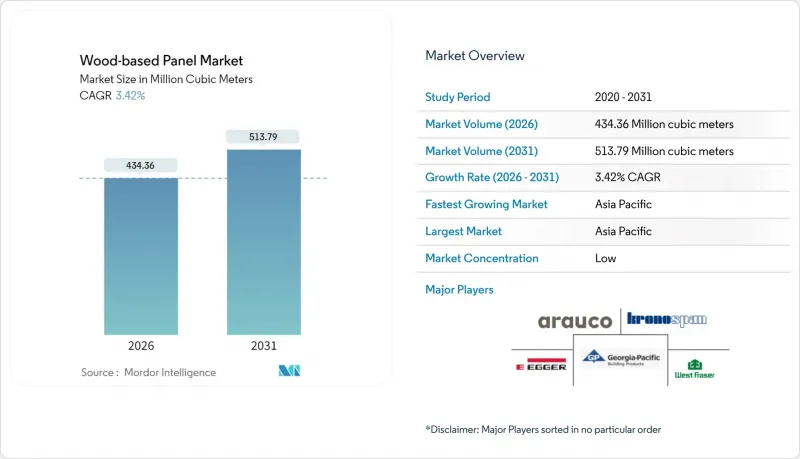
2026년 목질 패널 시장 규모는 4억 3,436만 입방미터로 추정되며, 2025년 4억 1,999만 입방미터로부터 성장을 이루어 2031년에는 5억 1,379만 입방미터에 달할 것으로 예측됩니다.
2026-2031년 연평균 복합 성장률(CAGR) 3.42%로 확대될 것으로 예측됩니다.
견고한 주택 건설, E-Commerce로 인한 가구 수요, 순환형 경제 규제가 성장을 지원하고 있습니다. 한편, 제조업체들은 강화된 배출 규제와 섬유 비용 변동에 직면해 있습니다. 아시아태평양의 풍부한 목재 자원, 동유럽과 미국 남부의 생산 능력 확대, 모듈러 주택의 구조용 단열 패널(SIP)의 급속한 보급이 추가적인 원동력이 되고 있습니다. 경쟁 전략은 현재 수직 통합, 수지 혁신, 사용한 보드에서 섬유를 회수하는 재활용 라인에 대한 투자에 초점을 맞추었습니다. 이러한 움직임은 투명 목재 유리, 광휘 파사드 및 기타 고성능 응용 분야가 총 잠재 시장을 확대하는 가운데 가치를 창출하는 것을 목표로 하고 있습니다.
아시아태평양과 라틴아메리카 일부 지역에서는 각국 정부가 인프라 지출을 두 배로 늘리면서 합판, MDF, OSB(배향성 스트랜드 보드)에 대한 지속적인 수요를 창출하고 있습니다. 인도의 연방 고속도로 계획과 인도네시아의 신수도 프로젝트는 다년간의 조달 주기를 지원했으며, 튀르키예의 지진 재건 프로젝트에서 러시아산 목재 수입량은 2024년 초에 292,200m3로 3배 증가했습니다. 제조업체들은 단기적인 수요 둔화에도 불구하고 향후 공급 부족에 대비하여 원목 비축을 진행하고 있으며, 인도에서 분기별 40%의 수입 급증은 이를 증명하고 있습니다. 스미토모 임업을 비롯한 일본 대기업은 5년내 동남아시아에 7,000채의 주택 건설을 약속하며 지역 주택 수요에 대한 자신감을 보이고 있습니다. 이러한 추세로 인해 구조용 패널의 소비는 적어도 2028년까지 상승세를 이어갈 것으로 예측됩니다.
온라인 가구 판매 증가는 지역적 장벽을 낮추고 모델 변경을 가속화하고 소량 생산을 촉진하여 유연한 패널 공급업체에 유리하게 작용하고 있습니다. 미국내 주거용 가구 주문은 2024년 4월에 전년 대비 22% 증가했으나, 국내 목재 가구 출하량은 2000년 대비 48% 낮은 수준입니다. 수입 중심의 밸류체인은 여전히 파티클보드, MDF, 합판 기판에 대한 의존도가 높으며, 대량의 패널 수요를 지원하고 있습니다. 말레이시아는 E-Commerce 물류를 활용하여 2021년 목재 수출액을 227억 링깃까지 끌어올렸으며, 합판이 주요 품목이 되었습니다. 적시 라미네이팅과 디지털 프린트 장식을 공급할 수 있는 민첩한 공장은 빠르게 변화하는 유통 경로에서 지속적으로 점유율을 확보하고 있습니다.
EU는 2026년 8월부터 실내 공기 중 포름알데히드 농도를 0.062mg/m3로 제한하므로 공장은 15-25% 더 비싼 무첨가 포름알데히드 수지로 전환해야 합니다. 독일은 EU 규정을 준수하여 국내 예외조치를 폐지한 반면, 미국 환경보호청(EPA)의 기준치는 동일한 수준을 유지하고 있으며, 회피할 여지가 거의 없습니다. 연속 프레스 라인에 대한 설비 투자 및 대체 접착제 시스템으로의 전환은 현금흐름을 압박하고 있으며, 특히 이미 저매출으로 운영되고 있는 중소 파티클보드 공장에 큰 영향을 미치고 있습니다.
세계 MDF/HDF 출하량은 CAGR 4.12%로 확대되어 전체 목재 패널 시장 성장률을 상회할 것으로 예측됩니다. 중국은 여전히 세계 MDF 공급량의 약 60%를 차지하고 있지만, 베트남과 동유럽의 신규 공장이 저비용 섬유, 자동 샌딩 라인, 디지털 프린트 장식으로 그 격차를 좁히고 있습니다. 메콩우드 캄케 공장의 60만m3 프레스 설비는 2024년 7월부터 가동될 예정이며, 즉시 CARB 기준 적합 보드를 요구하는 일본 수입업체를 타겟으로 하고 있습니다. 성숙한 경제권에서는 지속가능성 라벨을 통해 굽힘 강도를 손상시키지 않고 최대 24%의 재생 섬유를 함유한 MDF에 대한 수요를 유도하고 있습니다.
합판은 외장재 및 캐비닛 골격의 범용성으로 인해 여전히 27.85%의 압도적인 점유율을 유지하고 있습니다. 그러나 구조용 단열패널(SIPs)과 건축기준 적합 전단 패널 수요 증가를 배경으로 OSB의 생산량은 더욱 빠르게 증가하고 있습니다. 한편, 파티클보드는 저가 가구 분야에서 존재감을 유지하고 있습니다. 고급 주방이나 RV(레저용 차량) 내장재에는 EU 목재 규제(EUDR)에 따른 공급 부족에도 불구하고 고급 단판을 활용한 경재 합판이 채택되고 있습니다. 생산자들은 원료의 다양화를 추진하고 있으며, 인도에서는 플랜테이션 티크 단목, 말레이시아에서는 고무재를 활용함으로써 원목 비용 절감과 수명주기 평가 향상을 도모하고 있습니다.
이 보고서는 제품별(중밀도섬유판(MDF)/고밀도섬유판(HDF), 배향성 스트랜드보드(OSB), 파티클보드, 합판, 경재합판, 기타), 용도별(가구, 건설, 포장, 기타), 지역별(아시아태평양, 북미, 유럽, 남미, 중동 및 아프리카)로 분석되고 있습니다. 시장 예측은 수량(백만 입방 미터)으로 제공됩니다.
아시아태평양은 2025년 출하량의 52.12%를 차지하며 2031년까지 연평균 복합 성장률(CAGR) 3.85%로 확대될 것으로 예측됩니다. 중국의 합판 수출은 2024년 1,327만m3(52억 7,000만 달러 상당)에 달할 것으로 예상되며, 아세안 및 중동에 대한 관세 우대 조치에 힘입어 성장세를 이어갈 것입니다. 유럽의 패널 제조업체들은 복잡한 상황에 직면해 있습니다. 공장은 포름알데히드 프리 수지로의 개보수 및 EUDR(유럽목재규정) 추적성 도입이 의무화되면서 비용 상승 압력이 발생하고 있습니다. 그러나 독일과 프랑스에서 팬데믹 이후 급증한 리노베이션 수요와 패널 단부재에 대한 바이오매스 보조금 지급이 수요를 지원하고 있습니다. 크로노스판사의 리우네 공장(연간 70만m3의 OSB 라인)을 비롯한 동유럽의 공장들은 침엽수림지대와 EU의 최종사용자와 가까운 입지를 활용하여 공급 부족을 보완할 수 있는 위치에 있습니다.
북미에서는 양극화 추세를 보이고 있습니다. 2023년 구조용 패널 생산량은 OSB는 4.6%, 합판은 1.0% 감소했습니다. 미국 남부 공장은 낮은 벌채권료와 개량형 연속 프레스를 활용하여 잉여 OSB를 유럽으로 수출하고 있습니다. 브리티시컬럼비아주에서는 벌목권료 상승과 산불로 인한 조업 중단의 영향으로 생산 능력의 합리화가 진행되고 있습니다. 브라질을 필두로 한 라틴아메리카는 신흥 공급기지로서 풍부한 소나무 조림지와 통화 우위로 가격경쟁력 있는 수출이 가능한 반면, 조립식 사회주택 계획의 진전에 따라 국내 소비가 증가하고 있습니다.
The Wood-based Panel Market size in 2026 is estimated at 434.36 million cubic meters, growing from 2025 value of 419.99 million cubic meters with 2031 projections showing 513.79 million cubic meters, growing at 3.42% CAGR over 2026-2031.
Robust residential construction, e-commerce-driven furniture demand, and circular-economy regulations anchor this growth even as manufacturers contend with tightening emission norms and volatile fiber costs. Abundant timber resources in Asia-Pacific, capacity expansions across Eastern Europe and the U.S. South, and the rapid uptake of structural insulated panels (SIPs) in modular housing provide additional tailwinds. Competitive strategies now center on vertical integration, resin innovation, and investments in recycling lines that recover fiber from end-of-life boards. These moves aim to capture value as transparent-wood glazing, photoluminescent facades, and other high-performance applications expand the total addressable market.
Governments across Asia-Pacific and parts of Latin America are doubling infrastructure outlays, triggering sustained demand for plywood, MDF, and oriented strand board. India's federal highway program and Indonesia's new capital project underpin multi-year procurement cycles, while Turkey's earthquake reconstruction tripled imports of Russian sawn timber to 292,200 m3 in early 2024. Manufacturers are stockpiling logs despite near-term demand softness to hedge against future supply squeezes, as evidenced by India's 40% import surge over two quarters. Japanese conglomerates such as Sumitomo Forestry are committing to building 7,000 Southeast-Asian homes within five years, signaling confidence in regional housing pipelines. These developments cement an upward consumption trajectory across structural panels through at least 2028.
Rising online furniture sales reduce geographic barriers, prompting quicker model turnover and small-lot production that favors flexible panel suppliers. U.S. residential furniture orders rose 22% year-on-year in April 2024, even as domestic wood-furniture shipments are 48% below 2000 levels. Import-oriented value chains still depend heavily on particleboard, MDF, and plywood substrates, sustaining bulk panel volumes. Malaysia leveraged e-commerce logistics to lift wood exports to RM 22.7 billion in 2021, with plywood the top item. Agile mills capable of just-in-time lamination and digital-print decor delivery continue capturing share within this fast-moving channel.
The EU will cap indoor-air formaldehyde at 0.062 mg/m3 from August 2026, compelling mills to switch to no-added-formaldehyde resins that cost 15-25% more. Germany's harmonization with the EU rule eliminates domestic carve-outs, while U.S. EPA limits remain at similar thresholds, leaving little room for avoidance. Capital upgrades to continuous-press lines and alternative adhesive systems squeeze cash flows, especially at smaller particleboard facilities that already operate on slim spreads.
Other drivers and restraints analyzed in the detailed report include:
For complete list of drivers and restraints, kindly check the Table Of Contents.
Global MDF/HDF shipments are projected to expand at a 4.12% CAGR, outpacing overall wood-based panel market growth. China continues to supply roughly 60% of the world's MDF, yet new mills in Vietnam and Eastern Europe are closing distance through lower-cost fiber, automated sanding lines, and digital-print decors. Mekong Wood's 600,000 m3 press in Cam Khe entered service in July 2024, immediately targeting Japanese importers seeking CARB-compliant board. In mature economies, sustainability labeling steers demand toward MDF blended with up to 24% recycled fiber without compromising bending strength.
Plywood retains a commanding 27.85% share thanks to universality in sheathing and cabinet carcasses. Yet OSB volumes are rising faster on the back of SIPs and code-compliant shear panels, while particleboard holds relevance in value-priced furniture. Hardwood plywood captures premium kitchen and RV interiors, leveraging exotic veneers despite supply tightness linked to the EUDR. Producers are diversifying feedstocks, using plantation teak offcuts in India and rubberwood in Malaysia to cut log costs and improve lifecycle scores.
The Wood-Based Panel Report is Segmented by Product Type (Medium Density Fiberboard (MDF)/High-Density Fiberboard (HDF), Oriented Strand Board (OSB), Particleboard, Plywood, Hardwood, and Other Types), Application (Furniture, Construction, Packaging, and Other), and Geography (Asia Pacific, North America, Europe, South America, and Middle-East and Africa). The Market Forecasts are Provided in Terms of Volume (Million Cubic Meters).
Asia-Pacific generated 52.12% of 2025 shipments and is set to expand at a 3.85% CAGR through 2031. China's plywood exports reached 13.27 million m3 valued at USD 5.27 billion in 2024, bolstered by tariff concessions into ASEAN and the Middle East. Europe's panel makers confront mixed conditions. Mills must retrofit formaldehyde-free resins and implement EUDR tracing, elevating cost curves. Yet post-pandemic renovation booms in Germany and France, plus biomass subsidies for panel offcuts, cushion demand. Eastern European plants, such as Kronospan's 700,000 m3 OSB line in Rivne, enjoy proximity to conifer stands and EU end-users, positioning them to backfill supply gaps.
North America exhibits bifurcated trends. Structural panel output fell 4.6% for OSB and 1.0% for plywood in 2023. Mills in the U.S. South leverage low stumpage and upgraded continuous presses to export surplus OSB to Europe. British Columbia capacity rationalization continues due to stumpage hikes and wildfire disruptions. Latin America, led by Brazil, is the emergent supply base; abundant Pinus plantations and currency advantages permit price-competitive exports, while domestic consumption grows alongside prefabricated social housing schemes.