



2026년 윈도우 필름 시장 규모는 26억 6,000만 달러로 추정되며, 2025년 25억 달러에서 성장이 전망됩니다.
2031년의 예측에서는 36억 2,000만 달러에 달하며, 2026-2031년에 CAGR 6.39%로 확대할 전망입니다.
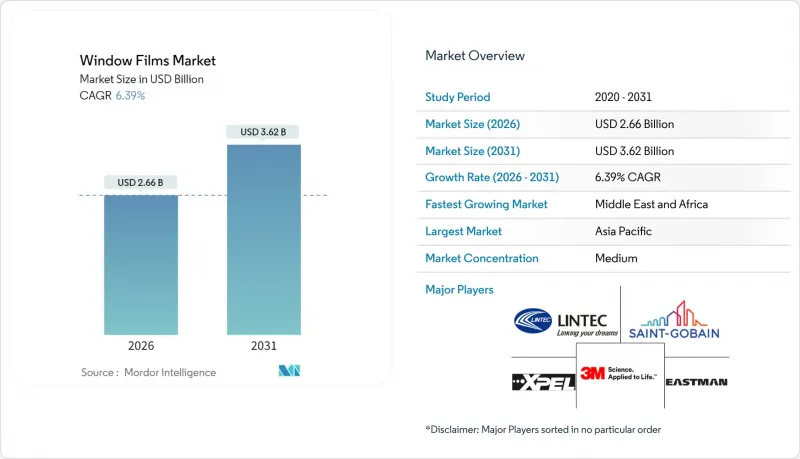
수요의 초점은 기본적인 일사량 제어에서 에너지 관리, 안전, 연결성의 장점을 결합한 다기능 필름으로 이동하고 있으며, 자동차, 건축, 특수 용도 분야에서 채택이 증가하고 있습니다. 넷제로 건축 의무화가 리노베이션 활동을 가속화하는 한편, 전기자동차(EV) 보급 확대와 빠른 유리 교체 주기가 자동차 수요를 지원하고 있습니다. 각 공급업체들은 5G 대응 운전지원시스템에 필요한 전파투과성을 훼손하지 않으면서도 엄격한 에너지 절약 기준을 충족하는 나노세라믹 및 저방사율 구조를 도입하고 있습니다. 아시아태평양은 생산과 소비의 중심지이지만, 사우디아라비아 및 아랍에미리트(UAE)의 대형 프로젝트가 고성능 유리를 채택하면서 중동 및 아프리카이 가장 빠르게 성장하는 지역으로 부상하고 있습니다. 시장 집중도는 중간 정도에 머물러 있습니다. 이는 전기변색(전착조광) 스마트 유리와 저가의 범용 필름이 경쟁 압력을 강화하고 있음에도 불구하고 주요 기존 기업이 혁신과 지역별 생산능력 확대를 통해 입지를 지키고 있기 때문입니다.
능동적 위협 시나리오에 대한 인식이 높아짐에 따라 강제 침입이나 폭발시 유리 파편을 막아주는 24mm 두께의 보안 라미네이트 필름의 채택이 확대되고 있습니다. 시산업체에서는 기존 폴리에스테르 제품을 뛰어넘는 찢어짐 방지 및 엣지 그립 성능을 갖춘 다층 우레탄 구조의 지정이 증가하고 있습니다. 시설 관리자들은 침입방지 기능과 자외선 차단 기능을 결합하여 하나의 제품으로 안전과 에너지 절약이라는 두 가지 과제를 모두 해결할 수 있다는 점을 높이 평가했습니다. 허리케인 다발 지역의 보험료 할인 제도가 개보수 활동을 더욱 촉진하고 있습니다. 이해관계자들이 비용 효율적인 외장재 강화를 요구하면서 이 기술은 고위험군 정부 시설에서 학교, 소매 체인, 복합용도 타워로 보급이 확대되고 있습니다. 제조업체들은 ANSI Z97.1 및 EN 12600 충격 테스트 표준을 준수하는 보안 필름으로 이러한 추세에 대응하고 있으며, 세계 각국의 건축 기준에서 그 중요성이 강화되고 있습니다.
EU의 건축물 에너지 성능 지침 및 캘리포니아주 Title 24는 유리부의 열관류율(U값)과 일사량 취득률을 규제하여 소유주에게 고비용의 창호 교체가 아닌 기존 창호의 개보수를 권장하고 있습니다. 고성능 일사 제어 필름은 에너지 성능 인증서를 즉시 향상시켜 부동산 포트폴리오가 2030년 탈탄소화 목표를 달성할 수 있도록 합니다. 나노세라믹 배합 기술은 적외선 투과율을 낮추면서도 자연채광을 유지하여 웰빙을 지향하는 인테리어 디자인에서 중요한 요소로 작용하고 있습니다. 스마트 광변색 필름의 조사 시제품은 저방사율(Low-E) 단열 유리와 결합하여 연간 에너지 사용량을 최대 35%까지 절감할 수 있는 가능성을 보여주고 있습니다. 롤-투-롤 제조기술로 전기변색유리와의 가격경쟁력을 유지하며, 효율성 향상이 요구되는 수백만 채의 건물에서 필름이 주류 개보수 수단으로 자리 잡을 것으로 예측됩니다.
고급 다층 필름은 완벽한 표면 처리, 습도 관리, 정밀한 스퀴지 기술이 요구됩니다. 시공자의 기술력에 편차가 있으면 기포, 테두리 부동, 광학 흐림이 발생하며, 특히 가격에 민감한 신흥 시장에서 보증 분쟁을 유발합니다. 업계 단체는 시각적 품질 기준을 발표했으나, 그 이동 상황은 여전히 불균일합니다. 제조업체들은 인증 과정의 확대와 프리컷 키트 제공에 대응하고 있지만, 이러한 노력은 유통 비용을 증가시키고 맞춤형 솔루션을 제한하고 있습니다. 자동차 애프터마켓에서 복합 곡면은 복잡성을 증폭시키고, 시공 시간을 연장시키며, 결함 발생시 소비자 불만을 야기하고 있습니다.
차열 및 자외선 차단 필름은 2025년 기준 윈도우 필름 시장의 40.89%를 차지하며, 즉각적인 열획득 감소와 거주자의 쾌적함을 실현하는 주요 개보수 옵션으로 확고히 자리매김하고 있습니다. 가구, 미술품, 자동차 내장재의 변색 방지 효과에 대한 인식이 확대되면서 판매 실적이 호조를 보이고 있습니다. 고급 나노세라믹 제품은 중성적인 색 재현성과 가혹한 기후 조건에서의 내구성으로 인해 평균 판매 가격이 높습니다. 현재 시장에는 스펙트럼 선택성 코팅과 장식 패턴을 융합한 하이브리드 제품이 등장하여 성능은 유지하면서 브랜드 차별화를 추구하는 소매점 수요를 충족시키고 있습니다. 공급업체는 연결된 건물이나 차량의 전파 간섭을 피하기 위해 금속화 처리를 하지 않는 적층 구조를 추진하고 있습니다.
단열/저방사선(Low-E) 제품은 순 제로 정책 목표와 중위도 지역의 난방 일수 증가에 힘입어 2031년까지 7.26%의 가장 빠른 CAGR을 나타낼 것으로 예측됩니다. 다층 스퍼터링 적층 구조로 전도 및 복사 손실을 감소시켜 단창이 교체 비용의 일부로 복층 유리의 성능 지표에 근접할 수 있도록 합니다. 온대 지역에서는 3년 이내의 투자 회수 기간이 입증되어 B급 오피스 재고의 리노베이션을 위한 시설 관리자의 채용을 촉진하고 있습니다. 건축 기준의 강화로 단열/저방사선(Low-E) 솔루션용 윈도우 필름 시장 규모는 급성장할 것으로 예상되지만, 제조의 복잡성과 첨단 시공 기술 요구 사항으로 인해 도입은 여전히 전문 업체 채널에 국한되어 있습니다. 장식, 프라이버시 보호, 안전 틈새 시장, 호텔, 의료, 중요 인프라 분야의 특수 수요층에 대한 공급을 지속하고 있습니다.
아시아태평양은 중국의 건축 면적과 자동차 생산의 이중 우위로 인해 2025년 세계 매출의 45.84%를 차지하며 1위를 차지할 것으로 예측됩니다. 일본과 한국의 야심찬 건축 에너지 규제가 프리미엄 저방사선율(Low-E) 및 스마트 필름 설치를 촉진하고 있습니다. 반면, 인도와 아세안 국가들은 도시화의 급격한 확대에 따라 낮은 수준에서 두 자릿수 성장을 보이고 있습니다. 현지 밸류체인은 경쟁력 있는 비용 우위를 제공하고 있으며, 주요 다국적 기업의 중국 및 싱가포르에서의 대규모 생산능력 증설이 이를 지원하고 있습니다. 지역 유통업체들은 차광장치 및 빌딩 자동화 센서와 필름을 결합하여 파사드 전체에 대한 가치 제안을 강조하고 있습니다.
중동 및 아프리카은 2031년까지 6.83%의 가장 높은 CAGR을 나타낼 것으로 예측됩니다. 이는 가혹한 일사량을 견디면서 LEED 또는 에스티다마의 친환경 건축 기준을 충족해야 하는 사우디의 '비전 2030' 거대 프로젝트의 기반이 되고 있습니다. 리야드 및 두바이의 개발업체들은 현대 건축을 상징하는 광활한 유리 외관을 유지하면서 공조 비용을 억제하기 위해 고선택성 필름을 지정하고 있습니다. 숙련공 부족과 경쟁적인 건축자재 수요로 인해 시공 능력이 제한될 수 있으며, 공급업체는 가속 프로그램을 통한 시공자 육성 및 메가 프로젝트를 위한 하도급업체 사전 심사를 실시했습니다.
북미와 유럽은 성숙한 시장이며, 성장은 건축 기준에 따른 개보수 공사와 프리미엄 부문으로의 침투에 의존하고 있습니다. EU가 2030년까지 상업용 건물 재고의 최소 16% 성능개선을 의무화함에 따라 거시경제의 변동에도 불구하고 수요는 견고한 임베디드니다. 미국에서는 주정부 차원의 심층 에너지 개조 인센티브가 안정적인 프로젝트 공급원이 되었고, 기업의 탈탄소화 약속이 그 기세를 이어나가고 있습니다. 남미에서는 경제 사이클과 환율 변동으로 인해 투자가 억제되어 도입이 더디지만, 상파울루와 산티아고와 같은 도시 지역에서는 더 높은 유리 표준이 채택되어 중간 성능 필름의 기회를 창출하고 있습니다.
Window Films market size in 2026 is estimated at USD 2.66 billion, growing from 2025 value of USD 2.50 billion with 2031 projections showing USD 3.62 billion, growing at 6.39% CAGR over 2026-2031.
Strong demand pivots from basic solar control toward multi-functional films that combine energy management, safety, and connectivity benefits, increasingly specified in automotive, building, and specialty applications. Net-zero building mandates accelerate retrofit activity, while an expanding electric-vehicle (EV) fleet and rapid glazing replacement cycles keep automotive volumes buoyant. Suppliers are introducing nanoceramic and low-emissivity constructions that meet stringent energy-code requirements without compromising the radio-wave transparency required for 5G-enabled driver-assistance systems. Asia-Pacific remains the production and consumption hub, yet Middle-East and Africa emerges as the fastest-growing geography as mega-projects in Saudi Arabia and the UAE embrace high-performance glazing. Market concentration stays moderate because leading incumbents defend their positions through innovation and regional capacity expansion, even as electrochromic smart glass and low-cost commodity films intensify competitive pressure.
Heightened awareness of active-threat scenarios drives wider adoption of 24-mil security laminates that retain glass fragments during forced entry or blast events. Installers are increasingly specifying multi-layer urethane constructions that surpass legacy polyester products in terms of tear resistance and edge-grip performance. Facility managers value the ability to combine intrusion mitigation with UV filtration, allowing a single product to address both safety and energy challenges. Insurance premium rebates in hurricane-prone regions further stimulate retrofit activity. The technology is migrating from high-risk government sites into schools, retail chains, and mixed-use towers as stakeholders seek cost-effective envelope hardening. Manufacturers answer the trend with security films certified under ANSI Z97.1 and EN 12600 impact protocols, reinforcing their relevance in global building codes.
The EU Energy Performance of Buildings Directive and California's Title 24 cap glazing U-factor and solar heat-gain coefficients, pushing owners to upgrade existing windows rather than pursue costly replacements. High-performance solar-control films demonstrate immediate Energy Performance Certificate uplifts, enabling property portfolios to meet 2030 decarbonization targets. Nanoceramic formulations cut infrared transmittance while preserving daylight, an important factor in wellness-oriented interior design. Research prototypes of smart photochromic films indicate potential annual energy-use reductions of up to 35% when paired with low-E double glazing. Roll-to-roll manufacturing keeps price points competitive against electrochromic glass, positioning films as the mainstream retrofit path for millions of buildings needing efficiency gains.
Advanced multi-layer films require pristine surface preparation, controlled humidity, and precise squeegee techniques. Variations in installer skill create bubbles, edge lift, and optical haze that trigger warranty disputes, particularly in price-sensitive emerging markets. Trade associations publish visual-quality standards, yet enforcement remains uneven. Manufacturers answer with expanded certification courses and pre-cut kits, but these initiatives raise channel costs and limit bespoke solutions. In the automotive aftermarket, compound curves amplify complexity, prolonging installation time and inviting consumer dissatisfaction when defects appear.
Other drivers and restraints analyzed in the detailed report include:
For complete list of drivers and restraints, kindly check the Table Of Contents.
Solar-control and UV-blocking constructions retained a 40.89% slice of the window films market in 2025, confirming their status as the go-to retrofit option for instant heat-gain reduction and occupant comfort. Strong sales track widespread awareness of fading protection in furniture, artworks, and automotive interiors. Premium nanoceramic variants command higher average selling prices thanks to neutral color rendition and longevity in harsh climates. The market now witnesses hybrid products that fuse spectrally selective coatings with decorative patterns, appealing to retail storefronts seeking brand differentiation without sacrificing performance. Suppliers promote metallized-free stacks to avert radio interference in connected buildings and vehicles.
Insulating/low-E products post the fastest 7.26% CAGR through 2031, buoyed by net-zero policy targets and rising heating-degree-day counts in mid-latitude regions. Their multi-layer sputtered stacks cut conducted and radiative losses, allowing single-pane windows to approach double-pane performance metrics at a fraction of replacement cost. Demonstrated payback periods of three years or less in temperate zones catalyze adoption among facility managers retrofitting Class-B office stock. The window films market size for insulating/low-E solutions is projected to surge as building codes tighten, yet production complexity and higher installation skill requirements still confine uptake to professional channels. Decorative, privacy and safety niches continue serving specialized demand pockets in hospitality, healthcare and critical-infrastructure verticals.
The Window Films Market Report is Segmented by Type (Solar-Control and UV-Blocking Films, Decorative Films, Safety and Security Films, Privacy Films, Insulating/Low-E Films, Others), End-User Industry (Automotive, Building and Construction, Marine, Aerospace, Others), and Geography (Asia-Pacific, North America, Europe, South America, Middle-East and Africa). The Market Forecasts are Provided in Terms of Value (USD).
Asia-Pacific led with 45.84% of 2025 global revenue, thanks to China's dual dominance in construction floor space and vehicle production. Ambitious building-energy regulations in Japan and South Korea propel premium low-E and smart-film installations, while India and ASEAN nations show double-digit growth off lower bases as urbanization surges. Local supply chains grant competitive cost positions, evidenced by large-scale capacity additions in China and Singapore announced by major multinationals. Regional distributors bundle films with shading devices and building-automation sensors, highlighting holistic facade value propositions.
Middle-East and Africa records the highest 6.83% CAGR through 2031, underpinned by Saudi Vision 2030 giga-projects that must endure extreme solar loads and meet LEED or Estidama green-building criteria. Developers in Riyadh and Dubai specify high-selectivity films to curb HVAC bills while preserving expansive glass facades emblematic of contemporary architecture. Skilled-labor shortages and competing construction material demand occasionally constrain installation capacity, prompting suppliers to train applicators under accelerated programs and pre-qualify subcontractors for mega-project packages.
North America and Europe constitute mature arenas where growth relies on code-driven retrofits and premium segment penetration. The EU's mandate to refurbish the worst-performing 16% of commercial stock by 2030 keeps demand resilient despite macroeconomic swings. U.S. state-level incentives for deep-energy retrofits feed a steady pipeline, and corporate decarbonization pledges extend momentum. South America follows with moderate uptake as economic cycles and currency volatility temper investment, yet urban centers such as Sao Paulo and Santiago adopt higher glazing standards that open opportunities for mid-tier performance films.