



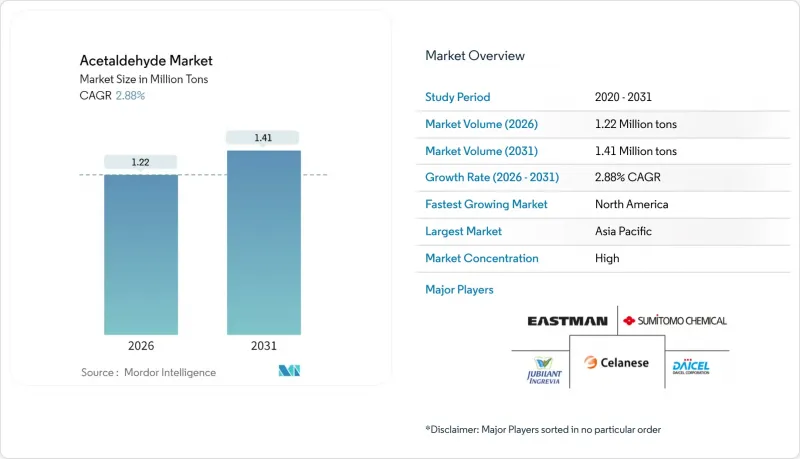
아세트알데히드 시장은 2025년에 119만 톤으로 평가되며, 2026년 122만 톤에서 2031년까지 141만 톤에 달할 것으로 예측됩니다.
예측 기간(2026-2031년)의 CAGR은 2.88%로 예상됩니다.
이 확장은 아세트산, 피리딘 염기, 펜타에리트리톨, 아세트산 에스테르 등 고부가가치 유도체의 중간체로서 본 화학물질의 확립된 역할을 반영하여 저VOC 용매 시스템, 지속가능한 코팅, 순환형 PET 재활용 솔루션을 실현합니다. 아시아태평양의 통합 석유화학 네트워크가 가격 형성을 주도하는 가운데, 북미 생산자들은 셰일에서 추출한 에탄과 획기적인 에탄-아세트알데히드 전환 촉매 기술을 활용하여 모멘텀을 얻고 있습니다. 경쟁 우위는 원료 조달의 유연성 확보, 의약품 합성을 위한 고순도 등급 달성, 첨단 PET 재활용을 위한 특수 스 캐빈저 첨가제 제공이 가능한 기업으로 이동하고 있습니다. 예측 기간 중 기술 도입, 규제 압력, 지속가능성에 대한 노력은 전체 아세트알데히드 시장의 가치 창출을 좌우할 것으로 보입니다.
의약품 제조는 빠르게 확장되고 있으며, 복잡한 약물 분자는 아세트알데히드에서 추출한 피리딘 중간체에 점점 더 의존하고 있습니다. 2030년까지 연평균 복합 성장률(CAGR) 3.94%는 이 유도체가 종양학 및 신경학 치료에서 전략적으로 중요하며, 아세트알데히드의 순도 향상으로 반응 수율을 높이고 FDA의 cGMP 요건을 준수할 수 있다는 것을 보여줍니다. 아시아 제네릭 제약사들은 다목적 원료의약품 라인을 확장하고 있으며, 이로 인해 고순도 아세트알데히드 등급의 지역 소비가 증가하고 있습니다. 맞춤형 의료로의 전환은 특수한 구성 요소가 필요하며, 피리딘 사슬의 견고한 수량 성장을 보장합니다. 저잔류 불순물 인증이 가능한 제조업체는 프리미엄 계약을 체결하여 아세트알데히드 시장에서 품질 중심 수요라는 선순환 구조를 강화하고 있습니다.
페인트 조제 업체들은 바이오 알키드 수지 및 속경화 UV 시스템으로 전환하고 있으며, 아세트알데히드와 포름알데히드로부터 합성되는 펜타에리트리톨은 필수 불가결한 존재가 되었습니다. 북미와 유럽공급업체들은 자동차 제조업체들이 생산 주기를 단축하고 에너지 소비를 줄이는 UV 경화형 클리어 코트를 채택함에 따라 인계량이 증가하고 있다고 보고하고 있습니다. 최근 연구에 따르면 펜타에리트리톨을 함유한 바이오 알키드 수지는 90일 만에 70%의 생분해성을 달성한 반면, 기존 수지는 34.7%에 그쳤으며, 이러한 지속가능성 우위는 가격 프리미엄을 지원하고 있습니다. 페인트 업계의 저 VOC화 요구는 아세트산 에스테르계 공용매에 대한 수요를 증가시키고, 아세트알데히드 밸류체인에서 파생 제품의 시너지 효과를 강화하고 있습니다. 그 결과, 펜타에리트리톨은 생산량 증가 수요를 불러일으켜 아세트알데히드 시장의 안정적 수요 기반이 되고 있습니다.
현재 전 세계 아세트산 생산능력의 85% 이상이 메탄올 카르보닐화 방식을 채택하고 있으며, 아세트알데히드의 중간 공정이 불필요하여 기존 수요 기반을 잠식하고 있습니다. 로듐(Rh) 및 이리듐(Ir) 촉매를 사용하는 이 경로는 우수한 선택성과 에너지 효율을 달성하고 아세트알데히드 기반 아세트산에 대한 신규 투자를 억제합니다. 동아시아 주요 제조업체의 생산량 증가 계획은 이러한 추세를 더욱 가속화하여 아세트알데히드의 CAGR 예측을 0.4% 낮출 것으로 예측됩니다. 이러한 장기적인 감소 추세를 상쇄하기 위해 생산업체들은 고부가가치 제품인 피리딘, 펜타에리트리톨, PET 재활용 첨가제 등 고부가가치 제품 진출을 추진하고 있으며, 아세트알데히드 시장내 사업 포트폴리오의 우선순위를 재검토하고 있습니다.
아세트산은 2025년 기준 아세트알데히드 시장 점유율의 27.95%를 차지하고 있으나, 메탄올 카르보닐화에 의한 구조적 대체가 진행되면서 물량 성장은 여전히 둔화되고 있습니다. 한편, 피리딘 및 피리딘 염기는 아시아태평양의 의약품 생산량 급증에 힘입어 2031년까지 연평균 3.74%의 견고한 성장세를 보일 것으로 예측됩니다. 펜타에리트리톨에 대한 페인트 부문 수요가 생산량 증가를 주도하고, 아세테이트 에스테르는 저 VOC 규제 대응 시스템을 지원하고 있습니다. 종합적으로 볼 때, 특수 유도체가 성숙된 아세트산 시장의 침체로부터 아세트알데히드 시장 규모를 보호하고 있습니다.
고부가가치 틈새 시장으로의 전환에 따라 순도 요구 사항이 증가하고 정제 컬럼, 분자 체, 연속 증류 제어에 대한 자본 투자가 요구되고 있습니다. 생산 공정 분석을 숙달한 생산자는 계약 프리미엄을 얻을 수 있는 반면, 뒤처지는 기업은 상품 시장으로 강등될 위험이 있습니다. 부틸렌글리콜, 클로랄, 과초산은 틈새 시장에 머물러 있지만, 화장품, 제약, 수처리 분야의 지속적인 수요로 설비 가동률이 양호하게 유지되고 있습니다. 이 계층화된 유도체 포트폴리오는 원자재 대량 생산과 특수 제품 이익률을 동시에 충족시켜 아세트알데히드 시장의 장기적인 회복력을 정의하고 있습니다.
아세트알데히드 보고서는 파생 제품별(피리딘 및 피리딘 염기, 펜타에리트리톨, 아세트산, 아세트산 에스테르 등), 최종사용자 산업별(접착제, 식품 및 음료, 페인트 및 코팅, 의약품, 기타 최종사용자 산업), 지역별(아시아태평양, 북미, 유럽, 남미, 중동 및 아프리카) 별로 구성되어 있습니다. 시장 예측은 톤 단위로 제시되어 있습니다.
2025년 기준 아시아태평양은 세계 수요의 57.20%를 차지하며, 중국의 세계적인 석유화학단지와 방향족에서 아세틸까지 통합된 공급망을 기반으로 하고 있습니다. 일본의 다이셀(Daicel Corporation)은 기술 고도화를 추진하고, 인도의 고다바리 바이오리파이너리(Godavari Biorefineries)는 석유화학과 바이오 공급원을 연결하고 있습니다.
북미는 2031년까지 연평균 복합 성장률(CAGR) 3.10%로 예상되며, 에탄에서 아세트알데히드로의 촉매 기술과 순환 화학에 대한 명확한 규제 강화가 그 기반이 될 것으로 보입니다. 세라네즈의 클리어레이크 플랫폼과 지역적 PET 재활용 시설의 확대는 저탄소 고순도 생산으로의 전환을 상징합니다.
유럽의 지속가능성 철학은 고성능 파생 제품에 대한 틈새 수요를 지원하고 있으며, 남미, 중동, 아프리카에서는 에탄올 고도화 및 원료 우위를 가진 석유화학 거점을 통해 생산 능력이 점차 증가하고 있습니다. 이 지역별 모자이크 구조는 성숙한 벌크 시장과 신흥 성장 시장의 균형을 맞추고, 아세트알데히드 시장의 세계 분산을 강화합니다.
The Acetaldehyde Market was valued at 1.19 million tons in 2025 and estimated to grow from 1.22 million tons in 2026 to reach 1.41 million tons by 2031, at a CAGR of 2.88% during the forecast period (2026-2031).
This expansion reflects the chemical's entrenched role as an intermediate for high-value derivatives such as acetic acid, pyridine bases, pentaerythritol, and acetate esters that enable low-VOC solvent systems, sustainable coatings, and circular PET recycling solutions. Asia-Pacific's integrated petrochemical networks continue to shape price discovery, while North American producers gain momentum by leveraging shale-derived ethane and breakthrough ethane-to-acetaldehyde catalysis. Competitive positioning is shifting toward players that can secure feedstock flexibility, achieve superior purity grades for pharmaceutical syntheses, and offer specialized scavenging additives for advanced PET recycling. Over the forecast horizon, technology adoption, regulatory pressure, and sustainability credentials will determine value capture across the acetaldehyde market.
Pharmaceutical manufacturing is scaling rapidly, and complex drug molecules increasingly rely on acetaldehyde-derived pyridine intermediates. The 3.94% CAGR to 2030 underscores the derivative's strategic relevance for oncology and neurology therapies, where acetaldehyde purity improvements deliver higher reaction yields and regulatory compliance with FDA cGMP requirements. Asian generic producers are expanding multi-purpose active-pharmaceutical-ingredient lines, which lifts regional consumption of high-purity acetaldehyde grades. The personalized-medicine shift calls for specialized building blocks, ensuring robust volume growth for pyridine chains. Producers that can certify low residual impurities win premium contracts, reinforcing a virtuous cycle of quality-driven demand in the acetaldehyde market.
Coatings formulators pivot toward bio-based alkyd and fast-curing UV systems, and pentaerythritol, synthesized from acetaldehyde and formaldehyde, has become indispensable. North American and European suppliers report accelerating off-takes as automakers adopt UV-curable clear coats that shorten production cycles and cut energy consumption. Recent research showed bio-alkyds featuring pentaerythritol achieve 70% biodegradability in 90 days versus 34.7% for conventional resins, a sustainability edge that supports price premiums. The coatings industry's low-VOC imperative boosts acetate-ester co-solvents, reinforcing derivative synergies along the acetaldehyde value chain. Consequently, pentaerythritol draws incremental capacity additions, anchoring stable demand in the acetaldehyde market.
More than 85% of global acetic-acid capacity now employs methanol carbonylation, obviating acetaldehyde intermediacy and eroding a legacy demand pillar. The Rh- and Ir-catalyzed route delivers superior selectivity and energy efficiency, depressing new investments in acetaldehyde-based acetic acid. Incremental expansions by East-Asian giants accentuate the swing, removing 0.4 percentage points from the acetaldehyde CAGR forecast. To offset this secular decline, producers push into higher-value pyridine, pentaerythritol, and PET-recycling additives, redefining portfolio priorities within the acetaldehyde market.
Other drivers and restraints analyzed in the detailed report include:
For complete list of drivers and restraints, kindly check the Table Of Contents.
Acetic acid retained a 27.95% slice of the acetaldehyde market share in 2025, but its volume growth remains muted amid structural substitution by methanol carbonylation. Conversely, pyridine and pyridine bases are set to register a robust 3.74% CAGR through 2031, propelled by surging pharmaceutical output in Asia-Pacific. The paints sector's appetite for pentaerythritol drives incremental additions, while acetate esters underpin compliant low-VOC systems. Collectively, specialty derivatives insulate the acetaldehyde market size against stagnation in the mature acetic-acid pool.
The migration to high-value niches heightens purity requirements, inviting capital investments in purification columns, molecular sieves, and continuous distillation control. Producers that master in-process analytics secure contract premiums, while laggards risk relegation to commodity pools. Butylene glycol, chloral, and peracetic acid remain niche outlets, yet continued demand from cosmetics, pharmaceuticals, and water treatment keeps asset utilization healthy. This tiered derivative portfolio balances commodity volume with specialty margins, defining long-run resilience for the acetaldehyde market.
The Acetaldehyde Report is Segmented by Derivative (Pyridine and Pyridine Bases, Pentaerythritol, Acetic Acid, Acetate Esters, and More), End-User Industry (Adhesives, Food and Beverage, Paints and Coatings, Pharmaceuticals, and Other End-User Industries), and Geography (Asia-Pacific, North America, Europe, South America, and Middle-East and Africa). The Market Forecasts are Provided in Terms of Volume (Tons).
Asia-Pacific commanded 57.20% of global demand in 2025, anchored by China's world-scale petrochemical complexes and integrated aromatics-to-acetyl chains. Japan's Daicel Corporation augments technological sophistication, while India's Godavari Biorefineries bridges petrochemical and bio-based streams.
North America is poised for a 3.10% CAGR through 2031, underpinned by ethane-to-acetaldehyde catalysts and clear regulatory tailwinds for circular chemistry. Celanese's Clear Lake platform and regional PET-recycling build-outs exemplify the pivot to low-carbon, high-purity production.
Europe's sustainability ethos sustains niche demand for high-performance derivatives, while South America and Middle-East and Africa gradually scale capacity via ethanol upgrading and feedstock-advantaged petrochemical hubs. This regional mosaic balances mature bulk markets with frontier growth, reinforcing global dispersion of the acetaldehyde market.